
Quincy, Washington may seem like a quiet Central Washington town today, but its story is rooted in the bold expansion of America’s railroads, the hard work of homesteaders, and the transformation of desert land into fertile farmland. Its history reflects the grit, hope, and persistence that shaped much of the American West.
Before Settlers: The Land and Its Early Visitors
Long before Europeans or Americans came through the region, the land that would become Quincy was shaped by powerful natural forces. The area lies atop ancient basalt flows and outburst flood deposits from the Ice Age, with glacial erratics carried from distant regions showing how dramatic those floods were.
Native peoples likely traveled through the region seasonally—following game and gathering roots and other food—but permanent settlement by non-Native people did not occur until the late 1800s.
The Railroad and the Birth of Quincy (1890s–1900s)
Quincy’s modern history begins with the railroad.
In 1892, the Great Northern Railway, led by James J. Hill (called the “Empire Builder”), completed its transcontinental route across northern Washington. The railway opened the region to settlement and commerce. Quincy originally began as a small railroad siding — literally a name on a post where trains could stop — along the tracks. According to local lore, the town’s name may have been chosen by Hill’s daughter from a list of possible names, borrowing it from Quincy, Illinois.
Before the railroad, Quincy Valley was dry desert land covered in sagebrush and grasses, used mostly for cattle and horse grazing by early ranchers like Thomas Smart Blythe in the 1880s.
Once the Great Northern arrived, people began to stake claims and settle. Between 1901 and 1902, dozens of homestead claims were filed around the future townsite as pioneers saw opportunity in the accessible transport and promise of the Pacific Northwest.
In February 1902, the fledgling community was formally platted by local resident Richard L. Coleman, who laid out the original townsite near the railroad. Quincy quickly gained basic services — a hotel, general store, lumber yard, and post office — and grew from a siding into a recognizable town.
Incorporation and Early Growth (1907–1910)
Quincy continued to attract settlers in the years that followed, and by 1907 the community was ready for local government.
On March 27, 1907, Quincy was officially incorporated as a town of the fourth class after residents voted in favor of incorporation by a wide margin earlier that month. At the time, Quincy was still part of Douglas County, though it would soon belong to a newly formed county.
By 1909, the Washington State Legislature had created Grant County, naming Ephrata its county seat and including Quincy within the new boundaries. This marked a new chapter for the region’s governance and its agricultural development.
During this early era, Quincy supported several banks, stores, lumber yards, warehouses, churches, and a weekly newspaper — evidence of an emerging, self-sustaining community.
Water, Irrigation, and the Columbia Basin Project
One of the defining transformations of Quincy and the broader region came not just through railroads, but through irrigation and water management.
For decades, the dry climate and limited rainfall made productive farming difficult in the Columbia Basin. Initial attempts at small irrigation projects in the early 20th century had limited impact, but a much larger vision was born with the Columbia Basin Project, authorized in the 1940s and tied to construction of the Grand Coulee Dam beginning in the 1930s.
By 1948, water began flowing through canal systems to local farms, dramatically altering the land’s productivity. The Quincy-Columbia Basin Irrigation District was established to operate portions of this system, bringing reliable irrigation to hundreds of thousands of acres and fueling an agricultural boom that would define the region’s economy.
Community, Culture, and Heritage
Throughout the 20th century, Quincy remained rooted in agriculture — wheat, corn, potatoes, and other crops — while expanding its identity as a community of families, workers, and businesses. Many early immigrant families from German, Ukrainian, Japanese, and other backgrounds helped shape the cultural fabric of the valley.
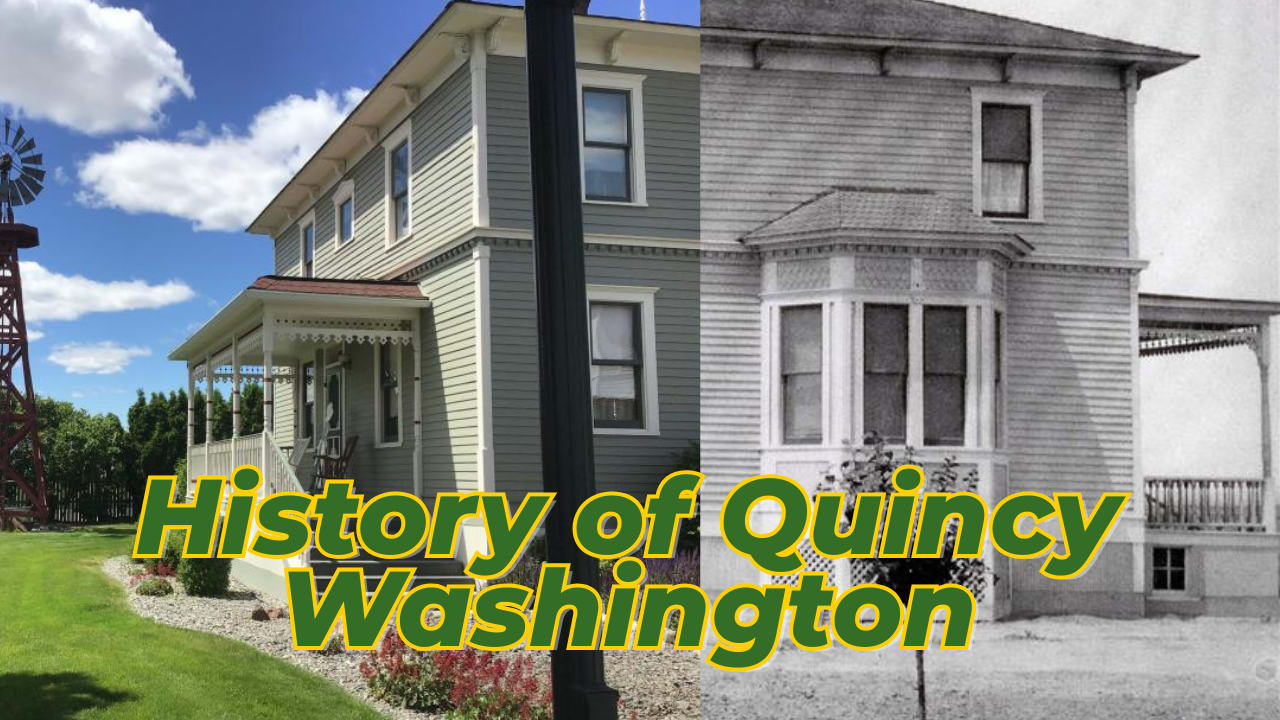
Today, historic structures like the Reiman-Simmons House and the Saint Paul’s German Lutheran Church stand as reminders of the generations who helped build Quincy, and are preserved through the work of the Quincy Valley Historical Society & Museum.
Quincy in the Modern Era
Quincy continued to evolve in the latter half of the 20th century and into the 21st. While agriculture remains a cornerstone of the local economy, the region has also become a hub for data centers and other modern industries — reflecting broader economic shifts in technology and infrastructure.
Today, Quincy proudly balances its past and future — honoring the homesteaders and pioneers whose grit built the town while embracing new opportunities and growth for future generations.
Why This History Matters
Quincy wasn’t just “founded.”
It was earned — by settlers who saw opportunity where others saw desert, by families who planted roots when water was scarce, and by a community that grew stronger when infrastructure and innovation arrived.
Understanding that history helps explain:
Why agriculture matters here today
Why community ties run deep
How a railroad siding became a thriving town