
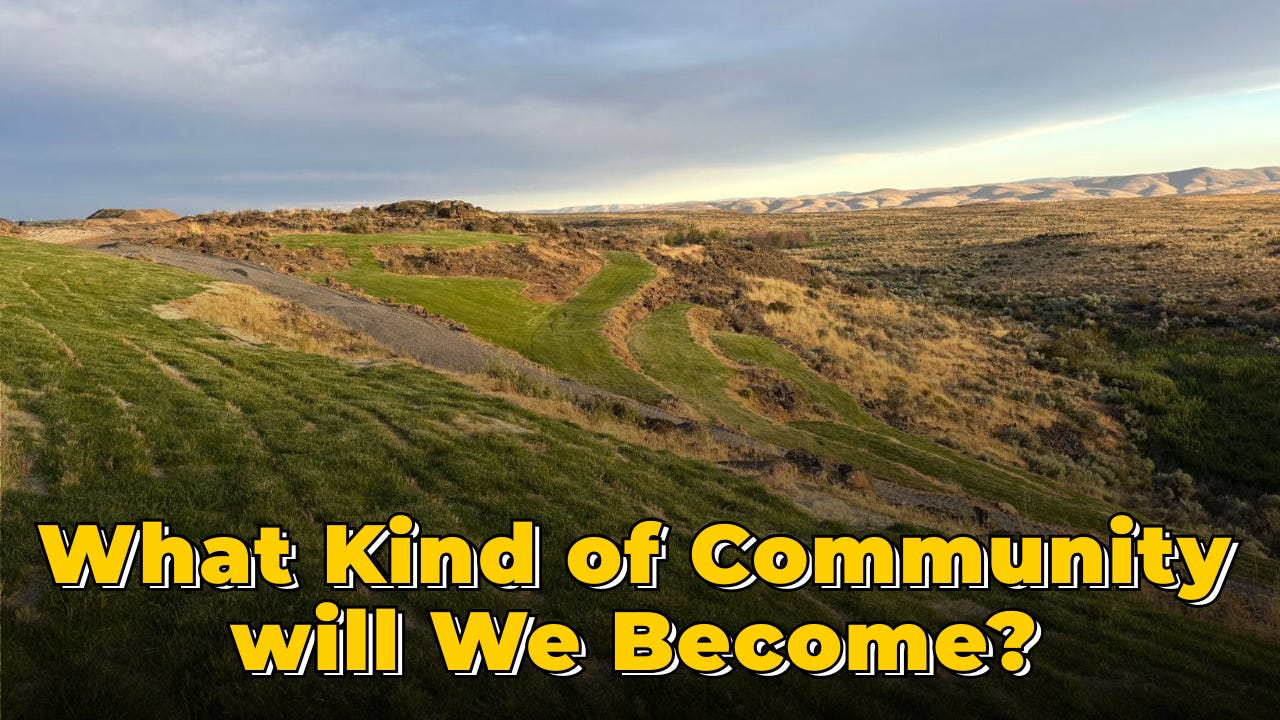
The room on the upper floor of Cave B Estate Winery was already filling Tuesday evening before Vince and Carol Bryan stepped to the front of the room. Community leaders, business owners, educators, tourism professionals, and local residents gathered overlooking the Columbia River Gorge to hear what organizers described as the next chapter in a vision that began more than four decades ago on the cliffs above the Columbia.
Most attendees arrived knowing they were about to hear details about a new nonprofit called The Hilltop. Few appeared to know the full scope of what would be presented over the next two hours.
By the end of the evening, after a presentation, questions, and a walking tour of the proposed site, the conversation had expanded far beyond a nonprofit organization or a fundraising event. Instead, it had become a discussion about what the future of the 98848 could look like as it continues to grow and evolve.
The Bryans unveiled The Hilltop, an ambitious long-term vision for a cultural campus overlooking the Columbia River Gorge. The project, which is being established as a nonprofit organization, seeks to create a destination focused on four interconnected pillars: arts, science, environment, and human experience.
Organizers acknowledged that the project remains in its earliest stages. The facilities presented Tuesday night have not yet been built, fundraising efforts are only beginning, and significant planning remains before the vision can move toward construction.
Yet the presentation captured attention because of who was presenting it.
For nearly half a century, Vince and Carol Bryan have been involved in projects that many initially considered unlikely. Their vineyards helped establish part of Washington’s modern wine industry. Their concert venue evolved into what is now known worldwide as the Gorge Amphitheatre. Their hospitality investments helped transform a remote stretch of cliffside property into one of the most recognizable tourism destinations in the Pacific Northwest.
The proposal raises a broader question about the future of the property and the region: can the next chapter of this landscape be built around education, discovery, culture, and community as much as entertainment?
TL;DR
• Vince and Carol Bryan introduced The Hilltop, a nonprofit cultural campus planned on the Cave B property overlooking the Columbia River Gorge.
• The project would include multiple performance and gathering spaces designed around arts, science, environmental education, and cultural experiences.
• The inaugural SOAR Festival on Aug. 22 will serve as both a fundraiser and a public introduction to the concept.
• Organizers believe the project could eventually attract visitors from around the world while creating new educational and cultural opportunities for local residents.
• The proposal raises larger questions about what the 98848 will look like as the region continues to grow over the next 25 years.

A History Written on the Cliffs Above the Columbia
To understand why Tuesday night’s presentation drew so much interest, it helps to understand the history behind it.
Long before the Gorge Amphitheater became a destination known across North America and the world, before Cave B became a recognized winery and resort, and before thousands of concertgoers began arriving each summer, much of the property overlooking the Columbia River was viewed very differently.
When the Bryans purchased the land more than four decades ago, it was not considered particularly valuable. The ancient Missoula Floods had stripped away much of the topsoil, leaving behind exposed basalt, steep cliffs, and rocky terrain that many considered unsuitable for traditional agricultural uses.
During Tuesday’s presentation, Vince Bryan recalled learning that previous owners had viewed portions of the property as little more than a cliff. Parts of it even became a dumping ground for old farm equipment. The landscape’s dramatic beauty had not yet become its economic value.
The Bryans believed the property held opportunities that others had overlooked.
Washington’s wine industry was still in its infancy. Today there are more than 1,600 wineries operating throughout the state. When the Bryans began planting grapes in 1980, Washington’s wine industry was still in its infancy. In 1982, Champs de Brionne Winery (now Cave B) produced its first vintage, becoming part of the early wave of wineries that helped establish Washington as a major wine-producing state.
As the winery attracted more visitors, the Bryans began experimenting with live music events on the property. Those early performances would eventually evolve into what became the Gorge Amphitheatre.
The first concerts were modest by today’s standards. A few thousand people gathered to hear musicians perform in a natural amphitheater formed by the landscape itself. What began as a local experiment eventually attracted the attention of major promoters and evolved into the Gorge Amphitheatre, a venue now regularly listed among the most iconic outdoor concert destinations in the world.
While that history does not guarantee success for future projects, it does provide context. Every new idea must stand on its own merits, but the people presenting The Hilltop have a track record that many attendees considered relevant when evaluating the proposal.
The people presenting The Hilltop are individuals whose previous visions have already helped reshape the regional economy, tourism industry, and identity of this portion of the Columbia Basin.
What Was Actually Announced
At its core, The Hilltop is being organized as a nonprofit cultural institution.
According to organizers, the mission is to create a place where arts, science, environmental education, and human experience intersect in a setting unlike any other in the Pacific Northwest.
The vision includes multiple gathering spaces integrated into the existing landscape.
One proposed venue, known as The Grotto, would transform a naturally occurring rock formation into an intimate indoor theater capable of hosting performances, lectures, educational programs, and other cultural events.
A second venue, known as The Terraces, would create an outdoor performance space using the natural contours of the hillside. Rather than constructing a traditional amphitheater, the design seeks to work with the existing topography of the property.
Additional gathering areas, walking paths, educational spaces, and event venues would connect the various components into a larger campus. Vince and Carol repeatedly emphasized that the project is not intended to become another Gorge Amphitheater.
Instead, they envision something fundamentally different.
The Gorge draws people together through a large music venue. The music may change form concert to concert, but the experience is designed around one concept. People coming together over their love of big outdoor concert venues frequently regardless of who is performing.
The Hilltop would draw people together through multiple forms of learning, creativity, and discovery.
The concept includes symphony performances, theatrical productions, scientific presentations, environmental education programs, speaker series, artist residencies, leadership gatherings, and multidisciplinary festivals designed to expose visitors to ideas and experiences they might not otherwise encounter.
Throughout the evening, Bryan repeatedly returned to the idea that exposure to new experiences can shape individual lives and communities. He argued that people often discover new opportunities when they encounter unfamiliar ideas, disciplines, and perspectives.
The Hilltop, organizers say, is intended to create those opportunities.

Walking the Future Campus
Following the presentation, some attendees took their cars and some attendees boarded a shuttle provided by Quincy Valley Shuttle Tours for a tour of the portion of the property where organizers hope The Hilltop will eventually take shape.
For many Attendees, the tour provided important context for understanding the project. Presentations can help explain a vision, but walking the landscape offered a clearer picture of why the Bryans believe the site is uniquely suited for the concept they are proposing.
The area being considered for development differs significantly from many traditional event venues. Rather than beginning with open ground and designing facilities to fit it, the concept has evolved from natural features already present on the property. Throughout the tour, Vince Bryan repeatedly described the process as one of discovering opportunities within the landscape rather than imposing a design upon it.
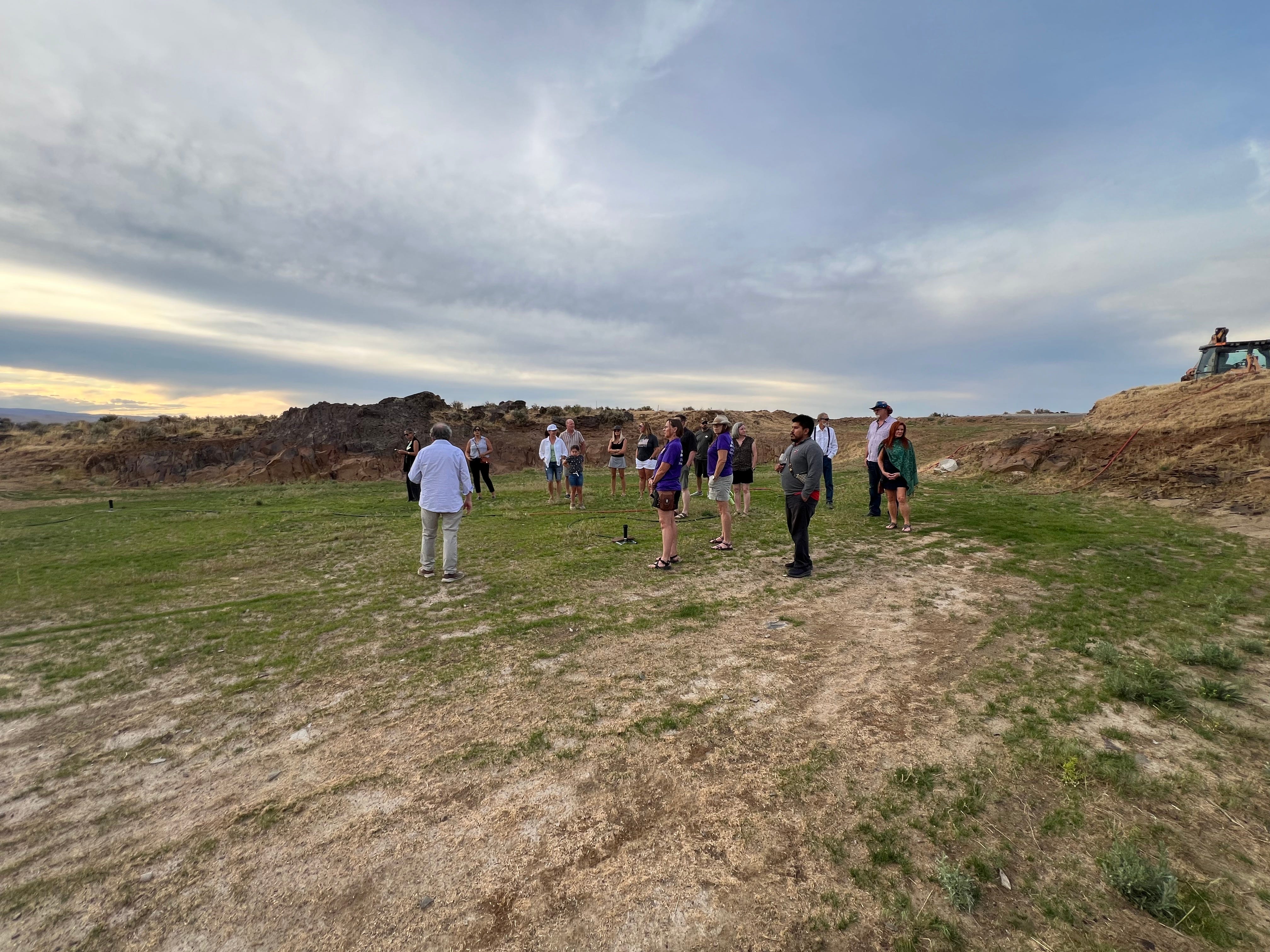
Visitors were guided through several locations that organizers believe could become key elements of the future campus. Among the most striking was a naturally formed circular space known as The Grotto. Hidden within the rock formations overlooking the Columbia River Gorge, the area feels secluded and personal. Organizers envision transforming the space into an intimate performance and gathering venue capable of hosting lectures, theatrical productions, musical performances, and educational programming. It is a large enough space for 1000 - 1200 seats if developed in the way Vince described, while still feeling very intimate. A mix of natural rock formations that are acoustically perfect and modern architecture to enclose it one day.
Nearby, attendees visited an area known as The Terraces. The site naturally creates a tiered amphitheater, with sloping elevations that provide clear sightlines toward a natural central performance area. The natural contours of the hillside create sightlines that strongly resemble a purpose-built amphitheater. Organizers noted that many of the seating terraces already exist as natural seams within the landscape, reducing the amount of excavation they believe would be necessary. Organizers noted that many of the terraces already exist as natural seams within the rocky landscape and described the site as an example of allowing the terrain itself to shape the design. Vince said preliminary concepts call for approximately 2,000 seats within the outdoor venue.
Vince and Carol explained that the whole concept of the Hilltop relies heavily on the existing topography rather than extensive earthmoving or large-scale alterations to the landscape.
As attendees between locations, conversations naturally turned toward the possibilities the spaces could create and of course, the views. Some discussed performances and concerts, while others focused on educational opportunities, tourism potential, and the ability to host conferences, symposiums, and community events. Participants commented on the uniqueness of the setting and the opportunities created by combining cultural programming with one of the most recognizable landscapes in Washington State.
The tour reinforced a point that had been emphasized throughout the evening: organizers are not proposing a single venue or event space. Their vision is for a campus that can support multiple activities simultaneously, creating opportunities for visitors to engage with music, education, science, environmental learning, and cultural experiences in one location.
Not Another Gorge
One of the most common assumptions surrounding the project is that it represents an attempt to build another version of the Gorge Amphitheater. Throughout the presentation, Vince and Carol worked to distinguish The Hilltop from that comparison.
The Gorge Amphitheater
was designed around large-scale music performances and has become one of the most successful outdoor concert venues in North America. Its focus remains on bringing thousands of people together to experience major touring artists in a world-class setting.
The Hilltop is being developed around a broader mission.
While music remains an important part of the concept, organizers envision programming that extends well beyond concerts. Discussions Tuesday evening included symphony performances, chamber music, theater, educational programming, scientific presentations, environmental learning opportunities, leadership events, and speaker series. The goal is to create a destination where multiple forms of learning, creativity, and discovery can coexist.
Vince Bryan spoke at length about experiences throughout his career that shaped this philosophy. Drawing from his years in medicine, he described the influence that exposure to accomplished individuals, new ideas, and unfamiliar disciplines had on his own professional development. He argued that many of life’s most important opportunities emerge when people encounter experiences they would not normally seek out on their own.
That belief appears central to the vision behind The Hilltop. Organizers hope the project will create opportunities for students, educators, professionals, artists, and visitors to interact with ideas and experiences that broaden perspectives and inspire future pursuits.
While the Gorge focuses on entertainment, The Hilltop is being positioned as a place where entertainment, education, culture, and community engagement intersect. Understanding that distinction is important to understanding the project itself.

Why Stakeholders and Investors Are Paying Attention
Although much of Tuesday night’s discussion focused on arts, education, and community experiences, the potential economic implications were also evident throughout the presentation.
The Columbia Basin has experienced several major periods of economic transformation over the past century. Agriculture established the region’s foundation. Hydropower expanded opportunities for industry and growth. More recently, data centers and technology investments have brought national and international attention to the area.
Rather than focusing on industrial development, the proposal centers on destination development and experience-based tourism. Organizers believe the project could build upon existing tourism infrastructure while attracting new audiences to the region.
The Gorge Amphitheatre provides a useful example of what that impact can look like. Each year, visitors travel from throughout Washington, across the United States, and from other countries to attend events at the venue. Vince shared that an average of 60% of concert attendees are actually international visitors. Those visitors support hotels, campgrounds, wineries, restaurants, retailers, and numerous other local businesses.
The Hilltop seeks to expand upon that foundation by creating reasons for visitors to come to the region outside traditional concert weekends.
Educational conferences, scientific symposiums, cultural festivals, leadership gatherings, theater productions, and environmental programs all attract different audiences. Unlike a single concert event, those activities could occur throughout the year and appeal to a broader range of visitors.
For local businesses, that possibility carries obvious implications. Additional visitors create demand for lodging, dining, transportation, retail services, and recreational opportunities. They also create opportunities for partnerships with educational institutions, cultural organizations, tourism operators, and community groups.
Supporters believe visitors would be drawn by a variety of experiences rather than a single attraction. Successful destination regions often develop ecosystems of complementary attractions that encourage visitors to stay longer, return more often, and explore multiple aspects of a community.
The Hilltop is being presented as one potential addition to that broader ecosystem.


The Cultural Question
Beyond economics, The Hilltop raises questions about the role culture plays in the long-term development of a community.
For many people, the word culture is associated primarily with entertainment. During Tuesday night’s presentation, however, organizers described a broader understanding of the term. Their vision includes arts, education, science, environmental awareness, history, and opportunities for shared experiences.
As the 98848 continues to grow, conversations about quality of life are becoming increasingly common. Economic development remains important, but many communities eventually reach a point where residents begin asking additional questions. What opportunities exist for lifelong learning? What experiences are available to local families? How can a community attract and retain talented people? What resources are available to young people growing up there?
Many of the themes discussed Tuesday night echo conversations that emerged during the recent 98848 Vision initiative, where residents identified quality of life, educational opportunities, recreation, cultural amenities, and long-term community identity as important topics for the area’s future. Communities throughout the country regularly invest in museums, performing arts centers, libraries, educational institutions, and cultural facilities because they view those investments as contributing to the overall strength of a community.
Supporters of The Hilltop see the project through a similar lens. They believe exposure to the arts, science, education, and new ideas creates opportunities that can influence lives in ways that are not always immediately measurable. A student may discover a career path through a lecture or workshop. A young musician may find inspiration through a performance. A family may gain access to experiences that would otherwise require travel to larger metropolitan areas.
Whether The Hilltop ultimately achieves those goals remains to be seen. However, the discussion itself reflects broader questions about what types of opportunities residents want available within the 98848 as the region continues to evolve.
What This Means to You
The Hilltop remains a proposal. Significant fundraising, planning, partnerships, and construction will be required before the vision presented Tuesday night becomes reality.
At the same time, the project arrives during a period of substantial growth and change throughout the 98848. New industries continue to invest in the region. Tourism remains an important part of the local economy. Population growth is creating both opportunities and challenges as community leaders, businesses, and residents consider what the next generation of Quincy will look like.
That broader context helps explain why Tuesday night’s presentation resonated with many of those in attendance.
For decades, the Quincy area has been known for agriculture, hard work, innovation, and more recently, major investments in technology and industry. The Gorge Amphitheatre added another dimension to that identity by establishing the region as an international tourism destination. Today, people from around the world travel to the Columbia Basin for experiences that cannot be replicated anywhere else.
The Hilltop asks whether another chapter could be added to that story.
Supporters of the project see an opportunity to create a destination centered not only on entertainment, but also on education, science, culture, and lifelong learning. They envision a place where local students can hear world-class speakers without leaving the region, where families can attend performances and educational programs close to home, and where visitors come not only for concerts but for experiences that encourage learning, discovery, and connection.
Many of those same themes emerged during the recent 98848 Vision conversations, where residents discussed quality of life, opportunities for young people, cultural amenities, recreation, tourism, and the long-term identity of the community. While The Hilltop was not part of those discussions, the questions raised Tuesday night closely mirror many of the questions residents have already been asking about the future of the area.
Supporters view the proposal as an opportunity to build on assets that already exist within the region while expanding educational, cultural, and economic opportunities. Others may have questions about priorities, funding, or long-term sustainability. Those discussions are likely to continue as the project develops.
What became clear Tuesday night is that organizers are asking the community to think beyond a single event or venue and consider a larger question about the future of the 98848. As Quincy continues to grow and attract investment, what additional opportunities should be available to the people who live here, work here, and raise families here?
That conversation may ultimately prove as significant as the project itself.

Looking Toward the Next 25 Years
By the time the tour concluded, the sun was beginning to disappear behind the Cascades. Golden light stretched across the cliffs and coulees surrounding the property as small groups lingered, continuing conversations about what they had just seen.
Standing near the edge of the Columbia River Gorge after walking much of the proposed campus, it became easier to understand why Vince and Carol spent so much time talking about place. Vince explained the geology, history, and natural formation of the area. The venues being discussed were not designed first and then assigned to the landscape. The landscape itself appeared to be the starting point.
As attendees returned from the tour as the final light of day was fading across the cliffs overlooking the Columbia River, it was difficult not to reflect on how dramatically this landscape has changed during the past half-century.
The vineyards that helped establish the region’s wine industry once existed only as an idea. The Gorge Amphitheater began as a small concert series before growing into an internationally recognized destination. Hospitality businesses, wineries, restaurants, and tourism followed.
Today, those developments are woven into the identity of the 98848.
Whether The Hilltop eventually joins that list remains uncertain. The project is still in its earliest stages, and significant work lies ahead before its success can be measured.
What Tuesday night’s presentation demonstrated, however, is that organizers are thinking beyond the next event, the next season, or even the next decade. Their proposal is rooted in a longer view of what the Columbia Basin could become and how arts, education, science, and culture might contribute to that future.
Twenty-five years from now, the community will almost certainly look different than it does today. New businesses will have arrived. New families will have settled here. New opportunities will have emerged.
The question raised Tuesday night was not simply whether The Hilltop should be built. It was what role projects like it might play in shaping the future of the 98848 and the experiences available to the generations that will call it home.
For More information on The Hilltop go here

The SOAR Festival Offers First Glimpse
The first public demonstration of their vision will arrive Aug. 22 with the inaugural SOAR Festival.
Vince and Carol describe the event as both a fundraiser and a proof of concept for what The Hilltop could eventually become. While the permanent venues have not yet been constructed, attendees will have an opportunity to experience the property, view architectural renderings and participate in programming designed to showcase the broader vision. The majority of the event will happen on the Cave B Stage
The evening’s entertainment lineup reflects the project’s multidisciplinary approach.

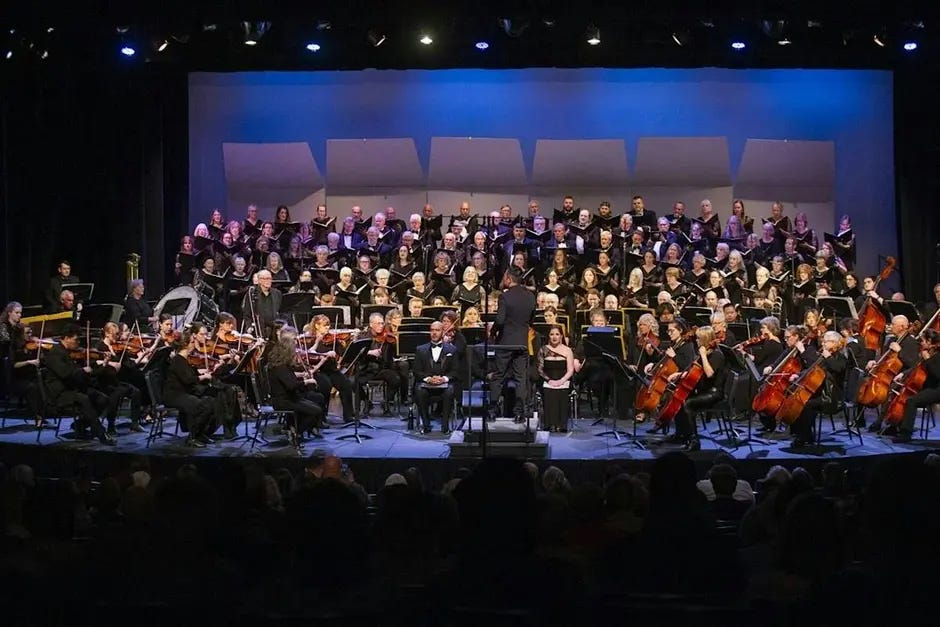
Scheduling include world-class performances by acclaimed producer, composer, and songwriter David Foster and Friends, including acclaimed vocalist, actress and Broadway performer Katharine McPhee, along with the Wenatchee Valley Symphony Orchestra. Organizers also announced with special appearances by Broadway veteran and celebrated Northwest stage actress Mari Nelson, and Alexander Kilian of Jesus Christ Superstar.
Ticket levels range from community-access pricing to premium philanthropic packages intended founding supporters and major donors. Organizers acknowledged that the initial event is structured as a fundraiser, it is priced higher than future events for that reason with proceeds supporting development of the nonprofit organization and future campus.