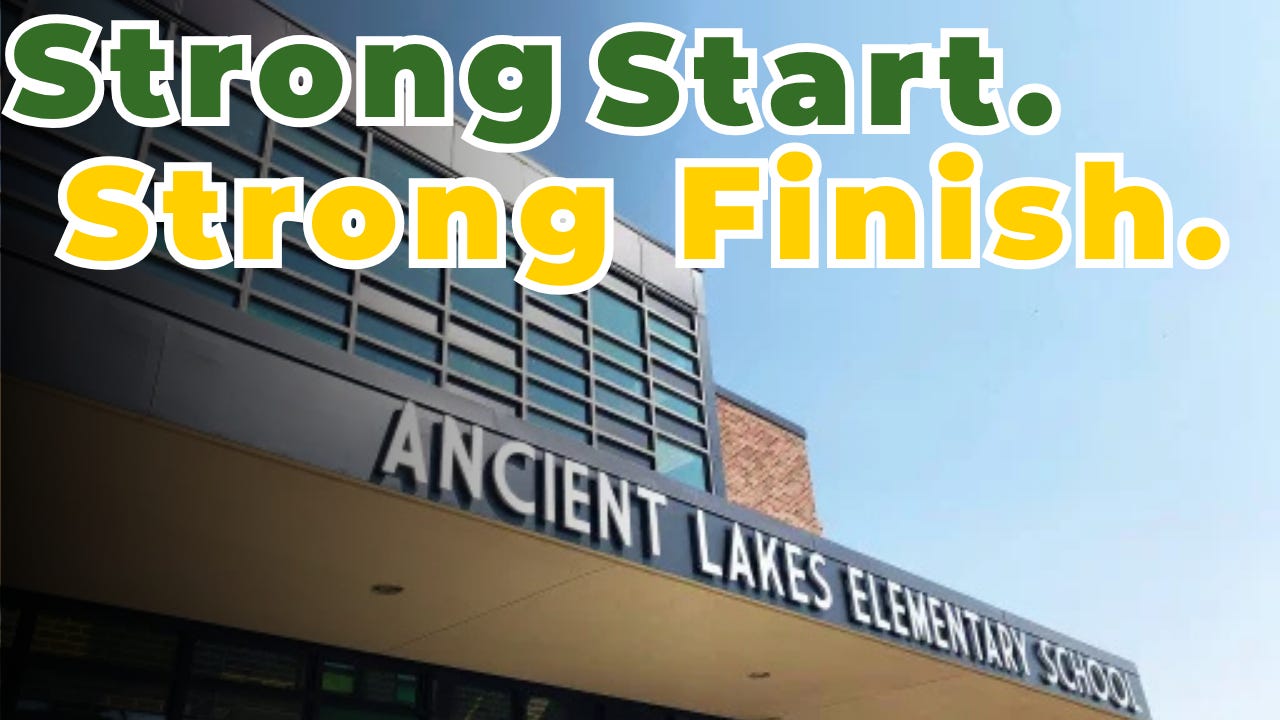
For anyone raising children in the 98848, one question sits beneath every report card, test score, and school improvement plan: Are our kids actually learning and growing?
That question was at the heart of Ancient Lakes Elementary Principal Whitney Gregg’s presentation to the Quincy School Board on June 9. The report included encouraging signs—kindergarten students showing exceptional literacy growth, fifth graders posting some of the strongest academic gains in the school, and dozens of struggling readers reaching grade-level decoding proficiency. Yet Gregg also shared a challenge that many educators recognize: students made significant gains during the year, only to see some of that momentum level off by spring. The result was a candid look at both the successes and the ongoing work happening inside one of the district’s largest elementary schools serving families across the 98848.
TL;DR
• Ancient Lakes Elementary serves 368 students with 28 certificated staff members.
• Fifth-grade students posted some of the strongest academic growth in the school, with 83% meeting expected growth in math and 62% meeting expected growth in reading.
• Kindergarten students showed exceptional early literacy growth, with 90% meeting expected growth targets.
• Thirty-four students exited intensive reading intervention after demonstrating grade-level decoding proficiency.
• Ancient Lakes’ Math Is Cool team placed fifth at the Masters Tournament, with three students finishing in the top 15 individually.
• More than half of school families completed the annual family perception survey, providing feedback for future improvement efforts.
• School leaders are continuing to focus on helping students sustain academic growth throughout the entire school year.

Celebrating Growth at Both Ends of Elementary School
One of the clearest themes in Gregg’s presentation was that Ancient Lakes is seeing some of its strongest results at the beginning and end of a student’s elementary experience.
According to STAR assessment data presented to the board, 90 percent of kindergarten students met expected growth targets in early literacy during the 2025-26 school year. Across kindergarten and first grade combined, 66 percent of students met expected growth expectations. Those results suggest students are building strong foundational reading skills during their earliest years in school.
At the other end of the building, fifth-grade students delivered some of the school’s strongest academic results. Sixty-two percent met expected growth targets in reading, while an impressive 83 percent met expected growth targets in mathematics. Schoolwide, 53 percent of students met expected reading growth and 55 percent met expected math growth, making the fifth-grade results stand out even more.
Gregg told board members that seeing such strong results in kindergarten and fifth grade gives staff confidence that many of their instructional strategies are working. The challenge now is ensuring that students continue making those gains consistently throughout the elementary years.
The success of the school’s fifth graders extended beyond classroom assessments. Earlier in the meeting, Gregg recognized four members of Ancient Lakes’ Math Is Cool team, which placed fifth at both the regional competition and the Masters Tournament. Three of the four team members also finished among the top 15 individual competitors at the state-level event. The accomplishment highlighted a theme that surfaced repeatedly throughout the report: when students are given opportunities to develop their skills, they are capable of achieving at a high level.
Reading Intervention Program Produces Results
One of the most significant pieces of data in the report involved students receiving reading intervention support.
Ancient Lakes uses the Really Great Reading program to provide targeted instruction for students struggling with decoding and phonics skills. During the 2025-26 school year, 105 students received intervention services. By the end of the year, 34 of those students had demonstrated grade-level decoding proficiency and no longer required intensive decoding support. That represents approximately 32 percent of intervention students successfully exiting the program.
Gregg spent time during the board meeting explaining what that data actually means. Decoding refers to a student’s ability to connect letters and letter patterns to sounds and use those skills to read words. For younger students, that may mean mastering letter sounds. For older students, it may involve more complex skills such as decoding multisyllabic words, vowel teams, and advanced word patterns.
The strongest intervention results appeared in fifth grade, where 16 of 17 students receiving support reached grade-level decoding proficiency and exited intervention services. Fourth grade also saw notable success, with 11 students exiting intervention.
At the same time, Gregg noted that reading proficiency involves more than decoding alone. Some students who master decoding still need support in vocabulary, language comprehension, reading fluency, and overall comprehension before reaching full reading proficiency. That distinction helps explain why schools often celebrate intervention success while continuing to focus on broader literacy development.

Family Partnerships Continue to Drive School Culture
While much of the presentation focused on academic data, Gregg also highlighted the role families play in the success of Ancient Lakes Elementary.
The school’s Parent Volunteer Committee remained highly active throughout the year, supporting field trips, assemblies, enrichment opportunities, classroom incentives, and teacher wish-list purchases through fundraising efforts. Activities included the Super Silly Fun Run, Butter Braid sales, Jackrabbit spirit gear sales, Popcorn Fridays, Candy Grams, Scholastic Book Fairs, the Christmas Store, and Noche de Lotería.
More importantly, families continued participating in school improvement conversations. Parents attended committee meetings focused on school improvement efforts, Positive Behavioral Interventions and Supports (PBIS), and survey data. More than half of school families completed the Panorama Family Perception Survey, giving school leaders valuable feedback about school climate, safety, communication, and overall effectiveness.
For a school where nearly 42 percent of students are multilingual learners and nearly 73 percent qualify for free or reduced-price lunch, maintaining strong family engagement is particularly important. The data suggests Ancient Lakes continues to build those relationships and create opportunities for families to remain connected to their children’s education.
What This Means to You
The Ancient Lakes report offers a reminder that school improvement is rarely a straight line.
Looking only at end-of-year numbers might cause someone to miss the progress happening underneath the surface. Students who struggled with reading are learning skills that allow them to leave intervention programs. Kindergarten students are building literacy foundations that could benefit them for years. Fifth graders are demonstrating that strong academic growth is possible and that Quincy students can compete successfully against some of the region’s best young mathematicians.
At the same time, Gregg’s presentation showed why educators spend so much time examining data. Schools are not just asking whether students improved. They are asking where growth occurred, when it occurred, and why it occurred. Understanding those patterns helps teachers adjust instruction and support students more effectively.
For families throughout the 98848, the report provides both reassurance and a realistic picture of the work still ahead. There are clear signs of success, but school leaders are not satisfied with maintaining the status quo. They are continuing to look for ways to help more students sustain growth from the first day of school through the last.
Looking Beyond the Numbers
One of the most revealing moments of the presentation came when Gregg described what she saw in the data. The school appeared to be “starting really strong and ending really strong,” she told board members, while staff continue working to understand what happens in the middle of the journey.
That observation may ultimately be the most important takeaway from the evening.
The story of Ancient Lakes Elementary is not simply about percentages on a chart. It is about hundreds of students learning to read, solve problems, build confidence, and prepare for the next stage of their education. The data presented to the board shows meaningful progress, but it also reflects a school committed to continuous improvement rather than celebrating numbers alone.
For families across the 98848, that may be the most encouraging result of all: a school willing to celebrate its successes, acknowledge its challenges, and keep searching for ways to help every student reach their potential.