
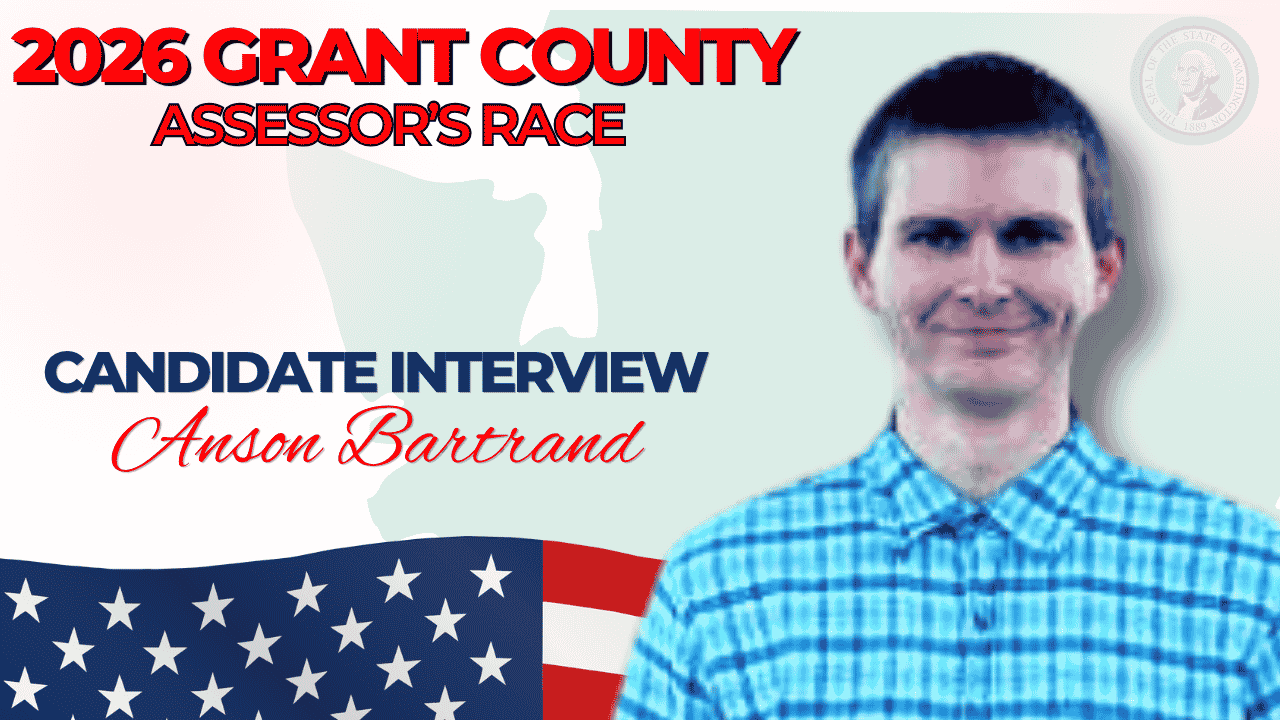
I interviewed 2 candidates for the Grant County Commissioner Assessor’s race for 2026.
Both Candidates were invited to be interviewed
Both Candidates responded were asked the exact same 20 questions in the exact same order
They never saw each others answers
The answers have not been altered, edited, modified, editorialized, changed, or edited in any way by the staff, ownership, or affiliates of this publication.
For each I have posted the transcript, not a story, their words. (transcripts by AI)
For each I have posted the audio from the interview.
A full list of the questions
Below the interviews I will post their posted bio from their candidate website, their sign and a link to their website and or FaceBook
The Interview Begins Here
Anson Bartrand Interview Audio File
Anson Bartrand Interview Grant County Assessor
Race for 2026
Brent Dowlen: [00:00:00] Please introduce yourself to our readers. Who are you? What is your connection to Grant County, and what would you like people to know about you personally and professionally?
Anson Bartrand: Hi, my name is Anson Bartrand. I am a third-generation Grant County resident, uh, and citizen.
I... My family’s been here since my da- my dad and his grandfather moved here shortly after World War II, and, uh, they’ve loved this area. And I, I look forward to raising my family here as well. I am the CFO of a land investment and management company, and I hope to bring that experience to the assessor’s office.
I have, uh, bachelor’s degrees in accounting and marketing management, and I also finished up law school over at the University of Idaho. And so I have- a ton of [00:01:00] education behind me. Perhaps I’m over-educated, but I think that it’s important to
Have a certain legal background and a certain accounting background, especially when you’re in a position of leadership over a large county department.
Brent Dowlen: Yeah Why are you running for Grant County Assessor, and why do you believe you’re qualified for the particular office?
Anson Bartrand: I’m running for... I’ll address the first question first.
I’m running for Grant County Assessor because I am aware that there’s been a lot of contention between the departments in Ephrata, the assessor’s office, the auditor’s office, and the treasurer’s office, and that friction ultimately harms the people of Grant County. I hope to bring a reasoned approach, and treat [00:02:00] people with dignity, and work hard for the people of Grant County, while still serving the conservative values of their, our constituents, the farmers, the businessmen, the landowners, the residents.
Um, can you repeat the second question?
Brent Dowlen: Yeah. Why do you believe you’re qualified for this particular office?
Anson Bartrand: So I’ve already discussed my educational background a little bit. I also have a bit of experience in the private sector, serving as a leader and working to... Working with budgets, working with limited resources to try and accomplish the goals of the company, which was Sentinel Shores.
Brent Dowlen: Okay. What experience, education, and training or professional background do you have that you believe has prepared you to serve as Grant County Assessor?
Anson Bartrand: [00:03:00] So working as CFO for a land investment and management company, although I do not have experience in property valuation specifically, I’m not trained in USPAP standards, I am very much familiar with this industry, and I’m very much familiar with how property valuations happen, and I’m aware of some of the standards.
I am not trained. But as assessor, you need someone who’s more equipped to lead a department, someone who has training, and my training is private sector. I don’t come from government bureaucracy. And I have some experience on, uh, nonprofit, uh, committees and boards. I served on the central committee for the Grand Columbia Council BSA when it was around.
I, um, have served [00:04:00] in various positions within the Grant County Republican Party on its executive board, and I believe that that experience has enabled me to be a better leader for the people of Grant County
Brent Dowlen: Many voters don’t have much interaction with the assessor’s office until they receive a property valuation notice.
In your own words, what does the Grant County Assessor do, and what does the assessor not control when it comes to somebody’s property tax bill?
Anson Bartrand: So the assessor’s office needs to be very proactive in helping landowners when they come. A lot of times a landowner will complain or, to the assessor’s office, or they’ll just go directly into filing an appeal with the Board of Equalization.
My goal is to implement a bit of a more formal mediation process first, because landowners, when they argue before the Board of Equalization, the Board of [00:05:00] Equalization is instructed to presume that the assessor’s office is correct. And so I hope to implement a more formal mediation process where the landowner who considers his property to be assessed too high and the assessor’s office can simply discuss and say, “Hey, what do we believe the valuation should be?”
I believe that an assessor needs to be humble and acknowledge that we’re not always right, and I know that there are a lot of landowners that feel like the assessor’s office doesn’t take into account what they put forward. Like they might go and get a fair market appraisal and go to, and get their own appraiser, and the value is substantially lower than what the assessor’s office lists the property at, and the assessor’s office doesn’t have to consider that [00:06:00] fair market appraisal.
Which, in my opinion, should have a fairly substantial weight, especially when an assessor’s office is conducting thousands of app- 60,000 appraisals across Grant County all at once
I think that With that program in place, the landowner’s interests would be better reflected and in an environment which is not as imposing as going to the Board of Equalization, and it would save the Board of Equalization a bunch of time by resolving a lot of these conflicts earlier.
Brent Dowlen: What do you believe the Grant County Assessor’s office currently does well, and what specifically would like to change to im- or improve if elected?
Anson Bartrand: I believe the assessor’s office does, by and large, a reasonable job at valuing property across Grant County. I... It’s very hard [00:07:00] to, um, value property, um, and I think that they do
A reasonable job, I won’t say a great job, and I certainly hope to improve that process. But some of the things that I hope to improve are, again, that process for landowners to mediate their differences rather than going directly to the Board of Equalization. Uh, second thing I hope to work on is coordinating with the other departments within Grant County to provide the best possible service that they can to the people of Grant County and the landowners of Grant County.
Another thing I hope to work on is budgetary responsibility. The assessor’s office has 15 employees and a substantial budget, over two million dollars, [00:08:00] which is a burden on the people of Grant County. I’ll look for ways that we can ef- more efficiently serve the people of Grant County with the resources that we have.
Brent Dowlen: Washington State requires property to be assessed according to state law and the valuations be fair and uniform. What would you do as the assessor to ensure that similar properties and property owners are treated consistently through Grant County?
Anson Bartrand: You have processes to value property. In reality, no property is 100% the same as the other property.
Under USPAP standards, you use fair market comparable sales in order to value the property. And what’s a comparable sale? You look at the neighborhood, you look at all the characteristics, but it’s really hard. You’ll never [00:09:00] have a perfect number that every appraiser would agree to, but you do your best job with the information you have and you try and do it in a way that Is expedient.
You don’t wanna spend m- $20 million appraising property across Grant County because you, you could spend as much money as you want to, but you want a process which is expedient, and you want a process which can fairly value property
Brent Dowlen: Grant County includes residential neighborhoods, farms, agricultural lands, small communities, recreational properties, commercial businesses, major industrial facilities, data centers, and rapidly developing areas.
How would you approach the challenge of accurately and eq- equitably valuing su- valuing such different types of properties?
Anson Bartrand: Grant County [00:10:00] is a very broad and diverse county. Yeah. And as I said, you have to consider each property as it is. Um, and there are different approaches to valuing commercial property. You can use replacement cost as opposed to simply fair market comps b- because how are you going to value data centers, for example, in Grant County?
You, you can’t use comps because, I mean, the data centers are new and they aren’t being sold-
Brent Dowlen: Mm-hmm ...
Anson Bartrand: in fair market sales. And so you have to use techniques under USPAP standards in order to value property. You have to consider what the information you have, and you need to do so in a way that, um, is ultimately fast because you [00:11:00] can’t value every property, um, using conventional appraisal standards.
Y- it’s a mass appraisal.
Brent Dowlen: Okay If a Grant County homeomer... If a Grant County homeowner receives an assessment showing a substantial increase in their property’s value even though they haven’t sold, remodeled, or made significant improvements to it, how would you explain how that can happen and how the county arrived at that valuation?
Anson Bartrand: So there are a few ways that can happen. Um, one of the things that can happen is, um, the assessor’s office might be, uh, looking at comparable sales in the area which have suddenly skyrocketed the price. It could be that they’re comparing to properties which are not logically within the neighborhood. So like for example, if you’re comparing two properties in Moses Lake [00:12:00] that are on the shoreline of Moses Lake, they’re going to be valued significantly higher than other nearby properties.
But like if they’re on a canal, you’ll end up with a different value, and sometimes the assessor’s office does not perfectly draw the boundaries to reflect that. And so you, when you’re talking with the landowner, you’re listening to them and seeing, okay, well, they- they’re sudden- noting a sudden increase, and they, they feel like perhaps these comparable sales don’t make any sense, and maybe they don’t.
You need to have humility when you’re considering that. Um, if the landowner, um-
You would explain why you’re using the properties you’re using to the landowner. Um, and you’d also [00:13:00] listen to the landowner if those other things don’t make sense to use.
Brent Dowlen: If a property owner believes the assessor’s office has gotten the value of their property wrong, what should they expect from you and your staff?
And what should they do to challenge that assessment?
Anson Bartrand: So if they believe that a property value is wrong, ideally, under my proposed system, they would go to the assessor’s office, and we’d set up a meeting, and we’d discuss and mediate through this difference of opinion regarding the value of the property.
And, um, maybe the answer is somewhere in the middle. Maybe it’s more to one side than the other based off of the facts that you have. You’d have to consider all the property’s characteristics and the comparable sales and all those factors. Another thing that you would... I- if they’re unwilling [00:14:00] to come to a consensus, then you would go to the Board of Equalization.
And, um, ultimately, when landowners go to the Board of Equalization, unfortunately, I, I very much disagree with this as a landowner here in Grant County, if you go to the Board of Equalization, you... as a landowner, you’re presumed to be wrong. The Board of Equalization has specifically instructed that they’re to assume that the assessor’s office is right, which I believe that’s wrong.
But that’s unfortunately the system in which we live under Washington state law.
Brent Dowlen: What is your philosophy towards property assessment appeals, and how will you balance being responsive to individuals, property owners, with your responsibility to apply the same valuation standards throughout the county?
Anson Bartrand: So you have to respect what the landowner says when they disagree with [00:15:00] their property evaluation, and you have to be fair and consistent throughout the county. And when you’re doing a mass appraisal, sometimes you get it wrong, and so you’re willing to correct that. But you’re fair and consistent in your char- in your valuation of the property, and y- there are guidelines which govern that, and I believe very much in the rule of law
Brent Dowlen: What information and measurements would you use to determine whether property assessments across Grant County are accurate, consistent, and equitable?
Anson Bartrand: So you could do a sampling to make sure that the way you’re valuing property is accurate, and that’s actually done by, I believe it’s the Department of Revenue that conducts, uh, regular audits. And it tells counties, “We believe that you are assessing property across your county at around 95% of the true and fair [00:16:00] value.”
Um, and so you have that as sort of telling you how accurately you’re doing it. Um, and that’s one metric that the State of Washington has for determining if counties are valuing property fairly across the board, uh, relative to the rest of the state. As far as within Grant County, you might ultimately be assessing property differently to where it should be.
One example that I can think of is a recent case from the Board of Equalization. There’s a property in Ephrata that’s had a for sale sign on it for many years, and, uh, they’ve been trying to sell it for around half of its assessed value. Mm-hmm. [00:17:00] Now, if it’s not selling for half of its assessed value, maybe the assessed value is wrong, and you need to look and see why it’s wrong.
And in that particular case, I believe that the landowner made a very compelling argument that the assessor’s office should have listened to. But when it goes before the Board of Equalization, the- Um, Board of Equalization is specifically instructed to assume that the Assessor’s Office is right.
Brent Dowlen: Mm-hmm.
Agriculture remains one of Grant County’s most important industries. What do you believe farmers and agricultural property owners should know about how you would administer agricultural and current use property assessments and programs?
Anson Bartrand: So the Assessor’s Office handles current use applications, and I believe that agriculture is the backbone of the American economy, and it’s certainly the backbone, the heart, and the soul of Grant County.[00:18:00]
Um, we need to protect farmers and work collaboratively with farmers when they are submitting their current use applications, when they’re in- valuing their property, and ensure that they’re protected. Because agriculture faces a number of difficulties on every side. They’re facing water shortage, they’re facing all of these.
We don’t need them to also have to face a bureaucratic machine that doesn’t work.
Brent Dowlen: Grant County has experienced a substantial industrial development and boom, including data centers and other large and complex facilities. What challenges do these properties present for an assessor, and how would your administration approach valuing them accurately?
Anson Bartrand: Data centers are very difficult to value, and it’s a new challenge that Grant County faces. We don’t have [00:19:00] sales of data centers that we can compare with, and so you have to value them based off of their, uh... You have to use other techniques under USPAP standards- Mm-hmm ... including replacement cost, including, um, potentially income generation if you have that information provided by them.
You have to u- you have to follow the standards in order to value the data centers.
Brent Dowlen: The assessor’s office maintains records for tens of thousands of parcels, including valuations, ownership information, legal descriptions, maps, property characteristics. How would you use technology to improve the accuracy, efficiency, accessibility, and transparency of the office?
Anson Bartrand: I believe technology is a very wonderful tool, and it used to be that 100 years ago, you were valuing property on the order of however many dollars per acre, and it was [00:20:00] just, like, flat all the way across the county. Now, we have tools that you can say, “Okay, what neighborhood is it in? What is the land being used for?”
And so technology has brought the assessor’s office a long way. I believe it can bring the assessor’s office further. One of the requirements under state law is that you have to, uh, conduct a physical inspection of each property every six years. And, uh, most counties across Washington, not Grant County, um, place a picture of the house on that, um, to...
With a date stamp for when they last looked at the house, and I believe that that would help, uh, people of Grant County, including realtors, to better, um, be able to receive and communicate [00:21:00] information regarding property. Um, I believe that technology can... A lot of the processes can be automated- Mm-hmm ... and perhaps end up with some financial savings for the people of Grant County.
Um, I, I look forward to integrating with technology. One drawback that I see from the assessor’s office is, um, or the Grant County spent, uh, several thousand dollars, uh, getting iPads for, or tablets, I can’t remember which they were, for the assessors when they go around and conduct field inspections. But, um, those computers that they got ultimately were not able to use the software that [00:22:00] the assessor’s office was using, and so they sit in Ephrata doing absolutely nothing.
I, I think we need to use technology responsibly, with an eye towards saving the taxpayers of Grant County money rather than adding to their burden. I think-
R- fiscal responsibility is one of my main concerns, and I hope to bring my experience as a CFO to help s- solve some of these problems
Brent Dowlen: What information do you believe Grant County property owners should be easily, should be able to easily find and understand about their property assessment, how it was determined, available exemptions or programs, and their right to appeal?
Anson Bartrand: Okay. So I, I believe that all of that information should be readily accessible on the website. And if you know how to [00:23:00] dig and where to dig, I mean, you can find it. There are multiple property tax exemptions available. You can get a property tax exemption if you are disabled. You can get it if you are a senior, um, and with a certain qualifying level of income.
You can get, uh, it if the property is in current use. And there, there are all these programs, and a lot of property owners are unfortunately unfamiliar with the system enough to navigate it. And one of the main struggles is, so there’s a senior property tax exemption. Ha- ha- seniors a lot of times struggle with technology.
And, and so you need an assessor’s office that is willing to work with these seniors. As I was at the Grant County Fair, there was a person I was talking to [00:24:00] who was unaware of the senior property tax exemption, and she has been noticing that the property taxes have been going up and up and up. And she’s on a fixed income, and she is struggling with, how am I going to make ends meet?
How am I going to hopefully keep this property still available for my kids when I pass on? And I believe that the assessor’s office needs to help these individuals. And when they go to the assessor’s office, they need a responsive group of people, a task force who’s dedicated to helping them.
Brent Dowlen: Washington provides property tax exemptions and deferral programs for certain qualifying residents, including seniors, people with disabilities.
What responsibility do you believe the assessor’s office has to educate residents about programs for which they may [00:25:00] qualify or help them navigate the process?
Anson Bartrand: I believe we have a very high responsibility. I believe that there are better ways than simply posting it on the website to reach a lot of those people.
And one of the things I would potentially be open to is having town halls across Grant County, uh, in which these people can come and hopefully learn more about the process i- that they need to go through in order to help them save money and lower their property tax burden
Brent Dowlen: The county assessor is also responsible for managing an office and its employees.
How would you describe your management style, and what would you do to recruit, train, retain, or hold accountable the people responsible for assessing properties throughout Grant County?
Anson Bartrand: So if you ask any of my friends, I have a fairly laid-back [00:26:00] style, except when it comes to thing... if things are not done properly, I will ensure...
I, I’m not going to be an absentee assessor. I’m going to be right there in the trenches, helping them with it and working towards serving the people of Grant County. I have management experience, uh, as a CFO. I have other professional experience leading other people, and I have nonprofit board experience as well.
And I, I believe that all of that will come to Help serve the people of Grant County
Brent Dowlen: If elected, what are your three highest priorities for the first year as Grant County Assessor? What specifically would you hope to accomplish on each of them?
Anson Bartrand: [00:27:00] So my three pri- highest priorities, uh, one would be budgetary responsibility.
I wanna make sure that the people of Grant County get the most bang for their buck in the assessor’s office, and ensure that money is spent properly and not wasted. And if there’s any efficiencies that can be re- achieved, I hope to achieve those efficiencies. Two, I hope to ensure that property is fairly and accurately assessed.
I think that that’s a core duty. I think that Daughtered
County Assessor’s Office does an okay job at it, but I think that there’s room for improvement. The third goal I hope to achieve is to help communicate to landowners and, uh, foster good relationship [00:28:00] with the landowners as well as other departments in Ephrata. I- There, there’s a lot of animosity in Ephrata, and there’s a lot of animosity with the landowners too, and I believe that if you comport yourself in a professional manner and Treat people civilly that, that will help bring about the best experience for the people of Grant County.
Brent Dowlen: Four years from now, what specific results or measurements should Grant County residents be able to look at to determine whether you fulfilled the commitments you’re making during this campaign?
Anson Bartrand: Well, I think that one thing that they can look at is the budget. Um, I hope to achieve some synergies and, uh, reduce the budget of the assessor’s office.
Um, and [00:29:00] that will be directly measurable in terms of people’s levy rate. They’ll be able to see, oh, the Grant County is not sending as much money to the assessor’s office, and that’s an absolute win for the people of Grant County, and something which is actually very easily measurable. You have numeric data for that.
As far as, uh, property evaluations, um, that’s a little bit harder to measure. You would need studies in order to measure the accuracy of that. But I believe that landowners will be able to look at their property tax bill and say, “That, that’s reasonable. I think my property’s worth that.” And so I think that You’ll end up with a more accurate and hopefully on a, at least on an individual base, measurable for the people, uh, for the taxpayers of Grant [00:30:00] County metric.
Um, another thing I hope they’ll be able to look at is, uh, the departments up in Ephrata working collaboratively together and solving problems, and putting the people of Grant County first rather than their own egos. And so I believe that hopefully four years from now, they’ll look at all that and say, “You know what?
I think Anson Bartran did a good job as an assessor, and he put our conservative values first,” and yeah.
Brent Dowlen: You’ve had an opportunity to explain your experience, your approach to office, your priorities. What’s the final case you wanna make to Grant County voters as they decide whether to elect you as their next county assessor?
Anson Bartrand: One thing about the assessor’s office, it’s very oftentimes [00:31:00] overlooked. People sometimes don’t even know the difference between an assessor and an auditor. They, they both start with an A, and th- they don’t know. They do something up in Ephrata. Um- But some things that they need to consider when deciding whether or not they want a conservative in the office or not is the assessor has a lot of power.
You, you don’t want someone liberally assessing your valuation of property. Um, but beyond that, they also have the power to, as I was going into earlier, con- they have to conduct a physical inspection of property at least every six years according to state law, and that could be simply looking at a house from the street, or that could be a bureaucrat traipsing around your yard.
[00:32:00] And I believe very much in property rights and privacy rights as well, and I believe that you should limit the amount of intrusion upon privacy and intrusion upon property as possible. And that is something that the assessor’s office, uh, of various counties have begun to implement more and more. There have been some counties, uh, that have had their assessor’s office begin to implement drone technology to aerially surveil people’s property.
And I do not want drones flying over my yard, and I don’t want them flying over your yard either. So like the sheriff’s office, you need someone who shares your conservative values
Website Bio (condensed)
Anson Bartrand My professional background includes years of business experience, including serving as Chief Financial Officer (CFO) for a land investment and management company. In that role, I gained firsthand experience overseeing budgets, financial reporting, property-related matters, and responsible fiscal management. That experience has taught me the importance of accuracy, transparency, and making sound financial decisions—qualities that are essential for an effective County Assessor..
Website: https://www.ansonbartrand.com

Questions for Candidate

Back to Candidate Hub
Disclaimer:
This interview is presented as part of our commitment to providing accessible, local information to the community. All candidates in the 2026 Grant County Auditor’s race were given the same questions, in the same format, and the opportunity to share their perspectives directly.
The responses published here are the candidate’s own words, presented without editing, interpretation, or commentary beyond basic transcription. Audio recordings are provided alongside transcripts to ensure full transparency.
Welcome to Quincy WA News does not endorse, support, or oppose any candidate. Our role is to provide information so residents of Grant County—including the 98848 communities—can make informed decisions based on their own judgment.