
Some of my favorite Quincy School Board meetings are the ones where individual schools have an opportunity to report directly to the board. District budgets, policies, and academic assessments are important, but hearing from the people working with our children every day offers a different perspective on what’s happening in our schools.
Tuesday morning’s October 27 meeting was one of those occasions. Ancient Lakes Elementary Principal Whitney Gregg, school counselor Mrs. Diaz, and student intervention specialist Mrs. Vega shared an extensive look at the programs, challenges, and successes shaping their school this year. Their presentation covered everything from new approaches to mathematics instruction and academic improvement goals to emotional regulation, student leadership, and staff recognition. What made the presentation particularly interesting was how the three educators connected those efforts to the everyday experiences of their students.
Ancient Lakes is working to improve academic performance, but the school is also placing considerable emphasis on relationships, emotional development, and creating an environment where students and staff feel supported.
TL;DR
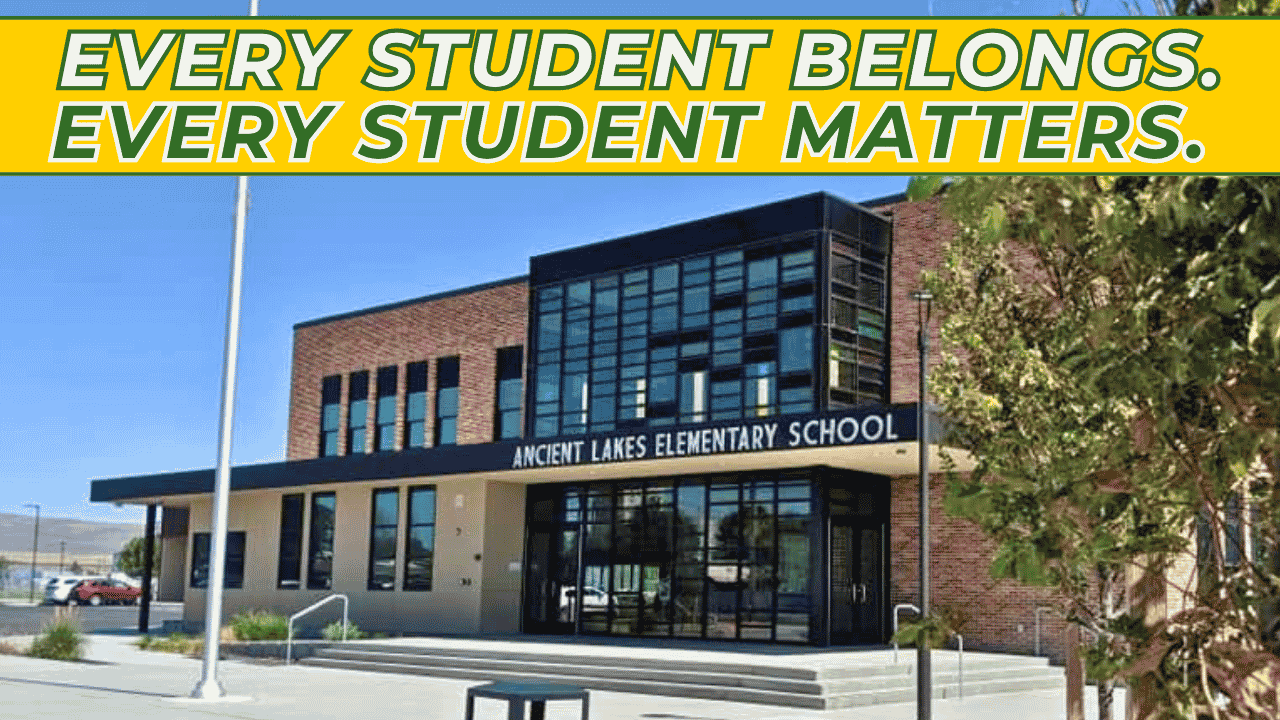
Ancient Lakes Elementary currently serves 361 students and employs 27 certificated staff members.
The school is participating in the Math Breakthrough Network, which brings educators together to improve instruction through collaborative classroom observations and student feedback.
A dedicated counseling classroom and expanded intervention services are helping students develop emotional regulation and problem-solving skills.
Mrs. Diaz has established a goal of sharing lunch with every student through smaller, quieter lunch groups.
A new student leadership group is giving fifth graders a voice in school activities, assemblies, and positive behavior incentives.
The school’s 2026–27 improvement plan establishes measurable goals for mathematics, reading, and emotional regulation.

A School Focused on the Student Experience
Ancient Lakes Elementary currently serves 361 students with 27 certificated staff members. Approximately 85% of its students identify as Hispanic or Latino, nearly 42% are multilingual learners, and approximately 74% qualify for free or reduced-price meals. The school also reports that 21.1% of its students receive special education services.
Principal Whitney Gregg opened her presentation by emphasizing that the purpose of the school is to serve children and that their experiences should remain central to decisions about instruction and support. Gregg described an approach that recognizes students’ individual strengths rather than focusing exclusively on their difficulties. She wants students to feel that their ideas matter, that they belong in their school community, and that they have the ability to succeed academically.
That philosophy is reflected in several initiatives currently underway at Ancient Lakes, beginning with a different approach to teaching mathematics.
Changing the Way Teachers and Students Experience Math
Mathematics improvement is a significant priority throughout the Quincy School District, and Ancient Lakes is participating in a collaborative initiative called the Math Breakthrough Network. The program brings educators together to examine how students experience mathematics instruction and identify teaching strategies that encourage engagement, confidence, and problem-solving.
Gregg explained that schools naturally spend considerable time discussing curriculum, instructional pacing, and assessment results. While those elements remain important, the Math Breakthrough Network asks teachers to pay closer attention to what students are actually experiencing during their lessons. Are students confident enough to share their ideas? Are they willing to attempt challenging problems? Do they understand why a particular solution works, and can they explain their reasoning to classmates?
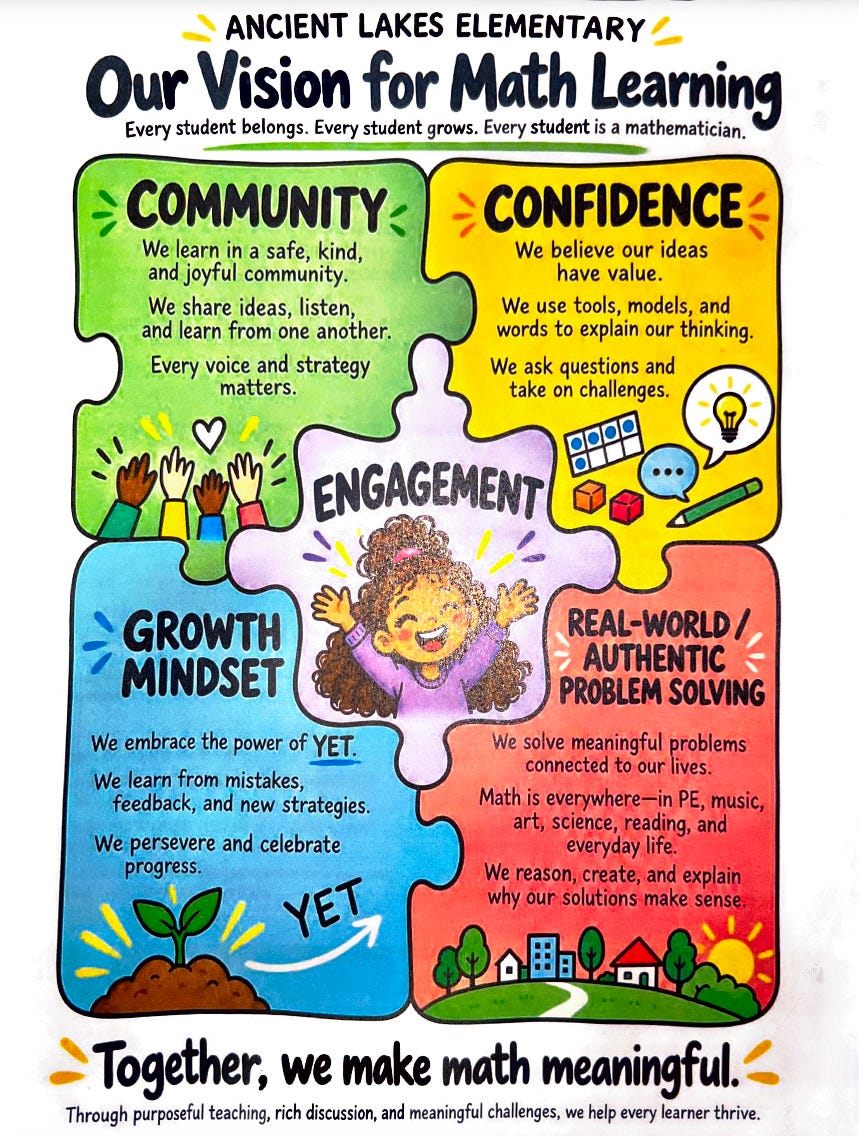
Ancient Lakes teachers have developed a shared vision for mathematics instruction built around five connected principles: community, confidence, engagement, growth mindset, and real-world problem-solving. The vision is summarized by the statement, “Every student belongs. Every student grows. Every student is a mathematician.”
Learning Together in the Classroom
One of the most interesting parts of Gregg’s presentation was her description of a recent Math Breakthrough Network studio day at Ancient Lakes. Fifth-grade teacher Mrs. Cruz volunteered to teach a mathematics lesson while a team of educators observed and collaborated. Thirteen adults participated in the classroom experience, including representatives working with the regional educational service district.
Unlike a traditional classroom observation, the purpose wasn’t to evaluate the teacher or identify mistakes. Instead, the educators worked together before the lesson to plan the instruction and anticipate how students might approach the mathematics. During the lesson, instruction could be paused while the participating educators gathered briefly to discuss what they were seeing. They considered how students were responding, what teaching strategies appeared effective, and what adjustments might help students move forward. Mrs. Cruz then continued teaching, incorporating ideas developed through those conversations.
The lesson involved a real-world purchasing problem in which students had to compare two buying options and determine which represented the better value. Gregg noted that the problem was challenging enough that the adults also had to work through the mathematics rather than immediately recognizing the answer.
The observers paid particular attention to moments when students demonstrated confidence, explained their reasoning, or helped classmates understand a different approach. For example, when a teacher invites a student to explain a strategy to the class, that simple decision may encourage the student to take pride in their work while helping other children recognize different ways to solve a problem. By identifying those successful teaching practices, educators can incorporate them into future lessons and share them with colleagues.
Students are also invited to discuss their experiences following the lessons, providing teachers with direct feedback about how the instruction worked from the students’ perspective. The Math Breakthrough Network currently focuses on third through fifth grades, with additional collaborative sessions planned throughout the school year. District leaders indicated that the approach could eventually expand as participating teachers gain experience.
Addressing the Need for Academic Growth
The emphasis on mathematics comes at a time when both Ancient Lakes and the broader Quincy School District are working to improve student performance. According to the school’s improvement plan, mathematics growth has been below typical levels overall, with second and fourth grades showing particular areas of concern. Third and fifth grades have demonstrated stronger results, providing examples of progress the school hopes to build upon.
Ancient Lakes has established a goal of increasing the percentage of students demonstrating typical or high growth in mathematics from 55% to 75% by the end of the school year. The school is also working to improve reading growth from 57% to 75%.
Gregg explained that achieving those goals requires teachers to be clear about what students are learning, how lessons are taught, and how progress is measured. The Math Breakthrough Network is one part of that larger effort, helping teachers refine their instruction through collaboration rather than working independently.
Click Here for Your New Home
A Different Approach to Student Counseling
While the mathematics initiative was an important part of Tuesday’s presentation, I was particularly impressed by the work being done through the school’s counseling and student intervention programs.
Growing up, I couldn’t have told you who my school counselor was. That was true throughout my school years, from elementary school through high school. I knew schools had counselors, but I had very little understanding of who they were or what they did. Listening to Mrs. Diaz and Mrs. Vega describe their work at Ancient Lakes was a striking contrast to that experience.
These aren’t educators waiting in an office for students to come to them when something goes wrong. They’re actively involved in the daily lives of the children, building relationships, teaching emotional skills, and working alongside students in classrooms, the cafeteria, and on the playground.
Mrs. Diaz, who is in her fifth year at Ancient Lakes, explained that the school’s counseling program has evolved considerably. The addition of Mrs. Vega as a student intervention specialist has allowed the school to expand its services while making counseling instruction more consistent. One of the biggest changes this year is the establishment of a dedicated counseling classroom.
Rather than scheduling lessons around other demands on the counselor’s time, counseling instruction is now built directly into the school’s master schedule. Every classroom visits Mrs. Diaz approximately once a month, accompanied by its regular teacher. Students participate in lessons and activities designed to help them understand their emotions, develop healthy responses to frustration, and learn how to make thoughtful decisions. Having classroom teachers participate also allows those lessons and strategies to carry over into everyday instruction.
The dedicated classroom provides a consistent environment where students know what to expect. It also offers space for students who need a quiet break, and Mrs. Diaz noted that teachers and other staff members have made use of the calming environment as well.
In previous years, counseling lessons sometimes had to be canceled when an unexpected situation required immediate attention. With Mrs. Vega available to respond to many of those needs, Diaz reported that no scheduled counseling lessons have been canceled so far this school year.
That consistency is particularly important because emotional regulation is one of Ancient Lakes’ three primary school improvement goals. The school wants to increase favorable responses on the emotional regulation portion of its student survey from 34% last spring to 60% by the end of the current school year. The emphasis is on teaching children to recognize when they’re becoming upset, understand what they’re feeling, and develop strategies to calm themselves before reacting.

Recognizing That Not Every Student Experiences School the Same Way
One initiative described during the presentation particularly caught my attention because it addresses something I understand personally.
Elementary school lunchrooms can be loud, crowded, and chaotic. For many children, that’s simply part of the school day. They enjoy the opportunity to talk with friends, socialize, and take a break from classroom instruction. For others, that same environment can be overwhelming.
Mrs. Diaz explained that some students at Ancient Lakes were struggling with the noise and activity in the cafeteria. As the volume increased, certain students became overstimulated or had difficulty regulating their behavior. Rather than treating every resulting behavior problem as a matter of discipline, the counseling team began considering whether the environment itself was contributing to the difficulty.
Their initial solution was to create a smaller, quieter lunch setting for students who needed additional support. As the program developed, however, the team recognized that many students could benefit from the opportunity to eat in a calmer environment. What began as a targeted intervention has grown into something much broader.
Mrs. Diaz now has a goal of sharing lunch with every student at Ancient Lakes during the school year. Students are invited into smaller lunch groups, organized by grade levels and rotated regularly so everyone has an opportunity to participate. They still eat with other children, socialize, and practice the same expectations they would follow in the regular cafeteria, but in a setting with fewer distractions.
According to Diaz, the response from students has been extremely positive. Some have enjoyed the experience so much that they’ve asked whether they could continue attending the smaller lunches permanently. The arrangement also provides opportunities for Diaz to build relationships with children she might not otherwise spend much individual time with.
I found this initiative particularly encouraging. Large, noisy groups can be difficult for me personally, and I have a child who experiences similar challenges. I understand how quickly an otherwise ordinary environment can become uncomfortable when there’s too much noise and activity happening at once. Seeing a school recognize that reality, acknowledge that different children have different needs, and make a practical adjustment was refreshing.
The goal isn’t to eliminate the traditional lunchroom experience or prevent children from enjoying time with their friends. It’s recognizing that the same environment doesn’t work equally well for every student. Sometimes helping a child succeed doesn’t require an elaborate new program. It requires understanding what that child is experiencing and being willing to approach the situation differently.

Teaching Problem-Solving Where Problems Actually Happen
The school’s approach to emotional regulation extends beyond scheduled counseling lessons. Mrs. Vega spends considerable time with students during recess, lunch, and other parts of the school day when disagreements and frustrations naturally arise.
Mrs. Diaz explained that teaching children about friendship, communication, and problem-solving in a classroom is important, but those lessons don’t always translate automatically into real-life situations. A child may understand how to resolve a disagreement during a counseling lesson and still struggle when another student changes the rules of a playground game.
Having Mrs. Vega present during those moments allows the school to teach and reinforce those skills as situations develop. She works alongside students and paraprofessionals to help children establish rules for games, manage frustration, communicate with one another, and take breaks when needed.
The approach emphasizes teaching appropriate behavior rather than simply responding after something goes wrong. Diaz reported that the additional support has helped reduce behavioral referrals, although the presentation did not include specific figures.
Ancient Lakes has also continued refining its Multi-Tiered System of Supports, commonly referred to as MTSS. The system brings teachers and specialists together to identify students who need additional academic, behavioral, or emotional support beyond regular classroom instruction.
This year, the school introduced more structured questions during those meetings to help teachers clearly communicate their concerns and provide the information needed to determine appropriate interventions. The team is also making greater use of organized student data to identify children who may need assistance.
Gregg explained that this helps ensure students aren’t overlooked simply because their needs may be less immediately noticeable than those of other children. Support can include small-group reading instruction, language development, mathematics interventions, social-emotional learning groups, or individualized assistance. The purpose is to identify needs early and provide appropriate support without unnecessarily singling students out.
Giving Fifth Graders a Voice in Their School
Another encouraging development at Ancient Lakes is the creation of a student leadership group.
Mrs. Diaz explained that she had wanted to establish an Associated Student Body, or ASB, program for several years. With the additional support now available through the intervention specialist position, she has been able to begin developing that opportunity.
The program is still in its early stages and doesn’t yet have all the formal structures of a traditional ASB organization. However, fifth-grade students have already begun participating in decisions that affect their school.
Students voted for representatives in their classrooms, and those representatives have helped develop positive behavior incentives and organize school activities. Diaz explained that adults had traditionally made decisions about rewards and celebrations without always asking students what they would find meaningful. The new leadership group gives students an opportunity to help shape those decisions.
Student representatives also helped organize and lead a school pep assembly, including reviewing assembly expectations, presenting awards, and participating in the planning process. One of the activities involved a Golden Cone Award, which recognized classrooms for meeting expectations.
The effort gives students practical leadership experience while encouraging them to take greater ownership of their school community.

Quincy Gold and a Pie in the Face
Ancient Lakes has also introduced some creative incentives through its Positive Behavioral Interventions and Supports program, known as PBIS.
Students earn Quincy Gold for demonstrating positive behaviors and meeting school expectations. This year, the school is giving students additional opportunities to spend that currency on special activities.
One recent example involved voting to determine which willing staff members would receive a pie in the face. Staff members volunteered to participate, and students could spend Quincy Gold to vote for their preferred candidates.
The activity proved popular enough that the school increased the voting cost to 10 Quincy Gold per vote. Diaz shared the story of one student who earned 100 Quincy Gold to vote for a particular staff member and immediately began planning how to earn more before the voting period ended.
Students could also bid for the opportunity to deliver the pie, with one winning bid reaching 80 Quincy Gold.
The activity provided a lighthearted incentive for students to demonstrate positive behavior while giving them something entertaining to anticipate. It also offered another example of how Ancient Lakes is trying to make school expectations meaningful and engaging rather than simply presenting students with a list of rules. I really applaud the out of the box thinking with this new incentive program and the willingness of staff to step out of their comfort zone and try something new. The pie in the face was one example, several other possibilities were mentioned to rotate through the year as possible incentives. Cheers to our incredible teachers and staff willing to be creative, possibly embarrassed and putting themselves out there in a big way to encourage and motive students.
Supporting the Adults Who Support Students
Ancient Lakes is also placing renewed attention on staff relationships and morale. Gregg emphasized that a positive school environment depends not only on how adults support students but also on how employees support one another.
The school has introduced an “Out of This World” staff recognition program, with employees recognized every two weeks through coworker nominations and principal awards. Recipients receive a space-themed pin for their lanyard and a personalized note acknowledging their contributions.
The school has also expanded opportunities for classified staff, including paraprofessionals, office personnel, and other support employees, to collaborate and receive assistance. Mrs. Vega’s position has provided additional support for staff members supervising recess and lunch, giving them someone who can respond to difficult situations and offer practical strategies.
The team also described several activities intended to strengthen relationships among employees. One example was a Friday activity called “Pumpkin in the Pocket.”
Two small pumpkins were secretly distributed to staff members, who then spent the day asking coworkers whether they had a pumpkin in their pocket. The pumpkins changed hands throughout the activity, encouraging employees to interact with colleagues they might not normally see during their busy schedules.
The activity included a coffee gift card prize, but its larger purpose was helping staff members connect and finish the week on a positive note. Friday activities for students also include music, movement, and opportunities to dance and have fun together.
These may seem like small things compared with academic assessments and improvement plans, but they reflect an intentional effort to build a school environment where people enjoy being together. The idea that a staff that enjoys working together, where they work and what they do makes for a better more effective team has been proven time and time again. I am personally excited to see it being embraced in our schools.

Recognizing Progress While Addressing Challenges
Ancient Lakes’ presentation also included an overview of its 2026–27 School Improvement Plan, which establishes measurable goals for academic growth and emotional regulation.
The school is targeting an increase in favorable emotional regulation survey responses from 34% to 60%, mathematics growth from 55% to 75%, and reading growth from 57% to 75%. Midyear targets have been established for each area, allowing school leaders to evaluate whether their strategies are producing the desired results.
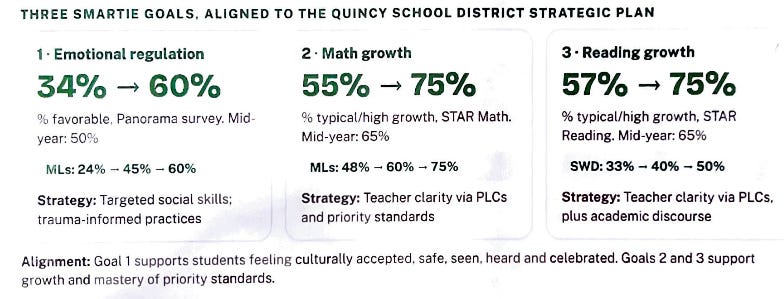
The improvement plan also identifies specific student populations requiring additional attention. Multilingual learners are a focus of the school’s emotional regulation and mathematics goals, while students with disabilities are a priority group for improving reading growth.
Gregg explained that language development plays an important role in both emotional regulation and mathematics. Students need the vocabulary to communicate their feelings, explain their reasoning, and demonstrate what they understand.
The school’s data also identifies several continuing challenges. Overall mathematics growth has been below typical levels, with particularly low growth in second and fourth grades. Reading growth among students with disabilities has also lagged behind the overall student population.
Attendance remains another area of concern, particularly in kindergarten, where the improvement plan reports that 42.9% of students met the 90% attendance measure.
Despite those challenges, Ancient Lakes has demonstrated progress in its overall school improvement indicators. Its Washington School Improvement Framework score increased from 1.70 in 2023 to 2.40 in 2024 and 2.45 in 2025, moving above the 2.25 threshold identified in the school’s improvement plan.
Gregg also noted that Ancient Lakes received recognition for closing achievement gaps during the previous school year.
The improvement plan calls for regular teacher collaboration, monthly school improvement team meetings, classroom observations, and ongoing review of student assessment data. A formal midyear review is scheduled for January, followed by an end-of-year evaluation in June.
The goals are ambitious, and the results will ultimately determine how successful the school’s current strategies prove to be. However, the presentation made clear that the staff is actively examining its challenges and working together to address them.
A School Community That Comes Together During Difficult Times
Before discussing any of the school’s programs or academic goals, Gregg opened her presentation by acknowledging a difficult loss experienced by the Ancient Lakes community.
She spoke about the passing of Becky, someone who had been part of the school community and was known by many students and staff members. Gregg described the grief experienced by the school and expressed appreciation for the support provided by district counselors, staff members, and others who came together to help students and employees through the loss.
She particularly recognized teachers who continued supporting their students while experiencing their own grief.
Later in the meeting, district leadership and school board members also acknowledged the compassion demonstrated by the Ancient Lakes team. One board member specifically praised the care shown to staff members during that difficult period, while another noted how unusual and encouraging it was to hear a school presentation place such emphasis on employees caring for one another.
It was a meaningful reminder that schools are communities, and the relationships within them become especially important when difficult circumstances arise.

What This Means to You
For families with children attending Ancient Lakes Elementary, Tuesday’s presentation offered a valuable look at the work happening beyond traditional classroom instruction.
Parents may hear their children talking about Quincy Gold, counseling lessons, lunch groups, student leadership activities, or new approaches to mathematics. Those experiences are part of a larger effort to improve academic achievement while helping students develop confidence, emotional awareness, and stronger relationships.
The school is also recognizing that children don’t all learn, communicate, or respond to their surroundings in the same way. By offering additional support and making adjustments where needed, staff members are working to create an environment where more students can succeed.
For the broader Quincy community, the presentation highlighted the importance of supporting both the academic and personal development of our children. The school has identified measurable challenges and established goals for improvement, but it is also investing in the relationships and experiences that shape how children feel about school.
Looking Beyond the Numbers
There is a reason I enjoy attending school board meetings where individual schools present their work.
We regularly hear about test scores, academic standards, budgets, and district policies. Those are necessary parts of understanding public education, but they don’t always tell us what a typical day looks like for the children attending our schools. Tuesday’s presentation gave us a much closer look.
We heard about a teacher willing to open her classroom to thirteen colleagues in an effort to improve mathematics instruction. We learned about a counselor who wants to share lunch with every student in the building and an intervention specialist who spends time on the playground helping children work through disagreements before they become larger problems.
We heard about fifth graders learning to lead, staff members finding ways to encourage one another, and a school community supporting its students and employees through a difficult loss.
What impressed me most was the level of involvement these educators have in the daily lives of their students. I grew up in a time when school counselors were largely invisible to me. Seeing the relationships Mrs. Diaz and Mrs. Vega are building with elementary students, and the effort being made to recognize the different needs those children bring to school, was encouraging.
Ancient Lakes still has academic challenges to address, and its improvement goals will require considerable work throughout the year. Those challenges shouldn’t be overlooked. But the October 27 presentation demonstrated that the school’s staff is thinking carefully about how children learn, how they experience their school environment, and what adults can do to help them succeed.
For the families who entrust their children to Ancient Lakes Elementary each morning, that commitment matters.