
Most residents of the 98848 probably don’t spend much time thinking about the Grant County Health District until something brings it to their attention. It might be a warning about unsafe water, a question about a restaurant inspection, or a public health advisory during wildfire season. What residents may not realize is how much work takes place between those announcements, from inspecting food vendors at community events to investigating communicable diseases and helping local families access healthcare. At the October 6 Quincy City Council meeting, Deputy Administrator Michele Wurl offered a closer look at that work, along with an explanation of how the Health District is funded and why Quincy continues to support its operations.
The Short Version
Public health reaches beyond the doctor’s office. The Grant County Health District oversees food safety, drinking water and septic systems, communicable disease investigations, environmental health, and several community assistance programs.
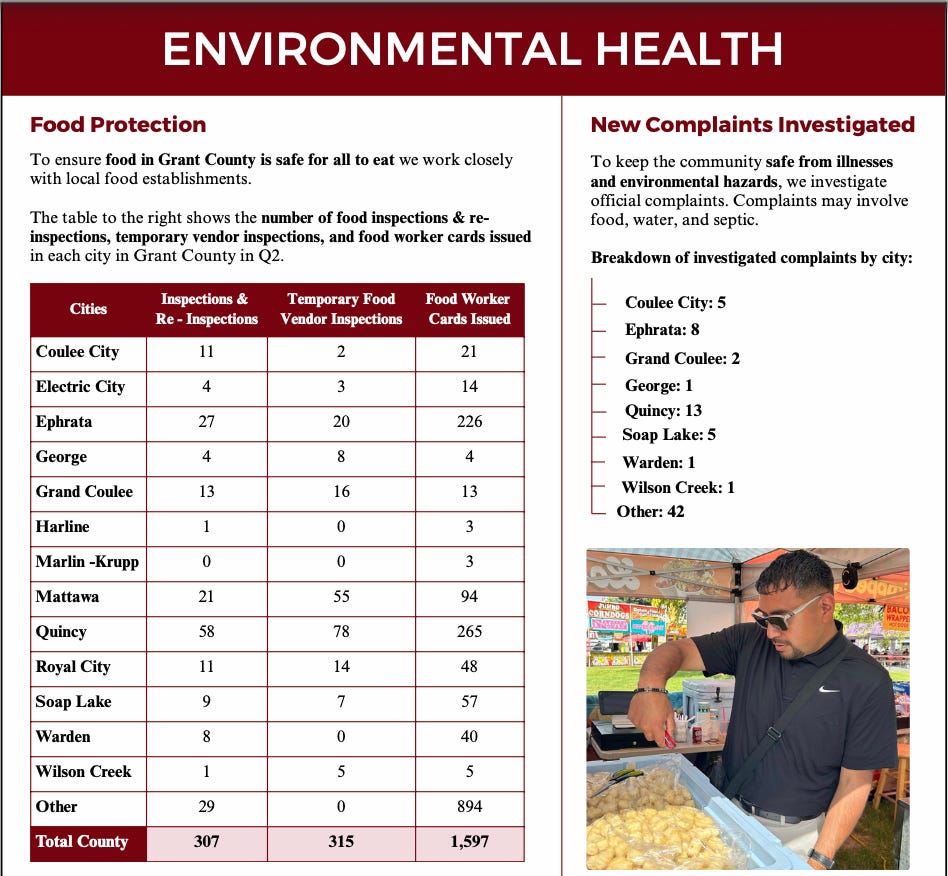
Quincy sees considerable activity. During April through June 2026, the district reported 58 food establishment inspections and reinspections, 78 temporary food vendor inspections, and 265 food worker cards issued in Quincy.
Disease prevention remains an important responsibility. During January through March 2026, the district worked with 23 communicable disease cases and 12 sexually transmitted infection cases in Quincy.
The Health District requests annual contributions from cities. Its standard request is $3 per resident, although Quincy has historically contributed $4 per resident. The City Council has not yet established its contribution for the coming year.
Quincy has representation in public health leadership. City Councilmember Tom Harris serves as chairman of the Grant County Board of Health.

What Does the Health District Actually Do?
When people hear the words health department, restaurant inspections and food handler cards are often the first things that come to mind. Those responsibilities are certainly part of the Grant County Health District’s work, but they represent only a portion of the services provided throughout the county.
The district is responsible for protecting public health through disease prevention, environmental health services, education, and coordination with other organizations. Its employees investigate communicable diseases, respond to outbreaks, monitor food safety, oversee certain drinking water and septic system requirements, and help residents connect with healthcare and social services. The district also participates in efforts involving traffic safety, childhood injury prevention, pollution prevention, and emergency preparedness.
Unlike a hospital or medical clinic, which generally treats patients after they become sick or injured, much of the Health District’s work is intended to prevent those problems from occurring in the first place. A restaurant inspection may identify unsafe food storage before anyone becomes ill. A communicable disease investigation can help prevent an infection from spreading to additional people. A drinking water inspection can identify a potential problem before it affects a household.
These services are not limited to the larger population centers of Grant County. The Health District serves Quincy and the surrounding communities, including rural areas where access to services and resources may be more limited.
During her October 6 presentation, Wurl provided council members with reports covering the first and second quarters of 2026. Together, those reports offer a more detailed picture of the district’s work in Quincy during the first half of the year.

A Closer Look at Public Health in Quincy
Food safety represents one of the most visible responsibilities of the Health District, particularly in a community that hosts numerous celebrations, festivals, and other events throughout the year.
According to the district’s second-quarter report, covering April through June 2026, inspectors completed 58 food establishment inspections and reinspections in Quincy. During the same period, the district recorded 78 temporary food vendor inspections and issued 265 food worker cards associated with the city.
Those figures help illustrate the amount of oversight involved in protecting the public when food is prepared and served. Established restaurants are subject to inspections, but temporary vendors at community events must also meet applicable food safety requirements.
That work extends beyond inspecting kitchens. During the second quarter, the Health District reported investigating 13 environmental health complaints in Quincy. The district also recorded three drinking water or well inspections, nine septic permits, and 13 septic or drinking water evaluations.
For homeowners and businesses, these services help ensure that systems affecting drinking water and wastewater disposal meet applicable public health requirements. Problems involving contaminated water or improperly functioning septic systems can have consequences beyond an individual property, making environmental health an important responsibility in both urban and rural communities.
The district’s work also includes investigating illnesses that can spread from person to person.
During the first quarter of 2026, covering January through March, the Health District reported working with 23 communicable disease cases in Quincy, along with 12 sexually transmitted infection cases. Across Grant County, the district reported 146 communicable disease cases and 132 sexually transmitted infection cases during that period.
These investigations are an example of public health work that generally receives little attention unless an outbreak becomes a larger concern. Health District personnel may need to identify possible exposures, provide guidance, coordinate testing or treatment information, and communicate with healthcare providers or other organizations.
The first-quarter report also described the district’s response to a measles exposure in March, including a free drive-up clinic offering the measles, mumps, and rubella vaccine.
Although these activities may take place outside public view, they are part of the work required to identify potential health threats and limit their impact on the community.
Helping Families Find the Services They Need
Not every Health District program involves inspections, regulations, or infectious diseases. Some are designed to help residents navigate the healthcare system and connect with services that may otherwise be difficult to access.
One example is Community Connect, a program that helps coordinate care and connect residents with social services. During the second quarter of 2026, the district reported two clients enrolled in Quincy, along with 57 care coordination services and 48 social service referrals.
Those numbers represent services and referrals rather than 57 or 48 separate individuals. They demonstrate how assisting even a small number of residents can involve considerable coordination between healthcare providers, community organizations, and other available resources.
The district also provides services for children and families with additional healthcare needs. During the same quarter, its Children with Special Health Care Needs program reported three referrals associated with Quincy and 21 services provided. Its Access to Baby and Child Dentistry program recorded eight Quincy referrals through WIC.
For families who have never needed these programs, they may be unfamiliar. For those trying to arrange specialized care, find dental services for a young child, or connect with available assistance, they can provide an important starting point.
These efforts also reflect the broader nature of public health. While inspections and disease investigations focus on preventing immediate risks, care coordination and family support programs address barriers that can affect a person’s health over time.
Food Vendors and the Challenges of Enforcement
One of the more practical discussions during Wurl’s presentation involved temporary food vendors operating without the necessary permits.
The subject is particularly relevant to Quincy because vendors sometimes establish operations near the city but outside municipal boundaries. While the location may affect which local government has jurisdiction, food safety concerns remain the responsibility of public health officials.
Wurl described situations in which inspectors encountered unsafe food-handling practices, including raw meat stored near ready-to-eat foods and inadequate handwashing facilities. These conditions can create risks for customers regardless of whether food is being sold from a permanent restaurant, a temporary stand, or another location.
The Health District has enforcement responsibilities, but Wurl explained that responding to unpermitted operations can present challenges involving jurisdiction, staffing, and the ability to take appropriate action. Inspectors can issue warnings and citations, and more serious circumstances may require additional measures or coordination with law enforcement.
The discussion highlighted an important distinction between collecting permit fees and protecting public health. Permits are part of the regulatory process, but the underlying purpose of food safety requirements is to ensure that food is prepared, stored, and served under conditions that reduce the risk of illness.
For properly permitted vendors, those requirements also establish expectations that apply to others selling food to the public. Residents who purchase food from temporary operations should be able to expect reasonable safeguards, whether the vendor is operating at a community festival or alongside a roadway.
As Quincy continues to host events that bring residents and visitors together, temporary food safety will remain one of the more recognizable ways the Health District’s work intersects with community life.

Who Oversees the Health District?
Although the Grant County Health District works closely with county and municipal governments, it operates under its own Board of Health.
The board has legal responsibilities established under Washington state law, including oversight of public health matters and the authority to enforce applicable health regulations. Its membership brings together elected officials and community representatives from throughout Grant County.
Quincy has a direct connection to that leadership. City Councilmember Tom Harris currently serves as chairman of the Grant County Board of Health, providing local representation in discussions and decisions that affect public health across the county.
During her presentation, Wurl also explained how Health District leadership maintains relationships with the communities it serves. She and Administrator Theresa Adkinson divide responsibility for geographic service areas within Grant County, with Wurl serving as a primary contact for Quincy.
That division of responsibilities is an administrative arrangement rather than a new program or expansion of staff. It provides a way for local officials to communicate with Health District leadership about concerns, questions, and services affecting their communities.
In a county with substantial distances between communities, maintaining those relationships is an important part of coordinating public health services.
How Is Public Health Funded?
The financial relationship between Quincy and the Grant County Health District was another important part of Wurl’s presentation.
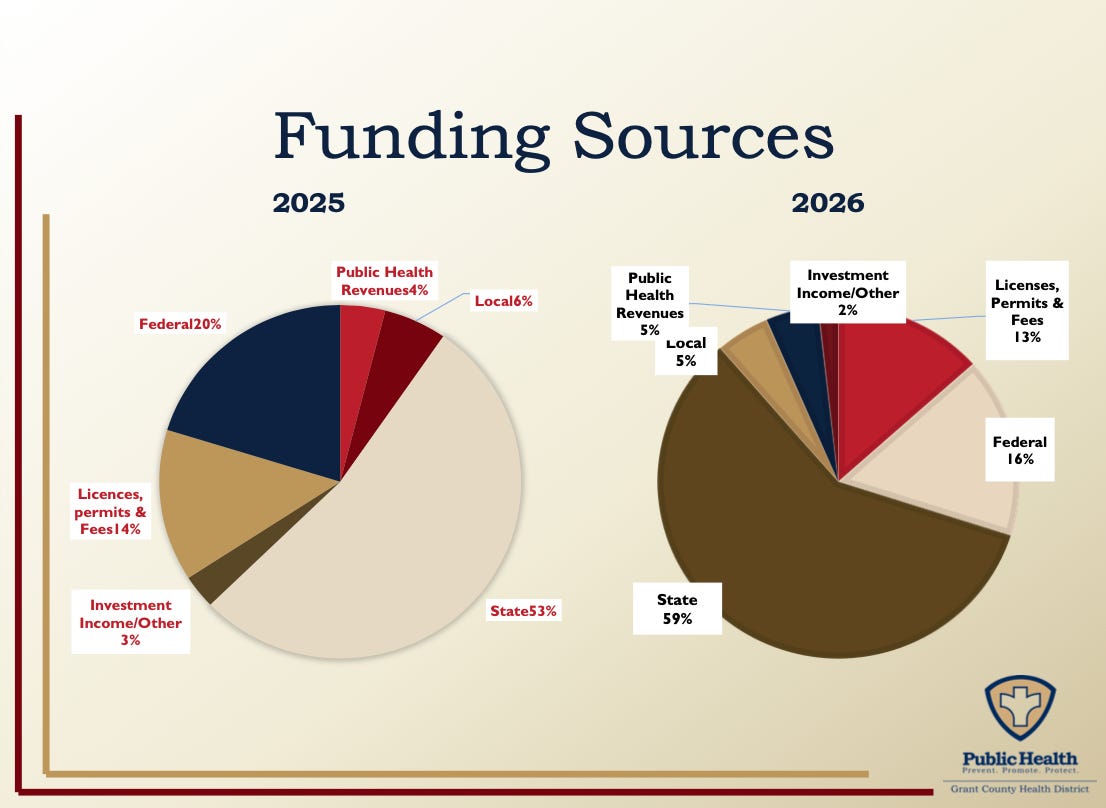
According to the district’s 2026 funding information, approximately 59 percent of its revenue comes from state sources, while federal funding accounts for another 16 percent. Licenses, permits, and fees provide approximately 13 percent, with local contributions accounting for about 5 percent. Other public health revenues, investments, and miscellaneous sources make up the remainder.
State and federal funding support a substantial portion of the district’s operations, but those funds do not necessarily cover every service the district is required to provide. Some funding is designated for specific programs or activities, leaving other responsibilities dependent on additional revenue.
Local contributions help support work such as outbreak response, communicable disease investigations, sexually transmitted infection investigations, and environmental health services that are not fully covered by permit fees.
Temporary food inspections at community events are one example of a service that may require financial support beyond the fees collected from vendors.
The Health District reported that 10 of Grant County’s 14 cities contribute financially to its operations. Each year, the district sends cities and towns a letter and agreement requesting a contribution of $3 per resident.
Quincy has historically contributed $4 per resident, exceeding the district’s standard request. The City Council has not yet formally established the amount it will contribute for the coming year.
The district also receives support from Grant County, including financial contributions, services, and office space.
For Quincy, the annual contribution is part of an established partnership rather than payment for a separate city-operated health department. The Health District provides countywide services, and local contributions help support responsibilities that benefit residents across municipal boundaries.
The funding discussion also raises a practical consideration for city leaders. Although public health may not be as visible as streets, parks, or other municipal services, its work contributes to the conditions that allow residents and businesses to function safely.
What This Means to You
For residents of the 98848, the most important part of the Health District’s presentation may be understanding how many of its responsibilities affect ordinary life.
A family attending a community celebration benefits from food safety inspections. A homeowner installing or replacing a septic system may work with the district’s environmental health staff. Parents seeking dental care or specialized services for their children may encounter one of its assistance programs. When an infectious disease poses a risk to the community, the district is responsible for investigating and helping coordinate the public health response.
Other responsibilities become more noticeable during particular seasons or circumstances. Wildfire smoke can affect outdoor activities, recreation, and community events throughout the region. The Health District has identified enhanced wildfire smoke response and public communication among its activities, reflecting the importance of providing residents with information when environmental conditions may affect their health.
These issues rarely stop at city limits. Someone may live in Quincy, work elsewhere in Grant County, and attend events in another community. Food safety, disease prevention, drinking water, and environmental health concerns can affect people across those boundaries.
That is one reason the Health District operates as a countywide organization and works with multiple local governments, healthcare providers, schools, and community partners.
The financial relationship with Quincy also deserves attention. The district’s request of $3 per resident and the city’s historical contribution of $4 per resident may sound like relatively small amounts when considered individually, but they represent a continuing public investment. As council members consider the next agreement, residents have an opportunity to understand what those contributions help support.
The quarterly reports provide one measure of that work. They show inspections completed, investigations conducted, permits issued, and services provided. They do not capture every interaction or every problem prevented, but they give residents a clearer picture of what the Health District is doing in their community.
An Investment in Everyday Community Life
Much of the work described during the October 6 City Council meeting is unlikely to attract widespread attention. A routine food inspection, a drinking water evaluation, or a referral to a healthcare service seldom becomes a major community story unless something goes wrong.
That does not make those services any less important. In many cases, the purpose of public health work is to address potential problems before they become serious enough to affect a larger number of people.
Wurl’s presentation offered council members an opportunity to review both the scope of the Health District’s responsibilities and the services documented in Quincy during the first half of 2026. It also placed the city’s annual financial contribution in the context of a broader countywide public health system.
As the City Council considers its contribution for the coming year, the discussion is about more than the difference between $3 and $4 per resident. It is about the role local governments play in supporting services that protect residents, assist families, and help maintain safe conditions for businesses and community activities.
For the people who call the 98848 home, the Grant County Health District may remain most recognizable when a health warning is issued or an inspection becomes necessary. But the reports presented to the council show that its responsibilities extend well beyond those occasional encounters.
The work is ongoing, often conducted outside public view, and woven into many of the ordinary activities that make up life in Quincy. That is what makes understanding the Health District’s role—and the city’s continued partnership with it—worth the community’s attention.
