
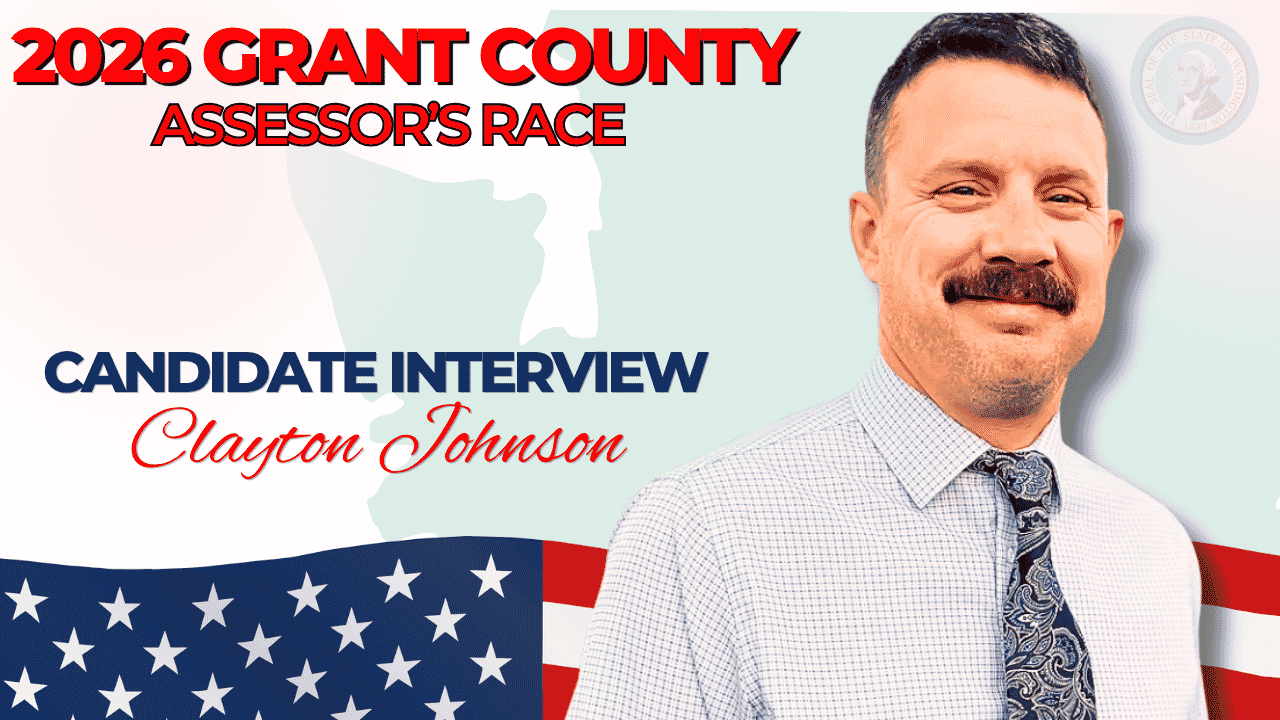
I interviewed 2 candidates for the Grant County Commissioner Assessor’s race for 2026.
Both Candidates were invited to be interviewed
Both Candidates responded were asked the exact same 20 questions in the exact same order
They never saw each others answers
The answers have not been altered, edited, modified, editorialized, changed, or edited in any way by the staff, ownership, or affiliates of this publication.
For each I have posted the transcript, not a story, their words. (transcripts by AI)
For each I have posted the audio from the interview.
A full list of the questions
Below the interviews I will post their posted bio from their candidate website, their sign and a link to their website and or FaceBook
The Interview Begins Here
Clayton Johnson Interview Audio File
Clayton Johnson Interview Grant County Assessor
Race for 2026
Brent Dowlen: [00:00:00] Please introduce yourself to our readers, who you are, what’s your connection to Grant County, and what you would like people to know about you personally and professionally.
Clayton Johnson: So my name is Clayton Johnson. I’m running for Grant County Assessor. A little bit about me, um, I am a husband and a wife of 20 years.
I have three amazing children, uh, one of whom is off serving his country in the United States Marines My connection to Grant County, uh, my wife, her family was from here. So, um, when I got out of the military, um, spent some time back where I grew up. So I grew up outside of, um, Pittsburgh in a, in a small steel mill, um, blue-collar town, and then, uh, joined the military and went back there for a little bit.
And then, um, we decided to move over here when, um, my wife’s family came over here. So, uh, we ended up moving here, um, and then that’s, that’s all, all she wrote there. We’ve been here ever since, since then. [00:01:00] Um, as soon... Pretty much almost, you know, maybe six months after I was here, um, I got an opportunity to go work at the assessor’s office, and I have been in the assessor’s office now for nine years.
I spent the first seven years of that as the commercial and industrial appraiser. Um, so I would do all the appraisals for, um, all the commercial and industrial properties, um, in Grant County. And I... Also some residential. Um, I didn’t strictly do commercial and industrial. Um, as you know, Grant County’s not huge in the commercial, um, some of the areas.
Um, there’s, there’s very little commercial, uh, say a place like Soap Lake. You know, there’s not a whole lot of commercial, um, properties to do. So I, I dabbled in some of the other stuff too, residential. Um, and then for the last two years I have been the sales analyst. So as a sales analyst, I, uh, look at market trends for real estate, uh, see what homes are selling for, [00:02:00] uh, and then make adjustments based on, um, bringing them up to true and fair market value.
Um, so a, a little bit about how that works, um, when, when we’re assessing properties, we are required to be at 100% of true and fair market value. So let’s say a house is, is... Their replacement cost new less depreciation is 100,000, um, but it sells for 200,000. We would have to adjust that to bring it up to its true and fair market value of $200,000.
And then what that, what you do is you apply that adjustment to all like and kind homes in that area. Um, and that’s what brings us to true, uh, the true, the true and fair market value. Um, and so that’s what I’ve done for the last two years. Also, with the sales analyst position, um, you do a lot of defending, uh, your values, uh, in the Board of Equalization.
So, um, anybody can, you know, say, “Okay, I don’t agree with your value,” um, and put in a, a petition to the Board of Equalization, um, to, to challenge [00:03:00] per se their value. Um, and I’ll go through those and I’ll, um, do a deep dive on that parcel and see can we support the value or is there adjustments that need to be made.
Um, because when you are looking at, you know, I think we’re upwards of almost 70,000 parcels in Grant County now, um, each individual parcel you can’t do a deep dive on that because We just, we would have to have a thousand appraisers to do that, um, on each parcel every year. So in a mass appraisal system, you’re, you’re looking at everything in mass.
So you’re comparing apples to apples, single family residence to single family residence, um, commercial building to commercial building or what have you. But when we do a deep dive, we might go even further and say, “Okay, well, they’re both apples, but let’s break them down to a Honeycrisp, to a Honeycrisp, or a Granny Smith to a Granny Smith.”
Um, and by doing that, what we’re doing is putting it into like a direct sales comparison grid. Um, and it’ll, [00:04:00] it’ll compare your homes a- and adjust them to be, um, exactly the same, adjust for the differences in the homes. Um, and we do a lot of that during our appeal process because, um, that’s the time we get to really, you know, like I said, do those deep dives into those parcels.
Um, in a mass appraisal, you can’t do that with every one, so... And that’s been part of my job as, as a sales analyst. Um, beyond that, you know, I, I’ve helped with, you know, training of other new appraisers, um, you know, as a senior position in the office, a sales analyst is a senior position in, in the office.
Um, uh, it’s not a supervisory role, um, but since it’s a senior position and since I’ve been doing it for nine years, um, I’ll, I’ll help out with other appraisers when we get new appraisers, um, which in the last six months, I think we’ve had four new appraisers. So you need that person to, you know, try to, you know, help them, help them [00:05:00] out a little bit.
So, um, that’s not necessarily part of my job, but just something that’s, um, that kinda comes with the job.
Brent Dowlen: Why are you running for Grant County Assessor, and why do you believe that you are qualified for the particular office?
Clayton Johnson: So I’m running for Grant County Assessor because since I’ve been working in that office, I’ve seen the problems. Um, I’ve seen areas that can be improved, um, and I know that I have the knowledge and experience, um, being there nine years.
I have that knowledge and experience in, in that con- continual drive for improvement in not only myself, but the office. Um, so you know, it’s, it’s really the next step in, in my career. Um, I care about the assessor’s office, and so I wanna see it succeed, and I feel like I have what it takes to be the one, um, to make it better.
Um, and now is, now is a n- [00:06:00] n- no better time than now to, to get that started.
Brent Dowlen: What experience, education, training, or professional background do you have you believe has prepared you to serve as Grant County Assessor?
Clayton Johnson: Well, that’s gonna be experience, experience, experience. You know, I have, um... Originally, I said over 250 hours of, uh, of continuing education is what I had put out there, but I also recently just did a two-day class, so you know, 16 more hours on top of that.
So I have, uh, needless to say, a ton of, of continuing education e- around property assessments. Um, obviously, nine years of experience in the office, but it’s just not, it’s not just those nine years of experience, it’s the classes, um, everything you learn, um, along the way. Um, that’s where I... That’s where, you know, what I believe will make me a good Grant County Assessor.
Um, as far as, you know, leading the office, you know, it... [00:07:00] I don’t necessarily have a leadership experience in the office. Um, but like I said earlier, I’ve raised three kids. Anybody who’s raised kids kinda knows that, um, it takes a leader to lead a family. Um, so it might not be professional experience in leadership, but, um, it’s experience nonetheless.
Brent Dowlen: Many voters don’t have much interaction with the assessor’s office until they receive a property valuation notice. In your own words, what does the Grant County Assessor’s Office do, and what does the assessor not control when it comes to somebody’s property tax bill?
Clayton Johnson: So when it comes to the property tax bill, that actually is sent out by the treasurer.
What the assessor’s office does is we value properties for taxing purposes, and we set the levy rates. Um, what we don’t do is come up with the budgets. Um, our main focus in the assessor’s office is valuations, um, exemptions. Uh, we do some, some [00:08:00] mapping, um, boundary line adjustments, things like that. Um, but mostly what the assessor’s office deals with is valuation.
Um, what was the second part of that question?
Brent Dowlen: In your own words, what do they do and what do they
Clayton Johnson: What can’t we change?
Brent Dowlen: Right.
Clayton Johnson: What can’t we change? So a lot of what the assessor’s office does is, um, bound by the state Department of Revenue. Um, how we value properties is, is set by Department of Revenue. Um, we can’t... We have to value properties at 100% of true and fair market value.
That is not something that the assessor’s office can change. So, you know, I, I know a lot of people say, “Oh, lower my, lower my property value.” Um, that’s not, that’s not gonna happen. I’m not gonna be a, a candidate that comes out here and says, “Oh, I’m gonna lower everybody’s valuation. Vote for me.” That’s just not how this works.
Um, again, it’s, it’s state, state law is what we follow. Um, we [00:09:00] have RCWs that we have to follow that tell us how to value property. Um, so that’s one thing that we can’t change. Now, can we, as an assessor, can I advocate, um, for my community? Absolutely, and I absolutely will do that. Um, but I can’t just make up new rules.
That’s just not how, um, government works, unfortunately.
Brent Dowlen: What do you believe the Grant County Assessor’s Office currently does well, and what would you specifically like to change or improve if elected?
Clayton Johnson: So I think what we do well, I mean, there, there’s a lot of things that we do well. Um, I’ve said it before and I’ll say it again, I’m not running against the Assessor’s Office.
Um, I’m running to make it better. Um, so my focus is going to be on the parts of the office that I believe can get better, and the one big part of that for me is transparency. Um, I, I’ve harped on transparency my whole campaign. I’ve put it on my signs. A, a lot of people don’t like that word because, “Oh, I’m [00:10:00] tired of hearing politicians talk about transparency.”
I, I feel that. I, I completely understand that, but it’s not just a word to me. I really do mean when I say that I wanna be a transparent office. And transparency isn’t just about showing people the process. That is a big part of it. It’s also about educating them on the process, getting out there and talking to people.
Um, even throughout my campaign so far, I’ve been, you know, out there talking to people, explaining the process. Um, obviously doing this job for nine years, I’ve been explaining it, you know, throughout those nine years too. Um, but even, even during my campaign, um, any time anybody asks me a question, um, I’ve gotten, I’ve gotten comments on social media, “Well, how do you do this?”
or, “What about this?” I will always answer those because it is important for people to understand the process. If you understand something, you’re more likely to accept it than if you don’t understand it at all. Like I said, we can’t change [00:11:00] things drastically, but we can at least educate people on how they work and give them a better understanding and hopefully, um, help them to accept it a little bit more.
Brent Dowlen: Washington requires property to be assessed according to state law evaluations to be fair and uniform. What would you do as assessor to ensure that similar properties and property owners are treated consistently throughout Grant County?
Clayton Johnson: That is a great question because- It is very important that you are consistent.
Um, like I said in my analogy earlier, the apples to apples, um, and then the even further, the different varieties of apples, um, to each other. You know, it’s important that when we’re valuing property, we are comparing it in the market to similar properties. Um, that’s consistency, making sure that everybody is being valued the same way.
Now, when I say that, some people go, “Oh, well, [00:12:00] you can’t value me the same as my neighbor because we’re not the same house.” No, I didn’t, I’m not saying that you’re gonna be valued the same, but we need to value you the same way. Um, it, there, there’s a difference there. Um, and, you know, it’s, there’s, there’s some intricacies in the process of, of property valuation.
It’s not, um, not everybody can just, you know, go in there and say, “This, this home’s worth X amount of, of money.” You know, that’s, that’s, there’s, there’s some, some things, um, that you have to understand about the cost approach and all of, all of that. And I, I know those things because I’ve been doing this, and I have, I have a lot of good ideas on how to ensure that we’re more consistent in our property valuations.
Um, making sure that we are getting our cost approach down correctly, um, that way we’re... Say a h- say a home has had a remodel. If we haven’t reflected that, well, then its cost isn’t [00:13:00] correct. So then when it sells for, for a percentage higher than its, its, its cost is, well, we’re not gonna have that cost correct, so then we’re gonna use the market to bring that up to its market value, and that’s affecting so many other parcels.
So ensuring that, that, that cost approach is correct too, um, is very important, and that’s something that I believe that we need to, um, focus on, um, that way we become more consistent in our, in our valuations
Brent Dowlen: Grant County includes residential neighborhoods, farms, agricultural lands, small communities, recreation properties, commercial businesses, major industrial facilities, data centers, and rapidly developing areas. How would you approach the challenge of accurately and equitably valuing such different types of property?
Clayton Johnson: So, you know, I hate to harp on to my experience, but I already have kind of done that. Um, you know, I... Like I [00:14:00] said earlier, I was the commercial and industrial appraiser, so I have experience doing those. Um, I, I’d done- I’ve done residential, so I have experience doing those. Um, I haven’t dabbled too much in the ag department, I will say that.
Um, but y- I’m familiar with it. I’m familiar with the current use program and, and the different programs that we have for, for those. Um, but, you know, as far as making sure that they’re valued properly individually, that’s, um... I guess, I guess it really comes down to I’ve, I’ve done that and I have the experience, um, in, in know how to value those properties.
You mentioned data centers in there. Um, data centers typically are, you know, high, high value properties, and those are typically done by the state. So we’ll have, um... it’s called an advisory appraisal. We’ll have the state come in and do those. Um, I would like to continue to have that happen, um, because they’re the experts in that area.
Um, I don’t... I, [00:15:00] I know the basis of how those valuations are come up with, but, um, I’m not an expert in that field. So I guess, you know, to answer the question simply is making sure that I have the right people or the right contacts to do those different types of properties, um, that way they’re being done fairly.
So if it’s an ag property, I have an ag team. If it’s a residential property, I have a residential team. Commercial. All the different fields or all the different types of properties, we have people that handle those. And so giving them the tools necessary, um, and the training necessary to excel in those fields is, is important and, and that would be my goal.
Brent Dowlen: If a Grant County homeowner receives an assessment showing a substantial increase in their property’s value even though they haven’t sold, remodeled, or made significant improvements to it, how will you explain how that can happen and how the county arrived at that valuation? [00:16:00]
Clayton Johnson: So, uh, I, I do this almost on, on the daily.
Um, as being the sales analyst, and I mentioned earlier, I am in, uh, in charge of doing, a, a large portion of the appeals. So essentially that’s what that is, is an appeal but not necessarily going through the whole process. Um, people call all the time and say, “How’d you come up with this value?” Well, as I explained earlier, it’s, it’s market adjusted cost approach.
So that’s how we come up with the value. Giving them the information and saying, “Okay, well, what’s, what neighborhood are you in?” You know? “Okay, let me pull up your parcel. I’ll take a look at your house. Okay, well, you know, you got an adjustment based on these sales.” And then explaining those sales, um, explaining the whole process to them because most of the time when somebody calls me, they don’t know the whole...
They don’t know the process. They have an idea maybe of how property’s valued in Washington State, but they don’t know the, the whole process. Um, so just, just explaining that to them. You know, at the end of the [00:17:00] day, is everybody gonna be happy and satisfied with that? Probably not. I’ve, I’ve had that. Um, I’ve had a lot of people who call and I explain the whole process.
“Okay, well, here’s the sales. Um, did you know that your neighbor sold their house, identical house to yours?” Doesn’t happen often ‘cause identical houses are few and far between, but you have some of the newer divisions where the houses are very similar. Um, “Did you know that they sold it for X amount, and you’re valued at X amount?
And we value properties at 100% true and fair market value.” “Oh, that’s how that works?” And, and, and just explaining that part to them, um, most of the time they’ll go, “Okay, I understand.” Um, not always are they like, “Oh, yay.” You know that’s, that’s just not the case. I mean, uh, let’s be honest, you know, property taxes aren’t the most popular thing.
Um, and I don’t think that I’m single-handedly gonna make everybody love property taxes. Um, but, uh, I will strive to make them understand it at least, and that’s all that I can really do. [00:18:00]
Brent Dowlen: If the property owner believes the assessor’s office has gotten the value of their property wrong, what should they expect from you and your staff, and what should they do to challenge that assessment?
Clayton Johnson: So there is a 30-day appeal period after you get your change of value notice. Um, I haven’t looked into that. I... Somebody told me recently that, you know, some other counties, uh, may do a longer appeal period. That may be something that we look at in the future, um, because I do often get people who call a little bit after that and say, “Oh, that’s a very short period of time, 30 days.”
Especially depending on when the notices come out, your change of value notice. Um, last year those change of value notices came out in December. Um, December’s a holiday m- month. You know, it’s like, it’s 30 days, you know, you got people traveling and stuff like that. Um, but if you miss it in that 30 days, by law we can’t do anything.
We just... Unless it was an error on our side, which, in which case we will fix it. Um, but you know, [00:19:00] the, the process for appealing or, or questioning it is, is you can fill out a board of equalization petition. A lot of times if you call and we have a, we have an error, then we can, we can take care of it. You know, we at the assessor’s office, we don’t, we’re not married to the values.
We wanna make them fair and accurate and correct. Um, we’re not trying to just get the highest value, um, we’re trying to get the most fair value, and that is our, that is our job. Um, and if you feel that we didn’t get that, um, you have the right to petition to the board of equalization. Now, when we receive those petitions, um, we’re going to, like I said earlier, we’re gonna do a deeper dive into your parcel, um, and make sure that we have it correct.
If we don’t, we’re gonna change it. Um, if we do, you still have the option to go in front of the board of equalization, which is, is consists of three taxpayers and I believe two alternates. Um, they’re just, [00:20:00] they’re trained by Department of Revenue. Uh, they’re hired by the, by the county, but they’re not, they’re not affiliated with the assessor’s office.
And they’ll, they hear the, they hear the appeals and they, they make a decision on it. Um, if y- if you have- information that is going to change that value, you know, they’ll, they’ll consider that. Um, I’ve gotten questions before, you know, “Why do most of the hearings, why do you guys, why does the assessor’s office always win in the hearings?”
Um, we don’t always win, um, but there is a high percentage of, of us being, our values being sustained or us making an adjustment and that, that value being sustained. And the reason for that is, is because if there is something that warrants your parcel value being lowered, before I got to that board of equalization hearing, I’ve already made that adjustment and I’ve already reached out to you.
I’m not going in front of the board of equalization if I’m not very, very confident that I, with the [00:21:00] information that I currently have, that I, that your value is correct. I, I’m not, like I said earlier, we’re not married to the value. If our value is incorrect, we’re gonna do what we need to do to make it correct.
Um, so when I’m sitting in front of that board and defending that value, I’m very, very confident in that value. Um, sometimes there’s information that we’re not aware of and, uh, a property owner will call and say, “Hey, I have X, Y, or Z,” and, “Oh, well, we weren’t, we weren’t aware of that. Um, that does have an effect on the value, and we’ll make that change.”
Um, usually that happens before we get to a board of equalization hearing. Um, sometimes we don’t get that information and, you know, then it’s like, well, we, we couldn’t do anything till now, and, you know, it’s up to the board to make that determination. Um, but like I said, any time there is something that’s going to warrant a lower valuation, um, whether it can be done for now or for the next year, we’re going to, uh, we’re going to make that adjustment and, and make it right because at the end of the day, we’re here [00:22:00] just to make your value fair, um, and accurate
Brent Dowlen: What is your philosophy towards property assessment appeals, and how would you balance being responsive to individual property owners’ concerns with your responsibility to apply the same valuation standards throughout the county?
Clayton Johnson: So, you know, I, I listen to everybody. If, if you question your value, we’re gonna look into it.
That’s, that’s our job. We are here to serve the public, so we will do our due diligence and look into your parcel and, and make sure that we have the correct value. I can’t... Obviously, I can’t say, “Oh, okay, I’m just gonna go ahead and lower it because you don’t like it.” I mean, that’s just not how, how it works.
Um, I’m not gonna lower it for any reason except for that it’s warranted to be lower. If there’s, if there’s issues or whatever, um, we’ll, we’ll lower it. Um, but if it, if it’s supported by the sales and, and you, you know, it’s at its [00:23:00] market value, um, that is an issue with the system, not our office. Um, a lot of times, you know, people don’t agree with the system of property valuation in Washington State.
That isn’t something that the assessor’s office really has any control over. Um, again, will I advocate for my people? Absolutely. If that’s what my people want, they want, um, they want me to go to Olympia and, and try to get reform in property valuations, absolutely. Um, but I can’t just do it on a, on a county level.
Brent Dowlen: What information and measurements would you use to determine whether property assessments across Grant County are accurate, consistent, and equitable?
Clayton Johnson: So we do... You know, that’s kind of part of my job as a sales analyst. I do sales ratio studies, um, that tell us, you know, the, the cost approach value versus the market values and, and we adjust accordingly.
So, [00:24:00] um, that’s how we ensure that they’re valued correctly. Um, we have, we have systems that, that do that. Um, and again, it kind of goes back to, uh, the, how I explained the process of it. That’s just part of the process, um, checking to make sure that we are, uh, we’re following the protocol and, and testing, and, and testing, um...
At the end of our... After we do our market adjustments, we would do what we call testing. So we’ll look at what last year’s value was versus this year’s value. That’ll tell us if, oh, there’s an error here, and it, it... Somebody put an extra zero in here, and now this person’s at a million. Um, we will be able to catch that because it’ll, it’ll pop out on that testing.
So there, there is protocols, um, checks and balances per se that, that as- ensure that we’re not, um, overvaluing, um, properties or, um, undervaluing. I mean, there, there could be [00:25:00] times where you... maybe somebody accidentally deletes the house off the parcel, and next, next thing you know, the, it’s only $40,000 and there’s a, it’s a house on the, you know, in, on the waterfront or something.
That would be more than 40,000 ‘cause the land alone for that is more. But, um, y- you know, those types of things get caught in those checks and balances in that, in that testing.
Brent Dowlen: Agriculture remains one of Grant County’s most important industries. What do you believe farmers and agricultural property owners should know about how you would administer agricultural and current use property assessments and programs?
Clayton Johnson: So, uh, first I have to say that I absolutely agree that, that farming and agriculture is, is the backbone of Grant County. It’s part of the identity of Grant County. Um, I want it to stay that way. Um, I, I think that, um, it’s very important that we, we keep farm ground and, and we, we make it manageable for farmers.
That’s why I’m a big proponent of the current use [00:26:00] program. Um, that, that current use program, we have, we have people in our office who, who are in charge of that program. Um, I, I tend to... And like I mentioned earlier, I tend to leave the, leave those types of things to those experts. I know about the program.
Um, but as far as, you know, how to get into that program, what the requirements are and all of that, um, I... We have somebody that handles that. So, you know, I would always, uh, recommend that they talk to that person. Same with the senior exemption program. Um, I know that wasn’t part of this question, but, um, it is, it is an exemption program as well, and we have somebody in our office who handles that.
So any of these exemption programs like farm, uh, current use and open space, um, I, I usually refer to the expert in that area, um, for the details on it. Now, it will be my goal to be out there in the community letting these people know that these programs exist. [00:27:00] Um, current use, I believe most of the farmers at this point are probably pretty aware of it.
Um, I, I think a large majority of the major farming operations in Grant County are probably part of this program already. Um, but if there’s changes in it or whatever, um, we need to vocalize that to them. But that goes with the... That’s, that’s part of my transparency. Yeah, it, that’s, that goes for everything, and that’s, and that’s part of it.
You know, letting... Getting out there and telling these farmers like, “Hey, did you know that there’s, there’s changes in the requirements?” Or whatever, um, things might be going on with that exemption, uh, getting out there and letting people know. Um, that’s, that’s my whole goal is, is educating the, e- educating the public and, and being transparent on those things.
Brent Dowlen: Grant County has experienced a substantial indus- industrial development, including data centers and other large and complex facilities. What challenges do these [00:28:00] properties present for an assessor, and how would your administration approach valuing them accordingly?
Clayton Johnson: So I did- Or
Brent Dowlen: accurately, sorry.
Clayton Johnson: Yeah. Uh, as I mentioned earlier, um, the large-- the high-value data centers are typically handled by the state.
Um, that is something that I don’t believe will change. I, I don’t have any intentions on changing that process, um, because like I said, those are-- they’re the experts in that. They have people who do that. Um, and that kinda goes for a lot of the large, the high-value, um, properties. Whether it be your, um, large industrials like your SIM plots, uh, your, uh...
Who’s another one? International Paper type. Your, your really high-value properties where, you know, the building isn’t the highest value. It’s, it’s everything that comes with the building, the machinery and equipment. Maybe, um, with data centers it’s, it’s the energy that they’re putting out or their server space or, or what have you.
Um, there-- those are very, [00:29:00] um, intricate valuations, and I, I believe the way it’s done now with it being done by the state is probably the, the way to continue to do that. Um, a- and that goes for some of the other industrial ones too. Um, if it’s, if it’s not broke, don’t fix it. Um, they are... You know, they-- I believe they’re valuing those properly.
Um, maybe the data centers might not agree that they’re being valued properly. Um, but, uh, you know, leaving... I- it kinda goes back to what I said about leaving the experts in my office to do those things. The-- that’s the same thing, leaving it to the Department of Revenue. They are the ones who are the experts in that, in that field.
Um, let’s, let’s let them handle that. Um, and we’ll, we’ll focus on, uh, the stuff that we’re already... what we have in, you know, that we’re valuing in our county. [00:30:00] Obviously, those are in our county too, but, um, it, it’s just always kind of been, since I’ve been there at least for nine years, um, it’s always been handled by, by the state.
And they’re, they’re coming up more, and there’s gonna be other complex properties that are starting to come up. Uh, solar farms is, is one that, um, I’ve heard some, um, talk of development of solar farms happening. They may be in that, in that same realm of very complex properties that need to be, um, handled differently than your average cost, market-adjusted cost approach.
And so, um, we’ll, we’ll cross that bridge when we get to them, but, uh, those I’ll leave to the experts in, in that particular field.
Brent Dowlen: The assessor’s office maintains records for tens of thousands of parcels, including valuations, ownership information, legal descriptions, maps, property characteristics. How would you use technology to improve the accuracy, efficiency, accessibility, and transparency of the office?
Clayton Johnson: Okay. So [00:31:00] technology, um, this has been something that I was, I was asked a question at a forum last night about AI, so, um, I- I’ll jump right into that one. If it’s going to help maximize efficiency in my office, I’m all for it. Um, I don’t know of... I haven’t heard of any offices using technology such as AI, um, in their valuation process.
Doesn’t mean it doesn’t happen. I just haven’t heard of it yet. Um, but if it’s going to make my office run better, um, and more efficiently and save the taxpayers money, then I’ll do it. Um, I don’t know if that’s the case. I haven’t... AI and, and some of this new technology is very new. Um, we, we haven’t explored that.
If it’s something I need to explore, then I absolutely will. Um, again, I’m all about making the office run as efficiently as possible. Um, there’s been talks of, uh... There’s some programs out [00:32:00] there that use, I don’t think they’re drones, um, because there’s some... I think there’s some ethics things there with drones.
But I wanna say they’re maybe like planes or something that use some technology to, um, get advanced imagery of houses so that maybe we don’t have to have boots on the ground. Um, is that better than having an appraiser go out there, um, and knock on the door and talk to them, or at least be out there in the neighborhood, um, in, in getting a picture of the house?
Um, ‘cause we, we do, um, keep records of pictures of the houses. That way, we can see what we’re valuing and see if there’s changes throughout the years. Um, is that, is that better for that? I don’t know, because we haven’t used that program yet. But is it... My question and, and what I would look at is, is it more cost efficient for the taxpayers?
Um, there might be great programs and technology out there that can make our job a lot easier, but it might, [00:33:00] might also cost millions of dollars for the taxpayers, and I don’t think that they’re gonna, they’re gonna appreciate that. Um, so it, it really all comes down to, does the technology make sense for efficiency and for our budget?
Brent Dowlen: What information do you believe a Grant County property owner should be able to easily find and understand about their property assessment, how it was determined, available exemptions and programs, or their rights to appeal?
Clayton Johnson: All of it. Every single last bit of it. Um, I, I hate to sound like a broken record, but transparency is huge for me.
I want, I want you to be able to not... Look, call me. I, I absolutely will a- answer every phone call and explain everything, even now as my job, now as a candidate, and if I get elected as assessor, I will gladly explain the process to everybody. But I want you to be able [00:34:00] to not have to do that. I don’t, I don’t want you to have to come into our office to find out this information.
I want it to be clear and accessible to everyone. Uh, what that looks like as far as, you know, maybe that’s, maybe that’s updating our website. There is a lot of stuff on our website now. Um, maybe it’s getting that, getting the information on how to find the information out there to more people. Um, you know, getting out there and talking to people, um like I stated before, you know, letting them know, “Okay, well, you can find that information here.”
Um, that, that is one way to get the information out to everybody. Um, uh, I, I’m somebody who I believe, you know, we don’t have a social media right now. Um, it’s 2026. I mean, uh, whether we like it or not, people are on social media, so maybe it’s time that we, you know, go down some of those avenues. I know the sheriff’s office, um, they were talking about last night they have, like, 60,000 people, um, following their social media [00:35:00] on Facebook.
Um, you know, why, why can’t we have something where, you know, we’re out there telling people, “Okay, there’s a change to the senior exemption” and, you know, we put that on our website, but not everybody knows to go to our website. Um, but, you know, your friend shares a post about the assessor’s office being in your neighborhood, then next thing you know it travels and then, then somebody’s like, “Oh, I saw on Facebook that the assessor’s in our neighborhood.”
And so, um... Or, or like I said, change it to an exemption program or, “Hey, this is where we’re at now. Change of values just went out. You only got 30 days. Make sure, make sure you get, uh, get your petition in if you disagree.” Um, and then, y- you know, having that stuff in multiple places. Because again, it’s on our website, but not everybody’s going to the Grant County website and then going to the assessor’s office and then digging around on there to find it.
Um, I really do think that we should be, we should be using, um, social media more than we are. [00:36:00] Um, and that’s just getting more into the technology per se, although social media, I mean, is not really a new technology. That’s kind of something that is, uh, uh, been around for quite some time. Um, so yeah. Yeah, just, uh, utilizing that more.
Brent Dowlen: Washington provides property tax exemptions and deferral programs for certain qualifying residents, including seniors and people with disabilities. What responsibility do you believe the assessor’s office has to educate residents about programs for which they may qualify and help them navigate the application process?
Clayton Johnson: It... You know, we have a huge responsibility to do that. Um, again, people aren’t necessarily gonna know about these programs if you don’t go out there and, and tell them about them. Um, word of mouth helps, you know, people will talk about them. Um, but it is definitely the responsibility of the assessor’s office to make sure that people are aware of, [00:37:00] of the different exemptions.
Uh, we have a few that are very common. The, the current use and the senior exemption are the two that, that jump out as the most common. But there is a, there is a few other exemptions, um, that we don’t get very often. There’s an exemption, um, that I, uh, was, uh, informed about recently that is for, um, remodels, and I don’t, I don’t recall hearing about anybody talk about that one.
Um, I don’t know all the details on it. It’s something I have to, would have to look into. Um, but, you know, getting, getting that information out there about those exemptions, um, is in- is important. And, uh, again, it’s goes back to my transparency, you know, informing everybody about all the different things that our office has.
Brent Dowlen: The county assessor is also responsible for managing an office and its employees. How would you describe your management style, and what would you do to recruit, train, retain, retain, and hold accountable the people [00:38:00] responsible for assessing property throughout Grant County?
Clayton Johnson: That is, that is a, a, a- Hot topic maybe right now, ‘cause, because our office is lacking in experience.
A- and we have, we have some people who have been there for a while, but, um, I think I mentioned earlier, in the last six months, I believe four of our appraisers are under six months. So, um, retaining employees really, in my opinion, comes down to treating them with respect and, you know, making the office an environment where people wanna work.
Um, people don’t leave jobs that they enjoy, or people don’t leave jobs where, um, they feel comfortable. People leave jobs because they’re not happy. Um, can I make everybody happy? No. Some people are gonna find a, a higher paying job. They’re gonna relocate. Those types of things happen. Um, but what we need to do is make it so [00:39:00] people are leaving for the right reasons and not the wrong reasons.
And, and too often in our office in the last, I’ll say five to seven years, um, people have left because they were unhappy. Um, and I can’t say exactly why all those people left. Um, that’s, that’s for, for them. That’s, you know, I’m not inside their head. I don’t know exactly why. Um, but I, I know not all of them left, um, because, you know, they had an opportunity that was, n- that they couldn’t pass up.
Uh, so, and with, with that, like I said, with having all these new people, that’s why I do believe it’s really important that we, that we elect an assessor who has experience and who can hit the ground running. Um, with the lack of experience we have in our office right now, uh, if we were to get an assessor who doesn’t have any experience, they’re going to have to spend, uh, years learning how [00:40:00] to do the job.
I mean, i- in order to get an accredited as, accredited as an appraiser, um, you have to have at least one year of doing the job, um, and that’s after you’ve, after you’ve started or after you’ve done some of the qualifications to get accredited. Um, it’s a process. Um, and so, you know, to be honest with you, right now, we don’t really have the, the experience in the office, um, to have somebody run in the office who doesn’t at least know, you know, doesn’t have any experience in property valuation.
Um, now, y- you know, I started in that office with not, not... I knew the basics of, of the assessor’s office, but I wasn’t an expert in it either. It can be, it can be taught, um, but at, at this point, it’s, it would probably be best to have somebody, um, elected with experience, and not only somebody elected with experience, but somebody who has the support of the office that they’re gonna lead.
Um, I have that. Um, being as somebody who’s been in [00:41:00] that office for nine years, I have, I have built relationships with the people in my office. Um, they respect me. Um, they, they will be willing to work for me, um, because I’ve always treated them with respect. Um, and, and I, I believe that they, um, they will, they will work hard for me, um, and they, they support me, and, you know, that’s gonna be very important for, for a leader to already have that, that team that’s built.
Um, I’m part of that team, and, you know, become the assessor, I would just be, you know, I’d be becoming the captain of that team. Um, but, uh, I don’t think... I, I’m certain that all of them would be more than happy for that to happen.
Brent Dowlen: If elected, what are your three highest priorities for your first year as Grant County Assessor?
What specifically would you hope to accomplish from each of them?
Clayton Johnson: Getting the office back to fully staffed is going to be one [00:42:00] priority, because when we are lacking staff, we don’t meet deadlines. Um, we... It just makes work for everybody else harder. Um, and then, you know, when you make work for everybody else harder, then you lose more people, and then you...
It’s, it’s a never-ending cycle of, of trying to get, um, back on track. So, uh, first priority is definitely going to be, um, get fully staffed. We’re, we’re missing our, our chief deputy or chief appraiser right now. Um, we don’t have one. Um, and then obviously, if I was elected, I’d have to fill my position, which then opens up...
There, there’s a whole... There’s other... There’s... It would create, um, openings, and we need to get that filled, and we need to g- get all of our staff trained, um, and, and up to speed. And, and that would be a, a large, a big priority, uh, for my first year. Um, and then another big priority for my first year would be getting out [00:43:00] there and, um, getting the public educated.
Um, I know I, I, I’ve mentioned it so many times. Uh, people are probably gonna read this and be like, “You know, I’m tired of hearing about his, his transparent educating, educating the people,” but it, it’s something that we need to do. Um, if... The more you do that now, the less you have to do that in your future.
Um, once you, once you get the message out there to people and they know, um, it makes everything a lot easier. So, you know, those would be probably my two biggest priorities. Um, and then get back on track as far as... And that, and again, that comes with getting the office fully staffed. Um, once that happens, then we can get back on track and start to meet our deadlines and, and, and get to where we’re not only meeting deadlines, but we’re al- we’re, we’re getting it done ahead of time.
That way, um... ‘Cause when you rush, you make mistakes, and in, in our field, mistakes are not, um... Y- you don’t wanna make mistakes, ‘cause you’re messing with [00:44:00] people’s money, essentially. Uh, and you, you don’t wanna do that. Um, and it’s just, it’s better to be ahead, um, and, and, and not trying to p- play catch up. So, yeah.
Uh, more, more, more education, uh, hiring more people, and getting back on track would p- be my top priorities. Um, top priorities. I have a lot of priorities, but, you know, those would be the top ones.
Brent Dowlen: Four years from now, what specific results or measurements should Grant County residents be able to look at to determine whether you fulfilled the commitments you’re making during this campaign?
Clayton Johnson: Well, in four years I would like them to go... I would like them to think to themselves, “Man, I’m happy that I voted for Clayton Johnson. I, I’m... He’s got things back on track. Um, I know him. He’s been out in our community.” You know, um, I, I would like them to [00:45:00] look at our office and say, “Oh, I... Four years ago, I didn’t know anything about that office, but now I know how it operates and, um, I- my value’s been consistent for the last four years.”
Um, you know, obviously there, it’s... I can hit the ground running with my experience. Um, can... You know, I don’t think our office is, is broken. There’s, uh, there’s some pieces that do need, um, adjusted, but I don’t think we’re, we’re, we’re broken. Um, but I would like for people in four years to go, “Oh, he went in there and he really, he really made that office run efficiently.”
Um, I would like in four years for me to be running that office so well that everybody’s like, “We’re gonna let him do that for another eight years,” or another however many years I, I decide to keep going. Um, i- ideally, you know, you, if you run the office smoothly, um, you can continue to run that office. Um, and I, I don’t plan on [00:46:00] going anywhere.
This is, this is my career. Um, you know, I’ve, I’ve been in that office for nine years, and I don’t plan on, um, going anywhere, whether that’s as a, as an appraiser or as a, as the assessor.
Sorry, somebody fell
Brent Dowlen: You’ve had the opportunity to explain your experience, your approach to the office, your priorities. What is the final case you’d like to make to Grant County voters as they decide whether you elect-- to elect you as their next county assessor?
Clayton Johnson: So experience. Uh, we need somebody to run that office who has the experience, has the support of the office, and, and knows the problems and knows where they need to be fixed.
Um, I’m that person. Um, I’m the only one that’s going to be on that ballot in November that has, has the [00:47:00] experience to hit the ground running. Um, that’s what this office needs. They need somebody who, um, from day one can get in there a- and start to, start to work, um, to get us caught up. Um, and there... A- and I honestly believe that, that, that there’s no better person than me for that...
to do that. So, um, I would love for everybody to vote for me, um, in November. And if anybody ever has any questions for me, they can feel free to reach out to me. I, um, I, I’m on social media and, and I will continue to, you know, be out there in the community answering questions. Um, my phone is always on, and I’m always...
I’m, I, I’m a public servant now, uh, and that’s part of who I am, and I don’t plan on changing that. Um, whether I’m the assessor or still just an employee of the assessor’s office, uh, I work for the public. Um, if you see me out, ask me a question. Um, if you have a [00:48:00] question about the assessor’s office, reach out to me.
Um, I am, I am... At the end of the day, like I said earlier, transparency is not just something I put on my signs. Um, I live it. Um, and I will continue to live it. Um, so yes, please vote for Clayton Johnson for Grant County Assessor.
Website Bio (condensed)
Clayton has worked in the Grant County Assessor’s Office for nine years, including seven years as a commercial and industrial appraiser. Two years ago, he was promoted to appraisal analyst, where he focuses on real estate market analysis. He has completed more than 250 hours of continuing education in property assessment.
A military veteran and man of faith, Clayton has been married for 20 years and is the father of three sons. He describes himself as a public servant rather than a politician and is running as a nonpartisan candidate with an emphasis on fair, impartial property assessments free from political influence.
Website: https://www.claytonforassessor.com

Questions for Candidate

Back to Candidate Hub
Disclaimer:
This interview is presented as part of our commitment to providing accessible, local information to the community. All candidates in the 2026 Grant County Auditor’s race were given the same questions, in the same format, and the opportunity to share their perspectives directly.
The responses published here are the candidate’s own words, presented without editing, interpretation, or commentary beyond basic transcription. Audio recordings are provided alongside transcripts to ensure full transparency.
Welcome to Quincy WA News does not endorse, support, or oppose any candidate. Our role is to provide information so residents of Grant County—including the 98848 communities—can make informed decisions based on their own judgment.