
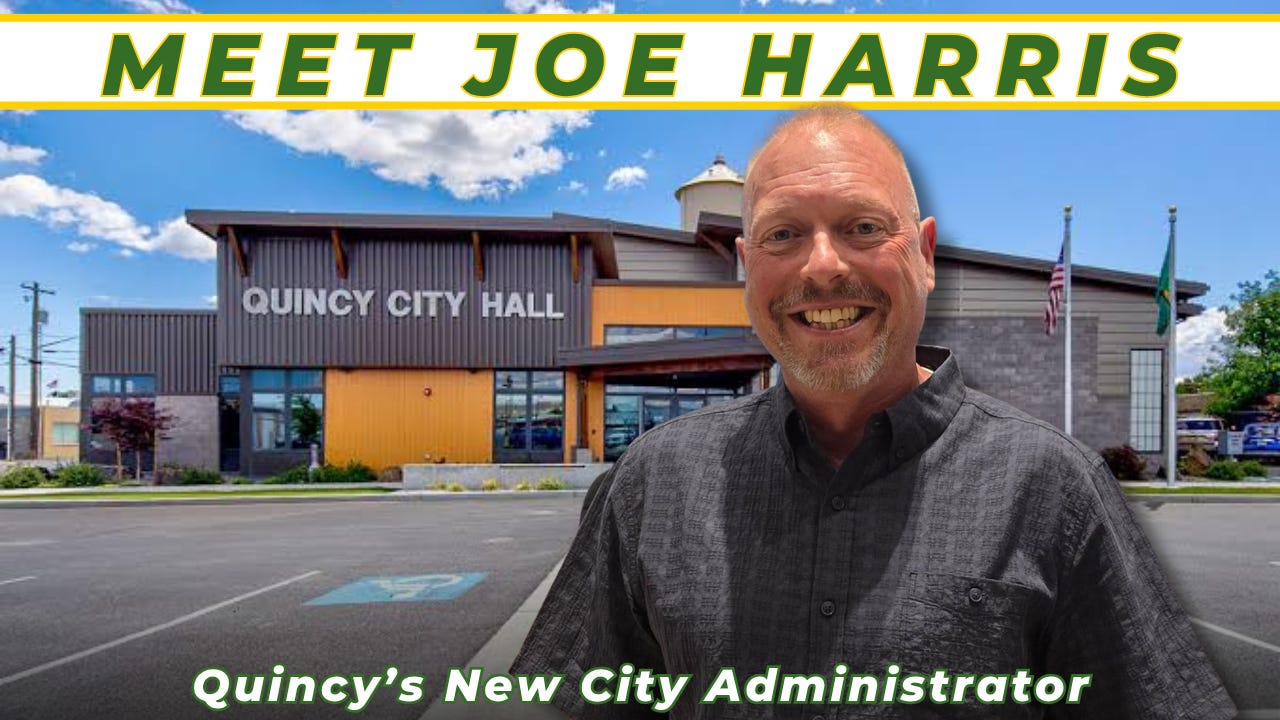
Joe Harris has spent much of his life moving from place to place, but Quincy has remained a recurring point on the map.
Harris grew up in an Air Force family, living in New Mexico, Arizona and Alaska as his father moved through a 30-year military career. His mother’s family, however, had roots at Sunland Estates, where Harris said his grandparents were among the early homeowners in the late 1970s. No matter where the Air Force sent his family, the Quincy area became one of the places they continued returning to.
“I never had a home because I grew up in the military,” Harris said. “Home was where my parents were. Quincy, Sunland was kind of home. It was where we always came back to.”
That connection eventually brought Harris to Quincy after eight years in the Marine Corps and helped launch a public-service career that would span more than two decades. He began as a Quincy police officer in 2001 and is now back with the City 25 years later, this time as its City Administrator.
The Quincy City Council confirmed Harris’ appointment Aug. 4, and he officially began work Aug. 17. The City’s announcement described the appointment as a homecoming and pointed to Harris’ public-service experience, doctorate in public administration and fluency in English and Spanish.
His résumé tells part of the story. In between his two periods working for the City of Quincy, Harris served with the Grant County Sheriff’s Office, became the first investigator assigned to the Washington Attorney General’s newly created civil rights unit, spent five years as Mattawa’s police chief, operated a private investigations business, ran for Grant County sheriff and eventually worked as a shift supervisor at Lamb Weston.
The experiences have given Harris several different perspectives on the community he now helps administer, but he said the reason for returning is considerably simpler. Public service is where he believes he belongs.
TL;DR
Joe Harris began his Quincy policing career in 2001 and worked for the City until 2006.
His career later included the Grant County Sheriff’s Office, the Washington Attorney General’s civil rights unit and five years as Mattawa’s police chief.
After retiring from law enforcement, Harris ran a private investigations business, ran for Grant County sheriff and worked as a shift supervisor for Lamb Weston.
Harris says working in both government and private industry gave him a different understanding of how Quincy businesses, residents and City government depend on one another.
He believes public service starts with respect, empathy, transparency and being willing to listen.
Harris says residents should feel comfortable approaching him at City Hall — or even if they run into him around town.

Finding a place to call home
Harris graduated from high school at Eielson Air Force Base near Fairbanks, Alaska, and joined the Marine Corps in 1993. He began in the infantry before moving into an M1A1 Abrams tank unit, spending several years at Twentynine Palms, California. His final two years were spent on recruiting duty in Texas.
When Harris left the Marine Corps after eight years, he was looking for more than employment. Having spent his childhood moving between military installations, he did not have a particular hometown waiting for him. His parents were living in the Quincy area, so Harris returned to Grant County and began applying for law enforcement jobs throughout Washington.
Quincy was the department that hired him.
Harris started with the Quincy Police Department in 2001 and remained until 2006, when he moved to the Grant County Sheriff’s Office. Looking back, he said those first years as a police officer were where he learned many of the lessons about people and public service that continue to influence him today.
Police officers usually encounter people when something has already gone wrong, Harris said. They respond to family disputes, accidents, crimes and other moments of crisis, which provides a different view of human behavior than most jobs.
“Everybody has a bad day,” Harris said. “That doesn’t mean they’re a bad person. People make bad decisions. Doesn’t mean they’re bad people.”
Working through those situations taught Harris to listen, deescalate problems and determine what had actually happened before deciding what should come next. It also led him to a belief that he carried throughout the rest of his law enforcement career.
“I don’t care who you are, I don’t care where you’re from, the color of your skin, what your political views are,” Harris said. “Everybody on the planet, I firmly believe, wants two things. They want respect, and they want empathy.”
Harris said the important lesson was that public servants could not simply demand those things from other people. Respect and empathy had to be offered first.
He also remembers supervisors Scott Jones and Randy Coleman emphasizing community relationships to the younger officers working under them. Harris said the department taught him that enforcing the law was only one portion of the job and that officers had a broader responsibility to the community they served.
“It’s about the community, it’s not about you,” Harris recalled.
Those early years helped establish relationships Harris still values today. Although his career would eventually take him into other agencies and leadership positions, he describes Quincy as the place where he learned the profession.
“Working for the City of Quincy, that’s where I cut my teeth, where I started,” Harris said.
A career beyond Quincy
Harris spent nearly a decade with the Grant County Sheriff’s Office before leaving in 2015 for the Washington Attorney General’s Office. The state had recently established a civil rights unit, and Harris was hired as its first investigator, working with three attorneys and a paralegal.
He enjoyed the work and remains passionate about civil rights, but Seattle itself proved to be a poor fit.
“I’m not a city guy,” Harris said. “I just couldn’t do Seattle.”
An opportunity to return to Grant County came in 2016 when the Mattawa police chief position became available. Harris applied and spent five years leading the department before retiring from law enforcement in 2021.
He continued pursuing his education during his career and eventually earned a doctorate in public administration. Harris’ original dissertation research involved interviews with police agencies concerning executive-level leadership programs, but COVID-19 restrictions disrupted that plan and forced him to substantially rewrite the project.
A process he expected to take roughly a year and a half stretched into approximately three and a half years. Harris admitted there were moments when walking away was tempting, but said quitting would have bothered him more than finishing the work.
“I wouldn’t be able to look at myself in the mirror if I didn’t finish it,” Harris said.
He sees that persistence as part of his personality rather than an isolated academic accomplishment.
“I don’t settle,” Harris said. “I have a goal, I go after it.”

Politics, business and the factory floor
Retirement from law enforcement did not turn into retirement from work.
Harris started a private investigations and security consulting business but operating that type of company in rural Grant County created an uneven workload. Some months were extremely busy, while others brought very little work.
He also ran for Grant County sheriff in 2022. Harris advanced through the primary but did not win the general election. Although the campaign had both positive and negative moments, he said one of its most valuable lessons came from talking directly with people throughout the county.
National political debates tend to receive most of the attention on television and social media, Harris said, but the concerns he heard from people over coffee were often much closer to home. People wanted good jobs, enough income to support their families, safe communities for their children and enough stability to enjoy their lives.
After the election, Harris returned to his business, but the inconsistent income eventually required another change. His wife, he joked, helped make the decision fairly straightforward by pointing out that he needed a steady job unless he wanted the family living under an overpass.
Harris went to work for Lamb Weston as a shift supervisor, beginning at the Warden plant and later transferring to Quincy. He spent roughly three years with the company before accepting the City Administrator position.
The job represented his first significant experience in the private sector after a professional career spent almost entirely in government, and Harris said the differences were eye-opening. It also gave him a firsthand understanding of the relationship between the City and one of the area’s largest industrial employers.
Inside Lamb Weston, Harris saw the amount of water, electricity and infrastructure required to operate a major food-processing facility, as well as the company’s emphasis on conserving those resources. He said water conservation was discussed regularly on the production floor.
That experience reinforced the interconnected nature of Quincy’s economy. Industrial employers depend on infrastructure and reliable municipal services, while the City and surrounding community depend on the jobs and economic activity those employers create.
“It’s a symbiotic relationship,” Harris said.
For Harris, working at Lamb Weston added another layer to his understanding of Quincy. He had already experienced the community as a resident, police officer, county employee, business owner and political candidate. The factory floor allowed him to see it through the perspective of an everyday private-sector workplace and the people who keep one of the community’s major employers operating.
Returning to public service
Harris was working at Lamb Weston when he learned that former City Administrator Pat Haley was leaving the position.
He had interacted with Haley through the Quincy Valley Chamber of Commerce while operating his private business, and after the position became available, several people encouraged Harris to consider applying. He initially was not sure whether becoming a City Administrator was the direction he wanted to take.
Harris stressed that his uncertainty had nothing to do with Lamb Weston. He described it as a good company with good employees and said he was treated well there. What he eventually recognized was that industrial management did not provide the same sense of purpose he had found throughout his public-service career.
“It’s just not me,” Harris said. “It’s not who I am.”
The Quincy position offered him an opportunity to return to that work while remaining connected to a community that had been part of his life for decades. “This was a perfect opportunity for me to get back into doing what I love, and that’s public service,” Harris said. “It was kind of a no-brainer, to be honest with you.”

What a City Administrator actually does
Harris knows many residents may have only a vague idea what a City Administrator does, particularly because Quincy also has an elected mayor and City Council.
He compares the arrangement loosely to the federal government. The City Council serves as the legislative body, establishing policy and controlling the budget. The mayor leads the executive side of City government, while Harris describes the administrator as functioning somewhat like a chief of staff who manages much of the organization’s day-to-day work.
That includes coordinating with City departments and directors responsible for finance, public works, police, personnel and records, as well as maintaining relationships with other local agencies and governments. Harris said he ultimately views the job through a straightforward question: How can he help the people working for the City succeed?
“The way I look at my job is, like, just the brass tacks of it, how can I make everybody else in the city successful?” Harris said. The mayor and council establish the direction they want the community to take, he said, while the administrator and City staff are responsible for carrying out that direction.
At the time of the interview, Harris had been on the job for only eight working days and was careful not to pretend he already had every answer. He described taking over the position as trying to control a 12-inch fire hose that had continued running at full pressure regardless of who was sitting in the administrator’s office.
His immediate work involves understanding the status of ongoing projects, City finances, personnel, public works, police operations and the City’s relationships with the Port of Quincy, Grant County Fire District 3, Quincy Valley Medical Center, Grant County and other public agencies.
For now, Harris said, he is listening, asking questions and learning where the City stands before determining what may need to change.
A community that grew without losing itself
Harris has watched Quincy change considerably since he first joined the police department in 2001. He remembers a community of roughly 5,000 residents. Today the population is approaching 9,000, while industrial and commercial development have expanded at an even faster pace.
What impresses Harris is that the growth has not erased the community he remembers. “Through all of that growth, Quincy is still Quincy,” Harris said.
Farmer Consumer Awareness Day is one example he frequently points toward. Quincy has welcomed data centers, industrial expansion and other major investments, but the community still stops each September to celebrate an event grounded in its agricultural history. Harris said he has seen other communities experience substantial economic or population growth and gradually lose some of the culture that once connected residents. He believes Quincy has managed to benefit from growth while retaining much of its small-town identity.
“We want Microsoft, we want Lamb Weston, we want all of this growth, because look what it’s done for us,” Harris said. “But through that whole process, we’re still Quincy.” He sees that same identity in a community made up of residents from different backgrounds. Harris has close connections with Quincy’s Hispanic community through his wife’s family and speaks Spanish himself, but he said the community’s strength comes from seeing those differences within a larger shared identity.
“It’s not a conversation of different groups,” Harris said. “It’s not a race thing. It’s not a nationality thing. It’s a Quincy thing.”
For Harris, the description that matters most is “neighbors.”
“We’re Quincy,” he said. “Doesn’t matter where you came from, doesn’t matter what color your skin, doesn’t matter what language you speak. We’re Quincy.”

Making the open door mean something
The City’s announcement introducing Harris said he intended to serve residents with transparency, dedication and an open door. Harris said he wants those words to describe how residents actually experience City government rather than simply becoming language in a press release. One of the first topics he discussed with City directors after arriving was customer service. Harris said municipal government is a public-service organization and residents should be treated accordingly, whether they are speaking with a department director, City Hall clerk or public works employee.
“We can sit here and say we have an open door as much as we want, but when people show up and the door is closed, that’s problematic,” Harris said. “If we’re gonna say it, we better do it.”
That does not mean every City interaction will end with residents receiving the answer they wanted. Someone may dispute a late fee, disagree with a policy or raise an issue that belongs with another department or elected official. Harris said the goal should still be for that person to leave the interaction understanding the situation and knowing where to go next.
He also places considerable emphasis on employee training. As Mattawa police chief, Harris once told his department that officers would patrol on horseback before he cut the training budget. His reasoning was that residents calling for help deserve properly trained people responding to them.
The same principle applies beyond law enforcement. When a water main breaks, residents should expect qualified public works employees to repair it. When City employees interact with the public, they should understand their jobs well enough to provide accurate information.
People will still make mistakes, Harris said, but if an employee makes a mistake because the City failed to provide appropriate training, he considers that an organizational failure.
Approachable inside City Hall and outside it
Harris’ idea of accessibility also extends beyond scheduled appointments. Asked whether residents should feel comfortable stopping him if they see him at Akins, at a community event or elsewhere around the area, Harris did not hesitate.
“Come talk to me,” he said. “Absolutely, that’s part of my job.”
He acknowledges that public officials and employees deserve reasonable personal boundaries. Showing up at someone’s home to complain about municipal business is different from approaching them in the grocery store. After more than 20 years in public service, however, Harris said most residents understand that distinction.
He also believes listening is sometimes a service in itself. Police work taught him that people who are angry or frustrated often need a chance to explain what is bothering them before a productive conversation can begin. Taking the time to hear someone out can lower the temperature and make it possible to address the actual problem.
Harris said that approach only works when the person listening is genuine. “People can tell when you’re not genuine,” he said. “That’s the quickest way to erode trust.” His message to residents is that he wants them to communicate with City Hall, particularly when something is not working.
“I can’t fix it if I don’t know about it,” Harris said. “Don’t be bashful about coming and talking to me.”

Family, football and life outside the office
Harris and his wife live outside George with their two daughters. Their oldest recently graduated from high school, while their youngest is entering seventh grade.
Outside work, the family enjoys camping, hiking and other outdoor activities. Harris and his wife also took up rock climbing several years ago. A shoulder problem has kept him from climbing recently, but he remembers enjoying the ability of the sport to force everything else out of his mind.
“You’re 80 foot up on a rock, you ain’t thinking about nothing else,” Harris said.
Harris also enjoys football and is a Seahawks fan, but he said most of his free time ultimately comes back to being with his family, watching his daughters grow and maintaining a strong relationship with his wife.
His father remains one of the most important influences in his life. Despite a demanding Air Force career that included considerable time overseas, Harris remembers his father making an effort to be involved whenever he was home, including coaching soccer and T-ball.
“My dad, absolutely my hero,” Harris said. “One hundred percent my hero.”
His mother also carried much of the responsibility for raising the family during those deployments, managing the household and caring for the children while his father was away. Those experiences, along with the years Harris spent moving between military communities, exposed him to different regions, people and cultures before he was old enough to begin a career of his own.
What This Means to You
The City Administrator is not an elected position, and many residents may never have a reason to sit across the desk from Joe Harris. They will, however, experience the results of the work he oversees. A utility bill, a street project, an interaction at City Hall, a police response, a water issue or the progress of a major City project can all eventually trace back to departments Harris is responsible for helping manage.
That makes his approach to the job important even for residents who rarely follow City Council meetings. Harris is stepping into the position with experience on several sides of the community. He has been a Quincy police officer and a county employee, managed a nearby police department, operated a small business and supervised employees at one of Quincy’s major industrial employers. He has seen how government decisions affect residents and businesses, but he has also experienced the limitations and responsibilities that come with working inside government.
For people throughout the 98848, Harris’ promise of an open door may be the easiest part of his approach to measure. Residents will not always get the answer they want from City Hall, and Harris readily acknowledges there will be problems he cannot personally solve. What he is promising is that people should be able to ask the question, raise the concern and receive an honest answer about what can happen next.
“I can’t fix it if I don’t know about it,” Harris said. “Don’t be bashful about coming and talking to me.”
Coming Back to Where Home Has Always Been
Harris’ return to City Hall is only the latest stop in a life that has rarely followed a straight line. He grew up moving between Air Force bases, served eight years in the Marine Corps and spent a career moving between agencies, jobs and responsibilities. Even his professional life after retiring from law enforcement took unexpected turns through private investigations, a campaign for sheriff and the production floor at Lamb Weston.
Through all of those changes, the Quincy area kept reappearing.
It was where his family returned when he was growing up. It was where he came after leaving the Marine Corps because his parents were here. It was where he put on a police uniform and began his public-service career in 2001. It became the community where he built relationships, raised a family nearby and eventually discovered that, after trying life in Seattle and careers outside government, small-town public service was still where he wanted to be.
That history may also explain why Harris talks about Quincy’s growth differently than someone encountering the community for the first time. He remembers a smaller Quincy, but he does not seem interested in turning back the clock. What matters to him is whether the community can continue benefiting from new employers, new investment and new residents without losing the relationships and traditions that made people want to stay in the first place.
“Through all of that growth, Quincy is still Quincy,” Harris said.
For someone who spent much of his childhood saying he never really had a hometown, Harris has now returned to the same place often enough that the pattern is difficult to miss. Twenty-five years after beginning his public-service career on the streets of Quincy, he is back at City Hall with a different title, a much broader résumé and responsibility for helping the community navigate whatever comes next.
After a lifetime of moving, Joe Harris has come back once again to the place his family always returned to and to the 98848 that, somewhere along the way, became home.