
A few days ago, I was driving through Quincy when I noticed a man using a leaf blower to clear the leaves from the curb in front of his house. There was nothing particularly unusual about that. Fall has arrived in the 98848, and anyone with trees knows how quickly the leaves can pile up. What caught my attention was where those leaves were going. Rather than collecting them, he was blowing them from the curb into the middle of the intersection. His property was getting cleaned up, but the problem wasn’t going away. It was simply becoming someone else’s responsibility.
I doubt the man gave it much thought, and I certainly don’t know anything about him beyond what I witnessed that day. Still, the scene stuck with me because it illustrates an attitude we occasionally see in our community. We want our homes, streets, parks and neighborhoods to look nice, but sometimes our willingness to take responsibility stops at the edge of our own property.
Over the past several weeks, I’ve been thinking about that distinction while watching two very different things happening in Quincy. On one side of town, volunteers have been working to beautify the western entrance to our community, contributing their time and energy to a project residents have wanted for years. Meanwhile, at one of Quincy’s newest parks, city employees have been repairing damage caused by repeated vandalism.
Both situations involve public property. Both affect the quality of life in our community. Yet they demonstrate two very different ways people can treat the place they call home.
TL;DR
Volunteers recently helped plant trees and landscaping at Quincy’s West Gateway, advancing a beautification effort residents have requested since at least 2018.
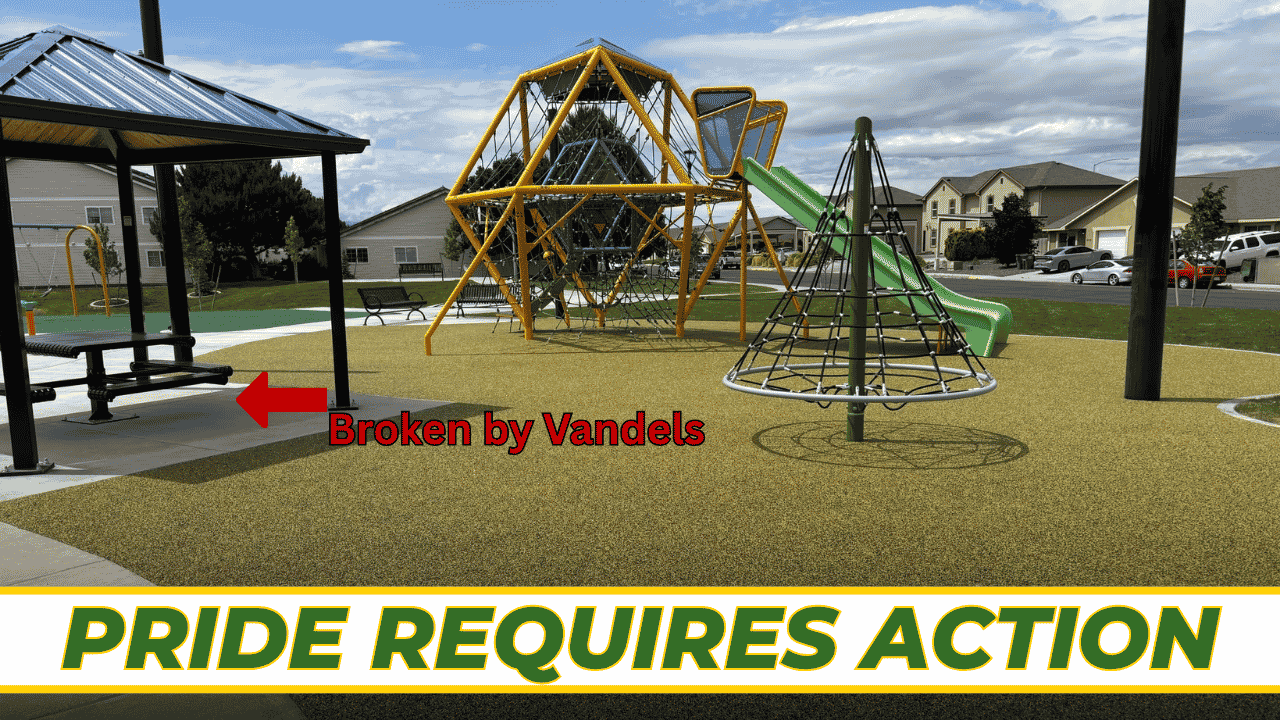
The city’s new splash pad park, which opened at the end of May, has experienced repeated vandalism involving restrooms, playground equipment and other facilities.
Quincy Municipal Services Director Carl Worley estimates approximately $10,275 in repair materials, protective measures and city labor associated with the damage. That is before all the numbers are in.
Earlier reporting on graffiti in Quincy shows why community reporting and involvement matter when addressing vandalism.
Public facilities are maintained by the city, but protecting the investments we’ve made in Quincy requires residents to take responsibility for the community we share.

Two Different Pictures of Community Pride
On October 6 and 8, volunteers gathered along Highway 28 to help plant trees and landscaping as part of the West Gateway Beautification Project. The work represents another step in an effort that began years ago, when residents participating in community planning discussions identified greener streets and more attractive entrances as priorities for Quincy’s future.
Those conversations date back to at least 2018. Residents wanted more trees, better recreational opportunities, improved public spaces and a community that made a stronger first impression on visitors. Microsoft helped fund the planning and landscaping work, while the City of Quincy coordinated the public improvements necessary to make the project possible.
The planting days were an opportunity for residents, businesses and city employees to participate directly in something that will benefit Quincy for years to come. The volunteers weren’t planting trees in their own yards or improving property they personally owned. They were contributing to a shared space because they believed it was worth making better.
That is the kind of community involvement we should celebrate. The West Gateway project required years of planning, financial support and cooperation between the city and its partners, but the volunteers demonstrated that residents have a role to play beyond waiting for improvements to be completed. Sometimes making Quincy better means being willing to show up, pick up a shovel and contribute something of our own.
Unfortunately, another recent story about public property presents a less encouraging picture.


Quincy’s new park at 6th Avenue NE and E Street NE opened in late May, giving families another place to enjoy the outdoors. The project, which includes a splash pad and playground facilities, cost $2,538,627.89 to construct, according to figures provided by Municipal Services Director Carl Worley.
Within weeks of opening, the city was already dealing with vandalism. In June, officials reminded residents about park rules and reported damage to buildings. By late September, the city announced that restrooms were closed for repairs, describing vandalism that had steadily increased since the park opened.
The damage has included broken windows, damaged doors, vandalized restroom fixtures, damaged playground equipment and the destruction of a security camera. City employees have also dealt with rocks placed in toilets, fireworks set off in restrooms and other incidents that required cleanup or repairs.
Worley provided an accounting of the expenses associated with those incidents. Materials and protective measures, including replacement mirrors, hardware, windows and an additional fence, totaled approximately $5,275. He estimated another 100 hours of Public Works labor at $50 per hour, bringing the combined total to approximately $10,275.
That figure does not include police time or all the expenses the city may ultimately incur. Additional damage has been reported, and some repairs have yet to be fully assessed or priced. The city continues working to address the problems while keeping the park available for families.
Ten thousand dollars may seem relatively small compared with the cost of building a $2.5 million park, but it represents money and labor that could have been spent elsewhere. Those 100 hours of employee time could have gone toward maintaining streets, caring for landscaping, repairing other facilities or completing any number of tasks on the city’s maintenance schedule.
Instead, city employees have been spending that time repairing damage that should never have occurred.

When Public Property Becomes Somebody Else’s Problem
During a September 21 conversation about the West Gateway project, Worley and Lisa Karstetter of Microsoft discussed the improvements Quincy residents have requested over the years with me. Karstetter had brought records from community planning meetings dating back to 2018, and it was striking how many of those priorities have since been completed or are underway.
Quincy has made considerable progress. We have new recreational facilities, improvements to public spaces, additional trails in development and projects that were little more than community wish lists several years ago.
When the conversation turned to the splash pad, Karstetter made an observation that has stayed with me. “It’s kind of like you wanted more park on that end. You got a splash pad. Well, let’s take care of it,” she said. Her point wasn’t that residents should stop asking for improvements. The West Gateway project itself grew out of years of listening to what people wanted for Quincy. Rather, it was a reminder that getting something built is only part of the responsibility. Once a community receives the improvements it has requested, there is an expectation that people will help preserve them.
Worley expressed similar concerns when I contacted him about the vandalism. He explained that the park was originally considered as a location for an off-leash dog park. The city ultimately chose to build something that would offer more recreational opportunities for children and families. Despite the ongoing problems, he still believes that decision was worthwhile.
“It is still worth it to see the smiles on the faces of the kids and the sound of laughter in the park,” Worley told me.
That is worth remembering. The splash pad isn’t simply another line item in the city budget. It’s a place where children can play during the summer, families can spend time together and neighbors can enjoy something their community has provided. For years, residents have asked for more places where families can spend time together without having to leave town. The splash pad is one example of Quincy responding to those requests.
If you have played there with your kids you know what a truly special place it is.
Every time a restroom is closed, a piece of equipment is damaged or another repair becomes necessary, the people who lose something are the families who should be enjoying the park.
Worley also pointed out that the park was built with public money and belongs to the community. City employees maintain it, and police officers patrol the area, but there isn’t an officer stationed there around the clock. Nor should that be necessary for people to respect a playground.
There is an important difference between expecting the city to maintain public facilities and expecting city employees to clean up after deliberate acts of destruction. Taxpayers fund municipal services because streets, parks and public buildings require professional maintenance. But no reasonable maintenance schedule can account for people repeatedly damaging equipment simply because they can.
While the responsibility for vandalism belongs to the people committing it, the responsibility for protecting and caring for our shared spaces extends to the entire community. At some point, we have to acknowledge that public property isn’t somebody else’s property. It belongs to all of us, and we all bear the consequences when it is mistreated.

The Cost of Looking the Other Way
Earlier this year, Quincy experienced a sharp increase in graffiti, including incidents police identified as gang-related tagging. During one two-week period, officers reported approximately 27 separate incidents, prompting the City Council to approve a reward program offering up to $1,000 for information leading to the arrest and conviction of graffiti offenders.
The city was responding to more than the cost of removing spray paint. Repeated vandalism affects how people view public spaces and whether they believe those spaces are being cared for. When damage is allowed to remain, it can create the impression that nobody is paying attention or that such behavior has simply become acceptable. That is a dangerous standard for any community to adopt.
In a later follow-up to my graffiti reporting, Quincy Police Chief Ryan Green said the number of reported incidents had declined. He did not claim that the reward program was responsible, and the department was still evaluating its effectiveness. However, Green believed increased community involvement was contributing to the improvement.
“Graffiti reports have gone down, and I believe it’s because Quincy citizens are taking an active approach in reporting suspicious activity,” Green said.
His comments reinforce something that is easy to overlook when discussing public safety. Police officers investigate crimes, but they depend on information from the people who live and work in the community. A resident who reports suspicious activity, provides a useful description or shares information about repeated vandalism may help officers identify patterns they otherwise would not see.
That doesn’t mean people should confront vandals or attempt to police their neighborhoods themselves. It means we shouldn’t automatically assume someone else has already reported a problem or that what happens to public property is none of our business. The same principle applies beyond criminal activity.
During our September conversation, Karstetter described seeing complaints online about litter around another public recreation area. She acknowledged that city staffing is limited and that maintenance demands change throughout the year, but she also questioned why residents couldn’t occasionally help with something as simple as picking up trash.
“The bigger question should be where is our community pride?” she asked. It’s a fair question, particularly when we consider how often we hear complaints about the appearance of our streets, parks and neighborhoods.
Perhaps the greatest concern isn’t the money already spent repairing the damage, but the possibility that we begin accepting it as an unavoidable part of having public facilities. Restrooms shouldn’t have to be repeatedly repaired because someone decided to destroy them. Playground equipment shouldn’t be routinely unavailable because someone deliberately damaged it. These aren’t ordinary maintenance problems, and we shouldn’t become so accustomed to them that we stop expecting better. Quincy has invested too much in improving its public spaces to accept their destruction as simply the cost of doing business.
We should expect the city to do its job. We should also recognize that there are practical limits to how much municipal employees can accomplish, especially when they are repeatedly pulled away from routine work to repair preventable damage.
Picking up a discarded cup isn’t the same as stopping someone from destroying a restroom, and we shouldn’t pretend otherwise. But both situations raise a question about how we view the spaces we share.
Do we see a problem and immediately decide that it belongs to someone else, or do we recognize that we might have a small part to play in making things better?
What This Means to You
Quincy has changed considerably over the past two decades, and many of those changes have brought opportunities that earlier generations of residents could only imagine. New businesses, improved public facilities, recreational investments and community partnerships have helped make the 98848 a place where families can put down roots and enjoy opportunities close to home.
Those improvements didn’t happen by accident. They required planning, financial commitments, public participation and people willing to work through the challenges that come with getting major projects completed.
Maintaining those improvements will require an ongoing commitment as well.
For parents, that includes teaching children to respect facilities they don’t personally own. A public playground isn’t an invitation to treat equipment carelessly, and posted rules aren’t suggestions that only matter when a city employee is watching. Children learn how to treat their community partly by observing how the adults around them behave.
For residents, it can mean reporting vandalism, respecting shared spaces, picking up litter when it’s practical or participating in volunteer opportunities. It might mean helping a neighbor maintain a property or taking a little extra care with something that doesn’t directly benefit us.
For city officials, it means continuing to maintain public investments, responding to damage and considering reasonable ways to protect facilities without making them less welcoming to the families they were built to serve.
None of these responsibilities eliminates the others.
I also think we need to recognize the people who are already doing this work. It’s easy to become frustrated when we see vandalism, litter or neglected property, but those problems don’t tell the whole story of Quincy.
The volunteers who helped plant trees along Highway 28 are part of that story. So are the residents who report problems, the businesses that contribute resources to community projects and the city employees who keep showing up to repair and maintain our public spaces.
Their efforts deserve as much attention as the damage caused by people who don’t seem to appreciate what has been built.
Perhaps more importantly, they offer an example the rest of us can follow.
Being Proud of Quincy and Taking Pride in Quincy
There’s a difference between being proud of Quincy and taking pride in Quincy, and I think it’s a distinction worth considering.
Being proud of Quincy is something most of us understand. We cheer for the Jacks, celebrate our community events, enjoy our parks and tell people why this is a good place to raise a family. We appreciate seeing new businesses open, watch with interest as major projects take shape and enjoy showing visitors the things that make our hometown special.
Taking pride in Quincy requires a little more.
It means picking up a piece of trash even when we weren’t the ones who dropped it. It means respecting public property, reporting vandalism when we see it and teaching our children that the parks and facilities they enjoy belong to everyone. It means occasionally giving up a few hours to help with a community project, even when we may never personally benefit from the work.
Being proud of Quincy is about how we feel about our community. Taking pride in Quincy is about what we’re willing to do for it.
We need both.
The West Gateway volunteers demonstrated what that second kind of pride looks like. Their work will help improve the appearance of a public space that thousands of people pass every week, including people who may never know who planted the trees or helped prepare the landscaping.
The families enjoying the splash pad deserve to benefit from that same spirit of community ownership. They shouldn’t have to wonder whether the restrooms will be open or whether playground equipment will be available because someone decided to damage it. And the employees responsible for maintaining those facilities shouldn’t have to spend their working hours repeatedly repairing preventable destruction.
None of us can personally solve every problem facing Quincy. We can’t prevent every act of vandalism, pick up every piece of litter or volunteer for every worthwhile project. We have jobs, families and responsibilities of our own, and there will always be more work to do than any one person can accomplish.
But we can make a difference in how we approach the responsibilities that are within our reach.
I keep coming back to that man blowing leaves into the intersection. I don’t know whether he considered where those leaves would end up or who might eventually have to deal with them. From what I could see, they were likely to end up in someone else’s yard. It was a small moment, and certainly not comparable to someone deliberately destroying public property. Still, it made me think about how easily we can convince ourselves that a problem no longer concerns us once it moves beyond our own property line.
The reality is that we all share the streets, parks and public spaces of the 98848. What happens to them eventually affects all of us, whether through our taxes, the services we receive or the quality of life we enjoy.
We have good reason to be proud of what Quincy has accomplished and the people who continue working to make it better. The progress we’ve seen in recent years is proof of what can happen when residents, businesses and local government work toward common goals.
The next part of that work may be less exciting than building a new park or planting trees along the highway, but it’s just as important. We have to take care of what we’ve built, look out for the places we share and recognize that the responsibility for making Quincy a better place doesn’t belong exclusively to city employees, elected officials or the volunteers who show up when there’s work to be done. It belongs to all of us.
We have plenty of reasons to be proud of Quincy. The question is whether we’re willing to take pride in keeping it that way. After all, community pride shouldn’t end at the curb.
