
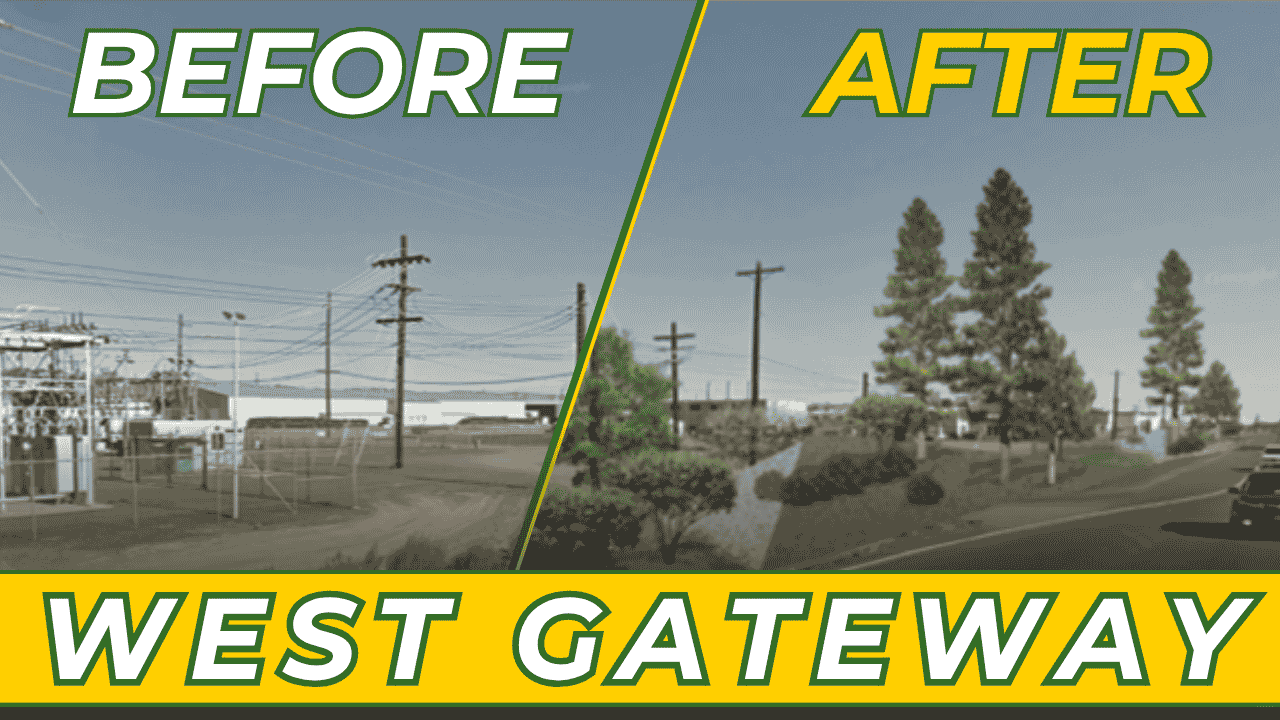
When you enter Quincy from the west on Highway 28, the first impression is largely industrial. It is a view that reflects an important part of the economy that has helped the Quincy grow, but it doesn’t necessarily reflect the parks, neighborhoods, schools, businesses and people that make up rest of the 98848. Beginning this fall, that entrance will start looking different as years of planning for the Quincy West Gateway Beautification Project finally reach the planting stage.
The project will add trees, shrubs, native-style grasses and other landscaping along the Highway 28 corridor beginning near Road R NW and extending east toward 10th Avenue SW. Microsoft has provided funding for much of the beautification work, while the City of Quincy has handled the public-project side of turning the concept into something that can actually be built. Perhaps the most important part of the project’s history, however, predates the drawings and engineering work. Quincy residents were asking for this nearly eight years ago.
TL;DR
West Gateway Beautification: Landscaping is moving forward along the Highway 28 entrance to Quincy from the west.
Years of Community Input: Residents identified a need for more trees and greenery and specifically asked for “beautiful entrances to our community” in 2018. Similar requests came up again in 2019.
Long Road to Construction: Microsoft funded early design work and provided funding for landscaping, while the project worked through engineering, contracts, COVID-era delays and coordination with the City of Quincy and WSDOT.
The Plan: Trees, shrubs, berms, grasses and flowering plants will change the appearance of the largely industrial corridor.
Community Planting: Planting days are planned for October 6 and October 8, with community members invited to participate.
A Second Phase: Additional landscaping toward the cemetery is being planned for spring 2027, pending WSDOT approval.

The Conversation Started in 2018
During a recent conversation with Lisa Karstetter of Microsoft and Quincy Municipal Services Director Carl Worley, Karstetter pulled out records from Microsoft’s old Voice of the Community meetings. We had been talking about the West Gateway project, but those records changed the context of the conversation. Instead of looking at the project as something new happening along Highway 28, they showed that some of the ideas behind it had been coming from Quincy residents for years.
In 2018, 62 people attended one of those meetings and were asked to identify Quincy’s strengths, its challenges and what they wanted the community to look like in the future. Participants saw plenty of strengths, including Quincy’s natural resources, location, available room to grow and local leadership. Their list of challenges was equally direct. Downtown was described as tired and in need of revitalization, and participants raised concerns about housing, transportation, childcare, community connectivity and the hospital. They also identified something much simpler: Quincy needed more trees and more green space.
When the same group looked ahead and described what they hoped to see five years later, their list included a park and bike system, a reinvigorated downtown, a recreation center, affordable housing, an updated or new senior center and a new hospital. It also included “beautiful entrances to our community.”
Sitting with Karstetter and Worley in 2026 and looking back at that list was interesting because a surprising amount of it is now either complete or underway. Quincy has a new hospital. The Q-PLEX is moving forward. Sections of a larger trail system are taking shape. Downtown and B Street have seen improvements, and tree programs have added greenery around town. The West Gateway is another piece of that much older list that is now moving from an idea to a physical project.
The request for beautification wasn’t limited to the 2018 meeting. In 2019, residents again talked about revitalizing the community and the main highway, beautifying streets coming into town, adding walking and biking routes and bringing in more trees and greenery. One of the descriptions recorded from those conversations was a desire for Quincy to become more of an “oasis in the desert.”
Turning Community Input Into a Plan
Karstetter said Microsoft would take the ideas from those community meetings back internally and look for projects that fit areas the company could support, including sustainability, education and workforce development. Trees were one of the ideas that fit, eventually leading to tree-planting efforts and the Rooted in Quincy program. Beautifying the entrance to town became another project Microsoft could help fund.
Microsoft paid for a consultant to develop concepts that included both the Highway 28 entrance and B Street. Community involvement continued during that process. Displays were set up locally, and people could review the concepts, place stickers on the boards and provide feedback about what they wanted to see when they drove into Quincy and what they wanted downtown to look like. The resulting concept was eventually presented to the Quincy City Council, which approved it.
Approval of a concept, of course, is a long way from putting a tree in the ground. The project then ran into many of the same problems that affected public projects across the country during and after COVID. Engineering schedules backed up, contracts reached their time limits and had to be revisited, and the city still had to work through the requirements that come with building within a state highway corridor. Worley said the city went through several contracts during that process as schedules continued to slip.

Karstetter said funding Microsoft had provided for trees and other portions of the project remained with the Columbia Basin Foundation while those pieces came together. She was also clear that Microsoft’s financial involvement doesn’t give the company control over when a public project moves forward. Private-sector projects can often move faster, while public projects have to work through requirements designed to provide oversight and accountability. When another government agency is involved, the timeline can grow longer still. In this case, because the project sits along State Route 28, WSDOT also has a role in what can be built and where.
That history helps explain why a project residents were talking about in 2018 is reaching the planting stage in 2026. It also illustrates something that came up repeatedly during my conversation with Karstetter and Worley: projects around Quincy don’t necessarily happen in the order residents first hear about them. Some move when grant funding becomes available, some depend on another project being completed first, and others have to wait on engineering, permits or another government agency.
What Drivers Will See Along Highway 28
Today, when you enter Quincy through the West Gateway, you’re greeted by some of the newer retail development and landscaping on one side of the highway. The north side is a different story, with the switchyard, water treatment facilities and industrial plants most of us are familiar with. I’m not usually much of a beautification guy, and everything sitting along that corridor serves an important purpose in our community, but even I can admit some landscaping would go a long way.
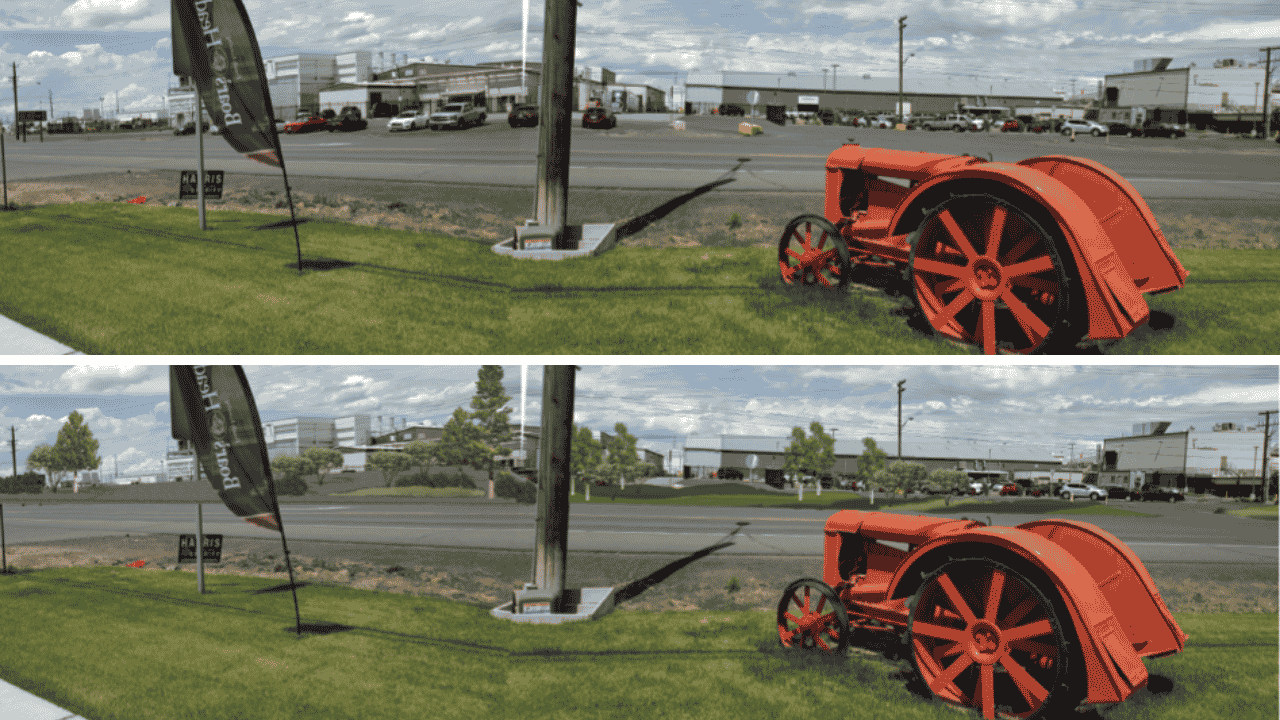
The West Gateway plans cover the Highway 28 corridor from the Road R NW area east toward 10th Avenue SW. If you’ve driven through recently, you may have already noticed the city building up dirt along the north side of the corridor. Those aren’t simply piles of dirt waiting to be moved. They are part of landscaped berms designed to provide height, shape and screening…
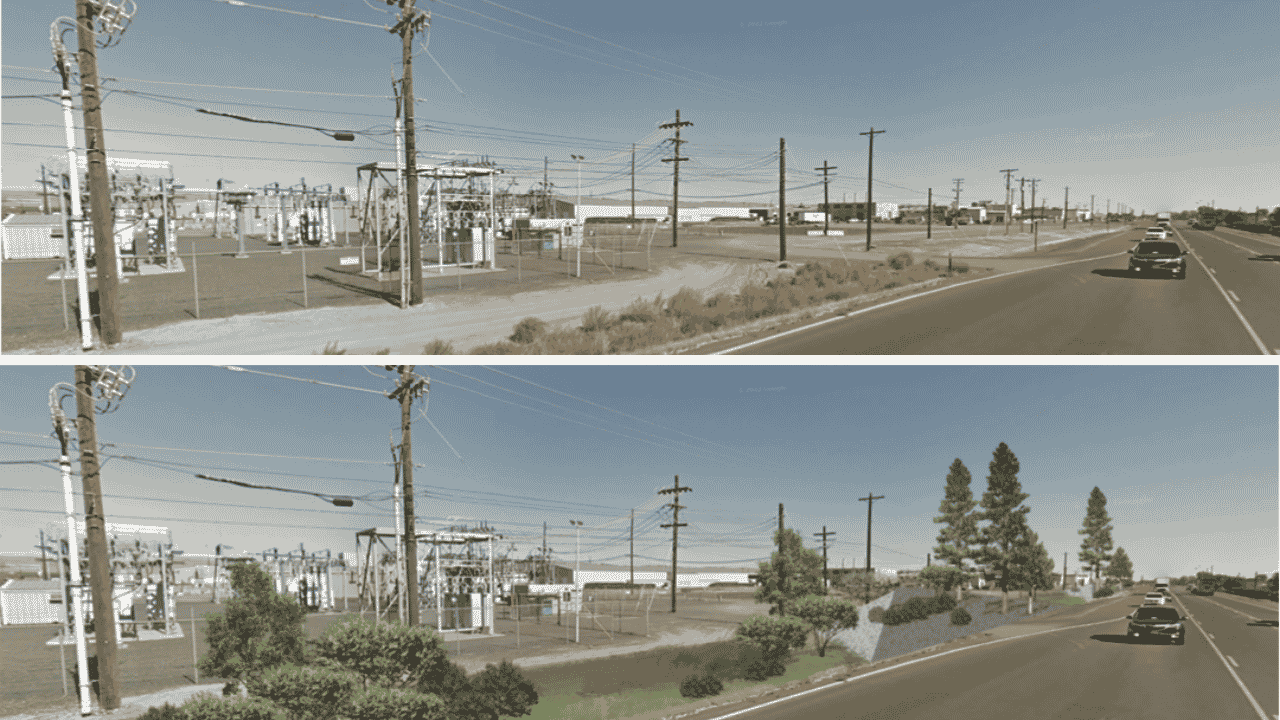
The 2022 concept drawings provide a useful before-and-after look at the original vision for the corridor, while the more recent plans show how that vision has developed into specific plantings and construction details. One view looks across Highway 28 toward the industrial facilities that dominate much of the current landscape. The proposed version shows the same facilities, but trees and other landscaping soften the foreground and give the entrance more definition. The industrial side of Quincy remains part of the view; the landscaping changes how the community is introduced around it.
More recent plans show how that broad concept has been translated into specific plantings. The current schedule includes serviceberry, Douglas maple, limber pine, ponderosa pine and Douglas fir. It also calls for hundreds of shrubs, including big sagebrush, rabbitbrush, mock orange, dwarf mountain pine, purple willow, western spirea and snowberry. Large seeded areas include grasses and flowering plants such as yarrow, snow buckwheat, showy milkweed and pearly everlasting.
The plans even identify a possible location for a future “Welcome to Quincy” sign. That sign is not part of the current phase; the plans specifically identify its fabrication and installation as future work.
Some details are also being adjusted before planting begins. Karstetter explained that several trees shown in the design needed to be moved because their mature height would eventually put them into overhead utility lines. The project plans include clearance requirements around those lines, so planting locations are being adjusted in the field before holes are dug.
It is the kind of detail that helps explain why a beautification project can take considerably more planning than the finished product might suggest. Once completed, drivers will mostly see trees and landscaping. Behind them are engineering plans dealing with everything from utility clearances and sight distances to stormwater, sidewalks and the eventual size of the vegetation.
Why Beautification Matters
There is a reasonable question that comes with a project like this. Quincy has roads to improve, pedestrian crossings to address and other infrastructure needs. Why spend time and money making an entrance to town look better?
Worley said the answer partly comes down to how public projects are funded. The West Gateway isn’t simply taking the place of another city project on a list. Microsoft has provided much of the support for the beautification work, while other transportation and infrastructure projects move forward using their own funding sources, including grants that can only be used for particular types of work. The city often has to move on a project when the right funding becomes available rather than simply working straight down a single priority list.
There are also transportation improvements tied into the larger area. Worley pointed to rapid-flashing pedestrian beacons, sidewalk improvements and trail connections that are being assembled as individual projects and funding opportunities make them possible. The West Gateway includes a sidewalk that will help extend that network toward 7th Avenue near the cemetery.
For Karstetter, however, beautification has another purpose: community pride. She pointed out that people form impressions about a place before they have the opportunity to know the people who live there. Quincy has a large industrial footprint, and for someone entering from the west, that can dominate the first impression before they reach the rest of the community.
“I think when you take pride in something like that to say, when you start coming in and going, ‘This is beautiful. It’s, like, we live here,’” Karstetter said. She hopes that feeling extends beyond appearances and encourages residents to take greater pride in, and better care of, the parks, neighborhoods and other community investments around them.
Worley described his reason more simply as appreciating the beauty it can add to town. He and Karstetter pointed out that Quincy already has things people remember when they pass through the area, including the crop signs and Christmas lights along the freeway. Karstetter would like Quincy’s streets and public spaces to become part of that impression as well.
What This Means to You
The West Gateway project is reaching a stage where residents won’t just be able to watch the work happen. They will have an opportunity to participate in it. Community planting days are planned for October 6 and October 8, and Microsoft employees, city staff and community volunteers are expected to take part.
When I met with Karstetter and Worley, some of the logistics were still being finalized. The plan was to mark planting locations with flags identifying what belongs in each location, allowing volunteers to work through the site while city crews handle some of the preparation and support. Karstetter was also looking at ways to involve other parts of the community, and we discussed possibilities ranging from FFA students and local organizations to making the planting days more of a community event.
Karstetter’s invitation to residents was straightforward: “This is your community. Be part of, like, the entrance to Quincy. We’re trying to beautify it and the city, you know, along with Microsoft’s help, and we would love anybody’s help to show up.”
Final details for the public planting days are still being confirmed. We will update this information as soon as those details are available.
Help Plant the Quincy West Gateway
Dates: October 6 3PM to 7PM - Planting
Dates: October 8 3PM to 6PM - Irrigation and Staking
Where to Meet: North Side of HWY 28 across from ACE
Who Can Participate: Anyone
What to Bring: Gardening/Work Gloves and water
Tools Provided?: Shovels
What to Wear: Weather Appropriate clothing
Food/Refreshments: BRING WATER
Do You Need to Sign Up?: No, we will find a place for you to help
The October planting is not necessarily the end of the West Gateway project. Karstetter said a second phase is being planned that would continue the landscaping farther east toward the cemetery. That phase still requires WSDOT approval, so while it is not yet final, Worley said he expects it to be approved, and the hope is that site preparation can take place through the fall and winter with additional planting in spring 2027.

Eight Years From an Idea to a Shovel
Looking back at the 2018 Voice of the Community notes provides some useful perspective on how change happens in a small community. Residents can raise an idea at a meeting, but that doesn’t mean construction begins the following year. Funding has to be found, plans have to be developed, public agencies have requirements to meet, and sometimes an unexpected event like COVID adds years to the process. Karstetter described the community-engagement process Microsoft was using at the time as research and listening, planning, funding, executing, communicating and evaluating, with community sessions repeating about every six months.
It is also worth remembering what those Quincy residents were asking for in 2018. They wanted a new hospital, recreation opportunities, trails and bike routes, a revitalized downtown and more trees. They also wanted an actionable community vision, something that has since developed into the Better Together 98848 Action Plan available at 98848vision.org and a better-looking community. Not everything on those old lists has happened, and some of the things that are happening have taken much longer than anyone probably imagined. Still, enough has changed around the 98848 that looking back at the list today tells a different story than it did eight years ago.
The West Gateway Beautification Project is one more piece of that story. What began with residents asking for more trees, more green space and beautiful entrances to Quincy eventually moved through community feedback, concept drawings, funding, engineering and years of work behind the scenes. This October, residents of the 98848 will have the opportunity to take the next step themselves: showing up, grabbing a shovel and helping plant the entrance their neighbors began asking for eight years ago.
