
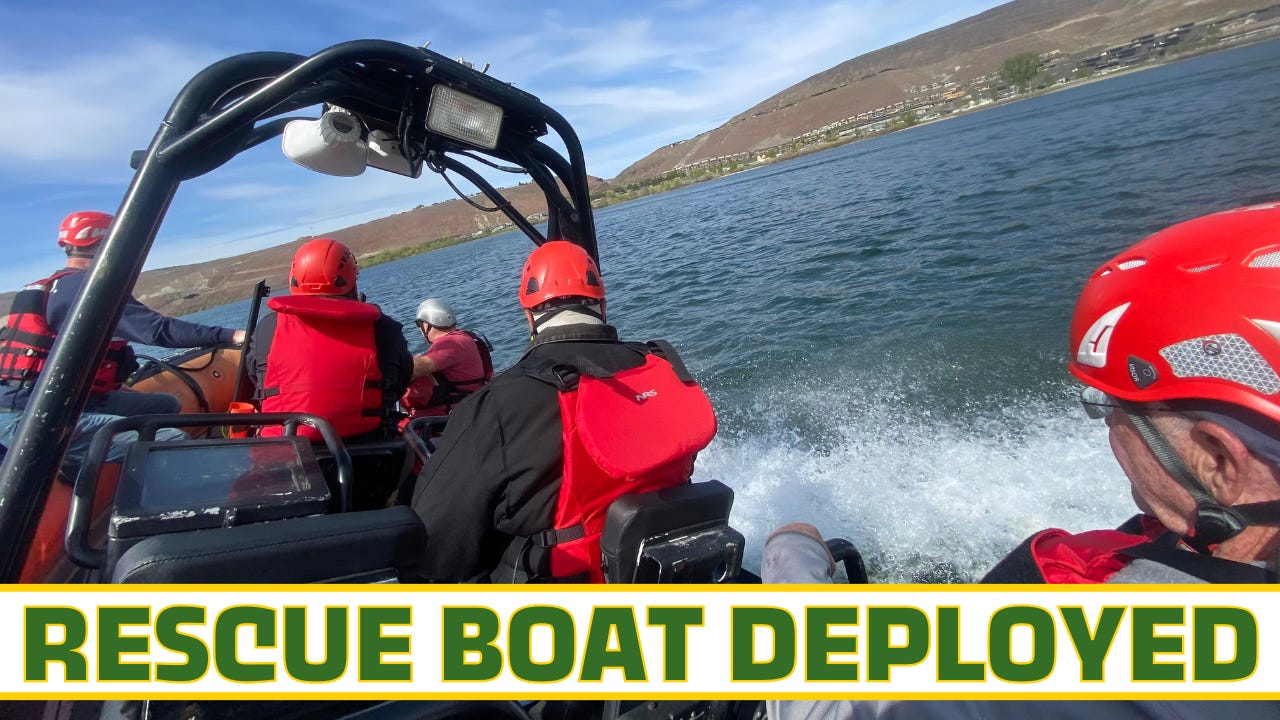
The Columbia River has always been one of the defining features of life in the 98848. It draws boaters, anglers, campers, vacationers, and residents to communities like Crescent Bar and Sunland Estates every year. It helps support agriculture, recreation, and tourism throughout the region. It also creates challenges that most people never think about until something goes wrong.
When an emergency happens on the water or along miles of rugged shoreline, firefighters cannot always solve the problem by simply putting an engine on the road and driving to it. Steep terrain, limited access points, rocky shoreline benches, and long stretches of river can all complicate emergency response.
I recently sat down with Grant County Fire District #3 Fire Chief David Durfee and District Mechanic Jose Chavez to talk about the district’s new 24-foot Zodiac Hurricane H729 rescue boat. What I expected to be a conversation about a boat quickly turned into a conversation about solving problems.
If you’ve spent any time around Durfee or Chavez, that probably won’t surprise you. Neither man spent much time talking about the boat itself. Instead, they talked about response times, firefighter safety, shoreline access, protecting communities, and finding ways to improve service without asking taxpayers to write a larger check. There was a genuine sense of excitement throughout the conversation, not because the district acquired a new piece of equipment, but because they believe they found a practical solution to several challenges that have existed along the Columbia River for years.
Don’t get me wrong, the team is excited about the boat like anyone with a new tool. However fireman are more excited about the problems they can solve with it.
TL;DR
• Grant County Fire District #3 has added a 24-foot Zodiac Hurricane H729 rescue boat to its tool list.
• The boat was acquired through a federal surplus program administered through the state.
• Approximately $20,000 in grant funding was used to equip the vessel for local operations.
• More than 20 firefighters have completed boat operations training.
• The vessel will support water rescues, shoreline access, and wildland fire suppression.
• The boat will be stationed at Crescent Bar during the summer months to improve response times along the Columbia River corridor.

Acquired Through a Federal Program
One of the first questions many residents will ask is simple: How much did this cost?
Durfee was quick to address that question.
The district acquired the vessel through the Firefighter Property Program, a state-administered program that helps fire departments obtain surplus federal equipment. Rather than being sold at auction, qualifying equipment can be transferred to agencies that can use it for public safety purposes. In this case, the district received the boat itself and secured grant funding to outfit it for local emergency response operations.
The vessel previously served as a Coast Guard boat before being transferred into the program. Chavez laughed as he described some of the work involved in preparing it for service. Much of the original wiring, electronics, and navigation equipment designed for Coast Guard operations was removed or simplified to better fit the district’s needs on the Columbia River. New radios, emergency lighting, rescue equipment, and a fire suppression system were added using grant funding.
Throughout the conversation, both men repeatedly returned to the same point. This was an opportunity to add a significant capability to the district without creating a significant burden for local taxpayers. While the district invested time into training personnel and preparing the vessel for service, the acquisition itself came through surplus and grant funding.
Improving Emergency Response Along the River
As we talked, it became clear that the district sees this as much more than a rescue boat.
Grant County Fire District #3 already responds to incidents involving the Columbia River. The challenge has often been getting the right resources to the right place quickly enough. Grant County covers a tremendous amount of territory, and specialized water resources are not always located nearby when an emergency occurs.
Durfee explained that incidents near Crescent Bar, Sunland Estates, Stone Island, and other shoreline locations can sometimes involve extended wait times for water-capable resources. The new boat gives Fire District #3 the ability to put trained personnel on the water much more quickly while supporting the agencies that already have primary responsibility for waterway operations.
One point Durfee emphasized several times was that the district is not creating a completely new mission. Firefighters are already responding to many of these incidents. The boat simply gives them additional capabilities once they arrive.
“We’re already going,” Durfee explained. “It just adds a capability.”
The district has already trained more than 20 personnel as boat operators and plans to continue expanding the program. Durfee said one of his highest priorities was ensuring firefighters received proper training before the vessel entered service. The district also worked through insurance requirements, operational policies, and safety procedures before finalizing the program.


A New Tool for Fighting Shoreline Fires
The most interesting part of the conversation came when we started talking about fire suppression.
Like many people, I initially thought of the vessel primarily as a rescue boat. Durfee and Chavez quickly pointed out that they see another major benefit.
Using grant funding, the district installed a 250-gallon wildland fire pump on the vessel. The system allows firefighters to draft water directly from the Columbia River and use it to support fire suppression operations. The pump can remain mounted on the boat and power the water cannon or be removed and placed on shore depending on what crews need at the scene.
As we discussed examples, both men described situations where firefighters may be able to reach fires more efficiently from the water than from land. Much of the shoreline within the district’s response area consists of steep terrain, rocky benches, and locations that are difficult to access with traditional apparatus.
Durfee pointed to a lightning-caused shoreline fire last year that ultimately required aviation resources because access was so limited. As we talked through that scenario, it became easy to see why the district is excited about this capability. In some situations, a boat carrying firefighters, equipment, and a pump capable of drafting directly from the river could provide options that simply did not exist before.
Chavez explained that firefighters can run hose lines directly from the river to support crews operating farther inland. In practical terms, the Columbia River itself becomes a water source for firefighting operations in places where fire engines may never be able to reach.
Why the Boat Will Be Based at Crescent Bar
One concern Durfee raised himself was a perception that some people might assume the boat only benefits Crescent Bar.
That is not how the district views it.
According to Durfee, the decision was based almost entirely on response times. District personnel evaluated multiple locations and determined that Crescent Bar provided the quickest and most reliable access point for serving the district’s river corridor. From the staffed station in Quincy, firefighters can typically reach the Crescent Bar launch area in approximately 15 minutes.
As we talked through the geography, the logic became fairly easy to understand. Crescent Bar allows firefighters to reach shoreline areas throughout the district quickly while eliminating the time required to tow, launch, and prepare a boat during an emergency. The vessel can already be in the water and ready to respond.
Durfee repeatedly emphasized that this is a resource for the entire shoreline. Communities such as Sunland Estates, Crescent Bar, and other areas along the Columbia River all stand to benefit from improved access and response capabilities. The district selected Crescent Bar because it offered the best strategic location for serving the district as a whole.

What This Means to You
One of the reasons I wanted to have this conversation was because I knew residents would immediately start asking questions.
What does this actually do?
How does it help my community?
Why does the fire district need a boat?
After spending time with Durfee and Chavez, the answer seems fairly straightforward.
This boat gives firefighters another way to reach people and another way to reach problems.
For boaters, anglers, campers, and families spending time on the river, it provides another layer of emergency response capability. For property owners along the shoreline, it offers firefighters a new tool for reaching and fighting fires in difficult terrain. For firefighters and volunteers, it provides another option for safely accessing areas that can be challenging to reach by land.
An important note is that this is not a tow boat or a river taxi. The district is not planning to rescue careless boaters who run out of fuel halfway through an afternoon on the water. Just like a fire engine or an ambulance, this vessel exists for emergency response. Its purpose is rescue operations, fire suppression, and supporting public safety when emergencies occur.
Perhaps just as important, the district was able to add those capabilities without requiring a major local investment. At a time when public agencies are constantly balancing service expectations with financial realities, that is a detail worth noting.
Meeting the Challenges of the River
The Columbia River has shaped the history, economy, recreation, and identity of the 98848 for generations. It is one of the reasons many people choose to live here and one of the reasons so many visitors return year after year. It also creates challenges that emergency responders have been working around for decades.
Standing next to the boat after our conversation, listening to Durfee and Chavez talk through possibilities, it was difficult not to share some of their excitement. They were already envisioning shoreline fires that could be reached more quickly, rescue scenarios that might have better outcomes, and ways to support neighboring agencies during major incidents.
Will the boat solve every problem on the river? Of course not.
What it does provide is another tool, another option, and another capability for firefighters protecting communities throughout the 98848. Most residents will hopefully never need it. But if the day comes when someone does, Durfee and Chavez are confident it will be ready.
And after spending part of the morning hearing them talk about it, it is easy to understand why they are excited to have it.
