

For a few minutes Saturday afternoon, I stopped thinking like a reporter.
I was standing on a rocky terrace high above the Columbia River, with the water far below us and miles of the Gorge stretching into the distance. After days of smoke across the 98848, the sky had opened into blue, the air was clear, and orchestral music was moving through a natural amphitheater that had been carved into the landscape long before anyone thought about putting a stage there. There was no concert hall around us. No walls. No ceiling. Just basalt, sagebrush, wind, sky and music.
And I thought about my dad.
He has been gone for several years now, but I could picture him sitting there beside me as clearly as if another chair had been pulled up. My father loved music, beauty and big ideas, and I knew exactly what he would have done in that place. He would have stayed. He would have listened for hours. He would have watched the Columbia below us and the cliffs beyond it while the music filled a space no human being had designed.
It was a deeply personal thought in the middle of what was supposed to be a reporting assignment, but looking back, I think that moment may have explained The Hilltop Above the Columbia better than any presentation I heard during the next several hours.
Vince and Carol Bryan have an enormous idea for this piece of land outside Quincy. They envision a cultural campus where arts, science, environment and human experience are deliberately brought together rather than separated; where a world-class performer might take the stage one night, a scientist might challenge an audience with a new idea the next, and someday a Quincy student might walk onto that same stage for a school production. The permanent venues are not there yet. Much of what visitors saw Saturday still exists as rock, stakes, architectural renderings and an ambitious plan.
But on August 22, during the inaugural SOAR Festival, Vince and Carol attempted something more difficult than explaining what they hope to build.
They tried to let us experience it.
Over the course of roughly 11 hours, my wife, Sarah, and I moved from ancient rock formations and conversations about geology and architecture to science and technology, dinner overlooking the Columbia, the Wenatchee Valley Symphony Orchestra, Broadway performers, and finally an extraordinary nighttime performance by David Foster & Friends with Katharine McPhee. The official program described the day as supporting a mission rooted in “arts, culture, science, nature, and community.” On paper, those can sound like four or five very different ideas competing for space in one very ambitious project.
By the time the final song faded Saturday night, they did not feel separate anymore.
That is the part I have struggled to explain since Sunday.
I can tell you who performed. I can describe the buildings that are planned. I can tell you what the architects said, what Vince and Carol hope this place becomes, and what happened hour by hour. Those are the easy parts of this story.
The difficult part is explaining what it felt like when all of those pieces came together when a place that largely does not exist yet briefly felt as though it already did.
To understand that, we have to go back to where Saturday really began.
Not at the concert stage.
In a hole in the ground.
TL;DR
The inaugural SOAR Festival on Saturday, August 22, offered the first full-scale glimpse of what Vince and Carol Bryan envision for The Hilltop Above the Columbia, bringing arts, science, environment and human experience together over an approximately 11-hour day.
Guests were introduced to plans for The Grotto, an intimate indoor performance and gathering space being designed around a naturally occurring rock formation, and The Terraces, an outdoor amphitheater shaped by the existing landscape overlooking the Columbia River.
Architects working on The Grotto described a venue intended to accommodate everything from symphonies and theater to lectures, educational programs, community productions and banquets while preserving the surrounding geology and pursuing ambitious sustainability goals.
The afternoon included a science and technology presentation from Whooshh Innovations, demonstrating how The Hilltop’s different areas of focus are intended to overlap rather than operate independently.
Evening performances featured the Wenatchee Valley Symphony Orchestra, Broadway performers Mari Nelson and Alexander Kilian, and David Foster & Friends with Katharine McPhee, with the Wenatchee Valley Symphony joining Foster’s performance.
The permanent Hilltop campus remains an ambitious project still under development. But SOAR accomplished something architectural renderings alone cannot: for one day, guests were able to experience what the larger idea might actually feel like.

A Dream That Is Still Mostly Rock
To understand how Saturday ended, you first have to understand where it began.
My wife, Sarah, and I arrived at Cave B Estate Winery shortly before lunchtime with considerably more anticipation than we normally bring to an assignment. I had previously sat down with Vince and Carol Bryan and heard them explain their plans for The Hilltop Above the Columbia and even walked the site with them. I had seen the concepts and heard the philosophy. I knew they were talking about something much larger than another concert venue overlooking the Columbia River.
But there is an enormous difference between understanding an idea and experiencing one.
After checking in, guests gathered near the pond at Cave B before boarding shuttles for the short trip across the property. There were people from our local community, visitors from the west side of the Cascades and others who had traveled considerably farther. Conversations started between people who knew one another and people who had only just met. For me, one of the first noticeable changes was considerably simpler: I stopped checking my phone.
That may sound insignificant, but in hindsight it wasn’t.
We were only about 20 minutes from home, yet the pace of the day already felt removed from everyday life. The smoke that had covered much of the region in the preceding days had largely cleared. The sky was blue. A breeze moved across the property. The vineyard, the cliffs and the Columbia seemed to operate on a different clock than the emails, notifications and unfinished work waiting back in Quincy.
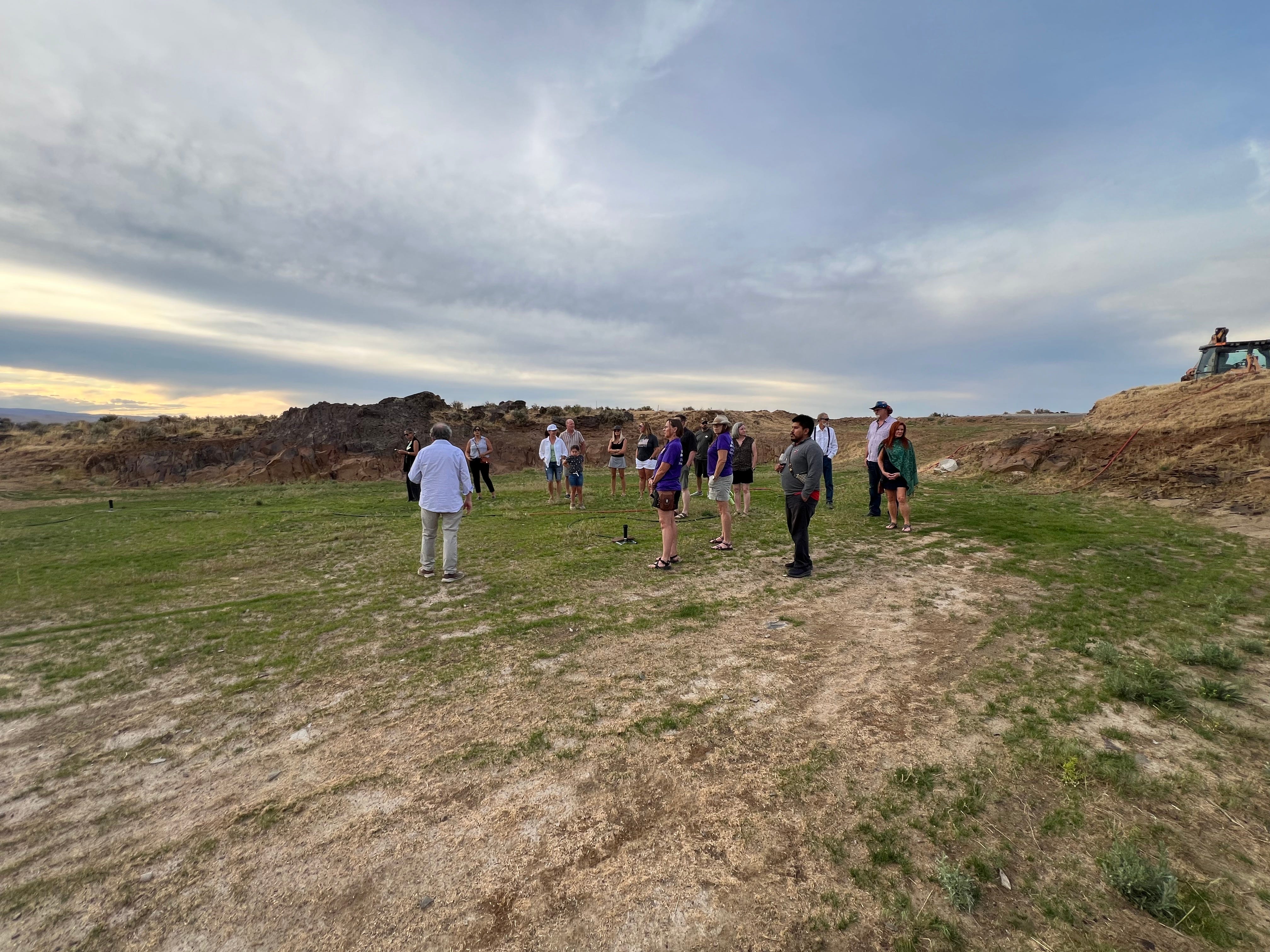
Then the shuttle deposited us in a hole in the ground.
Calling The Grotto a hole in the ground sounds dismissive until you stand inside it. In reality, the unusual depression in the rock is one of the discoveries around which much of The Hilltop’s current design has been organized.
Vince told the group that he and a worker began excavating the area roughly two and a half years ago. Across most of the top of the rock formation, he said, the soil is only about half an inch deep. Here, they dug approximately 15 feet without encountering even a pebble. They eventually moved outward until reaching rock roughly 47½ feet away, revealing what appeared to be an almost circular formation.
Instead of deciding what building they wanted and then forcing the landscape to accommodate it, the Bryans began asking a different question.
What was the landscape already asking them to build?
That question is important because The Grotto did not appear in isolation. Vince told guests that a theater district had been contemplated as part of a master plan dating to 2006. The discovery of this formation eventually convinced Vince and Carol that the indoor theater belonged here.
It also established one of the governing principles for everything that followed Saturday.
The Hilltop is not supposed to conquer this landscape.
It is supposed to listen to it.

When the Environment Becomes the Architecture
That philosophy creates an unusual assignment for an architect.
Representatives of ZGF Architects, selected through a design competition to work on the project, stood with guests inside the future Grotto and discussed what it means to design a sophisticated cultural venue in a place where one of the fundamental instructions is essentially: disturb as little as possible.
One architect described his first visit as a mixture of awe and uncertainty. The question wasn’t simply how to construct a building there. It was what they should touch, what they shouldn’t touch, what should remain visible and how architecture could be introduced without overwhelming the reason people would want to come there in the first place.
Another described the emerging building almost like a thunderegg, he even brought one to explain it, tough and rock-like on the outside, but containing something unexpected within. The goal, he explained, is for the architecture to respond naturally to the site while creating a place for discovery, art and ideas.
One phrase used during the presentation captured the approach particularly well:
The environment is the structure.
That creates practical problems as well as beautiful ideas.
The architects discussed solar generation, careful water use and reuse, native or appropriate landscaping, healthier building materials and methods of stitching the eventual structure into the existing landscape. They are considering whether the building could generate enough energy to support its operation across multiple performances and how water could be processed and reused rather than simply discharged.
Then there is the considerably harder question of what happens inside.
The Grotto is being envisioned as a roughly 1,200-seat venue capable of hosting remarkably different kinds of events. A symphony has different acoustic requirements than a speaker. Theater presents different demands than a banquet. Jazz is different again. Educational programs add another layer.
When asked how all of that would be packed into one building, one of the architects gave perhaps the most reassuring answer possible at this stage of a project this ambitious.
He said they didn’t know yet.
That wasn’t uncertainty masquerading as confidence. It was an acknowledgment of the complexity of what is being attempted. The design team still has work to do on acoustics, theater systems, operations and the business case necessary to make the venue function over time. Specialized acoustic and theater consultants are expected to be involved. The goal is not simply to create a beautiful room, but a room performers would want to visit, potentially record in, and return to because of how well it works.
Even the direction people look is part of the discussion.
There is the obvious view outward toward the Columbia and the surrounding landscape. There is the view downward toward ancient rock, lichen and tiny details most of us normally walk past without noticing. Then the architects realized there was another direction.
Up.
Early renderings contemplate an architectural opening toward the sky, introducing astronomy and the night above the Columbia into a building already intended to connect its visitors with what surrounds them. The idea sounds almost extravagant until you stand there and realize that the sky is every bit as much a part of this landscape as the basalt underneath your feet.
It was becoming clear that The Hilltop’s architecture wasn’t really the most important thing we were being shown.
The important thing was what Vince and Carol hoped would happen to people once they got there.


Getting Out of the Silos
Vince Bryan spent much of his professional life in neurosurgery, and his explanation for The Hilltop repeatedly returned to something he learned far away from concert stages and vineyards.
Silos are limiting.
Specialists become very good at looking deeply into their own disciplines. Scientists talk to scientists. Artists talk to artists. Technologists talk to technologists. Each field develops its own language, assumptions and ways of looking at the world.
Vince became interested in what happens when people start looking into one another’s silos instead.
He recalled an earlier gathering that brought together accomplished people from science, technology and the liberal arts. The early conversations were contentious enough that participants were effectively arguing that they didn’t need the other disciplines. After roughly 48 hours together, however, Vince said something different had emerged: there was value in bringing those worlds together.
That idea eventually became central to The Hilltop.
The project identifies four areas: Arts, Science, Environment and Human Experience but the more important idea is not the individual categories. It is what might happen at their intersections.
Vince illustrated the point Saturday with a story that may have explained the entire project better than any architectural rendering could.
Years ago, a string program was being held on the property and faculty members were preparing to perform for students and their families. Just before the performance began, a tall cowboy walked through the back door. Vince described the man’s hat, vest, string tie, buckle and boots in enough detail that it was easy to picture him, including Vince’s initial suspicion that the man had wandered into the wrong room.
Then the musicians began to play.
Vince watched the man react to the sound of the cello. He leaned forward. At the end of the movement, he stood and applauded enthusiastically. It happened again through the performance. At the end, the cowboy offered his own exuberant response before walking back out the door.
Vince could not know what happened after that man left. None of us can.
But for a few minutes, someone had encountered something beautiful that appeared to be completely new to him.
That, Vince explained, is what exposure can do.
It also helps explain why the Bryans talk as enthusiastically about a child seeing a performance for the first time as they do about attracting internationally recognized artists and thinkers.
The goal isn’t simply to put impressive people on a stage.
It is to create opportunities for somebody in the audience to discover something they did not know they loved.


A World Stage That Still Belongs to Home
That distinction matters in the 98848.
It would be easy to hear phrases like “world-class cultural destination” and assume The Hilltop is being designed primarily for people who will fly into Washington, attend an event overlooking the Columbia and leave again. The history of the neighboring Gorge Amphitheatre makes international tourism more than an abstract possibility.
Vince reminded the group Saturday that the original amphitheater began much more modestly.
The Bryans had planted grapes and needed people to come to the winery. For its grand opening, they planned to have the Wenatchee Brass Band perform while the mayor of George cut a ribbon. There was one problem: the Kentucky bluegrass planted around the winery had failed to germinate in the August heat.
Rather than welcome guests into a cloud of dust, the family and vineyard workers moved the event.
Vince described working around the clock, using irrigation materials and a backhoe to carve terraces into another portion of the property. That improvised gathering place became the beginning of the Gorge Amphitheatre.
The scale of what followed is now part of the identity of this corner of Grant County. The Gorge grew from a small local gathering place into one of the most recognizable outdoor music venues in the country.
Vince used that history Saturday to make a larger point. A place does not have to be in Seattle, Los Angeles, New York or Chicago to matter. He described this landscape not as being in “the middle of nowhere,” but “the middle of everywhere.”
But The Hilltop is not intended to become another Gorge.

In many respects, the Bryans are deliberately moving in the opposite direction.
Where the Gorge became enormous, The Hilltop is being designed around intimacy. Where tens of thousands of people can disappear into the scale of a major concert at the Gorge, The Grotto is intended to put audiences close to performers, speakers and one another.
Most importantly for Quincy and the surrounding communities, the Bryans are talking about local people using it too.
During the architectural presentation, the possibilities ranged from classical musicians and internationally known speakers to local schools staging Peter Pan or The Nutcracker. Vince spoke about educational opportunities. Church groups were mentioned. Community participation was not discussed as an afterthought to the “real” programming; it was discussed as part of what the building has to be capable of supporting.
That may ultimately become one of the most consequential tests of The Hilltop.
It is one thing to create a destination people will cross oceans to experience.
It is something else to create that destination while making sure the kid growing up a few miles away understands that the stage belongs to them, too.
Saturday afternoon, we began to see what that might look like.
And once again, it happened before the building existed.
For One Afternoon, the Future Appeared
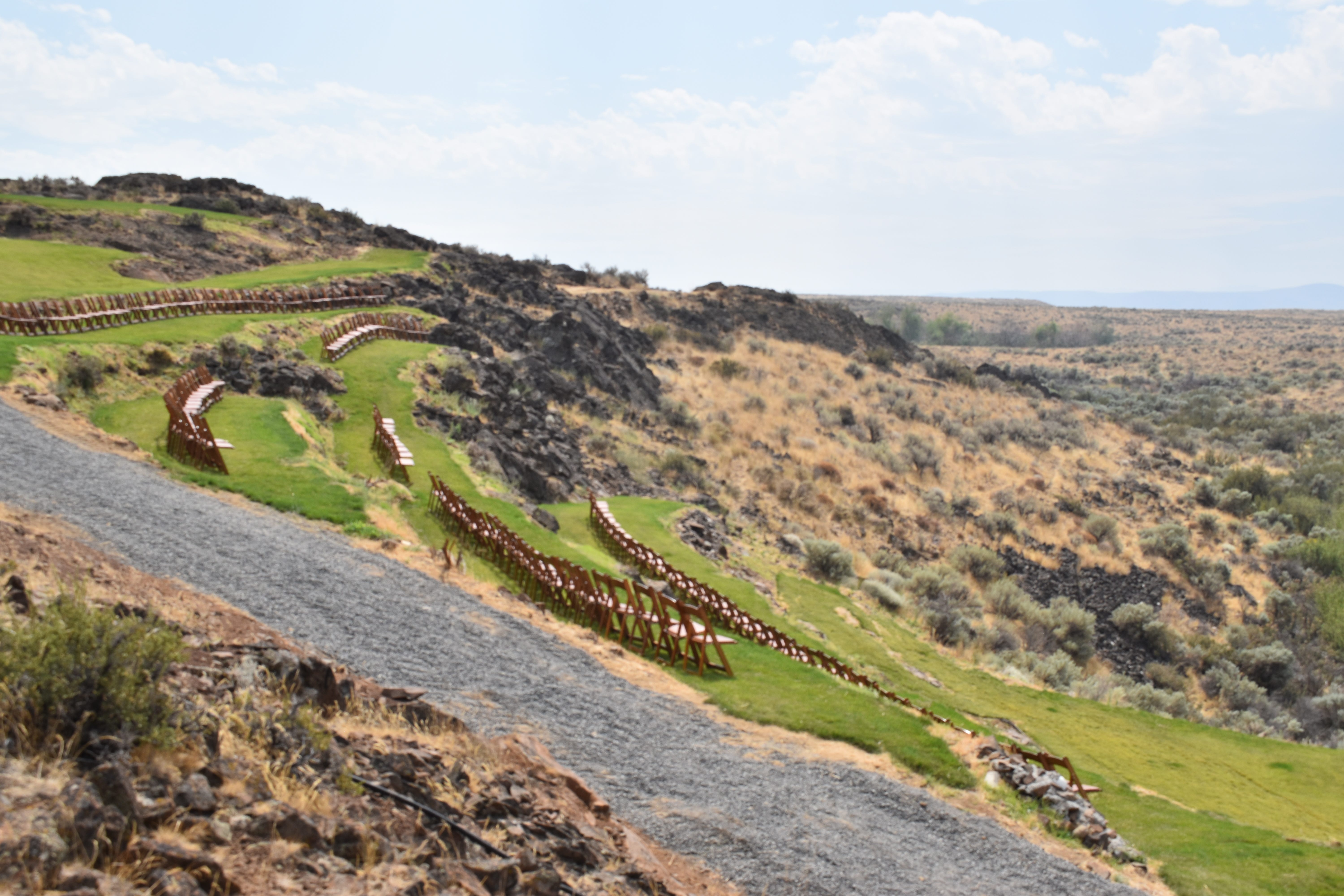
From The Grotto, we walked through the surrounding landscape toward The Terraces.
There was no finished performance venue waiting for us. What existed was something much older: a naturally formed set of terraces descending toward an open area that already resembles a stage, with the Columbia River and the Gorge beyond it.
Chairs had been positioned along the terraces.
Music began to play.
And that was where, for me, everything we had been hearing stopped being conceptual.
The sound moved through the natural formation while the landscape remained completely present around it. There was no need for a screen showing the Columbia because the Columbia was there. No theatrical backdrop was required to create scale. The cliffs, river, sky and distance had already taken care of that.
This was where I found myself thinking about my father.
It was also where I began to understand why Vince had spent so much time earlier talking about exposure.
You could show somebody a rendering of The Terraces. You could give them dimensions and seating capacities. You could explain acoustics. You could put together an impressive presentation about the Columbia River Gorge.
None of those things would recreate sitting there.
And before there was much time to absorb it, the day shifted again.
We returned toward The Grotto for a presentation from Whooshh Innovations focused on technology designed to help move fish through river systems. It was precisely the kind of transition that would have seemed strange almost anywhere else.
One minute, orchestral music overlooking the Columbia.
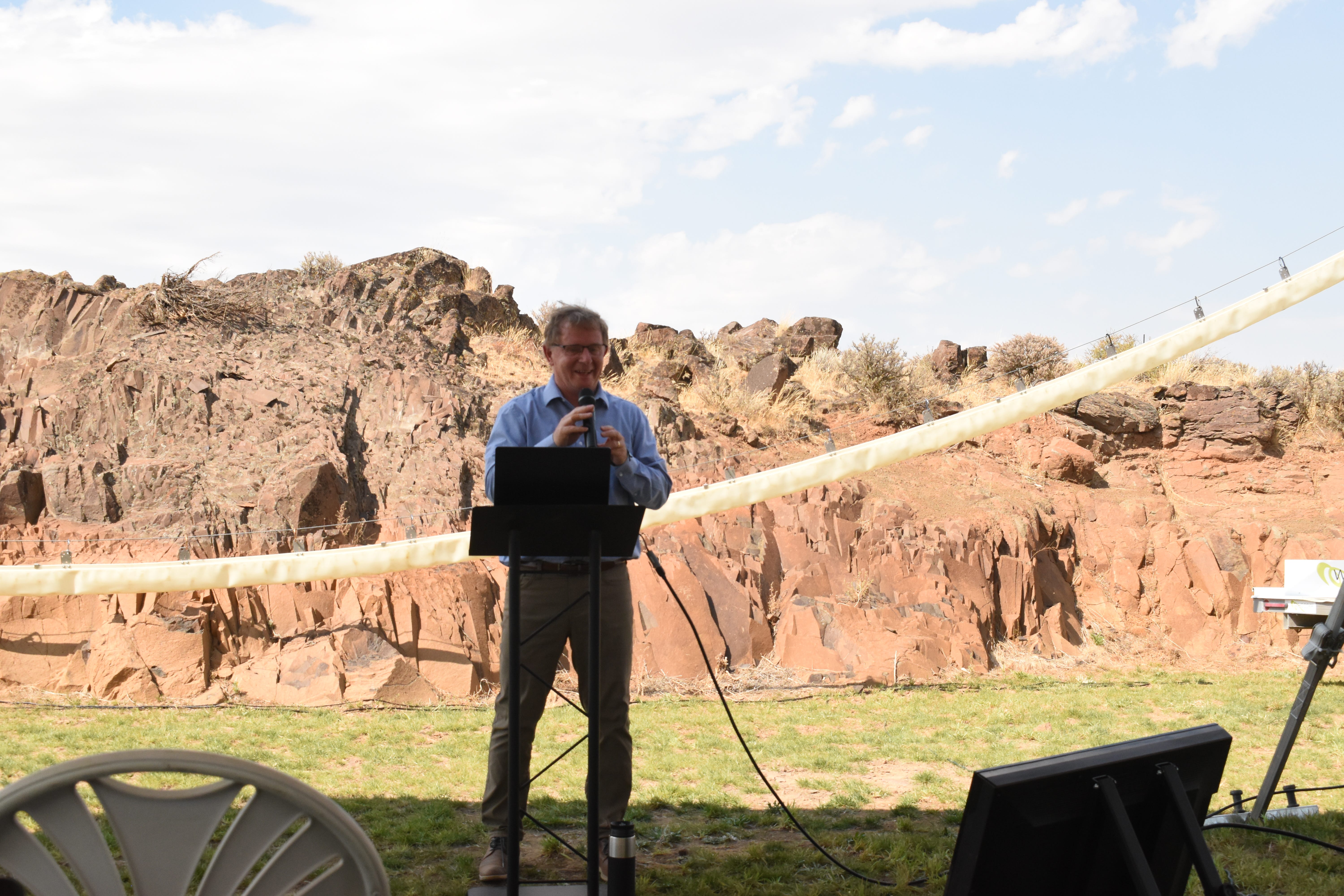
The next, fish passage technology.
Yet that apparent mismatch was the point.
Earlier we had heard Vince talk about getting people out of their silos. Now the festival itself was doing it to us. The same place intended to make room for musicians and actors was making room for engineers, scientists and environmental questions. The subject wasn’t included as an interruption between artistic performances. It belonged there because The Hilltop’s premise is that those conversations become more interesting when they stop being kept apart.
Later in the same presentation, that idea was pushed even further when the substance of the presentation was transformed into a professionally produced pop song, demonstrating what can happen when information and music are deliberately combined.
By late afternoon, the four ideas we had heard repeated; Arts, Science, Environment and Human Experience were beginning to feel less like words attached to a project.
We had spent several hours moving through them. What we had not experienced yet was what would happen when all four converged at once.
For that, we had to wait until the sun began to go down.


When the Sun Went Down, the Idea Changed
By the time we returned from the afternoon presentations for dinner, Vince and Carol Bryan had given us a fairly complete intellectual explanation of The Hilltop. We had stood inside the future Grotto and heard architects discuss a building that would have to accommodate performances, lectures, education and community events without overwhelming the ancient landscape surrounding it. We had walked through the rocks, sat in The Terraces with music moving through the natural formation and listened to a presentation about science and technology. Arts, science, environment and human experience had been repeated throughout the day as the four ideas around which The Hilltop is being organized.
We understood the concept. What we had not yet experienced was what might happen when all of those ideas began occupying the same moment.
Guests returned to Vince and Carol’s home for dinner on the lawn overlooking the Columbia before making their way to Stage B at Cave B Estate Winery for the evening performances. According to the official SOAR program, the Wenatchee Valley Symphony Orchestra was scheduled to begin at 7:15 p.m., followed by Broadway performances from Mari Nelson and Alexander Kilian, a message from The Hilltop, and David Foster & Friends with Katharine McPhee closing the festival from 9 to 11 p.m. It was an impressive lineup for the inaugural event, but simply listing the performers misses much of what made the next several hours work.
The Wenatchee Valley Symphony Orchestra took the stage first, and I have to admit that before SOAR, I did not know we had symphonic music of this caliber so close to home. I have heard symphonic music all my life, as almost everyone has, but mostly through recordings, movies and television. We sometimes forget how much of the music that gives our favorite films their scale, tension, emotion and sense of wonder originated with musicians sitting together in a room and creating that sound with actual instruments.
Hearing a full symphony in person strips away that distance. You can watch the strings move together, hear the brass enter behind them, feel percussion rather than simply hear it and begin to recognize how dozens of individual musicians become one instrument. When the orchestra performed the unmistakable opening associated with 2001: A Space Odyssey, the audience responded immediately. People applauded and called out as something deeply familiar suddenly arrived with the weight and dimension that only a live orchestra can give it.
Sitting there, I thought back to the story Vince had told earlier in The Grotto about the cowboy who apparently wandered into a classical performance years ago and encountered the sound of a cello in a way Vince believed he never had before. Vince remembered watching the man lean forward as he listened and then leap to his feet applauding at the end of the movement. The story wasn’t really about classical music. It was about what can happen when someone is exposed to something outside the boundaries of their normal experience.
Only a few hours after hearing that story, I was having a smaller version of the same realization. I had lived here for years without really knowing what the Wenatchee Valley Symphony could do, and before their performance was over, I was already thinking about bringing my daughters to hear them. That is the kind of outcome Vince had been describing all afternoon. Nobody had to convince me that I should appreciate a symphony. The opportunity to experience a good one is all the convincing I needed. They played through multiple genres of songs that most people recognized from movies whether they had known it was symphonic music or not.


The Gorge Became Part of the Performance
The orchestra would have been impressive inside a traditional concert hall, but there was another participant in the performance Saturday evening that no conductor controlled. As the Wenatchee Valley Symphony played, the sun began its descent beyond the Cascades and the Columbia River Gorge changed around us.
The bright afternoon gradually softened into evening. Light shifted across the cliffs, the sky changed with it, and the music continued while daylight slowly disappeared. There was no curtain and no carefully designed theatrical transition between scenes because the landscape was creating one of its own. The Columbia, the cliffs, the sky and the orchestra were all competing for your attention, yet somehow none of them seemed to take anything away from the others.
This is where describing SOAR becomes difficult without slipping into exaggeration. The sunset was beautiful. The music was beautiful. The vineyard was beautiful. The Gorge was beautiful. Those statements are all true, but they reduce an experience to a collection of adjectives. What made the moment remarkable was the way those separate things worked together. You could watch the changing light, hear the orchestra and feel the evening air at the same time, until eventually it became difficult to separate the music from the setting in which you were hearing it.
Earlier, Arts, Science, Environment and Human Experience had been presented as the four Waypoints behind The Hilltop. Sitting there as the sun dropped behind a live symphony, at least three of those ideas no longer required explanation. The environment wasn’t scenery placed behind the performance. It was participating in it. The art wasn’t isolated inside a building. It changed the way we experienced the landscape. The human experience was whatever was happening individually among the people sitting there as those two things came together.
For me, that connection had already happened earlier in The Terraces when the music and landscape unexpectedly brought my father to mind. Now, as evening arrived around an entire audience, I began to understand how deliberately Vince and Carol were trying to create opportunities for those kinds of connections. They cannot determine what someone will feel when they encounter a performance, an idea or the landscape. What they can do is create a place where the possibility exists.

Questions That Music and Theater Ask Differently
The evening shifted again when Broadway performers Mari Nelson and Alexander Kilian followed the symphony. Nelson and Kilian performed separately and together, bringing the human voice and theatrical storytelling into a day that had already included geology, architecture, environmental technology and orchestral music.
Their performances also helped clarify something that can sound abstract when The Hilltop is described only as a place where arts and sciences will meet. Science gives us extraordinarily powerful tools for asking what something is, how it works and what caused it. The arts often approach a different set of questions: what something means to us, why it matters and what it feels like to experience the parts of life that cannot be adequately described through measurements alone.
Those approaches do not have to compete with each other. In fact, much of Vince’s argument throughout the day was that we lose something when we insist that they remain separated. Earlier, he had talked about the limitations created when specialists remain inside their own silos and the possibilities that emerge when they begin looking into someone else’s. SOAR was beginning to function as a practical demonstration of that idea.


Viewed only as a schedule, the day should have felt disjointed. A presentation about fish passage technology does not naturally lead to Broadway. Ancient geology, architecture, symphonic music and discussions about human purpose do not ordinarily occupy the same program. Yet after several hours of moving between them, the contrasts started to feel intentional rather than strange. The festival wasn’t asking us to choose between those interests. It was asking what might happen when curiosity in one area leads us toward another.
That idea had been demonstrated particularly well earlier in the day when information from a presentation was transformed into a professionally produced pop song, using music to communicate the same ideas through an entirely different part of the human experience. By the time Nelson and Kilian finished, The Hilltop’s four Waypoints were becoming less useful as separate categories because the boundaries between them were already beginning to disappear.
Then the evening turned toward popular music, and something happened beside me that brought the entire idea down to the scale of one person’s life.

The Soundtrack We Carry With Us
David Foster’s name is familiar to a lot of people. His body of work is considerably more familiar.
Consider just a small piece of the catalog he has helped write, arrange or produce: Earth, Wind & Fire’s “After the Love Has Gone,” Chicago’s “Hard to Say I’m Sorry” and “You’re the Inspiration,” Peter Cetera’s “Glory of Love,” John Parr’s “St. Elmo’s Fire (Man in Motion),” Whitney Houston’s “I Have Nothing” and her recording of “I Will Always Love You,” Celine Dion’s “Because You Loved Me” and “The Power of Love,” Toni Braxton’s “Un-Break My Heart,” and “The Prayer,” recorded by Dion and Andrea Bocelli.
His credits extend far beyond those songs, through work with artists including Barbra Streisand, Michael Jackson, Madonna, Natalie Cole, Chaka Khan, Josh Groban, Michael Bublé, Andrea Bocelli, Dolly Parton and Kenny Rogers. Foster has won 16 Grammy Awards, including three as Producer of the Year, and his work has helped shape records and soundtracks that have collectively sold hundreds of millions of copies.
Before the headlining performance began, the audience watched a montage of music connected to Foster’s career. Songs and performers moved across decades, and as they did, Sarah was recognizing one after another. She has followed Foster’s work for years and knew considerably more about his career than I did, but even she seemed surprised by what happened when so much of it was assembled in one place.
As the montage continued, she leaned toward me and said that what we were hearing had been the soundtrack of her childhood, adolescence and young adult life.
That explained Foster’s career better than a list of awards or production credits could have in that moment. The music wasn’t important merely because it had been commercially successful. For people in the audience, those songs were attached to years of their lives. They belonged to movies they remembered, relationships, celebrations, difficult seasons, long drives, school years and versions of themselves that existed decades ago.
Music has an unusual ability to do that. A melody can remain somewhere in the background of memory for years, and then a few notes can suddenly return a person to a place, a relationship or a period of life with surprising clarity. Sarah wasn’t simply recognizing songs. She was recognizing pieces of her own history.
That was Human Experience, not as an institutional concept or a line on a presentation, but sitting in the chair next to me.
It also brought me back to what had happened earlier in The Terraces. My connection had been different. Music and landscape had made me think about my father and how much he would have loved sitting there. Sarah’s connection was to decades of songs that had accompanied her through different stages of life. Around us were hundreds of other people carrying memories and associations of their own.
A performer can play the same song for an entire audience, but there may be hundreds of different experiences of that song taking place at the same time.
David Foster & Friends
When David Foster & Friends finally took the stage, one of the surprises was how quickly the evening became funny.
After everything that had come before it; the presentations, the larger ideas, the symphony and Broadway performances the headlining show could easily have become overly formal. Instead, Foster and his wife, Katharine McPhee, brought humor and an easy chemistry to the stage. Stories and jokes filled the spaces between songs, and the interaction between them made the performance feel considerably more intimate than the résumés of the people onstage might suggest.
Daniel Emmet joined them during the performance, adding another distinctive voice to an evening that had already moved through several musical styles. Foster, McPhee and Emmet performed songs from across Foster’s long career, while the audience repeatedly recognized music that had been part of popular culture for decades. People laughed, sang along and responded to familiar openings before some songs had fully developed.
Behind them sat the Wenatchee Valley Symphony Orchestra.
That detail deserves attention because the orchestra’s role changed during the course of the evening. They had begun as one of the featured performances on the SOAR program. Later, they became part of David Foster & Friends itself. According to my notes from the performance, Foster told the audience that this version of the show had not previously been performed with a full orchestra, and the Wenatchee Valley Symphony stepped into that role for the night.
For a community story, that may be one of the most satisfying details of the entire evening. Musicians from our region were not simply there to warm up the crowd before nationally and internationally recognized performers took over the stage. They were part of the headlining performance, adding the depth of a full symphony to music many people in the audience had known for much of their lives.
The combination also reinforced something Vince had said earlier about wanting The Hilltop to remain intimate. The Gorge Amphitheatre has become extraordinary partly because of its scale. Tens of thousands of people sharing one performance can generate an energy that a small room could never reproduce. Vince and Carol are not trying to duplicate that experience. They are imagining something much closer, where the relationship between performer, audience and place operates differently.
Stage B was standing in for a future venue Saturday night, but the principle was already apparent. Foster could talk to the audience rather than simply perform in front of it. Humor could travel through the crowd. People could respond to a story, recognize a song and feel connected to the personalities onstage. The power of the evening wasn’t created by making everything bigger. Much of it came from making the distance feel smaller.
When the Pieces Stopped Feeling Separate
By the final portion of the concert, I had largely stopped trying to keep track of which part of The Hilltop’s mission we were supposed to be experiencing.
That may have been the clearest evidence that the idea was working.
The environment had never left. Even after darkness settled over the property, the Columbia River Gorge remained the place surrounding us. Science and technology had been part of the afternoon. Architecture had been discussed not merely as a way of constructing buildings, but as a way of preserving and directing people’s attention toward the natural world. The arts had moved from orchestral music to Broadway and then across decades of popular music.
Human experience had been threaded through all of it. It was in the cowboy from Vince’s story discovering the sound of a cello. It was in my thoughts about my father at The Terraces. It was in my decision that I wanted my daughters to hear the Wenatchee Valley Symphony. It was in Sarah hearing pieces of her life in David Foster’s catalog, and it was in the laughter, singing and recognition moving through the audience as the night continued.
Many of those moments were particularly grand by itself. The Hilltop’s ambition to bring them all together is enormous, but its success will eventually be measured one person at a time. A world-class building cannot make someone curious. A famous performer cannot guarantee inspiration. An architect cannot design an emotional response into a seat. They can only create conditions in which discovery and connection have a chance to happen.
Saturday offered an early test of those conditions.
The permanent Grotto has not been built. The Terraces remain largely a natural formation rather than a completed performance venue. The larger Hilltop campus remains a combination of land, plans, architectural work, fundraising and a great deal of construction still ahead. The architects themselves were candid that some of the difficult questions surrounding acoustics, operations and flexibility remain to be solved.
SOAR therefore could not prove that The Hilltop will ultimately become everything Vince and Carol envision. An inaugural festival cannot answer questions that will require years of design, fundraising, construction, programming and operation to resolve.
What it could test was the idea underneath all of that infrastructure: whether science, art, environment and human experience could be intentionally brought together without the result feeling forced.
For 11 hours Saturday, they were.

If This Was the Beginning
Eventually, David Foster & Friends reached the final song and an unusually long day began coming to an end.
People around us started gathering their belongings and talking about what they had just experienced. Sarah had spent much of the day documenting it through photographs and video while I had spent mine listening, taking notes and trying to understand what I was seeing. Normally, by the end of an event, I already have some idea of the story I am going to write.
This time, I didn’t.
I remained in my seat for a while trying to sort through it. I knew the evening performance had been exceptional, but describing SOAR as a great concert would have ignored most of what had happened. David Foster & Friends had been the culmination of the day, not the explanation for it. The story had started hours earlier among rocks that were hundreds of millions of years old, moved through conversations about architecture and environmental stewardship, into a technology presentation, across a naturally occurring amphitheater and finally onto a stage filled with musicians.
What made the experience difficult to put into words was not any one of those pieces. It was the accumulation of them.
Earlier in the day, Vince had described this part of Grant County not as being in the “middle of nowhere,” but in the “middle of everywhere.” There is a certain audacity to that statement, but Vince and Carol Bryan have some history behind it.
They have already watched one improbable idea on this landscape grow far beyond its beginnings. Vince told guests Saturday about the hurried work that went into preparing an improvised amphitheater for the winery’s early grand opening, a gathering place that eventually became the beginning of the Gorge Amphitheatre. What started as a solution to a very local problem became a venue capable of drawing people from around the world.
The Hilltop is another ambitious bet on this same corner of the 98848, but it is a different kind of bet. Rather than attempting to recreate the massive concert experience the Gorge now provides, Vince and Carol are proposing something smaller in scale and broader in purpose: a place where an internationally known performer and a Quincy student could potentially stand on the same stage at different times; where a scientist could introduce an audience to an idea they had never considered; where someone could hear a symphony for the first time; and where the landscape itself remains part of whatever happens there.
There are legitimate questions still ahead about whether all of that can be built, funded, sustained and kept accessible to the community around it. Those questions matter, particularly for a project with aspirations that extend far beyond Grant County, and they should remain part of the conversation as The Hilltop develops.
But after Saturday, there is also something concrete against which those future questions can be measured.
Before SOAR, The Hilltop was something Vince and Carol Bryan could explain to us. They could show us drawings, walk us across the property, describe the buildings and tell us what they hoped would happen when people from different disciplines and backgrounds eventually gathered there.
On August 22, for one long day above the Columbia, they did something more useful.
They showed us what they meant.
What This Means to You
It would be easy to finish this story with the final applause Saturday night, but for people living in the 98848, the more important part of The Hilltop story begins with what happens next.
The Hilltop is an ambitious project, and ambition alone does not guarantee success. The Grotto and The Terraces still have to move from concepts and natural formations into functioning venues. Money has to be raised. Architectural and engineering questions have to be answered. Buildings have to be constructed and maintained. Programs have to attract audiences, and the organization eventually has to prove that the combination of arts, science, environment and human experience can work beyond an inaugural festival designed specifically to demonstrate that possibility.
Those realities are important because Saturday made it very easy to get swept up in what The Hilltop could become. We experienced beautiful weather, an extraordinary landscape, accomplished performers, good food and an event carefully assembled to introduce people to a vision. SOAR was also a fundraiser, and the materials given to guests were clear that The Hilltop is seeking philanthropic support to help move that vision forward. Our experience Saturday gives us reason to take the idea seriously, but it does not eliminate the practical work between an impressive beginning and a sustainable institution.
For the local community, one of the most important questions will be whether The Hilltop can deliver on the part of its vision that received considerably less attention Saturday night than David Foster but came up repeatedly during the day: this is supposed to be a place for us, too.
During the architectural presentation, the examples weren’t limited to internationally known musicians, scientists or speakers. The conversation included local schools performing Peter Pan or The Nutcracker, educational opportunities, community productions and other uses that would put local people inside the same venue being designed to attract world-class talent. The architects are being asked to create a space flexible enough to accommodate all of those uses rather than designing exclusively for touring professionals.
That could matter enormously for young people growing up here.
A student in Quincy should not have to grow up believing that serious theater, symphonic music, scientific discovery and conversations with leading thinkers are things that happen somewhere else. Seattle has extraordinary cultural institutions. So do Portland and other major cities. Families with the money, time and ability to travel can seek those experiences out.
The Hilltop proposes reversing that equation and bringing some of those experiences here.
There is a difference between watching an extraordinary musician on a phone and sitting close enough to watch that person work. There is a difference between seeing a scientist explain an idea in an online video and having that person standing in front of you, potentially answering questions afterward. There is a difference between listening to orchestral music through earbuds and feeling a live symphony fill the space around you. We experienced some of those differences Saturday, and they help explain why Vince repeatedly returned to the importance of exposure.
Exposure does not determine what a young person will become. It gives them more possibilities from which to choose.
A Quincy student may encounter a cellist and decide to pick up an instrument. Another may listen to an engineer and become interested in solving environmental problems. Someone else may see an actor command a stage and discover theater. Most will simply have an interesting experience and continue with their lives, and that is perfectly fine. The point is not to manufacture musicians, scientists or artists. It is to make the world young people can imagine for themselves a little larger.
That is where Vince’s story about the cowboy and the cello becomes more than a charming memory. The man apparently did not walk into that performance because he was already a classical music enthusiast. He encountered something outside his normal experience and responded to it. Vince never knew what happened afterward, but he remembered the moment because of what it represented.
The Hilltop is essentially proposing to create a place where those encounters happen intentionally.
A Different Kind of Destination for the 98848
There is another potential consequence that reaches beyond education and cultural access.
Quincy already knows what happens when people from outside the region discover a reason to come here.
The Gorge Amphitheatre has spent decades bringing enormous crowds into this part of Grant County. Those weekends affect hotels, vacation rentals, campgrounds, restaurants, grocery stores, gas stations and other businesses throughout the area. They also bring traffic, public-safety demands and other pressures familiar to anyone who has lived here through a major concert weekend.
The Hilltop would target a different experience and, potentially, a different kind of visitor.
Its planned venues are considerably smaller than the Gorge, and intimacy is central to their design. The Grotto is being conceived around roughly 1,200 seats, while The Terraces is intended for approximately 2,000. Rather than competing with a 30,000-person amphitheater next door, The Hilltop is being built around the idea that smaller audiences can have closer experiences with performers, speakers and the surrounding environment.
If the project eventually attracts the caliber of artists, scientists and thinkers its founders envision, those visitors will still need places to stay, eat and spend time. They may also come for experiences that do not fit neatly into the traditional summer concert season. That creates potential opportunities for businesses throughout Quincy, George and the surrounding area, although the actual economic effect will depend on the eventual programming schedule, attendance, length of visitor stays and how much of that activity reaches businesses beyond the immediate property.
Those are questions worth following rather than answering prematurely.
There is also something less measurable at stake. The national and international identity of this part of Grant County has long been shaped by agriculture, the Columbia River, hydroelectric power and, increasingly, large-scale technology infrastructure. The Gorge added another identity by demonstrating that one of the world’s recognizable music destinations could exist among the basalt cliffs and sagebrush outside George.
The Hilltop is proposing another layer: that this landscape can also become a gathering place for ideas, arts, science and education.
Whether that happens at the scale Vince and Carol imagine remains to be seen. But after SOAR, it is no longer difficult to understand what they are attempting.

The Hard Part Starts Now
There is a danger after an event like Saturday’s of confusing a successful introduction with a completed project.
The Hilltop is not complete.
Its most important venues have not been built. Some design questions remain unresolved. The architects acknowledged as much when discussing the challenges of creating a room capable of handling everything from symphonic music and theater to lectures and banquets while maintaining excellent acoustics and efficient operations. Sustainability goals involving energy, water and the surrounding environment will eventually have to survive the transition from renderings and design conversations into engineering, construction and daily operation.
Then there is the financial reality. The founders’ SOAR letter described the festival as helping lay the foundation for The Hilltop and invited guests to consider becoming Founding Partners through philanthropic support. Building an institution with these ambitions will require more than enthusiasm generated by one successful event.
The local-access promise will also be worth watching carefully. There is an inherent tension in creating something intended to attract world-class talent and visitors while also promising that the community surrounding it will remain part of the institution. Tickets to major performers can be expensive. High-end destinations can unintentionally become places local families admire from a distance rather than places they actually use.
Nothing we heard Saturday suggested that is what Vince and Carol want. Quite the opposite. Their repeated references to schools, young people, community performances and exposing people to experiences they might not otherwise have were among the most consistent themes of the day.
The measure, however, will be what happens as the vision becomes an operating institution.
Will Quincy students perform there? Will local families be able to attend programs? Will teachers see educational opportunities that didn’t exist before? Will regional musicians share stages with internationally recognized performers, as the Wenatchee Valley Symphony did Saturday? Will someone who believes symphonies, Broadway, scientific lectures or serious theater “aren’t for people like me” walk through the door anyway?
If those things happen alongside the major performances and international visitors, The Hilltop could become something unusual: a destination that brings part of the world to the 98848 while simultaneously giving people who live here greater access to that world.
That possibility is worth paying attention to.

The Place That Isn’t Here Yet
I have spent several days trying to find the right way to describe Saturday.
I kept returning to the performers because they were extraordinary. I thought about the Wenatchee Valley Symphony playing as daylight faded behind the Cascades, Mari Nelson and Alexander Kilian bringing Broadway into the evening, Sarah realizing how much of David Foster’s music had accompanied her through different stages of life, and David Foster, Katharine McPhee and their friends turning the final hours into something that felt far more intimate than the résumés onstage would suggest.
But every time I tried to make the concert the center of the story, something felt incomplete.
Eventually, I kept coming back to that afternoon in The Terraces.
I was sitting on rock high above the Columbia, listening to music move through a natural amphitheater while looking across one of the landscapes that defines this part of Washington. Somewhere in that moment, I stopped thinking about the assignment and started thinking about my father. I could picture him sitting there, content to listen for hours, and I wished he could have experienced it.
That memory has stayed with me because it helped me understand something about what Vince and Carol are trying to build.
The most important thing about The Hilltop may never be its architecture, the famous people who perform there or the number of visitors it eventually attracts. Those things will determine whether the project succeeds institutionally, but they are not necessarily what people will carry home.
People carry home moments.
A child hearing an orchestra for the first time. A student meeting a scientist whose work suddenly makes a career seem possible. A family watching someone they know perform on a world-class stage. A person discovering an art form they had assumed wasn’t for them. A husband hearing a piece of music and unexpectedly thinking about his father.
Vince told us Saturday that his own mentor in neurosurgery deliberately exposed young residents to some of the greatest minds in their field because he understood what proximity to excellence could do. Vince and Carol are attempting to apply that idea on a much broader scale, creating a place where people can encounter excellence across disciplines and perhaps leave seeing some part of the world differently than they did when they arrived.
That is an enormous ambition for a hilltop outside Quincy.
Then again, this landscape has seen an enormous ambition before.
The Gorge Amphitheatre did not begin as the Gorge Amphitheatre the world knows today. It began with a winery, a local gathering, an improvised solution and two people willing to imagine that visitors might come to a remote piece of Grant County if there were something here worth experiencing.
Decades later, Vince and Carol Bryan are asking a similar question in a different way.
What if people came here not only to hear music, but to encounter ideas, science, theater, nature and one another? What if internationally recognized performers and thinkers came to the same place where children from Quincy and surrounding communities could someday take a stage? What if this corner of the 98848 could become, as Vince put it, not the middle of nowhere but the “middle of everywhere”?
There are buildings to design, money to raise and difficult questions still to answer before we know how much of that dream will become reality.
But Saturday gave us the first meaningful glimpse.
And when I think back on SOAR Festival 2026, I don’t first see the architectural renderings or even the famous performers under the lights. I see that unfinished terrace above the Columbia. I hear the music. I see the blue sky stretching across the Gorge, and for a moment, I can still picture my father sitting there beside me.
The Hilltop Vince and Carol imagine isn’t here yet.
For 11 hours Saturday, it felt like it was.