
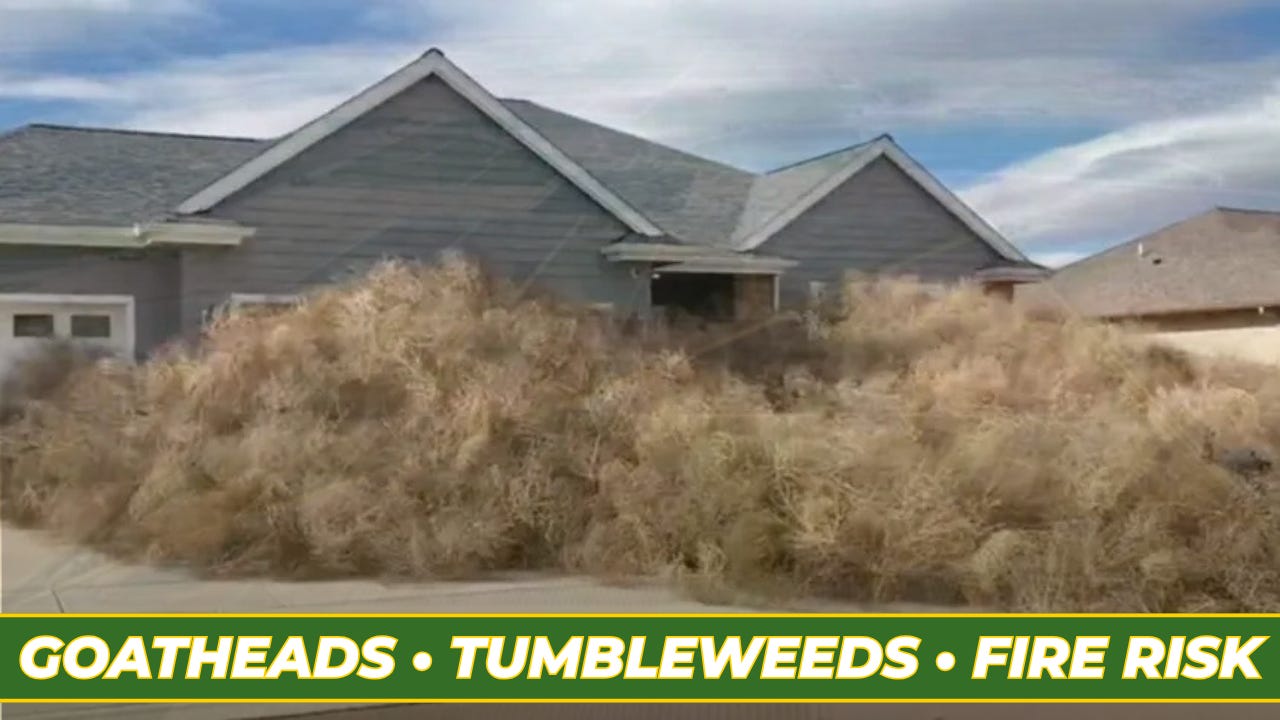
A flat bicycle tire is an inconvenience. A horse stepping into a patch of sharp goatheads is a larger concern. A wall of dry tumbleweeds piled against a home during fire season can become something more dangerous altogether. During the July 21 George City Council meeting, those problems came together in a lengthy discussion about how uncontrolled weeds are affecting daily life, tourism, private property and public safety in the 98848.
The conversation began during a review of the city’s climate-planning policies, but it quickly moved from long-range planning to conditions residents can see along streets, vacant lots, irrigation rights of way and the edges of town today. Council members said George has struggled for years with puncture vine, better known locally as goatheads and with tumbleweeds that blow into the city and collect around homes and businesses.
City staff said they are already spraying regularly, sometimes nearly every day, but the council acknowledged that the problem extends well beyond land controlled by the city. Seeds arrive on truck tires, equipment and hay. Tumbleweeds blow across property lines. Vacant and privately owned lots may go untreated. By the end of the discussion, the council was considering whether stronger enforcement, greater coordination and a more organized cleanup program may be necessary.
TL;DR
George council members said goatheads are damaging bicycle tires, affecting livestock and hurting the appearance and accessibility of the community.
Visitors and parade participants raised concerns about the weeds during George’s Fourth of July celebration.
Tumbleweeds collecting around homes and vacant properties were identified as a potential fire hazard.
City staff said they spray frequently, but goatheads spread quickly and can remain in the soil for years.
The council discussed private-property responsibility, nuisance notices, the Grant County Noxious Weed Control Board and contracted weed treatment.
City Attorney explained that George could potentially adopt a program allowing the city to clean up fire hazards and bill noncompliant property owners.
No new ordinance, fee or citywide weed-control program was approved during the meeting.

A Problem Residents and Visitors Can Feel
Council member Debbie Kooy raised the issue while discussing possible gaps in a climate policy report presented to the council. The report examined drought, extreme heat, heavy precipitation, wildfire smoke and air quality, but Kooy said George also faces environmental problems much closer to home.
“We’ve got a terrible environmental problem with weed control here,” Kooy said. “Every time the wind blows, we are inundated with tumbleweeds.”
She also pointed to puncture vine growing throughout town.
“You can’t ride a bicycle in this town without having your tires shredded,” she said.
The plant earns its goathead nickname from the shape of its hard, sharp seeds. Those seeds can puncture bicycle tires, lodge in shoes and paws, and create problems for horses and livestock. Kooy said the concern becomes especially visible during George’s Fourth of July celebration, when residents and thousands of visitors gather for the parade and other events.
“I can’t get through Fourth of July without having people in the parade griping at me and saying, ‘Why doesn’t the city do something about these goatheads?’” Kooy said.
Later in the meeting, she reported that approximately 8,200 people were in George for this year’s Fourth of July celebration, based on tourism data provided to the event board. That makes weed control more than a complaint about appearances. For many visitors, the city streets, pathways and gathering spaces they encounter during the holiday may be their most lasting impression of George.
The weeds also affect people who live in the community throughout the year. Kooy said the problem has accumulated season after season without a lasting solution.
“It just seems to accumulate from year to year to year to year,” she said. “And it gets worse.”
City Crews Are Spraying, but the Seeds Keep Coming
Public Works Director Aaron Hardwood said city staff are actively treating goatheads in public areas. He described spraying near rental property, city property, commercial areas and locations used by trucks.
“We pretty much spray every day,” Hardwood said.
One of the difficulties is how quickly puncture vine can grow and begin producing seeds. A plant that appears small one day can spread rapidly and become filled with mature goatheads before crews return.
“They go from the size of a can of chew to that big overnight,” Hardwood said. “It’s unbelievable.”
Killing the visible plant also does not necessarily end the problem. The council discussed how goathead seeds may remain viable in the ground for many years. If a plant has already bloomed and produced seeds, spraying it may stop further growth without removing what has already dropped into the soil.
New seeds also continue arriving. Trucks, cars, agricultural equipment and hay can carry goatheads from one property to another. Hardwood said truck traffic behind the Microtel is one example of how seeds can be carried through areas the city has already treated.
That makes weed control similar to clearing snow during a continuing storm. Crews may clean one section, but new material continues arriving from somewhere else. George can treat its streets and rights of way, but the city cannot prevent every seed or tumbleweed from crossing its boundaries.

The Question of Who Is Responsible
The council spent much of the discussion trying to define where the city’s responsibility ends and where the responsibility of a property owner or another public agency begins.
On private property, the responsibility generally rests with the owner. The situation becomes more complicated along irrigation district land, utility easements, vacant parcels and public rights of way.
Kooy described a large goathead plant growing in a water district right of way near her home. She said the district had indicated it no longer had money to maintain the area.
That raised a practical question: If the city does not own the land, the water district declines to treat it and the plant continues spreading seeds into the surrounding neighborhood, who is expected to act?
City officials also discussed the Grant County Noxious Weed Control Board. Hardwood said the city had not received a noxious weed notice this year, although signs had been posted on some privately owned properties.
The council considered having the city send nuisance letters to property owners and then refer unresolved cases to the county weed board. That would create a clearer process for notifying owners and documenting properties that continue to go untreated.
The council also discussed the limitations of city authority. George generally cannot enter private property and spray weeds simply because the city believes treatment is necessary. Doing so could create questions about liability, notice requirements and property rights.
One council member said private owners ultimately have a responsibility to maintain their property, but the discussion showed that identifying responsibility is easier than enforcing it.
Could George Contract for More Aggressive Treatment?
One participant asked whether the city could hire a private spraying company to treat problem areas with a soil sterilant and recover the cost through taxes, assessments or another fee.
A sterilant is different from a product used only to kill a visible weed. Depending on the product and location, it can prevent vegetation from growing for an extended period. The council discussed the possibility that an effective treatment could last several years.
The advantage would be a more organized approach carried out by a contractor with the time and equipment to remain ahead of the weeds. The disadvantage would be the cost and the question of who should pay.
If the city paid for a community wide contract, residents who maintain their property could be asked to help pay for properties whose owners do not. If the city billed individual owners, it would need a legal and administrative process to inspect properties, send notices, authorize work and collect unpaid costs.
Hardwood also drew a distinction between removing a nuisance and permanently changing private land. The city may have stronger legal authority to cut or remove vegetation creating an immediate hazard than it would to apply a chemical that prevents future vegetation from growing.
The council did not choose a funding method or authorize a contractor. However, the discussion made clear that regular spraying by a small public works staff may not be enough to control a problem spread across public, private and agency-owned land.

Tumbleweeds Turn Weed Control Into a Fire-Safety Issue
The conversation took on greater urgency when the council shifted from goatheads to tumbleweeds. Kooy said tumbleweeds blow into George from the west, where there is little to stop them, and collect around homes.
“There are people with tumbleweeds up to their knees in their houses,” she said.
Dry tumbleweeds can collect against fences, sheds, vehicles and homes. During the hot, dry and windy conditions common throughout the 98848, those piles can become concentrated fuel for a fire.
The council’s attorney said fire danger could give George a stronger basis for requiring property owners to remove accumulated vegetation. One member described a program he previously worked with in Chelan, where absentee owners sometimes left vacant properties unmanaged while waiting for the land to increase in value.
Under that program, the city notified owners that hazardous vegetation had to be removed. If an owner failed to act, the city could hire a contractor to complete the work and send the owner a bill. When the bill went unpaid, the cost could be placed against the property through a lien if the city had followed the proper legal process.
Hardwood said such a program could be created in George, but he cautioned that it would require considerable work. Properties would need to be inspected, notices prepared, deadlines tracked and contractors coordinated. The city would also need to document why a property presented a hazard and ensure that owners received the required opportunity to correct it.
The council did not direct staff to prepare an ordinance during the meeting, but the discussion established a possible path if George decides its current nuisance rules are not strong enough.
Timing Matters With Tumbleweed Control
Council members also discussed why mowing once during the summer may do little to prevent the next wave of tumbleweeds. Hardwood said tumbleweeds need to be addressed while they are still attached to the ground, preferably before seasonal winds break them loose.
“Mowing the town in July, that doesn’t work,” he said. “You’ve got to mow in the fall while it’s still attached.”
Once the plants begin rolling, assigning responsibility becomes nearly impossible. A tumbleweed found against one home may have started on a nearby lot, outside the city or miles away.
As the council joked during the meeting, no one can look at a tumbleweed that has crossed the community and confidently identify its original area code.
That uncertainty is one reason prevention matters. Removing plants before they break loose may be less expensive and more effective than repeatedly clearing large piles after they have already crossed roads and property lines.
Burning the Piles Creates Its Own Danger
The council also discussed whether tumbleweeds can be burned.
There may be limited exceptions that allow the burning of tumbleweeds under certain conditions, but participants agreed that dry tumbleweeds are especially dangerous fuel. They ignite rapidly and can be carried by wind, potentially spreading fire rather than simply disposing of the weeds.
One participant described tumbleweeds as the thing most likely to burn in George and called the possibility frightening.
That leaves the city and property owners with a narrow set of practical choices. The weeds must be cut, crushed, hauled away or otherwise removed before they form large piles. Waiting until they accumulate can turn a maintenance problem into a disposal problem, and eventually into a fire concern.
What This Means to You
Residents should continue reporting large goathead patches on city property or public rights of way to George Public Works. Hardwood specifically asked residents to call when they see a plant so crews can treat it before it grows and produces more seeds.
Property owners remain responsible for weeds and dry vegetation on their own land. Although the council did not adopt a new enforcement program, the discussion suggests the city may take a closer look at nuisance notices and the authority it has to require cleanup when vegetation creates a fire danger.
Owners of vacant lots and rarely visited property may be most affected by any future policy. Those parcels can become collection points for goatheads and tumbleweeds, particularly when the owner lives outside the community and does not regularly inspect the land.
For people who walk, cycle or keep animals in George, the issue is immediate. Goatheads can make sidewalks, shoulders and open areas difficult to use. For homeowners, dry tumbleweeds collecting near structures carry a different level of concern.
For the city, the challenge will be finding a response that is effective without placing the full cost on taxpayers or expecting a small public works department to maintain property it does not own.
George Must Decide Whether the Current Approach Is Enough
The July 21 discussion did not end with a vote, a new fee or a citywide cleanup contract. It did establish that council members see the problem as more than an occasional maintenance complaint.
Goatheads affect how residents move around town and how visitors experience George. Tumbleweeds affect the appearance of neighborhoods and can create dangerous fuel near homes. Both spread across boundaries that do not match the lines on a property map.
George cannot eliminate every seed carried into town on a truck tire, and it cannot stop every tumbleweed rolling in from outside the city. It can decide how quickly it responds, how clearly it defines responsibility and what happens when a property owner allows a known hazard to remain.
The conversation began with a flat tire and ended with a question of fire safety. That is why the weed problem can no longer be dismissed as something unsightly along the roadside. For George and the wider 98848, it has become a question of accessibility, community pride and how much preventable risk residents are willing to accept.
