
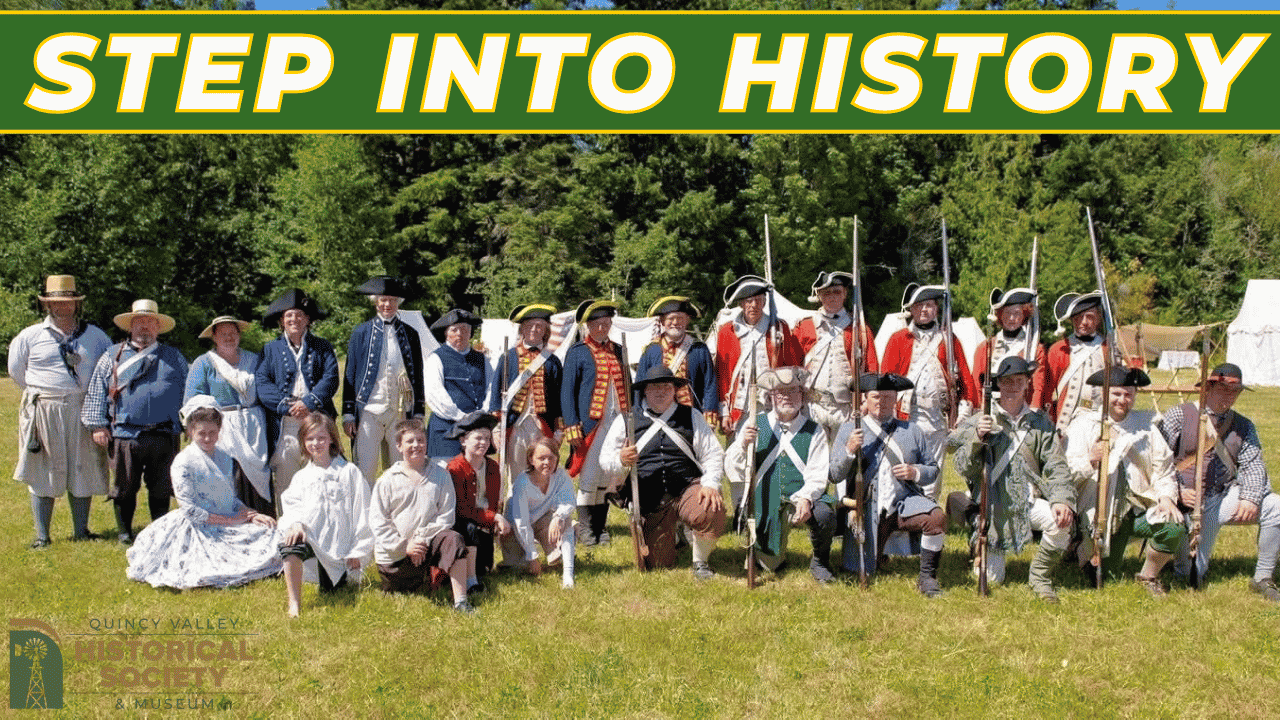
History will not be sitting quietly behind glass at the Quincy Valley Historical Society & Museum this weekend. It will be firing black powder, pressing apples, playing the fiddle, dancing the Virginia reel and walking the museum grounds dressed for the 1770s as the Historical Society invites the 98848 to take part in A Weekend of Heritage & Community, a multi-day celebration of America’s 250th anniversary.
For Director of Operations Harriet Weber, the weekend is about more than marking a milestone. After more than a year of planning, she hopes the celebration gives people an opportunity to experience history, learn something they did not know and spend time together as a community.
“This is the most ambitious festival we’ve ever put on,” Weber said. “But it’s because it’s America 250.”
Weber remembers the work that went into Quincy’s Centennial in 2007, but said the Historical Society has never attempted a celebration on this scale. “I’m a firm believer that you need to celebrate things in life,” she said. “They can be fun, but they’re also educational and inspiring. And so that’s been my goal.”
TL;DR
A Weekend of Heritage & Community celebrates America’s 250th anniversary with events Friday through Sunday.
A George Washington historical interpreter is visiting Quincy and participating throughout the weekend.
The Spirit of ’76 Living History Association will establish a colonial encampment at the museum.
Saturday includes apple pressing, fried bread, old-time games, weaving, black powder demonstrations and more.
Five-time National Fiddler Champion Jacie Sites and the Nitpickers will perform twice Saturday.
The Ceremony of Oneness will bring 27 country-of-origin flags together beneath the American flag.
Saturday evening features a Heritage Barn Dance and candlelit colonial encampment.
Sunday concludes the weekend with A Heritage of Faith in the Heritage Barn.

Bringing History Out of the Museum
The celebration reaches beyond the museum grounds before Saturday’s main festival even begins. A George Washington historical interpreter is visiting Quincy and speaking with local students, giving them an opportunity to encounter the first president through living history rather than only through a textbook.
Friday evening, Washington will be joined by a local John Hancock for An Evening with George and John in the Pioneer Church. Riley Youngren will play the church’s harpsichord, mixing Mozart with Beatles music, while Washington speaks between musical segments. Weber described it as a deliberately lighthearted approach to history, joking that it is George and John “without Paul and Ringo.”
By Saturday morning, the experience expands across the museum grounds with the arrival of the Spirit of ’76 Living History Association. The group is traveling from the west side of the state to establish a colonial encampment near the Heritage Barn, where members will camp, cook their own food and demonstrate aspects of everyday life from the period. Black powder demonstrations will add another element of living history, and visitors can return Saturday evening from 8 to 9 p.m. to see the camp by candlelight during the Spirit of ’76 Camp Glow.


A Celebration Meant to Be Experienced
Saturday’s Celebration of Harvest & Culture runs from 11 a.m. to 3 p.m., although the Spirit of ’76 encampment will remain open from 10 a.m. to 4 p.m. Much of the day is built around activities that allow visitors, particularly children and families, to experience pieces of the past instead of simply reading about them.
There will be apple juice pressing, old-time games, a weaving demonstration and fried bread prepared in the Summer Kitchen. George Washington will have a trivia booth, the Sagebrush Mercantile will be open, and Jimmy’s Hot Dogs will have food available for purchase. Samples of the apple juice and fried bread will be free.
Music is also a major part of the day. Jacie Sites and the Nitpickers will perform twice in the Heritage Barn, from 11:30 a.m. to 12:30 p.m. and again from 1 to 2 p.m. Sites is a five-time National Fiddler Champion traveling from Idaho for the celebration. Between the two sets, members of Spirit of ’76 will present a fife and drum performance.
Taken together, the activities reflect Weber’s larger goal for the weekend. A visitor may come because the children want to play the games, because someone wants to hear a national champion fiddler or simply because they are curious about the colonial encampment. Once they are there, each activity becomes another opportunity to encounter a piece of history.
Out of Many, One
One of the most meaningful parts of Saturday for Weber is not new to the Historical Society. At 2:15 p.m., the Ceremony of Oneness returns to the Heritage Barn, bringing together 27 flags representing the countries of origin of people whose stories became part of the American story.
Volunteers will carry flags representing countries including Mexico, Ireland and Sweden. State Rep. Alex Ybarra will speak, the Quincy High School Spectrum Choir will perform two patriotic selections and George Washington will offer brief remarks. The group will then proceed outside, where the 27 flags will be placed around the base of the American flag.
For Weber, the image represents E pluribus unum — “out of many, one.”
“All these different countries, we should be one people,” Weber said.
The Spectrum Choir will sing the national anthem at the flagpole before Spirit of ’76 conducts another black powder demonstration to close the major daytime festivities and shift towards eveing. In a community like Quincy, where families trace their histories to many different parts of the world, the ceremony connects the nation’s larger anniversary with the people who make up the 98848 today.

From the Minuet to Footloose
After the daytime festival ends, the Heritage Barn will reopen at 7 p.m. for a community barn dance designed to move through several generations of American dance.
The evening begins with the minuet, representing the 1700s, before moving into the Virginia reel. Sites will return with her fiddle to provide live music for the reel, followed by a country waltz and later generations of popular dances. Harvey and Diana Cameron will teach the Macarena and another line dance before Quincy High School theater students who performed in Footloose last spring lead the evening’s finale.
Weber is not expecting anyone to master generations of dance in one evening. The dances will be taught quickly, practiced a couple of times and then attempted with the music. Like much of the weekend, the goal is to give people a chance to participate and perhaps discover something new while having fun together.
During the evening, visitors will also be able to step outside for the Spirit of ’76 Camp Glow from 8 to 9 p.m., offering a very different look at the colonial encampment after dark.
Sunday Looks at a Heritage of Faith
The weekend concludes Sunday morning with A Heritage of Faith at 11 a.m. in the Heritage Barn, a program Weber particularly wanted to include in the anniversary celebration. The service is designed as a historical journey through portions of America’s religious history rather than a typical Sunday worship service.
Narrator Ron Huxtable will help guide the audience through different periods, beginning before the nation’s founding with the Puritans and moving through the First and Second Great Awakenings, Revolutionary War, Civil War and into more modern periods. Jess Slusher will serve as officiating pastor and present excerpts from sermons connected to the different eras, while hymns and live music will change along with the historical timeline.
Local musicians will help tell that story, including the Roseburg children on violin and piano and gospel pianist Glenda Bishop. A small choir will lead “The Battle Hymn of the Republic” when the program reaches the Civil War era. Members of Spirit of ’76 will also participate, and a final black powder demonstration following the service will bring the weekend to a close.
“We have every reason to celebrate, and I hope they learn something.” – Harriet Weber
Why Celebrate 250 Years?
Weber is in her 25th year with the Quincy Valley Historical Society & Museum, and the America 250 celebration has become one of the most ambitious projects of that tenure. Her reason for putting so much effort into the anniversary, however, is relatively simple: she believes important things are worth celebrating and history is worth understanding.
Her hope is not that everyone leaves knowing every name, date or detail presented during the weekend. She would rather see someone encounter a person, idea or piece of history that makes them curious enough to learn more.
“It’s a good thing to celebrate 250 years of freedom,” Weber said. She also hopes visitors “learn something” and perhaps find themselves challenged by something they assumed they already understood.
That distinction matters. The history of the United States is not a story without mistakes, disagreements or difficult chapters. It is a story and a work in progress; it is our story. Weber and the Historical Society know the value of learning from history and are always striving to share that with us as a community. History gives a community an opportunity to understand where it came from, appreciate what previous generations built and learn from what they got wrong along the way. The United States of America is the longest running Constitutional Republic in history. Our story as a nation is still being written and by knowing our history we write an even brighter future.


What This Means to You
For families in the 98848, this weekend offers something that can be difficult to reproduce through a book, classroom lesson or video: the chance to experience pieces of history together. Children can watch apples being pressed, try old-time games, hear a fife and drum, watch a loom at work and walk through a colonial encampment. Adults can listen to music, learn a dance, talk with historical interpreters or discover something about the country’s past that they did not know before.
You do not have to be a historian to participate; walking though pieces of American history for an afternoon learning more about it, seeing it though a different lens is open to everybody. The Historical Society has built the weekend around an idea that has guided much of its work in Quincy: history belongs to the entire community, and understanding it becomes easier when people can see, hear and experience it for themselves.
Weekend Schedule at a Glance
Friday, September 25
George Washington visits local schools (though out the day)
7 p.m. — An Evening with George & John, Pioneer Church
Saturday, September 26
10 a.m.–4 p.m. — Spirit of ’76 History Encampment
11 a.m. — Spirit of ’76 Black Powder Demonstration
11 a.m.–1 p.m. — Apple Juice Pressing
11 a.m.–2 p.m. — Old-Time Games & Weaving Demonstration
11:30 a.m.–12:30 p.m. — Jacie Sites & the Nitpickers
12:30 p.m. — Spirit of ’76 Fife & Drum
12:30–2 p.m. — Fried Bread Dough in the Summer Kitchen
1–2 p.m. — Jacie Sites & the Nitpickers
2:15 p.m. — Ceremony of Oneness
3 p.m. — Spirit of ’76 Black Powder Demonstration
3 p.m. — Daytime Festival Ends
7 p.m. — Heritage Barn Dance
8–9 p.m. — Spirit of ’76 Camp Glow
All day — George Washington Trivia Booth, Sagebrush Mercantile, cotton candy and Jimmy’s Hot Dogs
Sunday, September 27
11 a.m. — A Heritage of Faith, Heritage Barn
Following the service — Spirit of ’76 Black Powder Demonstration
History Worth Passing Along
After more than a year of preparation, the tents will eventually come down, the period clothing will be packed away and the museum grounds will become quiet again. What Weber hopes remains is a little more curiosity about the people and events that came before us, along with an appreciation for what it means to reach a milestone few nations have reached.
That may ultimately be the best reason for the 98848 to participate. The weekend is not asking residents simply to look backward. It is giving parents and grandparents an opportunity to bring children with them, giving neighbors an excuse to gather together and giving another generation a chance to encounter stories that only survive when someone decides they are worth telling.
For one weekend in Quincy, those stories will not be sitting quietly behind glass. They will be outside the museum, playing music, pressing apples, carrying flags, dancing in the barn and inviting the next generation to come take a closer look.
