
At Tuesday night’s Quincy School Board meeting, Monument Elementary quietly delivered one of the most important conversations happening anywhere in the 98848 right now.
Not because administrators stood up and claimed everything was perfect.
Actually, the opposite.
Principal Phil Averill and his staff openly discussed attendance struggles, intervention gaps, reading concerns, scheduling limitations, and the reality that many students need more support than schools traditionally have time to provide. But alongside those challenges was something else: a school actively redesigning how it serves students instead of simply accepting that the system is overloaded.
The presentation was honest, practical, and deeply focused on students.
That tone mattered.
Because for parents in the 98848, hearing a school say, “Here’s where we are, here’s what’s working, and here’s what still needs improvement,” builds trust in a way polished statistics never will.
TL;DR
• Monument Elementary improved its percentage of students attending school 90% of the time from 69% to 73% this year
• Monument staff said illness outbreaks in February significantly impacted attendance numbers
• Students reported record-high feelings of safety and connection inside the school building
• Monument created a “dual intervention schedule” allowing students to receive multiple support services instead of forcing schools to choose only one intervention path
• Forty-three additional students were able to participate in STEAM because of the new intervention structure
• Monument reported major math growth gains for special education students, including a 37% increase in students reaching “Typical” or “High Growth” on STAR Math
• Restorative circles continue to become a major part of Monument’s culture and conflict resolution process
The Attendance Conversation Was About More Than Attendance
One of Monument’s major School Improvement Plan goals this year focused on attendance. The school set a target of increasing the percentage of students attending at least 90% of the time from 69% to 79%. Current numbers now sit around 73%.
During the meeting, Averill noted that February illness outbreaks heavily impacted the data, adding that without that month the school would likely have been closer to 76%.
But the most important part of the discussion was not the percentage itself. It was how Monument framed the problem.
“The most important part of that is creating an environment that they wanna be in,” Averill told the board.
That sentence became the through-line for much of the night.
The school is not approaching attendance as simply a compliance issue. Monument’s leadership repeatedly tied attendance back to relationships, belonging, safety, and connection. Based on the school’s student survey data, those efforts appear to be making an impact.
According to Panorama survey results shared during the presentation, 96% of Monument students reported having a trusted adult in the building. That number increased from 92% earlier in the year. Students also reported the highest school safety scores Monument has seen in years.
That kind of growth does not happen accidentally. It reflects a deliberate effort to build a school culture students actually want to be part of.
Monument Is Rethinking How Intervention Works
One of the strongest parts of the presentation centered around Monument’s intervention schedule.
Traditionally, schools often face a difficult reality: students may qualify for multiple support services, but schedules only allow schools to prioritize one at a time.
A student may need reading intervention, multilingual learner support, special education services, or enrichment opportunities like STEAM. In many schools, staff are forced to choose which need gets addressed during intervention periods.
Monument decided to rethink that model.
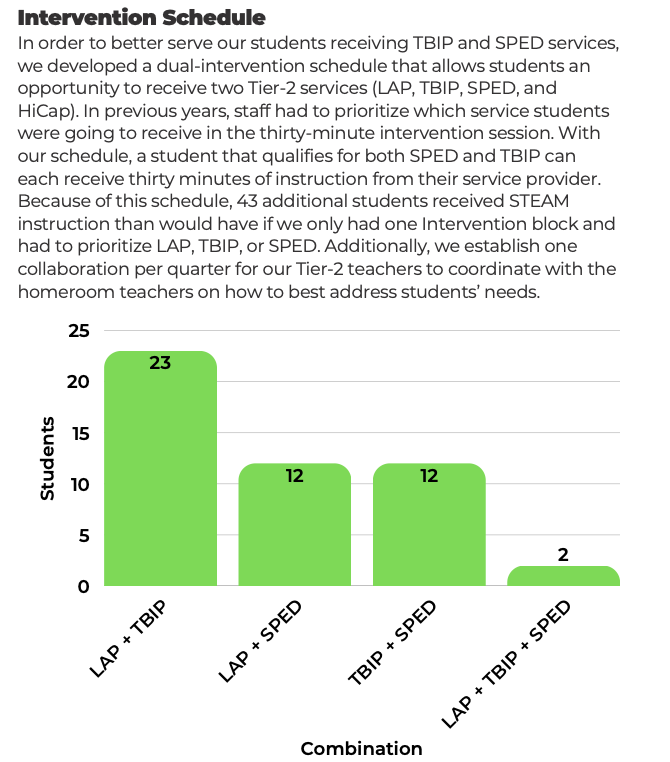
The school developed what staff called a “dual intervention schedule,” allowing students to receive multiple Tier-2 supports instead of forcing teachers to choose one service over another.
Tier-2 specialist Pauline Boffen described the old reality honestly during the meeting: “We would have to say, ‘Well, I want this student, but you need this student,’ and we were making decisions about what intervention students were receiving.”
The redesigned schedule now allows students to receive combinations of services including LAP, TBIP, SPED, and STEAM instruction. Monument reported that 43 additional students were able to participate in STEAM this year because of the new schedule structure.
That matters because enrichment opportunities are often the first thing students lose when intervention schedules become overloaded. Instead of asking students to sacrifice one need for another, Monument is trying to create enough flexibility to support both.
The Math Growth Numbers Got Attention
While Monument acknowledged reading growth still needs improvement, the school’s math numbers stood out during the presentation. Particularly for special education students.
According to Monument’s report, the percentage of special education students reaching “Typical” or “High Growth” in STAR Math increased by 37% compared to the previous year. That is a substantial jump. Averill acknowledged the school intentionally put heavy focus on math this year after recognizing performance concerns.
“It wasn’t like a quiet whisper of math,” he said. “It was a very loud, ‘We need to get better at math.’”
At the same time, staff also acknowledged that heavily focusing on one area can sometimes unintentionally allow another area to receive less attention. Reading growth numbers showed improvement for some student groups but not at the same pace as math.
Again, the tone mattered. There was no attempt to avoid the uncomfortable parts of the data. Instead, the conversation focused on what adjustments need to happen moving forward.
Restorative Circles Are Becoming Part of Monument’s Identity
Another major portion of the report focused on restorative circles, which Monument increasingly uses as part of its school culture and conflict resolution process. Unlike traditional discipline systems focused primarily on punishment, restorative circles bring students together to discuss conflict, emotions, harm, accountability, and solutions. Students answer guided questions in structured conversations designed to help them understand both impact and responsibility.
“If we don’t take care of their SEL needs and meet those needs, we’re never gonna get to them in the academic realm,” Averill explained during the meeting.
The process appears to be becoming deeply embedded inside the school culture. Staff said students now regularly ask for restorative circles themselves when conflict happens. “I need a circle with…” has become common language inside the building.
That may be one of the strongest indicators that the process is working. It is no longer simply a disciplinary tool being imposed on students. It is becoming part of how students communicate and solve problems.
What This Means for Families in the 98848
For parents watching Monday night’s presentation, one thing became very clear:
Monument Elementary is not standing still.
The school is actively evaluating where students are struggling, where systems are failing, and where schedules or structures need to change in order to better serve students. That does not mean every problem is solved. It absolutely is not. But the willingness to openly discuss weaknesses while simultaneously building new solutions matters.
There is also a larger theme emerging across Quincy schools right now. Increasingly, schools are moving away from broad one-size-fits-all approaches and toward targeted intervention systems designed around specific student needs.
Monday night’s conversation offered one of the clearest examples yet of what that looks like in practice.
The Bigger Story Happening Inside Monument Elementary
At one point during the presentation, Averill described Monument’s larger goal this way:
“Our goal is to create a place where students experience safety and belonging.”
That idea connected nearly every part of the discussion Monday night.
Attendance.
Interventions.
Math growth.
Reading struggles.
Restorative circles.
STEAM access.
All of it ultimately comes back to whether students feel connected enough to engage in learning. That may have been the biggest takeaway from Monument Elementary’s report. The school is not treating relationships as separate from academics. They are treating relationships as the foundation academics are built on.
For families across the 98848, that is probably worth paying attention to.
