
🔓 This article is free for the community.
Help keep local independent news alive in 98848.
Become a Founding Supporter →
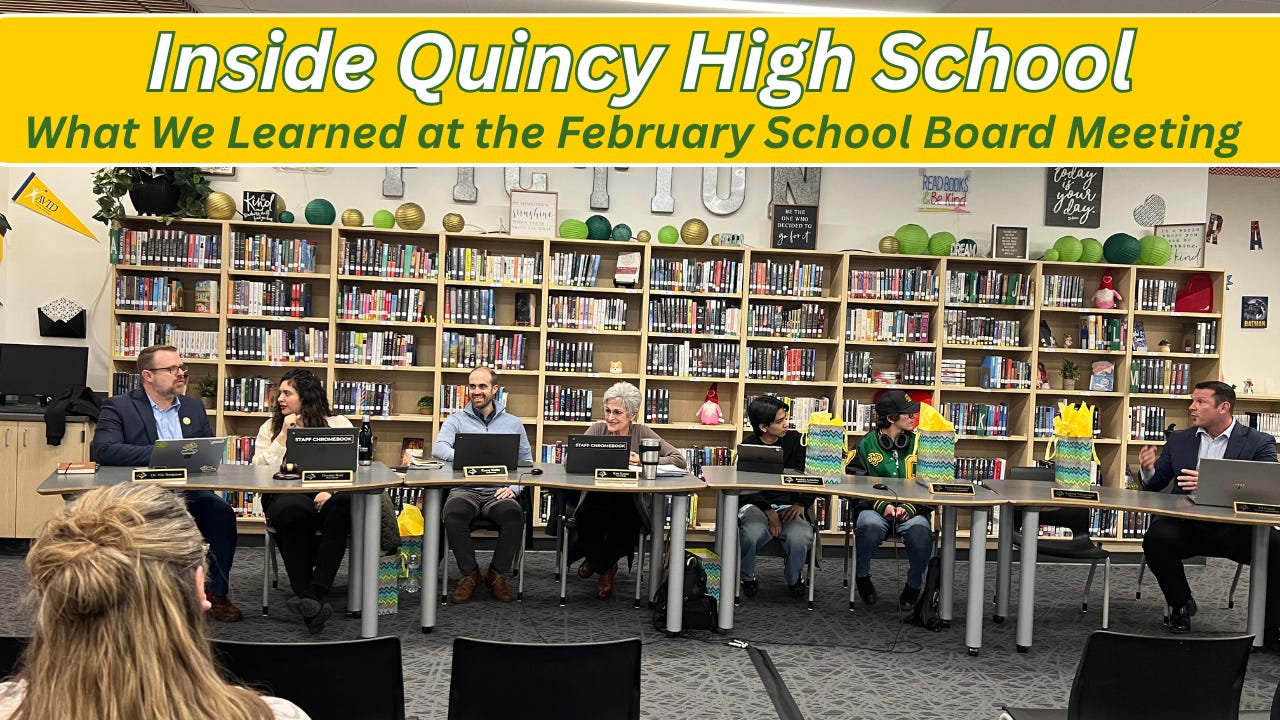
When Quincy High School administrators stepped up to present at the February 10 school board meeting, this wasn’t just a slideshow of statistics.
It was a snapshot of where our high school stands — and where it’s trying to go.
If you’re a parent, taxpayer, or just someone who cares about the next generation here in the Valley, here’s what stood out.
A School That Reflects Our Community
Quincy High School currently serves 942 students. Nearly 90% of those students are Hispanic/Latino. More than 75% qualify as low-income. About 22% are English language learners.
Those numbers matter.
They’re not excuses. They’re context.
And in that context, an 89.9% four-year graduation rate is something worth paying attention to.
The administration made it clear: their focus is building lifelong learners while balancing accountability with belonging. It’s a phrase you hear often — but in a town like ours, it carries weight.
The Honest Academic Conversation
There was no sugarcoating the math numbers.
Currently, overall math SBA proficiency sits at 14.2%. The goal is to raise that to 20% by May 2026.
That’s ambitious.
To get there, Algebra 1 teachers are revisiting foundational concepts throughout the year instead of teaching them once and moving on. They’re also using student feedback to adjust instruction — something that wasn’t standard practice a decade ago. Another positive step, analyzing the 6th - 8th grade math programs to see what can be update to help prepare for students for success in Algebra.
Literacy is stronger but still being pushed.
The goal is to move 10th-grade proficiency from 75% to 80% by next spring. English teachers are focusing heavily on key details, central ideas, and collaborative learning — strengthening not just reading scores, but analytical thinking.
This wasn’t presented as “we’ve solved it.”
It was presented as “we know where we need to grow.”
That matters.
The Real Push: Life After Graduation
The strongest theme of the night wasn’t test scores.
It was pathways.
Right now, Quincy High School students have access to 170 college credits through dual enrollment, Running Start, College in the High School, and articulated credit programs. Onsite admissions partnerships include EWU, CWU, and WSU.
That means students can walk across the graduation stage with real college credit already earned.
But there’s another number administrators want to move.
FAFSA/WAFSA completion currently sits at 50%. The goal is 60%.
Why? Because if students don’t complete financial aid paperwork, many never enroll — even if they qualify.
One thing many families don’t understand is that FAFSA/WAFSA programs aren’t just for 4 year universities. It can be used for community college, tech schools and more in to help students based on the direction they want to go.
So the school is making personal calls to families. Hosting parent nights. Partnering with WSAC and Big Bend. Tracking completion more closely.
It’s less about paperwork.
It’s about opening doors.
The dedication of our teachers and staff to helping our young people know they CAN move forward with hope and real possibility is commendable. At the same time, it was tragic to hear how many students don’t know that they can go further.
The best news, our teachers are effectively changing that limiting belief to give our young people brighter futures.
Safety: A Quiet but Important Shift
One of the more encouraging updates was about discipline and campus safety.
Referrals are down.
Fights are dramatically down — just two this year compared to sixteen last year.
Nicotine and THC vape incidents have dropped significantly as well. The school has implemented vape sensors and recently added a metal-detecting wand.
Administrators noted that about 2% of students account for 40% of referrals — a small group that requires targeted intervention rather than blanket discipline.
Student Intervention Specialists are working directly with Tier 2 and Tier 3 students, meeting regularly and supporting families.
In a time when school safety dominates headlines nationwide, the tone here was steady and proactive — not reactive.
Participation Is Strong — and Growing
Athletics numbers are solid.
This year shows strong multi-sport participation, with more students playing two and three sports than last year at this time.
Arts and academic programs remain active — from FFA and DECA to Husky Band Day and the annual musical.
The message was clear: students are showing up.
And that’s half the battle.
What This Means for Quincy
If you boil the entire presentation down, here’s what I walked away with:
Quincy High School is not pretending everything is perfect.
Math scores need work. Financial aid completion needs work. Like every school in Washington, there are academic gaps to close.
But behavior is improving. Participation is strong. Graduation rates are solid. College pathways are expanding. And there is intentional effort behind the scenes to move the needle.
For a school serving nearly 90% Hispanic students, many from working-class and migrant families, that effort is significant.
The story isn’t “everything is amazing.”
The story is this:
There is measurable progress happening inside Quincy High School — and administrators are being transparent about where growth still needs to happen.
That’s what a healthy school looks like.
And for a town like ours, that’s worth paying attention to.