
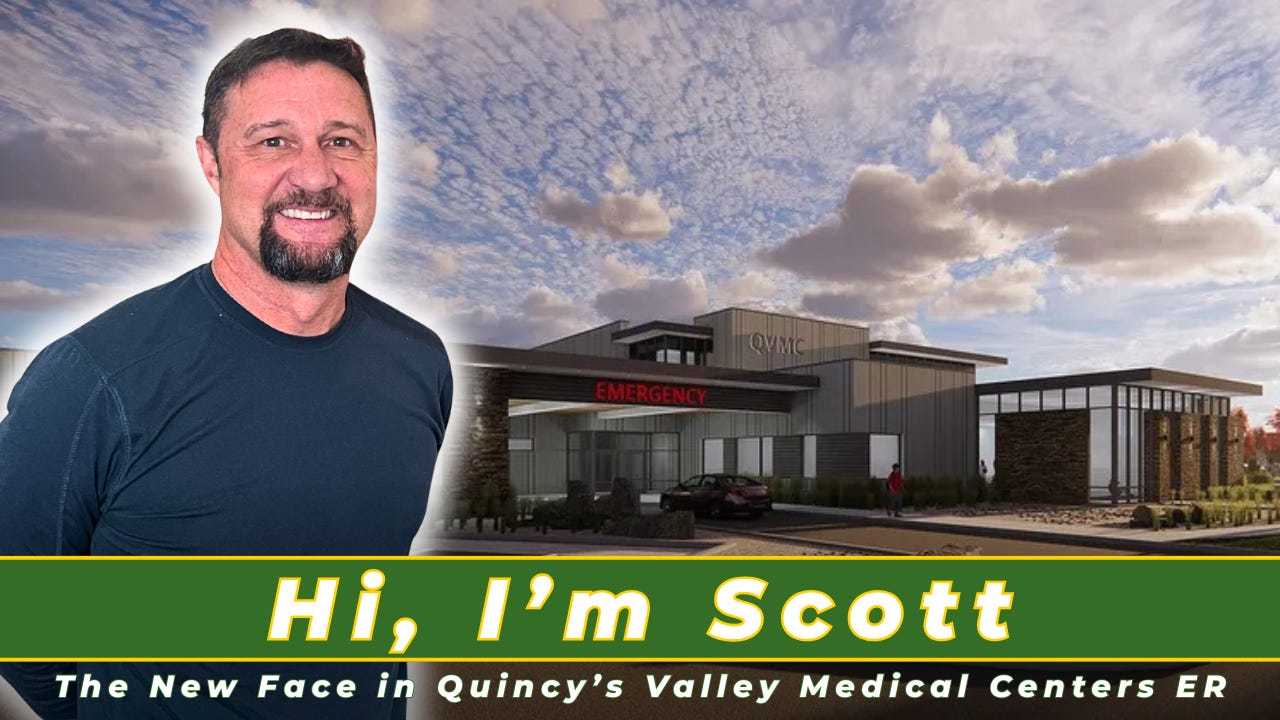
There are some interviews where the tone is set before the first question is even asked. When Dr. Scott Ekin walked into our interview at Quincy Valley Medical Center, he smiled, reached out, and said, “Hi, I’m Scott. Nice to meet you.” That matters. In a place like the 98848, where people want to know who is taking care of their families, that small introduction said a lot. Dr. Ekin is the newest full-time ER doctor at Quincy Valley Medical Center, and this conversation was about helping the community meet the person behind the title before they ever need him in an emergency room.
TL;DR
• Dr. Scott Ekin has joined Quincy Valley Medical Center as a full-time ER doctor after previously serving through visiting rotations.
• He brings about 30 years of emergency medicine experience, including work in larger urban ER settings.
• He chose Quincy in large part because of QVMC CEO Glenda Bishop and what he saw in the hospital and community.
• He described Quincy Valley Medical Center as “the single nicest hospital I’ve ever worked in.”
• His approach to emergency medicine is calm, team-based, and focused on both medical skill and personal care.
• His advice to the community is simple: move your body, get outside, and take your health seriously before an emergency happens.
A Doctor Who Still Wants to Be on the Front Line
Back on March 23, the Grant County Public Hospital District 2 Board of Commissioners voted to extend full-time privileges to Dr. Scott Ekin, making permanent what had started as visiting rotations at Quincy Valley Medical Center.
Dr. Ekin is originally from Pittsburgh, Pennsylvania. He grew up as what he described as a baseball player, hunter, outdoorsman, and trumpet player in the marching band. He originally thought he would become an engineer, but somewhere along the way, he realized he liked people more than math. That realization eventually took him to medical school at the Mayo Clinic, residency in Pennsylvania, time serving in the Air Force in Omaha, and then to Washington, where he has been since 1999.
He is also a father of five in a blended family, recently became a grandfather, and is preparing for life as an empty nester. Outside the ER, he loves music, the outdoors, woodworking, and staying active.
That personal side matters because this story is not just about adding another doctor to the schedule. It is about introducing the 98848 to someone people may meet on one of the hardest or scariest days of their life.
“I’m happy to be here.”
See Listing Here
Why Emergency Medicine?
Dr. Ekin did not originally plan to become an ER doctor. In medical school, he thought he wanted to become a hand surgeon. He loved the complexity and elegance of the anatomy. But after hearing a surgeon’s son talk about how much his father missed because he was always at the clinic or in the operating room, Ekin reconsidered.
Emergency medicine gave him a different rhythm.
He described himself as a sprinter, not a long-distance runner. ER medicine lets him work hard, focus intensely, and then go home without being on call or carrying a patient panel with him.
But there was another reason too.
He remembered seeing a very sick patient during medical training and realizing the specialist in the room was scared. That moment stayed with him.
“I never want to be scared of a patient. I want to be capable.”
That sentence explains a lot about how he sees the work. He knows he may not always be able to save someone, but he wants to know what to do when the moment comes.
Why Quincy?
When asked what brought him to Quincy Valley Medical Center, his answer was immediate.
“That’s easy. That’s one word answer or two word answer. Glenda Bishop.”
Dr. Ekin said he had left Kaiser last summer and was not quite ready to retire. He still felt like he had “gas in the tank,” but he did not want to keep doing full-contact urban emergency medicine. A friend told him he should check out Quincy. He stopped by on his way back from taking his daughter to WSU and met with QVMC CEO Glenda Bishop on a Sunday afternoon.
That made an impression.
He described Bishop as smart, driven, and capable, and said she believed deeply in what the hospital was becoming. After working here, he said he believes she was right.
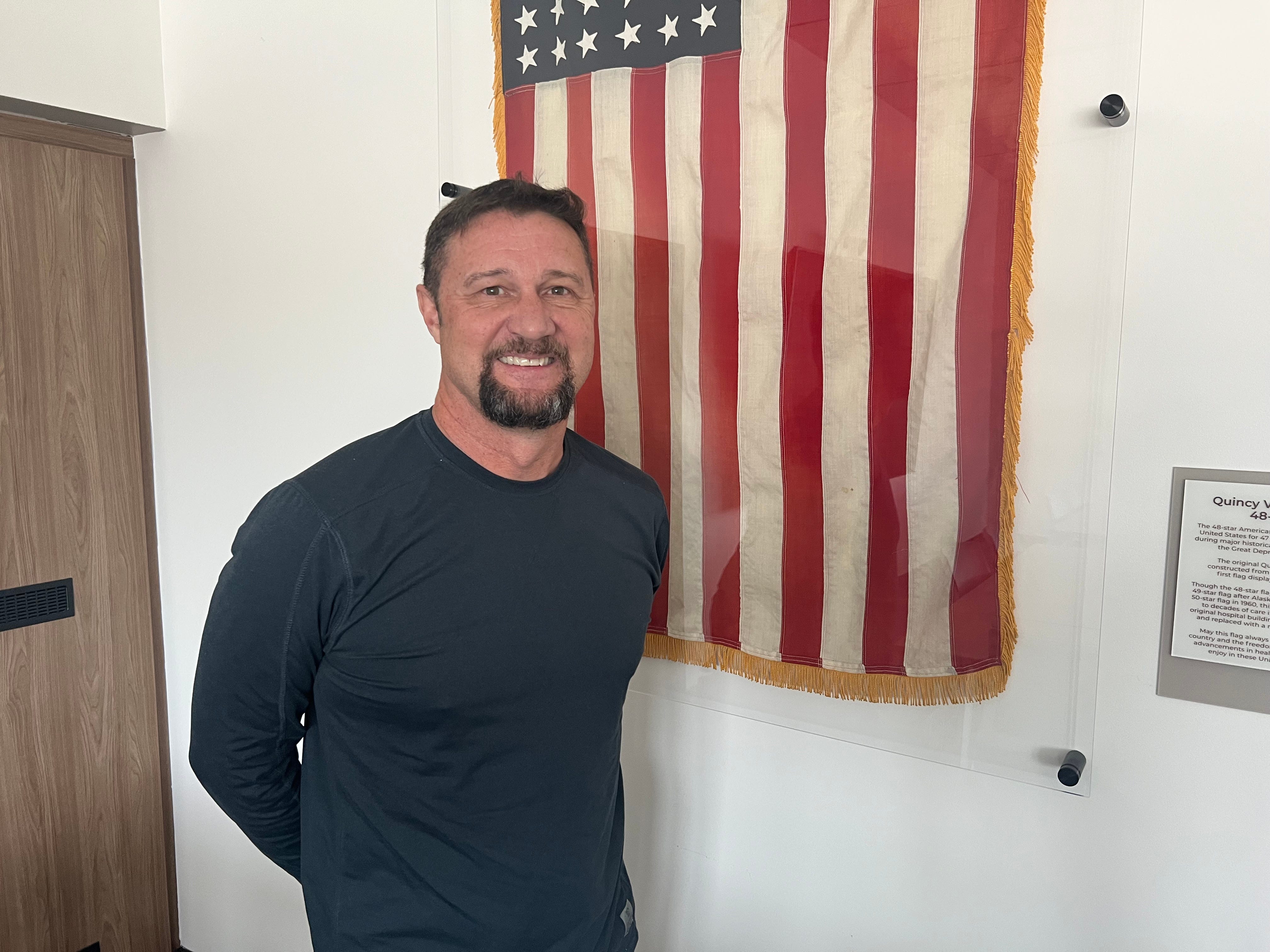
What Stood Out About Quincy
One of the things that has stood out to Dr. Ekin is the way people in Quincy care for each other. He talked about staff giving patients rides home, families gathering around loved ones, and the kind of community cohesion that is harder to find in larger systems.
He also spoke warmly about working with Quincy’s Hispanic community, describing people who work hard, laugh easily, are thankful for care, and are deeply family-oriented.
For him, that has been one of the eye-opening parts of coming here.
“There’s cohesion here.”
That is a simple statement, but it says something important about what he has seen in our hospital and in this community.
What Kind of Care Can People Expect?
Dr. Ekin was direct about this. He wants people to know Quincy Valley Medical Center is capable, well-equipped, and providing good care.
He called the new facility “top-notch” and said that for a small-town hospital, it has what is needed to keep someone alive, stabilize them, treat them, or get them to the next level of care when needed.
He also pointed to the teams around him: nurses, technicians, wound care, physical therapy, and the broader hospital staff.
“This facility is the single nicest hospital I’ve ever worked in.”
That is a strong statement from someone who has worked in emergency medicine for about 30 years.
He also used a phrase from his medical school days: “not many, but good.” That is how he described QVMC. It may not be the biggest hospital. It may not have every specialty. But what it does have, he said, is good.
Rural ER Work Is Different
Emergency medicine in Quincy is not the same as working in a large urban hospital. Dr. Ekin said ER shifts here are typically 48 hours, sometimes 72 depending on the schedule. The patient volume is lower than a city ER, but the responsibility is still real.
He said they may see 10 to 15 patients a day, compared with 20 or 30 in eight hours at a larger hospital. But the slower pace allows for something valuable: time.
Time to talk.
Time to educate.
Time to understand what is happening.
Time to walk a family through a hard decision.
He compared it to “cooking ribs instead of microwave.” It is a slower process, but it is still emergency medicine.

When Should You Come to the ER?
Dr. Ekin said there are two common extremes. Some people refuse to come in until things are almost unbearable (that’s me). Others come in for things that could wait for a primary care appointment.
His message was balanced: do not ignore serious symptoms, and do not wait too long.
Chest pain, abdominal pain, serious injuries, shortness of breath, confusion, severe headache, and concerning symptoms should be taken seriously.
“Don’t mess around with these things. Come get it checked out.”
In the Quincy ER, he said they see the usual “meat and potatoes” emergency medicine: chest pain, headaches, shortness of breath, abdominal pain, injuries, fevers, and confusion. But Quincy also has its own local flavor, including orchard and agricultural injuries.
He joked that for a while he felt like the “orchard ladder specialist” because of the number of serious falls he treated from orchard ladders.
Calm in the Room
One of the strongest parts of the interview came when Dr. Ekin described how he handles pressure.
He said emergency medicine is not about one doctor being the hero. It is a team sport. The nurses, technicians, and support staff matter. If a nurse tells him he is needed in a room immediately, he goes.
He described his role as figuring out who needs care now, who can wait, and what has to happen next. From there, he leads his team towards getting the patient to the next step.
When a patient is critically ill, he said the first thing he does is slow himself down.
“My job is to bring the temperature down.”
That kind of calm matters. In an emergency, the tone of the room often follows the tone of the person leading it. Dr. Ekin said he will stand at the end of the bed, breathe, and think through what has to happen first.
He shared a personal philosophy he learned from military teams guys, you may have heard this before, but it is critical when lives are on the line. Slow is smooth. Smooth is fast.
That is not just a saying. In an ER, it can be the difference between chaos and care.
Why He Still Does This Work
Dr. Ekin shared a story from the night before our interview. An elderly patient, someone he had seen several times recently, was nearing the end of life. Dr. Ekin had the time to sit with the man’s wife and talk through what the patient would want. Would he want to be transferred? Would he want to be placed on a ventilator? Or was it time to keep him comfortable and let him pass peacefully?
The family was able to gather. The staff was present. The patient was cared for in a calm, respectful way. Something that is not usually possible in a bigger urban ER
“Helping somebody have a good death, that’s a good day.”
That is not the kind of thing people always think about when they think of emergency medicine. But it is part of the work. Sometimes the ER is about saving a life. Sometimes it is about helping a family through the end of one.
Either way, it requires both skill and humanity.

His Advice to Quincy
When asked what health or safety advice he would give every household in Quincy, Dr. Ekin did not hesitate for long.
Move your body. Get outside. Get sweaty.
He said if there were a medication that reduced depression, heart disease, and helped people live longer, everyone would want it. But much of that benefit is available through something basic: regular movement.
His recommendation was simple: 150 minutes a week of aerobic exercise. That could be five 30-minute walks.
It does not have to be CrossFit. It does not have to be complicated. Just move.
And if you see someone walking laps around the hospital with headphones on, there is a good chance it might be Dr. Ekin himself. Dr. Ekin doesn’t just think other people should follow his advice, he lives by it himself.
What This Means to You
For people in the 98848, this matters because emergency care is not theoretical. At some point, someone you love may need it. You may need it. And when that happens, confidence matters. Dr. Scott Ekin wants people to know Quincy Valley Medical Center is capable, the staff is caring, and the ER is ready to handle more than many people may realize. If you need a bigger hospital, they can help arrange that. But if you live here, his message is clear: do not be afraid to come here first.
A Face Behind the Care
The point of this interview was not to turn a doctor into a celebrity. It was much simpler than that. It was to put a face, a voice, and a little bit of story behind one of the people who may be standing in the room when your family needs help.
Dr. Scott Ekin came across as experienced, calm, direct, and human. He has worked in bigger places. He has seen harder rooms. He has nothing to prove by insisting on a title. He introduced himself as Scott, talked about emergency medicine as a team sport, and made it clear that he believes Quincy Valley Medical Center is a place where good care is happening.
That matters here. Because in the 98848, trust is still built face to face. And sometimes it starts with something as simple as, “Hi, I’m Scott. Nice to meet you.”