
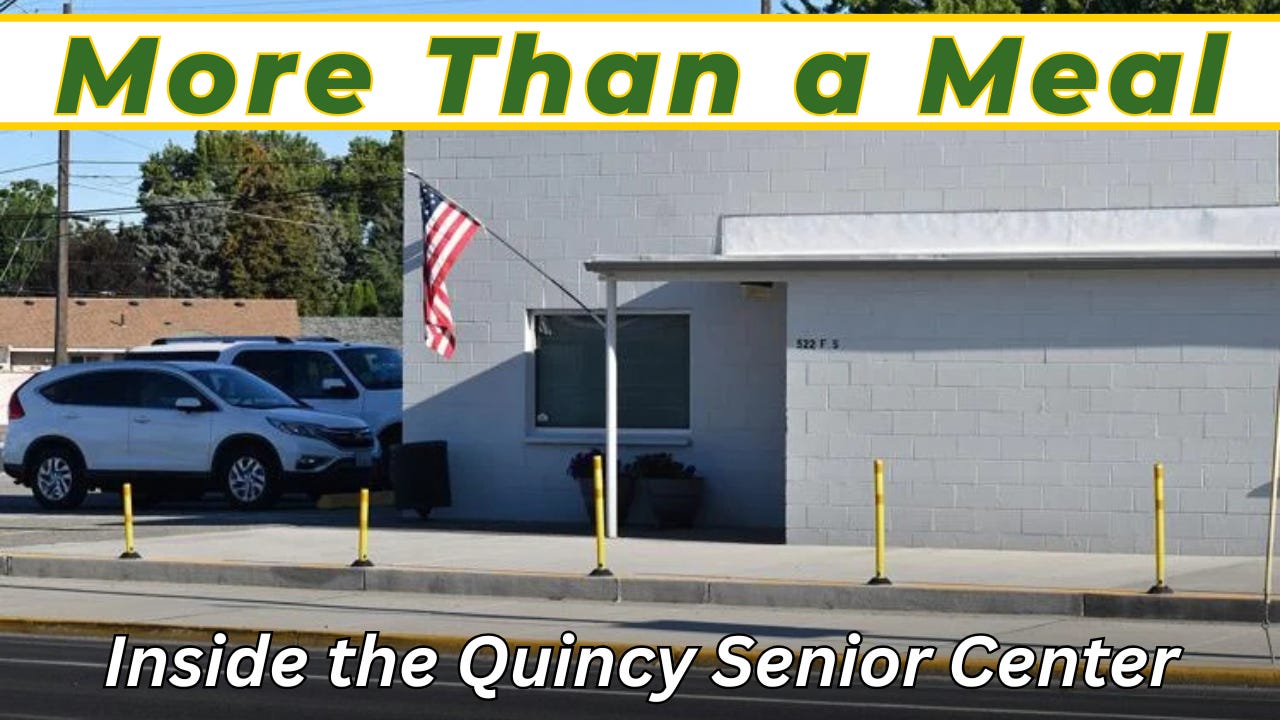
The first thing a visitor notices at the Quincy Senior Center is not the schedule on the wall or the meal being prepared in the kitchen. It is the conversation. Around the room, people are playing cards, catching up with friends, sharing news about their families and checking on those who have been having a difficult week. In a community where gathering places can be hard to find, the center has quietly become one of the places holding people together across the 98848.
That role is especially important for older residents who may live alone, no longer drive or have family living elsewhere. Yet the center is not only a place for seniors, and it is not simply a dining hall. Its meals are open to the public, many of its activities welcome community members of different ages, and its staff regularly helps people find services, borrow medical equipment or determine whom to call when they do not know where else to begin.
Now, as Director Stacia prepares to step down in August after eight and a half years, the center is also looking for someone willing to learn beside her and carry that work forward.
TL;DR
The Quincy Senior Center offers meals, exercise classes, games, social gatherings, entertainment and educational presentations throughout the week.
Lunch is served Mondays and Wednesdays; dinner is served Tuesdays and Thursdays. Meals are open to everyone, not only seniors.
Lunch costs $6 for members and $7 for nonmembers. Dinner costs $11 for members and $12 for nonmembers.
The center loans medical equipment, including wheelchairs, walkers, canes and other mobility or home-care supplies.
Community members may participate in activities, eat meals, donate supplies or produce, and help provide rides for seniors who cannot drive.
Director Stacia is leaving after eight and a half years, and the center is seeking a service-minded successor who can train with her before she departs.

A Place to Come as You Are
Stacia did not arrive in Quincy expecting to lead a senior center. She moved to the community about 10 years ago and found that her professional background, including work as a paralegal and in school administration did not easily translate into local employment.
A neighbor who served on the Senior Center board encouraged her to apply for an open director position. Stacia initially protested that she had never worked in that field. She applied anyway, interviewed before a large board and was hired.
“I’d say I was sink or swim,” she recalled. “I’ve been here now eight and a half years, and it’s been a good ride.”
Over time, she came to believe she had been brought to Quincy to serve through the center. Much of that service cannot be summarized on a job description. It happens when someone walks into her office needing a wheelchair before a medical procedure, asks for help locating in-home care or simply needs another person to listen.
When asked how she describes the center, Stacia did not begin with programs or facilities.
“It’s a place to come and meet friends, get a good meal, laugh, cry if you need to cry,” she said. “Just come and join our family. Come as you are.”
Bonnie, an active member who helps with public relations, decorations and entertainment, pointed toward a woman who had recently experienced a death in her family. Instead of remaining alone at home with her grief, the woman had come to the center, where she could be surrounded by people who knew her and cared about what she was carrying.
That, Stacia said, is part of what the center provides: a place to celebrate being alive, even when life includes loss.
A Full Week of Meals, Movement and Friendship
The Quincy Senior Center’s calendar is fuller than many residents may realize.
Mondays begin with a morning coffee social, giving members an opportunity to talk about their weekends and reconnect. The day also includes line dancing and lunch.
Tuesdays feature an afternoon exercise class, dinner and games afterward. Members regularly play Mexican Train, a dominoes game, along with Fast Track. Bingo is held on the third Tuesday of each month.
On Wednesdays, a dedicated bridge group gathers for several hours, while the Chat and Stitch group knits hats for local children. Hundreds of hats have been produced through the group’s work. Lunch is also served that day.
Thursdays include another exercise class, pinochle and dinner. Once a month, the center hosts special entertainment coordinated by Bonnie. Those events have included Western nights, Hawaiian-themed evenings and visiting performers from outside the area.
The center also hosts occasional Seahawks watch parties, Super Bowl gatherings, cornhole games and educational presentations. Banks and public agencies have spoken with members about fraud prevention, utility-assistance programs and other issues affecting seniors.
Stacia said the exercise class, formerly associated with the Staying Active and Independent for Life program, focuses on balance and strength. Participants can adapt the movements to their ability level, and even people using wheelchairs have taken part.
The variety is intentional. Bonnie remembered a time when the center offered fewer activities and was known primarily for card and domino games. She wanted more opportunities for members to do things together, so she began helping with decorations and then arranging entertainment.
That effort has grown into a year-round calendar.
Stacia credited Bonnie with bringing an additional sense of fun to the center. She recalled Bonnie arriving with an entire year of entertainment already planned and ready to be placed on the schedule.
The center now has 128 members, with roughly half participating regularly. Others maintain memberships because they want to support the organization, even if they attend only occasionally.

The Meals Are Open to Everyone
One of the center’s most visible services is also one of the most misunderstood.
You do not have to be a senior or a member to eat at the Quincy Senior Center.
Lunch is served on Mondays and Wednesdays. Dinner is served on Tuesdays and Thursdays. The kitchen prepares most meals from scratch, and the menu includes long-standing favorites such as meatloaf and roast beef.
Lunch costs $6 for members and $7 for nonmembers. Dinner costs $11 for members and $12 for nonmembers. Beverages are included.
The center’s cooks also adapt when necessary. On the day of the interview, the kitchen had planned chef salads, but the lettuce delivered the previous day was not in acceptable condition. Rather than serve it, the staff changed the menu to chef salad wraps with mandarin oranges and a cookie.
“We don’t play around with stuff like that,” Stacia said.
For community members, the meals provide an affordable place to eat. For the center, they are also one of the ways new relationships begin. A person may arrive for lunch because the menu sounds good and discover a table of people who are ready to welcome them into the conversation.
Visitors regularly comment on that friendliness, Stacia said. Some have told her they previously visited senior centers where no one acknowledged their arrival, so they never returned. That is not the experience she wants anyone to have in Quincy.
Performers have noticed the difference as well. Visiting entertainers are often seated among members instead of being separated at their own table, giving them an opportunity to eat, visit and become part of the evening rather than simply appearing for a performance.
Help That Extends Beyond the Dining Room
The center’s role in the 98848 extends beyond scheduled events.
A medical-supply closet contains items that can be loaned to people who need them temporarily. Available equipment may include wheelchairs, walkers, canes, bedside commodes, toilet risers and other personal-care supplies.
The service can save families from purchasing expensive equipment for a short recovery period. It can also help someone who does not know where to turn before a procedure or after a change in mobility.
Stacia also receives calls from people who are not center members but need information about senior services. She may help them identify in-home-care resources, contact Aging and Adult Care services or understand how to arrange transportation through People For People.
“If I don’t personally know the answer, I will do my best to find it,” she said.
The center also provides something more difficult to measure: a dependable support network.
Stacia and Bonnie recalled members walking through serious illnesses affecting spouses, children and grandchildren. In those moments, other members offered encouragement, practical help and a place where the person could speak honestly without being expected to have everything figured out.
Sometimes, Stacia said, people are not looking for someone to solve the problem. They need to know somebody cares enough to listen.
One of her most memorable stories involves a widow and a widower, one in their 90s and the other in their late 80s who met at the center and found companionship and love.
Without the Senior Center, Stacia believes they may never have met.

Seniors Need Their Own Space and Community Connections
The Quincy Senior Center is open to the broader community, but both Stacia and Bonnie believe it must remain a place where older residents feel ownership, comfort and safety.
Senior centers are sometimes stereotyped as places where inactive people eat a simple meal and then return home. That image does not reflect the people who gather in Quincy, Stacia said. Members remain active to the extent their health permits, and the friendships formed inside the center often continue elsewhere.
Members attend dinners together, travel to concerts and meet outside the building. The center may introduce people, but their relationships are not confined to its walls.
At the same time, the Senior Center has built valuable connections with younger generations. Quincy High School students have participated through choir, band and DECA activities. DECA students have hosted a “Golden Prom,” creating an event that appeared to be as meaningful to the students as it was to the seniors.
Both women would like those intergenerational connections to continue. They also recognize that seniors sometimes need a space where they can talk openly with peers who understand similar stages of life.
The goal is not to separate the generations. It is to maintain a dependable place for seniors while creating thoughtful opportunities for the wider community to join them.
Community members may eat at the center, participate in appropriate activities or inquire about volunteer opportunities. Stacia said the center already has many volunteers among its membership, but occasional needs still arise. A high school student, for example, has helped clear tables during busy Thursday dinners.

The Transportation Gap
One of the center’s greatest challenges is not what happens inside the building. It is helping people get through the door.
Some seniors no longer drive. Others avoid driving at night, particularly during winter. Members who once provided rides have moved away or reached a point where they can no longer drive themselves.
That leaves residents who want to attend meals or activities but have no reliable way to reach the center.
Stacia said a small group of community members willing to provide occasional transportation could make a meaningful difference. The need might be as simple as picking up a resident at home, bringing that person to dinner and returning them afterward.
Transportation has also surfaced in broader community discussions throughout the 98848. For seniors, it can determine whether a person remains connected or gradually becomes isolated.
A calendar full of programs only helps those who can reach the building. Solving that final mile may require cooperation among local agencies, volunteers, families and transportation providers.
Preparing for a New Director
Stacia plans to leave the director’s position in August, creating both an emotional transition and an important opportunity for the center.
She hopes the next director can begin early enough to train alongside her before she departs. Office skills and administrative competence matter, but she believes the most important qualifications will not necessarily be found on a résumé.
The job requires compassion, patience and a genuine desire to serve older adults.
“I think more important than what they can perform as far as the many office duties is a true love for service,” Stacia said. “Establishing relationships is important.”
The next director will manage meals, activities, paperwork and day-to-day questions, but the work also includes recognizing when someone needs help, conversation or reassurance. It requires knowing the members as people rather than treating them as names on a roster.
Stacia is hopeful that the right person will step forward and bring new ideas to the center. Her confidence comes largely from the members, whom she believes will continue fighting to protect the organization and support one another.
“They love this place,” she said. “They love everyone that comes in, and that’s not going to change.”
What This Means to You
For seniors in Quincy and the surrounding area, the center offers far more than a meal schedule. It is a place to maintain strength, build friendships, ask for help, learn about available resources and remain connected to community life.
For younger residents, families and local businesses, it offers several practical ways to become involved.
Residents may attend a meal, participate in an activity, donate money or contribute useful medical equipment. Local farmers with surplus produce may also be able to donate fresh, usable fruits or vegetables. The center cannot accept opened household food items, but it can accept appropriate homegrown produce that is in good condition.
Businesses have previously sponsored meals, and financial contributions remain welcome. Stacia said the center is financially stable, but its leaders want to remain proactive rather than wait until a crisis develops. Donations may currently be delivered in person or mailed to the center, while a new website is being developed that may provide additional options.
Community members can also help by sharing information. Someone who knows an isolated senior can tell them about the center, bring them to lunch or offer to introduce them to others. A resident able to provide an occasional ride may remove the largest barrier preventing someone else from participating.
Perhaps the easiest first step is the one Stacia and Bonnie repeated throughout the conversation: come and see it.
“You might be surprised what you find,” Stacia said.
The Work of Keeping People Connected
When asked about her favorite memory from eight and a half years at the Quincy Senior Center, Stacia did not choose a large event, an award or a particularly successful dinner.
She remembered an email she sent during the COVID-19 shutdown, telling members to contact her if they needed toilet paper.
It was an unusual message born from an unusual moment, but it captured the work of the center. When normal routines disappeared and store shelves emptied, the question was not simply how to preserve a program. It was how to make sure people knew they had not been forgotten.
During the shutdown, the center shifted to takeout meals and found ways to check on members whose usual lifeline had been interrupted. The building could not operate normally, but the community surrounding it continued.
That same work is happening today through lunches, card games, medical-equipment loans, exercise classes, phone calls, shared grief and ordinary conversations over coffee. The Quincy Senior Center is not merely filling hours on a weekly calendar. It is helping people remain visible to one another.
As the center prepares for a leadership change, the next chapter will depend on finding a director who understands that difference and on a community across the 98848 that recognizes what is already happening inside those doors.
The meals matter. The programs matter. The building matters. But the real resource is the promise behind Stacia’s unexpected toilet-paper email: when life becomes difficult, someone here will notice, and someone will try to help.
