
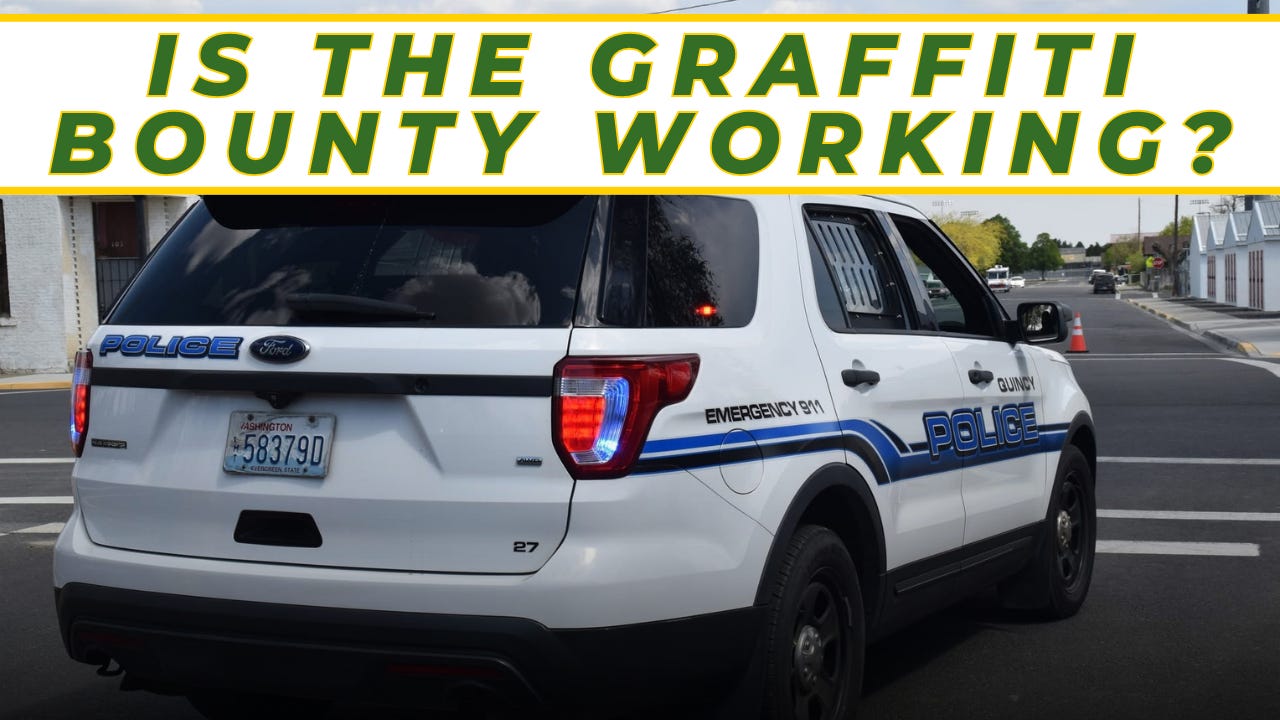
QUINCY — Months after Quincy officials approved a cash reward program in response to a rapid increase in graffiti across the city, no one has collected a reward. Graffiti reports, however, have declined.
That leaves Quincy Police with an encouraging development but an unanswered question: Is the city’s graffiti reward program working, or are other parts of the community’s response making the difference?
Quincy Police Chief Ryan Green said the department does not yet have enough information to answer that question. “At this time, we have not paid a bounty, and we are still evaluating the overall effectiveness of the program,” Green said in response to questions from Source One News.
Rather than judging the program by whether someone collects a reward, Green said the department is evaluating the number and quality of tips it receives, whether those tips help identify suspects or advance cases, and whether the financial incentive is generating information investigators otherwise would have difficulty obtaining.
What police can say is that fewer graffiti incidents are being reported.
“Graffiti reports have gone down, and I believe it’s because Quincy citizens are taking an active approach in reporting suspicious activity,” Green said.
Police have not provided updated numbers showing the size of that decline, and Green did not attribute the reduction directly to the reward program.
TL;DR
No graffiti reward has been paid since Quincy established the program.
Police Chief Ryan Green says it is still too early to determine the program’s overall effectiveness.
Graffiti reports have declined, which Green believes is partly connected to increased reporting of suspicious activity by residents.
Police are evaluating both the number and quality of tips and whether they lead to suspects or advance investigations.
QPD says the reward was never intended to be the city’s only response to graffiti.
The department is also tracking graffiti, looking for patterns and repeat offenders, working with property owners and pursuing cases when sufficient evidence can be developed.
Research on graffiti-control programs elsewhere suggests coordinated strategies involving reporting, tracking, rapid removal and targeted enforcement can be effective.

Program Followed Sharp Increase in Graffiti
The Quincy City Council approved the reward program earlier this year after police reported a sharp increase in graffiti incidents, including tagging authorities described as gang-related.
During the council meeting in which the program was approved, police reported approximately 27 separate graffiti incidents over a recent two-week period. Captain Jorge Trujillo, who was leading the investigation at the time, told council members officers had identified a suspect who was not a Quincy resident and were pursuing search warrants and digital evidence.
City officials also described how quickly some of the vandalism was occurring. Mayor Paul Worley referenced surveillance footage in which approximately 30 feet was tagged in about 22 seconds.
The speed of those incidents created an obvious problem for traditional police response. Unless an officer or witness happened to see the crime occurring, the person responsible could be gone long before police arrived.
The city responded by adopting a policy authorizing rewards of up to $1,000 for information leading to the arrest and conviction of someone responsible for graffiti. The policy also allows an additional $250 when the crime occurs within 500 feet of a school, recreation center or library.
The reward is not automatically paid when someone submits a name. Information must be investigated and satisfy the requirements established under the city’s policy.
Reward Was Never Intended as the Only Response
Green said the financial incentive should be viewed as one part of a larger effort rather than Quincy’s primary answer to graffiti.
“We have not viewed the reward as a sole solution to the graffiti problem,” Green said. “Our approach also includes investigating graffiti incidents, identifying repeat offenders and patterns, working with property owners, documenting and tracking graffiti, and pursuing enforcement when we can establish sufficient evidence.”
Some of those strategies were already developing when council approved the reward.
Police told city leaders at the time that investigators were examining cell phone and GPS information as they attempted to connect multiple incidents to individual suspects. Trujillo explained that establishing a connection between several cases could potentially allow prosecutors to aggregate offenses and pursue more serious charges rather than treating each incident as an isolated misdemeanor.
Residents had also begun discussing neighborhood involvement. Trujillo told council that police had met with community members concerned about graffiti and that some expressed interest in establishing block-watch programs.
Green’s assessment several months later suggests community participation may have become one of the more important pieces of the response. One of the persistent difficulties in graffiti cases, he said, remains establishing who actually committed the offense, particularly when one person may be responsible for multiple locations.
“That is why community involvement and timely reporting are important,” Green said. “The City currently encourages residents to report graffiti and other criminal activity, so officers can follow up on the information.”
Other Cities Have Used Broader Strategies
The approach Green described is consistent with graffiti-control strategies studied elsewhere, where financial rewards are generally one possible tool rather than the centerpiece of a response.
U.S. Department of Justice guidance on graffiti recommends a combination of strategies that can include encouraging residents to report graffiti and offenders, routinely monitoring frequently targeted locations, rapidly removing graffiti, increasing the likelihood offenders will be identified and concentrating enforcement efforts on chronic offenders.
One example studied by the National Institute of Justice came from St. Louis Park, Minnesota, where city departments developed a coordinated program involving citizen reporting, rapid removal, graffiti tracking, public education and cooperation among police, public works, property owners and other organizations.
The city identified 710 graffiti incidents during the first year of the effort, including graffiti that had been present for some time. Six years later, approximately 150 incidents were being reported annually.
The experience does not establish that Quincy will see similar results or that any single strategy was responsible for St. Louis Park’s reduction. The communities are different, and Quincy’s program is still relatively new. It does demonstrate why graffiti-control efforts often combine enforcement with reporting, documentation, removal and community participation rather than relying on one tactic.
Rapid removal is another strategy frequently emphasized in graffiti-control guidance because allowing tags to remain visible can provide offenders with the recognition they are seeking while signaling that an area is not being actively maintained.
For Quincy, that could mean the next phase of the response develops well beyond the original cash incentive.
Measuring Whether the Reward Actually Works
Determining whether Quincy’s program is successful will require more than counting reward checks.
No reward has been paid, but that fact alone does not establish that the program is ineffective. A reward program could encourage information or increase awareness without producing a claim that ultimately qualifies for payment. Conversely, paying a reward would not necessarily demonstrate that the program reduced graffiti citywide.
Green said police are therefore looking at the information the program produces.
The department is evaluating the number and quality of tips, whether they identify suspects, whether they contribute to cases and whether police are receiving information that would otherwise have been difficult to obtain.
One figure QPD has not yet provided is the number of tips generated by the program since its adoption. Without that number, it is too early to determine how much direct investigative activity the financial incentive itself has produced.
The decline in graffiti reports is similarly encouraging but does not establish causation. Increased citizen reporting, police investigations, greater public awareness, deterrence, removal efforts or other factors could all contribute to a reduction.
For now, Green believes the program should be given more time.
“At this point, I believe the bounty is worth continuing while we collect enough information to properly evaluate its effectiveness,” he said. “I also think we should continue looking at additional strategies rather than relying solely on a financial reward.”
What This Means for Quincy Residents
For residents, the city’s current approach places considerable importance on reporting graffiti and suspicious activity promptly rather than assuming someone else has already contacted police.
The reward remains available, but the larger value of a report may be the information it gives investigators. A vehicle description, location, time, surveillance recording or recurring pattern could help police connect incidents that initially appear unrelated.
At the same time, the city now has an opportunity to determine which pieces of its response are actually producing results. If graffiti reports continue falling, officials will need to examine whether that change is connected to the reward, increased public awareness, police investigations, faster reporting, other enforcement efforts or some combination of those factors.
Community Reporting Remains Central to Police Response
Whatever role the reward ultimately plays, QPD’s current strategy continues to depend heavily on residents reporting graffiti and suspicious activity promptly.
Those reports can provide more than notification that another property has been tagged. Information about the time an incident occurred, vehicles in the area, surveillance footage or recurring activity can potentially help investigators identify patterns between cases.
That becomes particularly important when the same offender is suspected of operating at multiple locations. The city’s challenge now is determining which pieces of its response are producing measurable results and where additional resources should be directed.
“Graffiti continues to be something we take seriously, and we want to make sure the resources we are putting toward it are producing results,” Green said.
Several months after Quincy offered money for information, the most visible result is therefore not a reward payment. It is a decline in reported graffiti. Whether the bounty helped produce that decline remains an open question.
For Green and the Quincy Police Department, that is reason to keep evaluating the program rather than declaring either success or failure; while continuing the investigations, community reporting and additional strategies that may ultimately prove more important than the reward itself.