
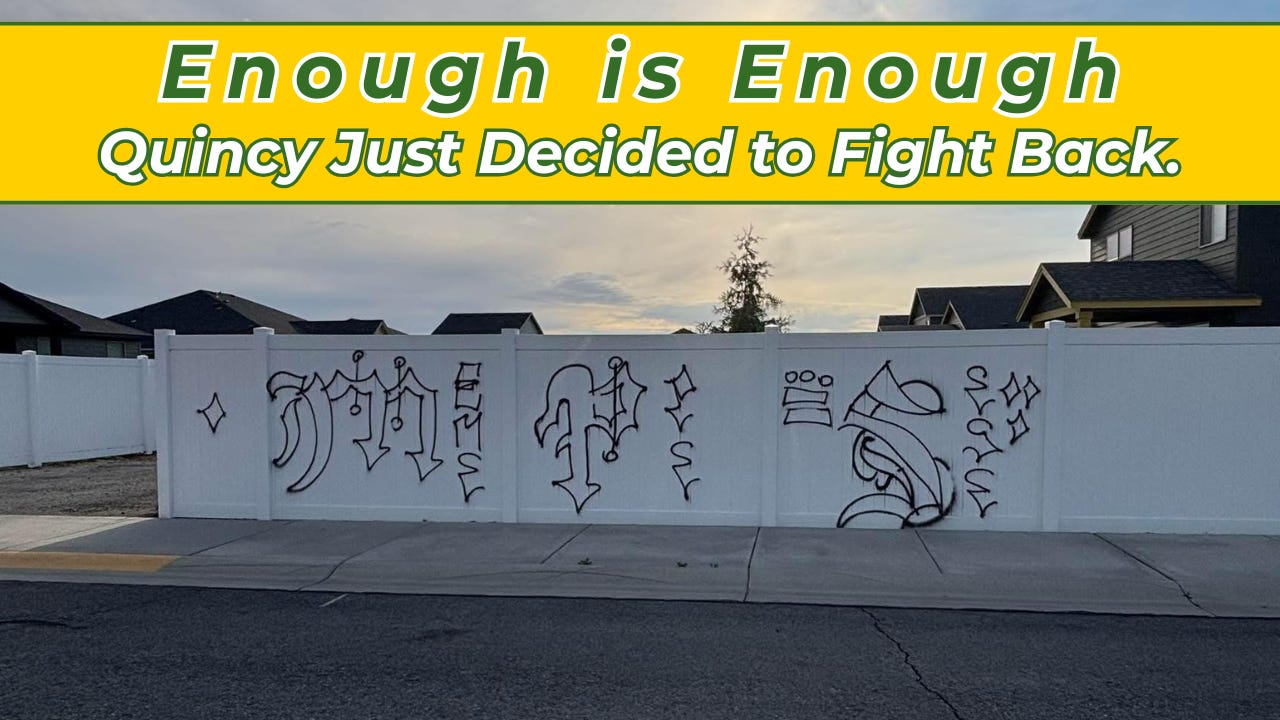
If you’ve been paying attention around Quincy lately, you’ve probably noticed it too. Spray paint showing up on fences, alleys, buildings, signs, and public spaces faster than crews can clean it up. Some of it is random vandalism. Some of it, according to Quincy Police, is gang-related tagging. And after weeks of growing frustration among both the city, the community and a spike in incidents across town, Quincy’s city leadership decided this week they were done waiting for it to get worse.
At Tuesday night’s Quincy City Council meeting, the city formally approved a new reward program offering up to $1,000 for information leading to the arrest and conviction of graffiti offenders. It’s one of the strongest public responses the city has taken on the issue so far, and officials made it clear: this is no longer being treated as harmless vandalism. In the 98848, they see it as a public safety and community identity issue.
TL;DR
Quincy approved a new graffiti reward program this week
Residents can receive up to $1,000 for information leading to an arrest and conviction
An additional $250 reward is available if the graffiti happens near schools, parks, libraries, or recreation centers
Police say graffiti incidents spiked dramatically over the last several weeks
Quincy PD believes some tagging is gang-related
Officers are now using cell phone and GPS data in investigations
Police say they have identified at least one suspect who is not a Quincy resident
Community members are discussing creating neighborhood block watch groups
City leaders say the goal is to stop the problem before it becomes normalized in the 98848

A Sharp Rise in Graffiti Reports
During the meeting, Quincy Police Captain Jorge Trujillo told council members the city had seen roughly 27 separate graffiti incidents over a recent two-week stretch before numbers started slowing down. According to Ruiz, last week only two incidents were reported, and this week officers investigated another call that turned out to already be documented.
That drop may not be accidental.
Ruiz told council the department has already identified a suspect and is actively building a larger case using cell phone location data and GPS evidence. The strategy matters because if investigators can connect multiple incidents together, prosecutors may be able to elevate the charges from misdemeanor vandalism to felony-level crimes.
That changes the stakes significantly.
The city also acknowledged just how fast these crimes are happening. Mayor Paul Worley referenced surveillance footage showing taggers covering nearly 30 feet of surface area in just 22 seconds before disappearing.
That speed is part of why Quincy leaders say they need community help.
The New Reward Program
The resolution approved Tuesday authorizes rewards of up to $1,000 for information leading to the arrest and conviction of graffiti offenders.
According to discussion during the meeting, the reward program includes safeguards and eligibility requirements. Tips are investigated, claims must follow a formal process, and rewards are not automatically issued simply because someone reports another person.
The policy also includes an additional $250 reward enhancement if graffiti occurs within 500 feet of:
Schools
Recreation centers
Libraries
Council members discussed concerns about retaliation, false reporting, and even the possibility of rival taggers turning each other in. City officials said the policy requires investigation and conviction standards before any reward is paid out.
In other words, this is structured as an investigative tool, not just a hotline.

Why City Leaders Are Taking This Seriously
For a lot of longtime residents, graffiti hits differently in a smaller community like Quincy.
In larger cities, people sometimes become numb to tagging over time. In the 98848, many residents still see it as a warning sign that something is changing in the community — and not for the better.
That tension has been building quietly for months.
Police and city officials are increasingly connecting portions of the graffiti activity to gang-related behavior. Even when the actual property damage is relatively small, the broader concern is what repeated tagging represents: territory marking, intimidation, normalization of vandalism, and the feeling that public spaces are no longer being respected.
And once that perception takes hold, it becomes much harder to reverse.
The city’s response this week felt less like a routine policy vote and more like an attempt to stop momentum before the problem becomes embedded.
Technology Is Changing These Investigations
One of the more important details shared Tuesday night was how Quincy Police are approaching investigations differently than they may have in the past.
Captain Trujillo specifically referenced officers using:
Cell phone data
GPS data
Aggregated incident analysis
That matters because graffiti crimes are often difficult to solve traditionally. By the time officers arrive, the suspects are long gone.But modern digital evidence can create patterns.
If investigators can place the same individual near multiple incidents across the city, especially within narrow time windows, prosecutors may be able to pursue significantly stronger cases.
For a town the size of Quincy, that represents a fairly aggressive investigative posture toward graffiti crimes.

Residents May Become Part of the Response
The city’s strategy is not just enforcement-based.
Trujillo also shared that residents who attended a recent graffiti discussion meeting expressed interest in launching neighborhood block watch programs. Quincy Police are now preparing informational packets to help organize those efforts.
That could become an important piece of the equation.
Small towns often succeed against problems like this when residents stay engaged, communicate quickly, and report suspicious activity before patterns grow larger. Officials repeatedly emphasized that rapid reporting helps investigators connect incidents together.
And in a town where people still recognize neighbors, vehicles, and unusual activity, community awareness can matter more than many people realize.
What This Means to You
Whether you’ve personally dealt with graffiti or not, this issue affects more than just the property owners cleaning spray paint off walls.
It affects how safe people feel walking downtown. It affects how kids view public spaces. It affects how visitors see Quincy. And it affects whether residents feel like problems are being addressed before they spiral.
The city’s decision this week sends a pretty clear message: Quincy leadership does not want the kind of normalization that has happened in larger communities where graffiti simply becomes part of the landscape.
For residents in the 98848, this also means there is now a direct pathway to report information and potentially receive compensation, if that information leads to arrests and convictions.
At the same time, the discussion Tuesday night showed city leaders trying to balance enforcement with fairness, accountability, and community involvement.
A Small Town Drawing a Line
The reality is graffiti is rarely just about paint.
It’s about visibility. Presence. Territory. Attention. Sometimes intimidation.
And for a community like Quincy, the bigger fear is not one tagged fence or one alley wall. It’s the idea that people stop caring because they start seeing it everywhere.
Tuesday night’s vote was the city drawing a line before that happens.
The 98848 has grown fast over the last two decades. With that growth comes pressure, challenges, and problems many longtime residents never used to think about. The question now is whether Quincy can stay proactive enough to protect the sense of community people still value here.
This week, city leaders made it clear they intend to try.
