
If you ask most adults where they fell behind in math, very few can tell you.
They can tell you they struggled with algebra. They can tell you geometry was difficult. They can tell you they never felt confident in math class. What most people cannot identify is the specific skill they missed years earlier that made everything afterward harder.
That was the central theme of a Quincy School District math study presented to the School Board in late May.
District leaders believe many students are not struggling because they lack ability or effort. They are struggling because small gaps in foundational skills, often developed years earlier, continue to follow them from one grade level to the next. For families across the 98848, the district’s findings offer both a warning and a reason for optimism.
The warning is that many students are arriving in middle school and high school without fully mastering some of the skills they need most. That is not a Quincy problem. It is a challenge being discussed in school districts across Washington and much of the country. The difference is that Quincy is now taking a closer look at exactly where those gaps are occurring.
The optimism comes from the fact that the district now believes it knows where many of those gaps exist and has a plan to address them.
TL;DR
• Quincy School District recently completed a major review of its K-12 math program following the adoption of new Washington State math standards.
• District leaders found that many students are carrying foundational skill gaps into middle school and high school.
• Fractions, multiplication fluency, equations, and other foundational concepts emerged as critical building blocks for future success.
• The district is creating new learning progressions, assessments, interventions, and teacher supports centered on the state’s newly identified priority standards.
• New intervention opportunities are being planned for sixth-grade and ninth-grade students who need additional support before advancing into higher-level math.
• The work is expected to continue for several years as the district adjusts curriculum, assessments, and instructional practices.

A Different Way of Looking at Math
The math study presented by Director of Teaching and Learning Alicen Gaytley was not focused on blaming students, teachers, parents, or curriculum. Instead, it focused on understanding how students progress through mathematics and identifying the skills that matter most along the way.
Part of that work was driven by changes coming from the state level. Washington adopted updated math standards in late 2025 and identified 134 priority standards that students should master as they move through school. Previously, districts were working through hundreds of standards with much less guidance about which skills were most essential for future success.
That distinction may sound like educational jargon, but it carries significant consequences inside the classroom.
For years, teachers have worked hard to cover an enormous amount of content. The challenge is that when everything is treated as a priority, it becomes difficult to focus deeply on the skills that serve as the foundation for everything that comes later. The district’s current work is centered on identifying those foundations and building instruction around them.
The Foundation Beneath Algebra
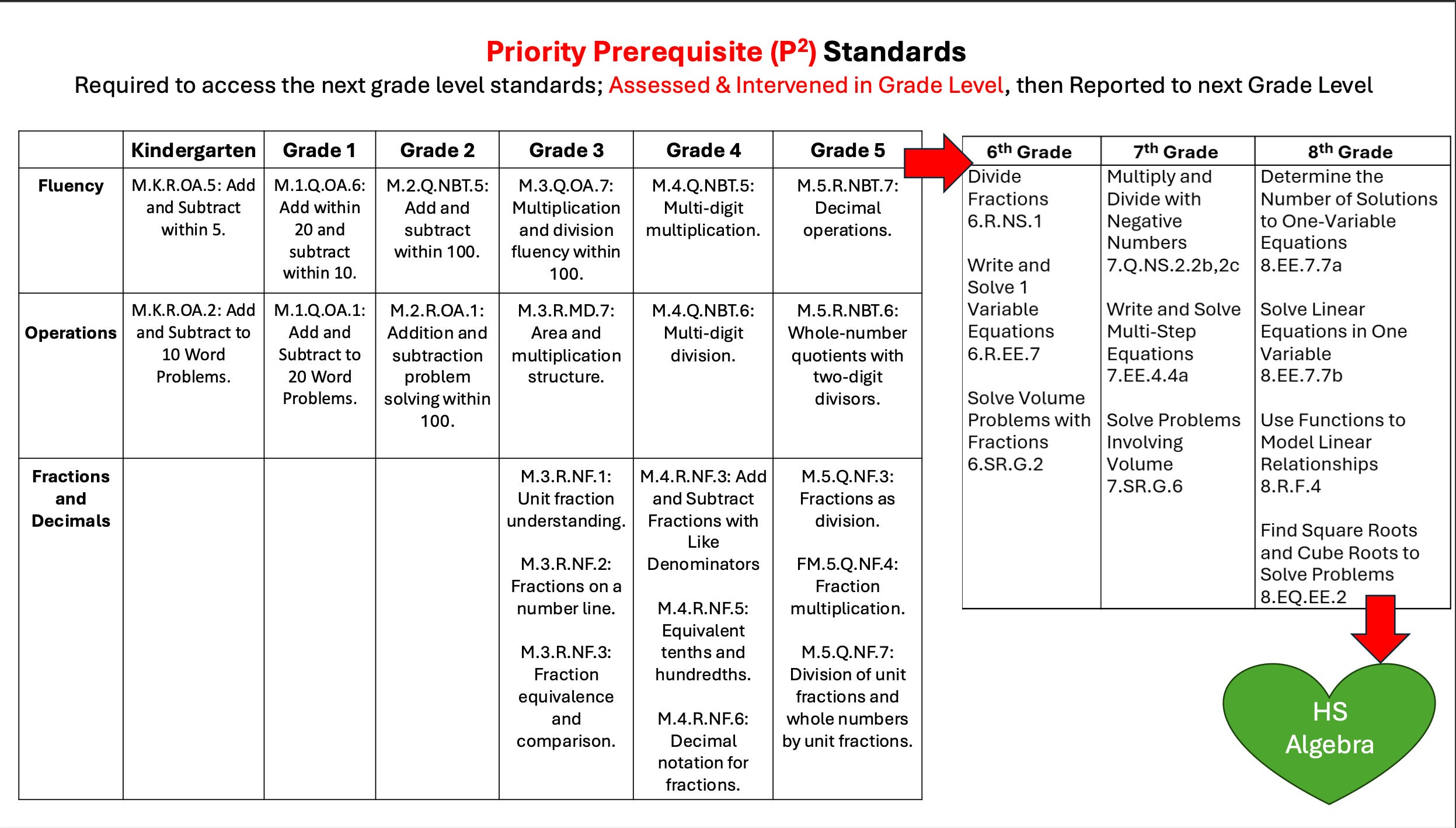
One of the most interesting parts of the presentation was the district’s discussion of what it calls Priority Prerequisite Standards.
These are the skills students need before they can successfully access future grade-level learning.
The list includes concepts many adults probably have not thought about in years. Fraction equivalency. Multiplication fluency. Multi-digit division. Solving equations. Working with negative numbers. Individually, they may not seem particularly significant. Collectively, they form the foundation that supports nearly every advanced math concept students will encounter later.
District leaders repeatedly returned to fractions as an example. Students who struggle with fractions often encounter challenges later with ratios, proportions, equations, algebra, and many other mathematical concepts. When that foundation is weak, every new layer becomes more difficult to build.
Rather than viewing those struggles as isolated problems, the district is beginning to view them as symptoms of earlier learning gaps that may have gone unnoticed for years.
The Data Told a Story
One of the strengths of the presentation was its focus on data rather than assumptions.
District leaders reviewed STAR, iReady, and DreamBox information to identify where students were struggling and where intervention efforts could have the greatest impact. The goal was not simply to measure performance but to understand the specific skills students had not yet mastered.
That distinction matters.
Too often conversations about education become focused on scores, rankings, and percentages. While those numbers can be useful, they don’t always explain why students are struggling. The district’s approach attempts to move beyond the score itself and identify the missing pieces underneath it.
When educators can pinpoint specific prerequisite skills that students have not mastered, they can design interventions that address the actual problem rather than treating the symptoms.
Listening to Students
Another encouraging aspect of the study was the district’s effort to include student voices in the process.
During listening sessions, high school students consistently identified many of the same themes. They wanted teachers who explained concepts clearly. They wanted step-by-step instruction. They wanted fair assessments that helped them improve. They wanted lessons that felt relevant and engaging.
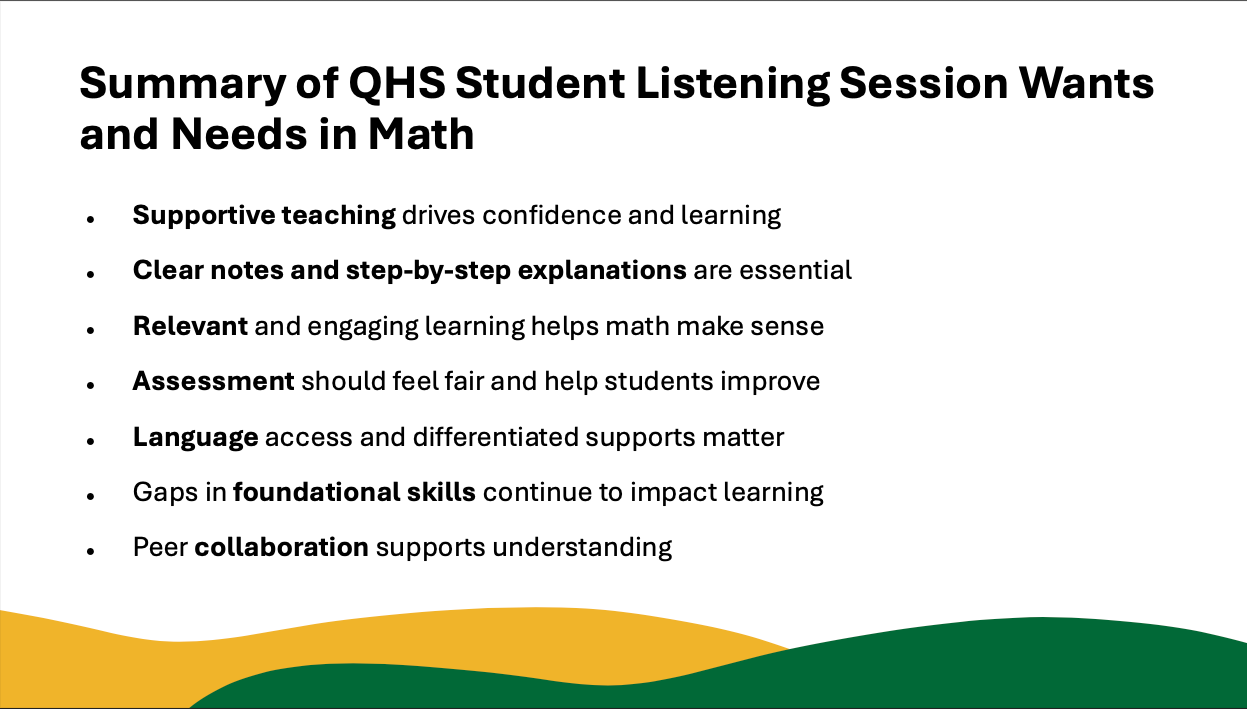
Perhaps most importantly, students recognized the impact that foundational skill gaps were having on their ability to learn new material. That observation aligned closely with the district’s own findings.
Sometimes the people experiencing a challenge every day have much more valuable insights into what is working and what is not, beyond what a report can tell you.
Building a Better System
The district’s response is not centered on purchasing a new curriculum or implementing a single new program. Instead, the work focuses on building a more intentional system around math instruction.
Teacher teams have spent months developing learning progressions that connect standards across grade levels. They have revised pacing guides, developed new assessments, and begun creating intervention structures designed to address learning gaps earlier.
The district is also working to align assessments more closely with the standards students are expected to master. New assessments will be shorter, more targeted, and designed to provide teachers with clearer information about student learning.
The goal is not more testing.
The goal is better information.
Closing the Gaps
One of the most significant developments discussed during the presentation involves planned intervention opportunities for sixth-grade and ninth-grade students.
These transition years are particularly important because they often serve as gateways into more advanced mathematics. District leaders are exploring intervention courses specifically designed to help students close foundational gaps before those gaps become larger barriers to success.
The district also plans to continue refining assessments, pacing guides, learning progressions, and instructional practices over the coming years.
No one involved in the discussion suggested there would be a quick fix.
Learning gaps that developed over several years are unlikely to disappear in a single school year.
What district leaders did express was confidence that they are moving in the right direction.

Why This Matters to the 98848
At its heart, this presentation was not about curriculum.
It was about opportunity.
For many families, discussions about curriculum standards and assessment systems can feel disconnected from everyday life. Most parents are not spending their evenings thinking about learning progressions, pacing guides, or state standards. They are thinking about whether their child understands the homework they brought home, whether they are prepared for the next grade level, and whether they will have opportunities available to them after graduation.
That is why this work matters.
Every student who falls behind in foundational math skills faces a steeper climb in future classes. Every student who develops confidence and competence in mathematics gains access to more opportunities, whether that means college, technical training, apprenticeships, healthcare careers, engineering, agriculture, business, or countless other paths. The district’s math study is ultimately about ensuring students across Quincy, George, Winchester, Crescent Bar, and the rest of the 98848 have the foundation necessary to pursue whatever future they choose.
The work is unlikely to generate headlines the way a new building project or major athletic accomplishment might. Yet the long-term impact could be just as significant because it focuses on one of the core responsibilities of any school system: making sure students are prepared for what comes next.
Finding the Missing Pieces
Most adults can remember the moment math became difficult.
What most people cannot remember is the lesson they missed three years earlier that made everything afterward harder. That realization may be the most important takeaway from Quincy School District’s math study.
District leaders are no longer asking broad questions about whether students are good or bad at math. They are asking much more specific questions. Which skills are students missing? Where are those gaps developing? How early can they be identified? What support can be provided before those gaps become barriers?
Those questions may not produce quick answers, and district leaders were clear that this work will take time. But they are the right questions to ask.
For years, many students have reached middle school and high school carrying learning gaps that nobody could clearly identify. The district’s goal is to find those missing pieces sooner, help students master them, and keep them moving forward with confidence.
If that effort succeeds, the greatest measure of success may not be found in a test score or a state report. It may be found in the growing number of students across the 98848 who never reach the point where they decide math simply is not for them. Instead, they will have the foundation, support, and confidence to keep building toward whatever future they choose.
