
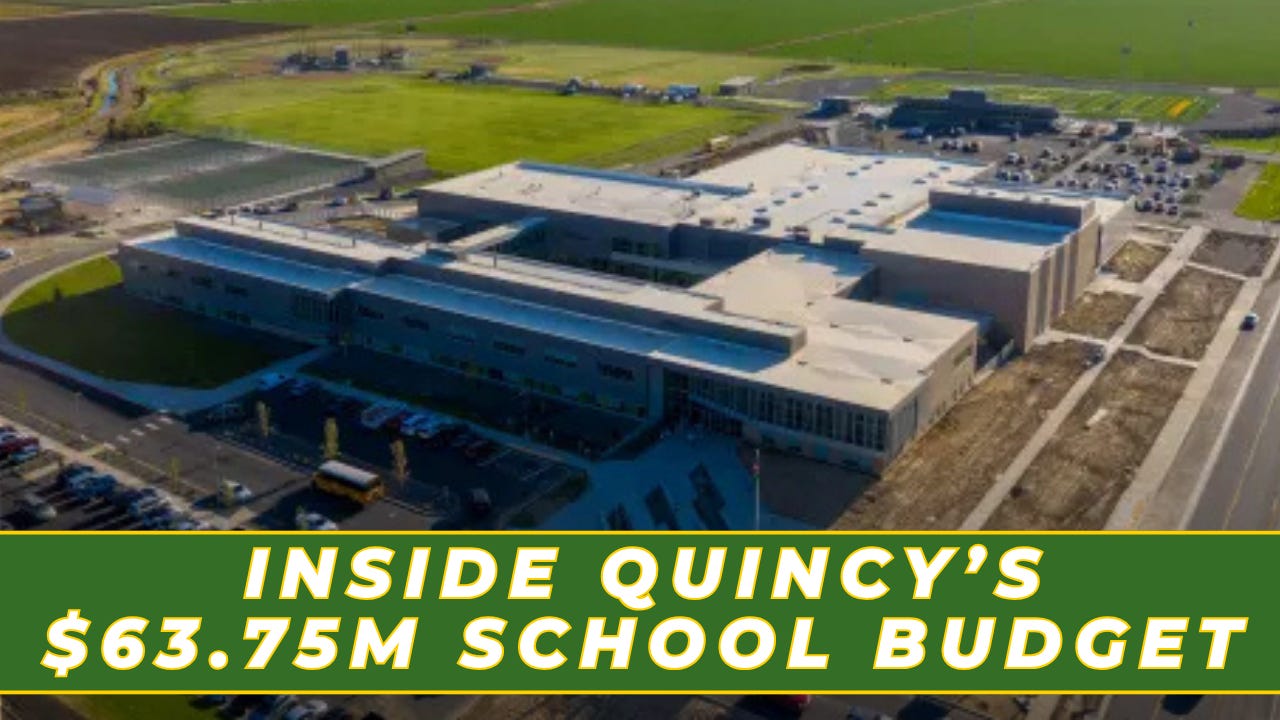
When students return to classrooms across the 98848, the Quincy School District will begin operating under a General Fund budget of nearly $63.75 million. It is the largest annual school budget most residents have probably ever seen attached to the district, and taken by itself, that number can produce an understandable reaction: Where does $63.75 million go in a community our size?
That is a fair question. It also turns out to be much more complicated than dividing $63.75 million by the number of students and calling it the cost of education in Quincy.
The Quincy School Board formally adopted the district’s 2026-27 budget during its August 18 meeting, approving $63,751,257 in General Fund expenditures, along with separate budgets for transportation vehicles, capital projects, debt service and Associated Student Body funds. The General Fund alone is about $3.3 million larger than the $60.44 million budget listed for 2025-26.
But that does not mean the district suddenly found another $3.3 million to spend however it chooses. It does not mean every dollar comes from local taxpayers, either. And even though the adopted General Fund shows exactly $63.75 million coming in and exactly $63.75 million going out, that does not mean district officials already know they will receive precisely that amount.
That is where understanding Quincy’s school budget begins.
The district receives money from the state, federal government and local sources. Much of the state funding depends on enrollment. Federal dollars are frequently restricted to particular programs. Local levy dollars help pay expenses state funding does not fully cover. Salaries and employee benefits consume more than four out of every five General Fund dollars. And some numbers in the budget are estimates that will change as actual enrollment, staffing and grant funding become known.
District officials were explicit about that uncertainty in the budget documents: actual 2026-27 General Fund revenue will not be known until January 2027, when funding can be adjusted using actual average student enrollment and staffing information.
So rather than simply reporting that Quincy approved a $63.75 million school budget, Life in the 98848 went through the district’s budget presentation, board discussions and adopted budget to answer a more useful question:
What does $63.75 million actually mean?

TL;DR
$63.75 million: The Quincy School District adopted a $63,751,257 General Fund budget for 2026-27.
That isn’t the district’s entire financial picture: Quincy separately budgets Capital Projects, Debt Service, ASB and Transportation Vehicle funds.
The General Fund is balanced on paper: The district budgeted $63.75 million in revenue and the same amount in expenditures, but some revenue remains dependent on enrollment, grants and other factors.
People are the biggest expense: Approximately 82.9% of General Fund expenditures are salaries and employee benefits.
Most of the money comes from the state: State funding accounts for roughly 76% of General Fund revenue, compared with about 16% from local sources and 8% from federal sources.
Enrollment matters enormously: Quincy budgeted for fewer students than its 2025-26 average, and enrollment is one of the primary drivers determining how much state funding the district ultimately receives.
The state doesn’t cover everything: The district reports a multimillion-dollar gap between state funding for materials, supplies and operating costs and what those expenses actually cost Quincy. Local levy dollars help close that gap.
The district has reserves: Quincy projects approximately $5.67 million in General Fund balance, with board policy requiring a minimum reserve equal to 8% of expenditures.
Some numbers deserve watching: The budget contains estimates for enrollment, staffing and future funding that will become clearer after the school year begins. A balanced adopted budget should therefore be understood as the district’s financial plan for the year, not a final accounting of what 2026-27 will ultimately cost.
First, $63.75 Million Is Not One Giant Checking Account
The easiest mistake to make when looking at a government budget is assuming the largest number represents a pile of money available for officials to spend. School finance does not work that way.
Quincy actually adopted budgets for five separate funds on August 18. The General Fund is by far the largest and pays for the day-to-day operation of the school district. The remaining funds serve more specific purposes.
For 2026-27, the district budgeted:
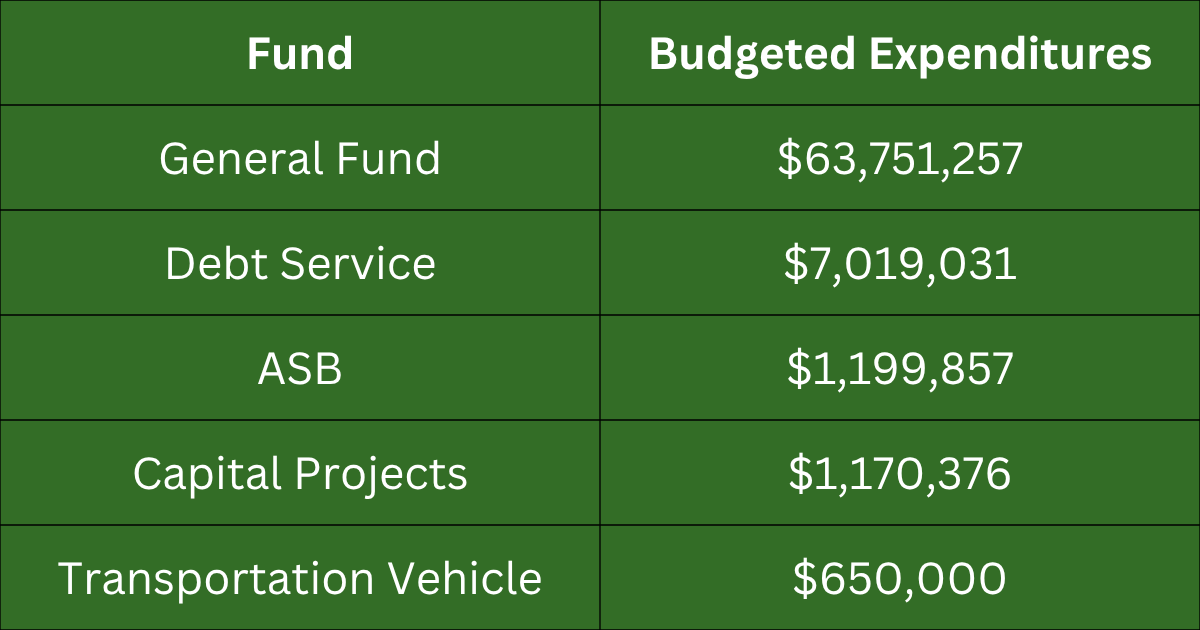
Adding those figures produces more than $73.7 million in authorized expenditures, but even that number needs context. It would be misleading to describe Quincy as having a “$73.7 million operating budget” because those funds do different jobs and some are spending money accumulated in previous years.
The General Fund is the number that matters most when trying to understand the annual operation of Quincy schools. It pays for teachers and other employees, benefits, classroom programs, special education, transportation operations, food service, utilities, maintenance, administration and many of the other expenses required to open the doors each morning.
The Capital Projects Fund is different. Quincy expects only $212,000 in new revenue there during 2026-27 but has authorized approximately $1.17 million in expenditures. At first glance, that looks like the district is spending nearly $1 million more than it receives.
It is — but that does not necessarily mean it is operating at a loss.
The district expects to begin the year with approximately $1.15 million already sitting in the Capital Projects Fund and plans to use much of that accumulated balance during the year. If the budget plays out as projected, approximately $193,000 would remain at the end of August 2027.
The Transportation Vehicle Fund operates similarly. Money accumulates in that fund partly through state depreciation payments and can then be spent on school buses. District officials explained during the July 28 presentation that this fund is specifically for yellow school buses used to transport students.
That distinction matters because without it, perfectly ordinary accounting can look alarming. A fund spending more this year than it receives this year can be intentional if the district saved the money previously for exactly that purpose.
The opposite is also true: a balanced General Fund does not automatically tell us that every part of the district’s finances is equally healthy.
And that brings us to the $63.75 million itself.

Where Does $63.75 Million Come From?
For all the complexity contained in a school budget, the Quincy School District’s General Fund ultimately depends on three broad sources of money: the state, the federal government and local revenue.
The state is by far the largest.
For 2026-27, approximately 76% of the district’s General Fund revenue is expected to come from the State of Washington. Local revenue accounts for roughly 16%, while federal funding makes up approximately 8%. District officials described that overall mix as very similar to the previous year.
That distinction is important in a community where discussions about a $63.75 million school budget can quickly become discussions about property taxes. Local taxpayers absolutely play an important role in funding Quincy schools, but they are not locally raising $63.75 million each year.
The largest share comes through state funding tied to education, and one of the most important drivers behind that money is something much easier to understand: how many students Quincy is actually educating.
State apportionment essentially the primary stream of state funding for basic education represents the district’s largest revenue source. The state also provides funding for programs including special education, transportation, Learning Assistance, Transitional Bilingual education and Transitional Kindergarten. Federal dollars help support programs including Title I, Migrant education, federal special education and portions of vocational education.
Local revenue is its own mixture. The district receives levy dollars, but local revenue also includes investment earnings, facility rentals, donations, smaller local grants and money collected through certain school activities. Even with free school meals, for example, families can still put money into student accounts for additional meals, milk or other à la carte purchases.
That leaves Quincy with a budget built from many different funding streams, some of which come with rules attached to them.
A federal Title I dollar cannot necessarily be moved wherever the district happens to need another dollar. Money allocated for special education supports special education. Transportation funding is connected to transportation. Other programs similarly have allowable uses.
That is one reason the $63.75 million number can be deceptive. It describes the size of the General Fund, but it does not describe $63.75 million of unrestricted spending power.
There is another complication: some of the money does not truly become known until students arrive.
In School Finance, Students Are Also a Revenue Number
No child should ever be reduced to a number on a spreadsheet, but when building a public-school budget, enrollment is unavoidable. The number of students attending Quincy schools helps determine how much money the district receives from the state.
That makes enrollment one of the biggest assumptions built into the 2026-27 budget.
During the 2025-26 school year, Quincy had budgeted for 3,148 students but actually averaged approximately 3,182 students, including Transitional Kindergarten. District officials said that higher-than-expected enrollment generated additional revenue during the year and contributed to the need for a budget extension.
For 2026-27, the district is projecting 3,120 FTE students, with Transitional Kindergarten accounted for separately under a change in how that enrollment is projected. At the July meeting, district officials said adding 48 projected Transitional Kindergarten students brings the overall student picture much closer to the previous year’s enrollment.
Even that requires some translation.
FTE means full-time equivalent. A student attending full time generally represents one FTE, while students participating only part time can represent fractions of an FTE. The state looks at enrollment throughout the year rather than simply counting everyone standing inside a Quincy classroom on the first day of school.
District staff told the board that enrollment is reported monthly and averaged across the school year. That becomes particularly important in Quincy because students move in and out of the district throughout the year.
Administrators described a noticeable pattern: enrollment can be relatively high in September and October, decline during the winter and sometimes increase again in the spring. They said Quincy can lose roughly 30 students between school years while also gaining new students as families move into the community.
There is another wrinkle at the high school.
The district’s enrollment projections show what initially appears to be a significant drop as students move into the upper grades. During the July presentation, however, staff explained that some of those students are not leaving Quincy schools at all. Approximately 20 incoming juniors were moved from the traditional high-school enrollment projection into Running Start, reflecting students expected to attend college courses instead.
All of this explains a sentence buried in the district’s budget presentation that may be one of the most important in the entire document:
Actual General Fund revenue will not be available until January 2027, when actual average FTE enrollment and staff funding can be incorporated into the numbers.
In other words, the School Board has adopted a $63.75 million budget, but the district has also openly acknowledged that the revenue side of that budget still contains projections. That isn’t necessarily a warning sign. It is how a school district must build a budget before the students who drive much of its state funding have actually arrived for the year.
It does, however, give the community an important number to watch.
If enrollment comes in stronger than projected, Quincy could receive more revenue than originally budgeted, as happened during 2025-26. If enrollment falls short, the equation can move the other direction. And once the money arrives, the largest share of it does not go toward textbooks, computers, sports, buses or buildings.
It goes to people.

More Than 80 Cents of Every Dollar Goes to Employees
The largest expense in the Quincy School District is the same expense that dominates most service organizations: the people required to operate it. Approximately 82.9% of the district’s projected General Fund expenditures for 2026-27 are salaries and employee benefits, leaving about 17.1% for non-employee costs.
Put another way, for every $100 Quincy expects to spend from its General Fund, roughly $83 is connected to employees.
That includes far more than classroom teachers.
The district operates multiple schools and programs requiring teachers, paraeducators, principals, secretaries, counselors, nurses, librarians, psychologists, administrators, transportation staff, maintenance and custodial employees, food-service operations and other personnel needed to keep a school system functioning.
Still, district administrators have been watching that percentage.
During the July budget presentation, district officials said employee costs had been closer to 85% the previous year and had created concern as the district worked to “right size” staffing after the end of federal ESSER pandemic-era funding. For 2026-27, that percentage has fallen to just under 83%.
There is an important caveat here as well.
The district believes even 82.9% may overstate where employee costs ultimately land. Some positions were included in the budget that had not been filled, and officials said some of that work could instead be purchased through contracts. If that happens, the expense does not disappear, but accounting moves it from an employee cost to a non-employee cost.
The staffing numbers themselves provide another example of why the first number on a government budget should not always be taken at face value.
The 2026-27 budget initially shows 181.91 certificated staff FTE compared with 170.25 FTE funded through Basic Education, apparently leaving the district with nearly 12 certificated positions beyond what the state funding model supports. That would be worth questioning if that were the whole story.
It isn’t.
The district specifically cautions in its budget presentation that federal program allocations had not yet been updated when the budget was submitted. Funding that had not yet been identified was temporarily allocated to Basic Education, making the apparent staffing difference larger than officials expect it to be after those dollars are properly assigned.
There is a useful comparison from the year that just ended. In June, Quincy reported 172.49 actual certificated staff FTE against 172.21 funded FTE, a difference of only 0.28 positions before final adjustments.
That doesn’t mean residents should ignore the 11.66-position difference in the new budget. It means the responsible thing is to watch whether that gap closes as the district says it should once federal and other funding allocations are finalized. It is a recurring theme throughout this budget: some numbers deserve attention without necessarily deserving alarm.
The next one deserves both attention and a much better explanation than most Washington residents ever receive.

The State Funds Schools But It Doesn’t Pay the Entire Bill
One of the most important numbers in Quincy’s budget is not $63.75 million.
It is $6,230,494.96.
That is the gap the district reports between what Washington provides Quincy for Materials, Supplies and Operating Costs commonly called MSOC and what the district expects those things will actually cost during 2026-27.
According to the district’s required MSOC disclosure, Quincy expects approximately $4.41 million in state MSOC funding. The district expects to spend approximately $10.64 million.
The difference is approximately $6.23 million.
That deserves some perspective.
MSOC is the decidedly unglamorous side of running schools: the materials, supplies and operating expenses necessary to keep the system functioning. During the July presentation, district administrators told the board directly that state funding does not cover what it actually costs Quincy to operate the district and that levy dollars are commonly used to help cover the difference.
Insurance is one significant example.
District officials said Quincy paid approximately $1.2 million for insurance last year. The district had previously experienced insurance increases of roughly 40%, followed by increases of 18% and 10%. For the coming year, officials said the increase is approximately 3%, which they described as a significant relief compared with recent years.
The district also reported having no insurance claims during the most recent year, after only two or three the year before. Administrators noted that mild winters have helped avoid some of the expensive building problems districts can face, pointing to a previous pipe-related event that cost roughly $150,000 to $180,000.
This is where the local levy begins to look different from the way it is often discussed during election season.
Residents frequently hear that Washington funds basic education while local levies support enhancements beyond basic education. The budget documents show a more complicated reality on the ground in Quincy: local money is also helping fill gaps between state allocations and what some district operations and programs actually cost.
During the July meeting, a board member noticed that projected expenditures for some programs were higher than the revenue specifically associated with them and asked whether levy dollars covered those shortfalls. District staff said that, in some cases, they do. Transitional Kindergarten and gifted education were specifically identified during that discussion.
That does not automatically tell us the state is underfunding every one of those programs by the difference shown on a budget line. State and local school accounting is more complicated than that. But the district’s own MSOC disclosure leaves little ambiguity about the larger issue: Quincy expects to spend more than twice what the state provides specifically for those operating costs.
For taxpayers in the 98848, that may be one of the most important pieces of the entire budget.
Because once we understand that local levy dollars are helping close gaps in what the state provides, another question becomes unavoidable:
How much financial breathing room does Quincy have if costs rise, enrollment changes or state funding doesn’t keep pace?
That answer is sitting in the district’s fund balance.

The $5.67 Million Reserve Is Not $5.67 Million Waiting to Be Spent
If there is one number in the budget that could be misunderstood almost as easily as the $63.75 million headline, it is the Quincy School District’s projected $5.67 million General Fund balance.
It is tempting to look at that figure and ask why a school district needs millions of dollars sitting in reserve while taxpayers continue paying a local levy and the district says state funding does not cover all of its operating costs.
The answer starts with a School Board policy requiring the district to maintain a minimum General Fund balance equal to 8% of its budgeted expenditures.
For 2026-27, that requirement accounts for approximately $5.1 million of the projected $5.67 million balance. The district’s budget documents specifically reserve $5,100,100.63 for the 8% minimum, leaving a much smaller amount assigned to other purposes.
The remaining balance includes $100,000 assigned for buses, $50,000 for technology, $50,000 for furniture and equipment replacement, $70,000 for curriculum materials, a $250,000 carryover allowance and approximately $53,000 for unemployment costs.
Those assignments can change as district needs change. The 8% minimum is different.
During the July 28 presentation, district staff explained that the minimum reserve had previously been 5% before the School Board increased it to 8%. When a board member jokingly suggested increasing it to 10%, the district’s presenter responded that 10% would be tight and said the district’s current position between roughly 8% and 10% was considered healthy.
There is a practical reason for keeping money available.
A school district does not receive every dollar of its annual revenue on September 1 and then steadily spend it until August 31. Revenue arrives throughout the year, expenses continue throughout the year, and some of the district’s largest costs — payroll, benefits, utilities, transportation and basic operations — cannot simply stop while it waits for another payment.
A reserve also gives the district some protection against an unexpected expense or a change in revenue. What is especially useful here is that Quincy provided more than two decades of fund-balance history, allowing residents to see whether the current reserve is unusual.
It isn’t.
Quincy’s General Fund balance has fluctuated considerably over the years. It reached more than 20% of the General Fund budget in 2015-16 and 2016-17, before gradually declining. More recently, the actual fund balance represented 12.4% in 2021-22, 10.3% in 2022-23, 9.81% in 2023-24 and 9.97% in 2024-25. The district currently projects its 2025-26 balance at approximately 9.39%, although the final number will not be available until year-end closing in October.
That history changes the context considerably.
The district is not currently accumulating reserves at the levels it was a decade ago. Instead, the projected $5.67 million balance puts Quincy relatively close to the minimum reserve established by the School Board.
There is also a notable bit of conservatism built into that projection. During the July meeting, district staff said they believed the 2025-26 ending balance could actually come in higher than $5.67 million because enrollment had exceeded expectations, but chose not to build the new budget around that assumption.
That final number will be worth returning to when the district closes its books this fall.
If the balance comes in substantially above $5.67 million, the district will have more financial breathing room than this budget currently shows. If it lands near the projection, Quincy will begin the year with most of its General Fund reserve already committed to maintaining the board’s 8% minimum.
That makes the reserve neither a hidden pile of money nor something residents should ignore. It is financial protection, and the amount of protection Quincy maintains is ultimately a policy decision made by the elected School Board.
There is, however, another $1.5 million sitting inside the General Fund budget that requires a different explanation.

There Is $1.5 Million in the Budget for Money That Doesn’t Fully Exist Yet
Buried among dozens of programs in Quincy’s General Fund is one unusually simple entry:
Program 79 — Capacity: $1,500,000.
That deserves explanation because, without it, a reader could reasonably assume the district has set aside $1.5 million for an unspecified program called “Capacity.”
It hasn’t.
The district describes the $1.5 million as budget capacity intended to accommodate anticipated grant carryover dollars, future grants and additional enrollment. It appears on both sides of the General Fund budget: $1.5 million is included within projected revenue and $1.5 million is included within authorized expenditures.
In plain English, think of it less like $1.5 million already sitting in a bank account and more like room built into the budget before the year begins.
Suppose Quincy receives a grant after the budget has already been adopted. The grant brings additional revenue, but accepting that money is only useful if the district also has legal budget authority to spend it. Similarly, if enrollment comes in higher than projected, additional students can generate additional state revenue while also creating additional expenses. The district is building room for some of that uncertainty into the budget from the beginning.
That accounting choice also reveals something important about the headline number.
Of the $63.75 million shown as both General Fund revenue and expenditures, $1.5 million about 2.35% of the entire General Fund budget is this capacity provision. That means readers should be careful about interpreting $63.75 million as a forecast that Quincy expects to collect and spend exactly $63.75 million during the year.
The district’s own documents say otherwise. They repeatedly characterize revenue and expenditures as estimates dependent on enrollment, staffing, grants and other variables.
There is nothing inherently troubling about creating budget capacity for anticipated changes. In fact, the previous school year demonstrates why the district might want it. Enrollment came in higher than budgeted in 2025-26, bringing additional revenue and eventually requiring the district to seek a budget extension.
Still, the $1.5 million provision creates an important transparency issue for the community to understand.
Capacity is not the same thing as revenue already secured.
The district identifies the reasons for the allowance — grant carryover, future grants and additional enrollment — but the adopted budget materials do not break the $1.5 million into specific amounts expected from each source. They also do not tell residents, at adoption, exactly where all $1.5 million would ultimately be spent because those circumstances have not yet occurred.
That is not an accusation of improper budgeting. It is simply where the certainty in the documents ends. If those revenues materialize, residents should eventually be able to see what came in and where the corresponding expenditures went. If they do not materialize, the existence of budget authority does not by itself create $1.5 million for the district to spend.
That distinction is particularly important because the General Fund is presented as perfectly balanced: $63,751,257 in revenue and $63,751,257 in expenditures. The two numbers match.
But $1.5 million on each side exists partly to accommodate financial events that have not happened yet. A balanced budget, in other words, is a plan. It is not a prediction that will be correct down to the dollar.

The Budget Has More Stability Than the Headline Suggests and More Uncertainty Too
After working through the numbers, two seemingly contradictory things can be true about Quincy’s 2026-27 school budget.
The district appears to enter the year from a reasonably stable financial position. It has a projected $5.67 million General Fund balance, an 8% minimum reserve policy, transportation that administrators say is currently fully funded, and a history of actual fund balances that has generally remained above the board’s current minimum. The district also budgeted enrollment conservatively enough last year that actual enrollment exceeded its projection.
At the same time, there are legitimate pressures worth watching.
The state provides approximately $4.41 million toward MSOC expenses that Quincy expects will cost $10.64 million. Local dollars help support programs where dedicated funding does not meet expenditures. More than 80% of the General Fund is tied to employees and benefits, meaning relatively small changes in staffing costs can quickly become large dollar amounts. Enrollment drives significant portions of state revenue, and the district will not know its actual General Fund revenue until well into the school year.
Transportation is healthy today, according to administrators, but district leadership specifically told the board it is concerned about proposals in Olympia that could lengthen the state’s bus depreciation schedule and reduce future funding.
None of those individually indicates Quincy is approaching a financial crisis.
Together, however, they explain why simply asking whether the district has a “balanced budget” does not tell us very much. The more useful question is whether the assumptions underneath that balance continue holding as the year unfolds.
What This Means to You
For families and taxpayers across the 98848, the first takeaway from this budget should probably be that $63.75 million is both a very large number and a surprisingly poor way to understand the financial condition of the Quincy School District.
Most of the money does not come directly from local property taxes. Most of it cannot simply be moved anywhere the district chooses. More than four-fifths of General Fund expenditures are tied to employees and their benefits. State funding changes with enrollment. Federal money comes with restrictions. Local levy dollars help cover expenses and programs where other funding does not meet the district’s actual costs.
The local property-tax piece is still substantial. The district projects approximately $10.06 million in local property-tax revenue in the General Fund for 2026-27. The budget presentation lists the 2026 levy rate at approximately $1.01 per $1,000 of assessed value, compared with $1.12 in 2025 and $1.08 in 2024.
For taxpayers, the important question is therefore not simply, “Why are we paying a levy if the state funds education?” The better question is, “What are our local dollars paying for that state and federal dollars don’t?”
This budget gives us part of that answer. Local money supports extracurricular activities, curriculum and professional development, contributes alongside state funding to numerous educational and operational programs, and helps cover funding gaps in areas where dedicated state dollars do not equal Quincy’s costs.
It does not give us every answer.
For parents, another important number may be enrollment. If Quincy continues attracting or retaining more students than projected, the district can receive additional revenue. If enrollment declines, particularly over multiple years, the district eventually has to reconcile staffing and other costs with a smaller funding base.
For employees, the most consequential number may be 82.9%. A school district whose budget is overwhelmingly devoted to people has limited ability to make large, lasting spending reductions without eventually confronting staffing.
For everyone else, the most useful approach may simply be to remember that the budget approved in August is the beginning of the financial story, not the end of it.
Actual enrollment will come in. Grant awards will become known. Staffing accounts will be reconciled. The 2025-26 books will close in October. Actual General Fund revenue should become clearer by January. And throughout the year, monthly financial reports will show whether the assumptions adopted in August are holding.
Those are the numbers Life in the 98848 intends to watch.
$63.75 Million Is the Starting Point
When we began, the obvious question was how a school district serving a community the size of Quincy could spend nearly $64 million in a single year. After digging through the budget, that question hasn’t become less legitimate. It has become more informed.
Quincy operates multiple schools, educates more than 3,000 students, employs hundreds of people, transports children across a large rural district, serves meals, maintains buildings, operates specialized programs and provides services ranging from special education and bilingual instruction to career and technical education. Doing all of that costs tens of millions of dollars.
But understanding the size of the operation should never mean residents stop asking questions about how those dollars are used.
The 2026-27 budget gives the Quincy School District room to operate, maintains its board-required reserve and anticipates another year with more than $63 million moving through the General Fund. It also depends on enrollment projections, future grant dollars and state funding formulas that do not always cover what programs actually cost.
That is why the number worth remembering is not simply $63.75 million.
It is the collection of numbers underneath it 82.9% for people, an 8% minimum reserve, a $6.23 million MSOC funding gap, $1.5 million of budget capacity and roughly 3,100 students whose enrollment ultimately helps determine how much money arrives.
Those are the numbers that will tell residents of the 98848 whether the budget approved in August works the way it was supposed to once the school year moves from a spreadsheet to actual classrooms.