
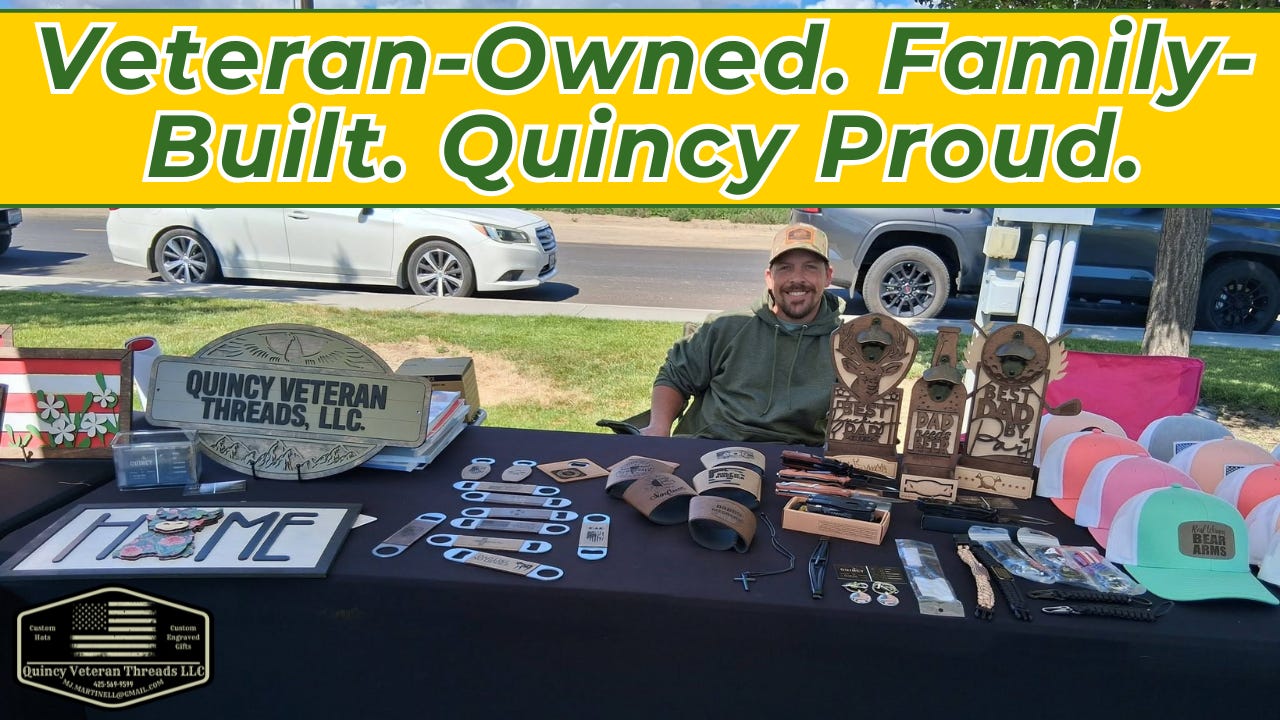
When Mike Martinell and his family moved to Quincy, they were primarily looking for property and room to build a life. They found five acres, a quieter pace and, over time, a community that began to feel like family. That same sense of belonging now sits at the center of Quincy Veteran Threads, a veteran-owned and family-operated business creating custom apparel, engraved gifts, signs, hats and promotional products for customers throughout the 98848 and beyond.
TL;DR
Mike Martinell served eight years in active-duty Army infantry before returning to Washington and eventually settling in Quincy.
He and his wife operate Quincy Veteran Threads as a family business offering custom shirts, hats, engraved gifts, signs, promotional products and patriotic merchandise.
Martinell’s interest in business began while he was a young enlisted soldier looking for ways to supplement his military pay.
The business grew from engraved wood products into apparel after encouragement from his wife, who later joined the company full time.
Local relationships, Chamber of Commerce events and word-of-mouth have helped the company grow quickly.
Continued growth may soon require the family to hire its first employee.

Finding a Home and a Community
Martinell has lived in Washington most of his life, although eight years in the Army took him to military installations, other states and several countries. After leaving active duty, he knew he wanted to return to Washington, but he and his family were looking for something different from the area they had known before.
They spent about three years living in Moses Lake while searching for property. Eventually, they found a five-acre parcel near Quincy and went to look at it after dark. They liked what they saw and quickly submitted an offer, even though they did not yet have a strong connection to the community.
Family members asked why they had chosen Quincy. At first, Martinell said, the answer was simply that the property offered the space they wanted. The deeper reason came later.
“We didn’t have any family out here, and the whole community is like a family,” Martinell said. “I think it makes us feel comfortable here.”
Michael and his wife Christina have been married for 16 years and have two children. Along with running the business, the family maintains a small farm and sells eggs. When time allows, they enjoy hunting, swimming, shooting and riding quads and utility vehicles together.
The family’s connection to the area developed gradually. Martinell described himself and his wife as naturally introverted, but living and doing business in Quincy pushed him into more conversations with neighbors, customers and other business owners. Over time, those conversations became one of the things he values most about the community.
Lessons Carried Home From the Army
Martinell entered the Army as a young man looking for direction, maturity and a way to pay for college. He spent eight years in active-duty infantry, completed basic training in Georgia and was later stationed at Fort Drum in upstate New York.
“I was just a kid, and I was trying to do some growing up,” he said. “The military is a good place for that.”
One of his most vivid memories came during basic training while his unit moved through a Georgia swamp. Martinell could barely swim, and as the water rose from his knees toward his neck, he quietly wondered whether he was in serious trouble. At the same time, he was thinking about the snakes and alligators that might be nearby.
Then the area began to light up with fireflies, something he had never seen before. “It was probably the most scary, overwhelming, but soothing thing I’ve ever been through,” he said.
The Army gave Mike more than memorable stories. It shaped how he views responsibility, family and follow-through. He said military service helped him mature quickly and made him more intentional about being present for his wife and children after returning to civilian life.
It also taught him that communication matters, especially when the answer is not what someone wants to hear. In the Army, failing to follow through could bring immediate consequences. In business, the consequences are different, but Martinell believes the responsibility remains the same.
“Following up is important,” he said. “Even if you have bad news for them, like, ‘I can’t help you with this, but I can point you in the right direction.’”
His military relationships have continued as well. Martinell said former soldiers still call one another when someone needs support, sometimes gathering by phone simply to talk or pray together.

Learning Business One Sale at a Time
Martinell’s interest in business began while he was still a junior enlisted soldier. In 2007, he was earning about $700 every two weeks and began looking for ways to bring in additional income.
He turned to eBay, which at the time was one of the primary places for individuals to sell products online. The platform gave him his first practical experience with product listings, customer communication, shipping and the changing habits of online buyers.
That early experience also taught him that no sales platform remains dominant forever. eBay eventually gave way to Amazon, Etsy, Facebook Marketplace and other options. Each change required sellers to adjust how they reached customers.
“Things change over the years, and then you have to adjust,” Martinell said. “We’ve been adjusting, and it’s a never-ending adjusting story.”
After leaving the Army, he used his military education benefits to earn a bachelor’s degree in business. The degree gave him a foundation in business formation, accounting and taxes, but it did not immediately tell him what kind of company he should build.
Martinell knew he wanted to own a business. He tried several ideas over the years, but the direction that eventually became Quincy Veteran Threads developed from a combination of woodworking, family knowledge and a suggestion he initially did not want to follow.
From Engraved Gifts to Apparel
The family first operated under the name Martinell Family Sales, creating engraved wood products, personalized gifts and custom pieces based on ideas customers had seen on Pinterest, Etsy or other websites.
The local advantage was clear. Customers could work with someone nearby instead of ordering from an unknown seller and waiting for an item to ship from another part of the country.
At the time, Martinell’s wife worked for an apparel company and supervised a call center. She understood the clothing business and suggested that he add apparel to what they were already producing.
Martinell resisted the idea.
“I said, ‘That’s not what I want to do. I don’t want to sell apparel,’” he recalled.
The family already owned some of the equipment, but it was packed away. Martinell preferred engraved work and did not want the business to become another online shirt seller. For about two months, he discussed the idea with his wife and prayed about the direction of the company.
Eventually, he reconsidered. His wife later left her job and joined the business full time. Each now handles different parts of the operation, with the couple meeting in the middle to plan jobs, solve problems and decide what comes next.
The addition of apparel did not replace the engraved products Martinell enjoyed creating. Instead, it widened the company’s services and gave customers more reasons to call.
Today, Quincy Veteran Threads offers custom shirts, hats, engraved tumblers, wooden signs, patriotic products, promotional items, gifts and other personalized work. Customers often arrive with a picture or idea and ask whether the family can make something similar.
Martinell prefers to begin with the idea and work forward from there.


Building a Patriotic Brand
The patriotic focus grew naturally from Martinell’s military service and from something he noticed while attending markets and vendor events.
He saw plenty of booths offering clothing, gifts and handmade products, but few that concentrated on patriotic merchandise. Martinell believed there was room for a business that served veterans, military families and customers who wanted to express pride in the country.
“I wanted to stick with something that I loved, but also something I knew other people would like,” he said.
He also saw a gap in products created for younger veterans. Traditional veteran hats often feature large patches and designs that have changed little over the years. Those styles remain meaningful to many customers, but Martinell believed veterans of Iraq, Afghanistan, Kuwait and more recent eras might also want updated designs.
That challenge appealed to his creative side. Instead of repeating what was already available, he began considering what a younger veteran might choose to wear and how military service could be recognized in a more contemporary way.
The name Quincy Veteran Threads reflects that identity, but the company’s work extends far beyond patriotic shirts. The shop also serves local businesses, organizations, medical offices, community groups and families looking for customized products.
The Work Behind the Finished Product
Martinell continues to enjoy the engraving and woodworking side of the business. Once a machine completes the initial cutting, he handles the finishing work, including sanding, staining, priming and checking the details that determine whether the final piece looks professional.
The most satisfying moment often comes when he sends the customer a photograph of the finished project. “I like taking that snapshot, sending it to the customer right away and saying, ‘Your sign is finished. What do you think?’” he said.
The company is preparing to add a four-foot-by-four-foot computer numerical control machine, commonly known as a CNC machine. The equipment will allow the business to cut and shape larger wood projects with computer-guided precision.
Bringing the machine into the shop will require about six people, presenting a small challenge for someone who admits he does not like asking for help. Martinell said living in Quincy has reminded him that businesses do not have to solve every problem alone.
“Being in Quincy, you’re a village,” he said. “You’re a family.”
While Martinell enjoys woodworking, hats may be the product that brings out the most enthusiasm. He previously became known as the “hat guy” at the apparel company where his wife worked. Coworkers would describe the style, bill and profile they needed, and he could often respond with the appropriate manufacturer and model number.
“The hats are what get me excited,” he said.
That knowledge allows Quincy Veteran Threads to help customers choose more than a logo. A customer ordering hats for a work crew, business, veterans group or event can discuss structure, crown height, fit and style before the order is produced.


Growing Through Quincy Relationships
Although Quincy Veteran Threads sells online, Martinell said the business has grown largely through local relationships and word-of-mouth.
Traditional sales methods do not always translate neatly into a small community. Formal pitches and cold calls may open some doors, but Martinell has found that Quincy residents and business owners usually prefer a conversation.
“People in Quincy just want to talk to you,” he said. “They just want to communicate in that community.”
Martinell said local Chamber of Commerce gatherings and Business After Hours events helped him meet other business owners and become more comfortable explaining what the company offers. Those gatherings also reinforced that trust often comes before the sale in the 98848.
“I want to buy from somebody if I like them and if I know them,” he said. “I would definitely buy from that person.”
That same principle has helped customers become familiar with Quincy Veteran Threads. Martinell’s work can now be seen in custom cups, staff gifts, hats and other products used by local businesses and organizations.
One example came through Quincy Valley Medical Center, where engraved tumblers were created as part of a staff anniversary gift. The project demonstrated how a simple product can carry several purposes at once. It can be useful, recognize an employee and remind the recipient that their work was appreciated.
Those local projects have kept the family busy enough that they have had limited time to attend outside vendor shows.
Larger Customers and Short Deadlines
While the company remains rooted in Quincy, some of its largest opportunities have come from businesses outside the community.
Martinell connected with a regional representative for a large equipment company, which led to orders from multiple locations. A single request might involve 40 hats for each branch and a deadline measured in days rather than weeks.
When asked how quickly he could complete one such order, Martinell said he could do it in three days.
The ability to communicate directly and move quickly is one of the advantages a smaller company can offer. Large suppliers may have more equipment and employees, but they may not provide the same direct access to the person designing and producing the order.
Martinell said the company does not pursue only large accounts, but he would like to develop more relationships with companies that need employee gifts, promotional products, anniversary items or recurring apparel orders.
The opportunity also creates a new challenge. As more work arrives, Martinell has less time to pursue additional sales, participate in community events and develop new products.

Growth May Bring the First Employee
Quincy Veteran Threads has reached a point where continued growth may require the family to hire help.
Martinell said he is careful with deadlines and does not like placing projects so close together that quality or communication suffers. His wife’s full-time involvement has increased the amount of work the family can complete, but the volume of new orders continues to rise.
“We’re growing so fast that I actually might have to start hiring,” he said.
Hiring would be a first for Martinell’s businesses. It would bring additional payroll, training and management responsibilities, but it would also allow him to devote more time to sales, community partnerships and larger projects.
It is a familiar point in the life of a small business. The owner begins by doing nearly everything, but the same hands that complete the orders eventually become too busy to develop the next opportunity.
Martinell said he does not want the company to remain small forever. He would like to reach more customers in other areas and potentially other states, but he remains focused on strengthening the company’s foundation in Quincy.
“I don’t want to stay little,” he said. “I want to expand. But right now, it’s Quincy.”
What This Means to You
Quincy Veteran Threads gives local residents, organizations and businesses another option when they need apparel, engraved gifts, signs or promotional products.
Instead of ordering from a distant company, customers can discuss a project directly with the person producing it. They can review a mock-up, ask for changes and understand what is possible before the final item is completed.
That does not mean every locally produced item will always beat a mass-market seller on price. It means customers can consider the full value of the purchase, including customization, communication, turnaround time and the ability to keep part of the transaction within the local economy.
The business also offers a useful example for people considering entrepreneurship. Martinell did not follow a straight path from military service to a successful company. He experimented with online sales, tried other business ideas, earned a degree, resisted advice from his wife and eventually changed direction.
His experience reflects a reality that is often missing from simplified success stories. Building a business is less like following a map and more like navigating with a compass. The direction may remain consistent, but the route changes as new information, opportunities and obstacles appear.
Martinell advises other business owners to become involved in the community, connect with the Chamber of Commerce and be willing to talk with people. In a community such as the 98848, a relationship can become the bridge between an unfamiliar business and a trusted local provider.
“Let Me Create”
One of the more unusual requests Quincy Veteran Threads received had little to do with apparel or engraving. For about a week, truck drivers stopped by asking Martinell to print shipping documents on ordinary paper.
Document printing was not part of the business plan, but Mike had a printer, paper and the ability to solve the problem.
He agreed to help.
The story may be small, but it explains something important about how Martinell approaches the business. Not every customer request fits neatly into a list of services. Sometimes the first question is simply whether he can help.
When asked what living in the 98848 means to him, Martinell returned to the community that welcomed his family after they moved here without relatives nearby. He described Quincy as a quiet place where neighbors can get to know one another and where block parties, local events and community gatherings provide reasons to participate.
His invitation to potential customers carries that same open-door approach. When someone has an idea for a shirt, hat, sign, gift or project they have not been able to find elsewhere, Martinell wants them to ask.
“Send me a request,” he said. “Just let me know, and we’ll see how much it costs. I love creating things, so let me create.”
Quincy Veteran Threads began with a family looking for property and a veteran searching for the right business to build. It is growing through service, craftsmanship and the relationships that continue to shape life in the 98848.
