
Quincy schools are rethinking special education, and that matters for the future of the 98848.
When people hear a school board presentation on special education, it is easy to assume it will be mostly numbers, staffing charts, and compliance language. But what came out of Quincy School District’s March 24 update was something much more important than that. It was a look at how the district is trying to better serve some of the most vulnerable students in the 98848 while also asking a harder question that communities like ours cannot afford to ignore: are we identifying students correctly, supporting them well, and giving them every possible chance to succeed alongside their peers?
That is not a small question. It is a question about fairness. It is a question about expectations. And in a community like Quincy, where so many families are working hard to build a better future for their kids, it is also a question about whether our school system is helping young people grow into confident, capable members of this community.
At the center of the presentation was a reminder of just how large and complex special education is in Quincy right now. The district reported serving 454 students in special education during the 2025-26 school year. To do that work, the district said it currently has 21 certificated staff, 48 classified staff, and a range of contracted specialists including speech and language staff, a teacher of the visually impaired, physical and occupational therapy support, a psychologist assistant, and behavioral support.
That alone tells you something important. Special education is not a side conversation in Quincy schools. It is a major part of how the district serves the youth of our community every single day.
A Big Number and a Bigger Question
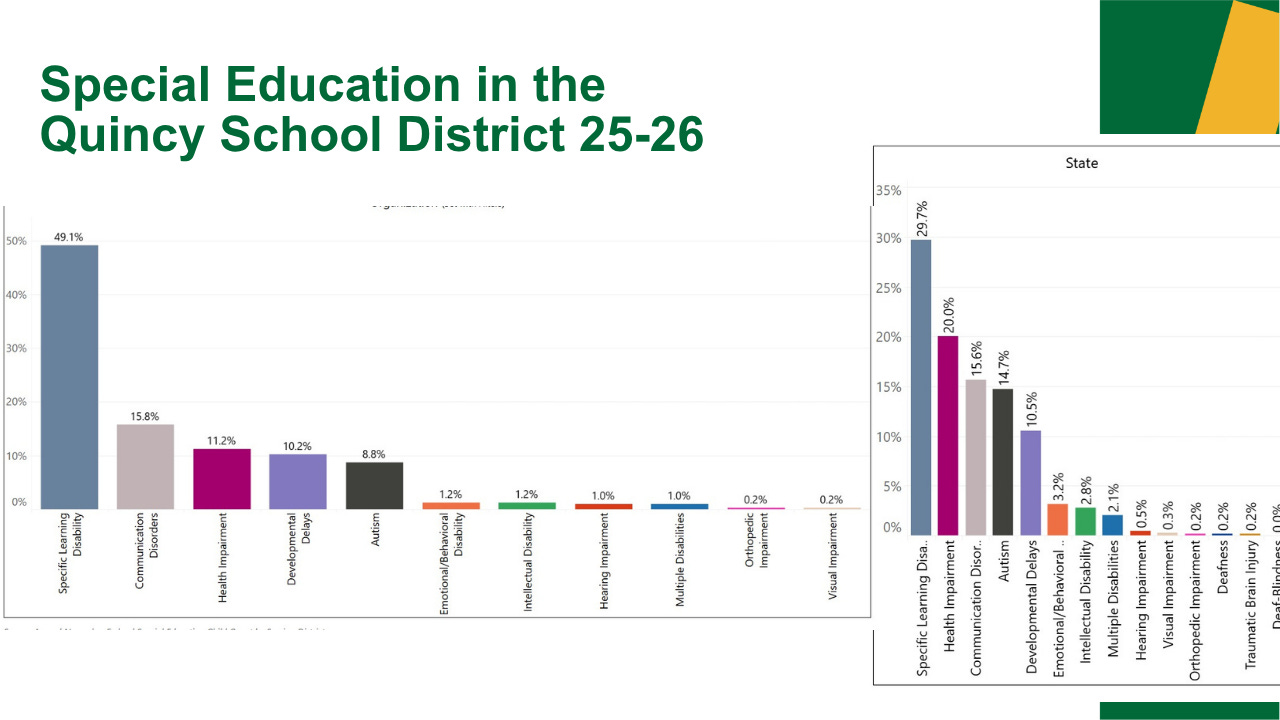
One of the most striking pieces of the presentation was the breakdown of disability categories. Of the district’s 454 special education students, 204 are identified under Specific Learning Disability. That is by far the largest category in Quincy’s program. The district’s own comparison slide showed Quincy at 49.1 percent in that category, while the state sits at 29.7 percent. That is not a minor difference. That is a gap big enough to demand a closer look.
And to the district’s credit, that was exactly what Special Education Director Sunshine Pray did during the presentation.
Rather than gloss over the number, Pray openly talked about the challenge of distinguishing between students who truly have a learning disability and students whose academic performance may still be catching up because of language development. In plain terms, the district is wrestling with whether some multilingual students may have been identified under Specific Learning Disability when language acquisition may have been a more important factor.
That is a hard conversation, but it is also the right one.
For a district like Quincy, where multilingual learners are a significant part of the student population, that question matters in a very real way. It matters because labels follow students. It matters because support systems are built around those labels. And it matters because if a student is placed in the wrong category, even with the best intentions, it can shape years of their educational experience.
The presentation included a chart showing multilingual and non-multilingual learners with disabilities by category, and it reinforced the district’s concern that Specific Learning Disability is an area requiring more careful review. Pray said Washington is moving away from the discrepancy model used to identify Specific Learning Disability, with that shift scheduled for the 2028-29 school year. That change will force districts to rely more on student growth patterns and broader evidence rather than the older model comparing cognitive ability to academic performance.
That part of the presentation may not have been the most emotional moment of the night, but it may end up being one of the most important. Because it is not just about process. It is about making sure Quincy gets this right for kids.
More Students in General Education Settings
The other major theme of the presentation was inclusion.
Last year, the district laid out a goal of increasing the number of students spending most of their school day in the least restrictive environment, meaning in general education settings with their peers whenever that is appropriate and workable for the individual student. This year, the district reported a major jump in that area at the secondary level.
According to the presentation, 60 percent of secondary special education students were in LRE 1 during the 2024-25 school year. This year, that figure rose to 88.4 percent. In practical terms, that means far more students are spending 80 to 100 percent of their day in general education environments.
That is a big change, and it reflects a broader shift in how Quincy is approaching support.
The district outlined a continuum of services that now includes full inclusion, limited support, supported classes, targeted support or grad success, foundations limited, and foundations classes, with placements based on the individual student’s needs rather than a one-size-fits-all model. At the elementary level, the district continues to offer developmental preschool, life skills classrooms, resource room, and full inclusion. At the secondary level, the district has expanded supports including limited support, full support, targeted support, replacement core classes, and full inclusion.
This isn’t just about where students sit during the day. It’s about whether we’re identifying them correctly and giving them the right support to succeed alongside their peers.
That matters because inclusion is not just a slogan. Real inclusion takes planning, staffing, accommodations, collaboration, and constant adjustment. The district said it has backed that work with professional development, co-teaching support, weekly collaboration with special education staff, regular grade reviews, progress monitoring, and tools for differentiation.
In other words, Quincy is not just saying more students should be in general education classrooms. It is trying to build the support systems to make that possible.
A Classroom-Level View of the Change
One of the more useful moments in the presentation came through a letter from middle school special education teacher Sandra Garcia, which was read aloud because she could not attend the meeting.
Garcia described inclusion in the secondary setting as full co-teaching, shared responsibility for instruction and grading, small-group support inside the classroom, and modifications that still allow students to work with grade-level content. She said she has seen students with IEPs grow in confidence, build stronger peer relationships, and become more independent. She also pointed to academic gains, noting that co-taught math classes at Quincy Middle School saw strong growth on STAR assessments from fall to winter.
That is the kind of thing numbers alone cannot show.
It is one thing to say a student spent more time in a general education classroom. It is another to say that student felt less labeled, had more confidence, and was making progress. That is where this conversation stops being just about educational structure and starts becoming a conversation about belonging.
And in a town like Quincy, belonging matters. We are a community where kids grow up seeing each other at school, at church, on ballfields, at community events, and eventually in the workforce. Learning how to live, work, and grow together is part of what school is supposed to do. So when the district talks about reducing stigma and helping students learn alongside their peers, that is not just an education talking point. That is local community building.
The Program Is Bigger Than the Headline Number
Another detail that stood out was how much movement happens behind the scenes, even when the overall total looks steady.
Pray told the board that while the district’s special education count usually only fluctuates by a few students from month to month, the real picture is far more active. In just five months, 42 students with existing IEPs moved into the district, 29 students newly qualified for services, and 49 students either moved out of the district or no longer qualified.
That is a lot of churn.
For families, that may be invisible. For staff, it is not. Every new student with an IEP means records, coordination, scheduling, and support planning. Every newly qualified student means evaluation, meetings, interventions, and a decision that can shape a child’s educational path. Every student who exits services represents another layer of review and follow-through.
So while 454 may look like a stable number on paper, the actual work behind that number is anything but static.
Where Quincy Says the Work Goes Next
The district also made it clear that it does not view this year as a finished success story.
The presentation listed several areas of focus for 2026-27, including continued review of the service matrix, stronger transition plans and post-secondary outcomes, expanded pre-employment transition services, growth of the district’s 18-22 program, and improved practices around dually qualified students. The district also highlighted family nights, preschool family nights, and field day as continuing parts of its outreach to families.
“One of the hardest questions in this work is knowing the difference between a true learning disability and a student who is still developing language. If we get that wrong, we shape their entire school experience.”
That transition piece may deserve even more attention going forward. Pray said the district has not been satisfied with post-secondary engagement results from students after graduation and wants to better prepare students for work, training, and adult life. The goal is not simply to keep students in school longer. It is to help them see a future for themselves in the world beyond school.
That is the right instinct.
Because if Quincy is going to talk seriously about local ownership in the youth of our community, then that ownership cannot stop at graduation day. It has to include whether students leave school prepared for life in the real world, whether that means work, college, supported employment, independent living, or some combination of the above.
Why This Matters Beyond the School Board Room
There is an easy way to hear a presentation like this and reduce it down to jargon. Inclusion. LRE. MTSS. Identification models. Transition services.
But underneath all of that is something very human.
This is about whether a child gets the right support early enough. It is about whether a parent feels seen and heard when they ask for help. It is about whether a student spends their school years feeling isolated or connected. It is about whether multilingual families can trust that language barriers will not be mistaken for disability. And it is about whether schools in the 98848 are preparing young people not just to pass through the system, but to become part of the long-term strength of this community.
There is still work to do. The district itself said that. There are still questions to answer, especially around identification, multilingual learners, and what success should really look like after high school. But there was also something encouraging in this update: Quincy is not pretending the work is simple, and it is not pretending the job is done.
That matters.
Because in a small community, the best version of local education is never just about checking boxes. For a community like Quincy, this isn’t just an education conversation. It’s about how we invest in the kids who are going to grow up and carry the 98848 forward.
That is why this story matters. Not just for special education families. Not just for teachers. Not just for school administrators.
It matters for all of us.