If you have noticed your utility bill this year, you are not alone. That was part of the bigger conversation sitting behind the City of Quincy’s first quarter finance report at the April 21 city council meeting.
Finance Director Carrie Lnenicka presented the FY26 First Quarter Report to council, with a focus on the city’s utility funds and the early impact of the rate increases put in place for 2026. The short version is that the rate increases appear to be doing what they were meant to do. The city’s water, sewer, and refuse funds are all showing signs of stability or recovery.
But this was not a victory lap. It was more of a check-in.
The bigger takeaway is that Quincy is no longer falling behind as quickly in these utility funds, but the cost of providing those services is still rising. That means the city is in a better position than it was, but the long-term conversation about rates, infrastructure, and future costs is still ahead.
TL;DR
Utility rate increases are beginning to stabilize Quincy’s utility funds
Water fund is stable, but costs are rising almost as fast as revenue
Sewer fund is recovering from a 2023 operating loss
Refuse fund is slightly positive, but fuel costs remain a concern
A 25-year utility rate study is underway to guide future pricing and infrastructure decisions
Water Fund: Stable, But Costs Are Still Climbing
The city’s water fund showed a positive first quarter. According to the report, the water fund came in at 57% revenue and 43% expense for Q1 2026. Compared to the same quarter in 2025, revenue increased 37%, while expenses increased 35%.
That is the part that matters.
Yes, revenue is up. That is what you would expect after a rate increase. But expenses are up almost as much. In plain English, the rate increase did not create some giant cushion. It helped the city keep up with what it costs to provide water service.
Lnenicka told council the fund is staying above the cost of delivering service, and the hope is that it can continue building enough momentum to remain healthy moving forward.
For residents, that means the city’s water fund is in a better position than it was, but it is not immune from rising costs.
Sewer Fund: Slowly Recovering
The sewer fund had a more encouraging first quarter.
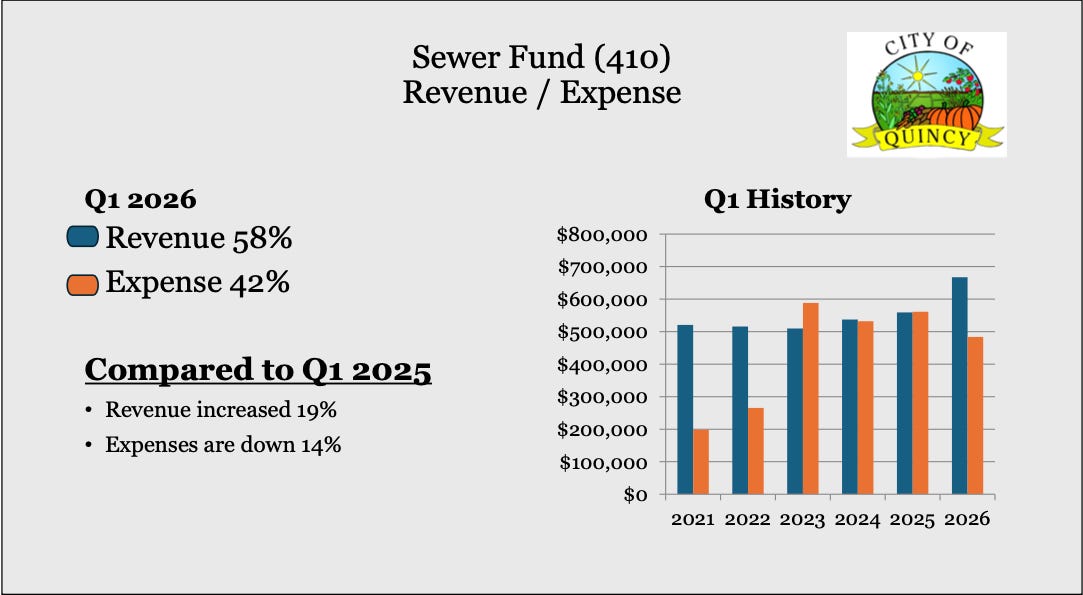
The report showed the domestic sewer fund at 58% revenue and 42% expense for Q1 2026. Compared to Q1 2025, revenues were up 19%, while expenses were down 14%.
That is a stronger shift in the right direction.
Lnenicka explained that the sewer fund had a surplus in 2021, but planned capital projects pushed expenses higher in the years that followed. The fund took a hit in 2023, but the first quarter numbers show it is now slowly recovering from that operating loss.
This is one of those quieter city finance details that most people do not follow closely, but it matters. Sewer infrastructure is not optional. It is one of those systems people only notice when something goes wrong, and keeping the fund stable helps the city stay ahead of problems instead of constantly reacting to them.
Refuse Fund: Slightly Positive, With Fuel Costs Still a Concern
The refuse fund, which covers garbage, recycling, compost, and yard waste, is also trending in a positive direction.
For Q1 2026, the fund showed 59% revenue and 41% expense. Compared to Q1 2025, revenue was up 19%, while expenses were down 6%.
Lnenicka described the refuse fund as having a slightly positive margin and trending stable, but she also noted that the city will continue to watch it closely because of fuel surcharges tied to rising fuel costs.
That is the wildcard.
Garbage service depends heavily on transportation, and fuel costs can change quickly. Even when a fund is stable on paper, those outside pressures can eat into the margin fast.
There is also a bigger future question tied to this fund. Lnenicka mentioned that the improving position could eventually allow the city to have a larger discussion about garbage services and whether Quincy still wants to move toward taking that on directly someday.
That was not a decision made at this meeting. It was not even really a debate. But it was a reminder that today’s fund balances often shape tomorrow’s options.

What This Means to You
This report was not flashy. There were no long arguments, no major controversy, and no public debate over the numbers.
But it matters.
Utility rates affect every household and business in Quincy. Water, sewer, and garbage are some of the most basic services the city provides, and if the funds behind those services fall too far behind, the choices get harder later.
The first quarter report suggests the city’s 2026 rate increases are helping stabilize the funds. That is good news. But it also shows how tight the margin can be. In the water fund especially, revenue and expenses are rising almost side by side.
So the practical takeaway is this: the city is making progress, but this is not over.
The Bigger Conversation Is Coming
One of the most important pieces of the report was the mention of the city’s utility rate study.
The city is working with FCS, a consulting group, to study water and sewer rates. According to Lnenicka, the study will give council a long-term look at what rates may need to be over the next 25 years in order to pay for infrastructure improvements and maintain operating budgets.
That is where the bigger conversation is likely to happen.
The first quarter numbers tell us where the city is right now. The rate study will help show where Quincy is headed.
For now, the water fund is stable, the sewer fund is recovering, and the refuse fund is slightly positive. That is a good first step.
But the real question for Quincy is not just whether the city caught up this quarter.
The real question is whether we are building a utility system that can keep up with the next 25 years.