
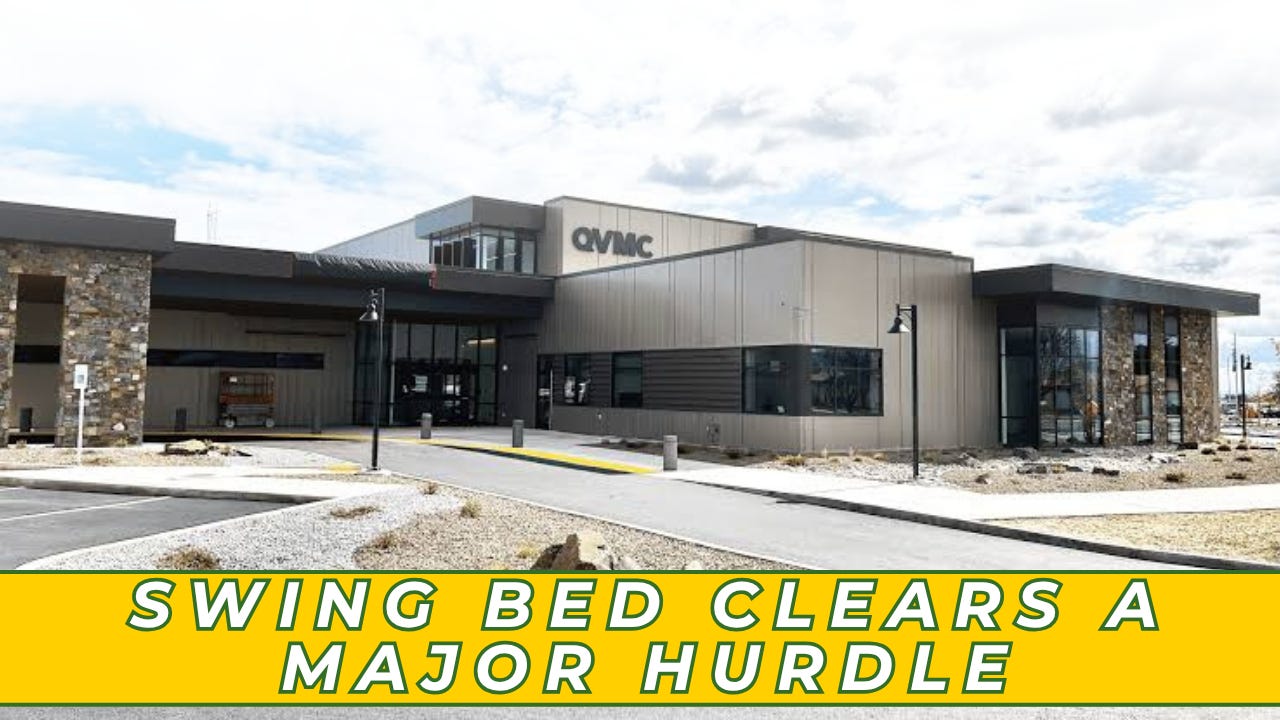
For months, Quincy Valley Medical Center has been caught in an unusual position: the hospital had the beds, the staff and patients already receiving swing bed care, but it was still waiting for the government process needed to fully restore the program in its new facility. At the August 24 meeting of the Grant County Public Hospital District No. 2 Board of Commissioners, hospital leaders finally had significant news for the 98848. The long-awaited state survey has happened, QVMC has received its approval letters, and one of the largest remaining obstacles is now behind it. The finish line, however, still includes another round of federal paperwork.
TL;DR
The Washington State Department of Health has completed QVMC’s long-awaited swing bed survey, and the hospital has received its approval letters.
An unexpected opening in the state’s survey schedule helped bring surveyors to Quincy sooner than anticipated.
QVMC is now working through the federal Medicare enrollment process involving CMS, PECOS and Medicare contractor Noridian.
The hospital ultimately needs a Provider Transaction Access Number, or PTAN, associated with swing bed services before the Medicare billing side of the process is complete.
QVMC reported seven swing bed admissions as of August 19, including two patients who remained in the program at that time.
Hospital officials also expect to formally close out the larger new-hospital construction project in September.

The Survey QVMC Had Been Waiting For
The latest development is an important one because QVMC’s swing bed certification has been one of the lingering pieces of unfinished business following the move into the new hospital. Swing bed care allows a qualifying hospital to use its beds for patients who no longer require the same level of acute hospital care but still need skilled nursing or rehabilitation before they are ready to return home or move to another setting.
At previous board meetings, CEO Glenda Bishop had described the frustration of waiting for the state survey needed to move the certification process forward. She had been told that it could take months to get a survey team there, or longer. At the August meeting, the tone was markedly different.
“The Department of Health did come in as per their promise,” Bishop told commissioners. She later summarized the result simply: “Survey, we already have both letters of approval. That’s all great.”
Getting the survey scheduled required some help. Bishop said she reached out to the Washington State Hospital Association, which contacted people on the state side to see what could be done. Within 48 hours, QVMC was hearing from the Department of Health about a possible survey visit.
The timing also involved a bit of circumstance. According to Bishop, the surveyors who came to Quincy had originally been scheduled to spend the week conducting surveys in Spokane. Wildfires disrupted that schedule and created an opening. QVMC was ready to take it. Had that opening not appeared, Bishop said the hospital could have been waiting until later in September.
That means the biggest question surrounding the program has changed. QVMC is no longer waiting for someone from the state to walk through the doors. Now it is waiting for the federal Medicare machinery to finish turning.
State Approval Isn’t the Final Step
Anyone who has ever dealt with a major government program knows that approval from one agency does not necessarily mean the paperwork is finished. Bishop spent several minutes during the meeting explaining what happens next, in part so commissioners and the public would understand why receiving the state approval letters does not immediately end the process.
Three acronyms now matter: PECOS, Noridian and PTAN. QVMC even added them to the frequently used terms and acronyms included with the August board packet.
PECOS is the Provider Enrollment, Chain, and Ownership System, the federal online system managed by the Centers for Medicare & Medicaid Services for provider enrollment and Medicare participation. QVMC has submitted its swing bed information through that system.
Noridian is QVMC’s Medicare Administrative Contractor. In practical terms, Noridian is responsible for reviewing the Medicare enrollment application submitted through PECOS and determining whether the necessary information is in place.
At the end of that process comes the PTAN, or Provider Transaction Access Number. QVMC already has different PTANs associated with other portions of its operation. The swing bed program needs the Medicare identification necessary for its own billing.
Bishop gave commissioners a straightforward benchmark for knowing when the process is finally complete.
“Once I have a PTAN, you’ll see the fireworks go off if we’re not under a burn ban,” she joked. “And we’ll be able to bill.” Until that PTAN comes in and all these hurdles are complete, QVMC has had to bear the cost of any swing bed patients it treated. That is not a small cost for a rural hospital to carry.

Even the Application Had Another Twist
The federal process has already produced another example of why this certification has taken persistence.
Bishop said she contacted PECOS the day before the state survey to find out what QVMC needed to do. She followed the instructions she was given, only to learn seven days later that the application needed to be handled differently.
Rather than proceeding under the type of application QVMC originally understood it needed, Bishop said the hospital was told it had to submit an initial application through a different part of the system and pay a $750 application fee. She said she completed that requirement the same day.
Now Noridian must review the application. That could include requests for additional documentation before the contractor is satisfied that all of QVMC’s enrollment information is complete.
It is another bureaucratic hurdle, but an important distinction for residents following the story. QVMC has cleared the state survey. The hospital is not waiting to learn whether it passed that inspection. What remains is the Medicare enrollment and billing process necessary to finish the certification work.
Swing Bed Care Is Already Happening in Quincy
While much of the story has centered on certification, forms and government agencies, the August board packet contains another part of the story that is much easier to understand: patients are already receiving the care.
QVMC’s August 19 Swing Bed Board Report shows the hospital had recorded seven swing bed admissions at the time of the report. One swing bed patient was admitted in July, and two patients remained in the program when the report was prepared. The department reported receiving two referrals in July and accepting both; one for hospice respite and one for swing bed care with no missed admissions reported for the month.
The lengths of stay recorded in the report show why this kind of service occupies a different place between a conventional hospital stay and returning home. Completed stays listed in the report ranged from five days to 55 days. One current patient had reached 107 days as of the report date, while another had been in the program for 12 days.
Those numbers put the regulatory discussion into perspective. A PTAN is an identification number. PECOS is a government portal. Noridian is a Medicare contractor. None of those terms mean much to a family whose real concern is where a parent, spouse or grandparent will recover after leaving acute care.
The program behind those acronyms can mean the difference between receiving qualifying skilled care here in the 98848 and having to find that care somewhere farther from home. That is why the seemingly tedious certification process has mattered.

Another Finish Line Is Approaching
Swing bed certification is not the only major QVMC project approaching its final administrative steps.
Bishop told commissioners that Joe Kunkel is expected to return to Quincy during the first or second week of September to help formally wrap up the new hospital project. QVMC has received the last invoices associated with the project and expects to submit its final Certificate of Need reporting.
“We are going to do, as he said, wrap it up and put a bow on it,” Bishop told the board.
The August meeting offered several reminders of just how much has changed since the hospital moved into the new facility. Department reports described new technology, expanded services and operational changes that were difficult or impossible in the former building. At the same time, the meeting showed that opening a hospital building and completing a hospital project are not quite the same thing.
Construction can end and patients can move in while certifications, reimbursement systems and final government reports continue for months afterward.
Swing bed has become perhaps the clearest example.
What This Means to You
For most residents, the important part of this story is not whether they can remember what PECOS or PTAN stand for. It is that QVMC has cleared the state survey that had been holding up the next stage of its swing bed certification process.
Swing bed services are designed for patients who have moved beyond acute hospital care but are not yet ready to simply go home. Depending on the patient’s circumstances, that can include skilled nursing and rehabilitation during recovery. Having that option locally can matter to the patient, but it also matters to spouses, children and caregivers who otherwise may be traveling outside the community to stay involved in someone’s recovery.
The August numbers also show that this is not merely a service QVMC hopes to provide someday. Patients are already using it. The remaining work is largely about completing the Medicare enrollment and billing framework around the program.
There is no firm date in the August 24 meeting for when Noridian will complete that review or when QVMC will receive its swing bed PTAN. That is the next milestone to watch. Until it happens, calling the entire certification process “finished” would be premature.
But after months of waiting for the state survey, QVMC is considerably closer.
From Building a Hospital to Using One
For several years, much of the public conversation surrounding Quincy Valley Medical Center understandably centered on the building itself: financing it, designing it, constructing it, moving into it and working through the inevitable issues that come with opening a new facility.
That conversation is beginning to change.
The August 24 meeting showed a hospital increasingly dealing with the next set of questions—not simply whether Quincy could build a new hospital, but what services can be delivered inside it and how those services fit into a much larger state and federal health-care system.
There is still paperwork ahead for swing bed. Noridian still has work to do, and QVMC still needs the Medicare approval and identification necessary to complete the billing side of the program. Hospital leaders did not give commissioners a date when that will happen, and the story is not finished until it does.
Still, the state survey that QVMC spent months waiting for is finally in the rearview mirror. Patients are already receiving swing bed care in Quincy, the hospital’s larger construction project is approaching formal closeout, and one more piece of what the community spent years building is moving toward its intended purpose: allowing more people in the 98848 to receive the care they need closer to home.
