
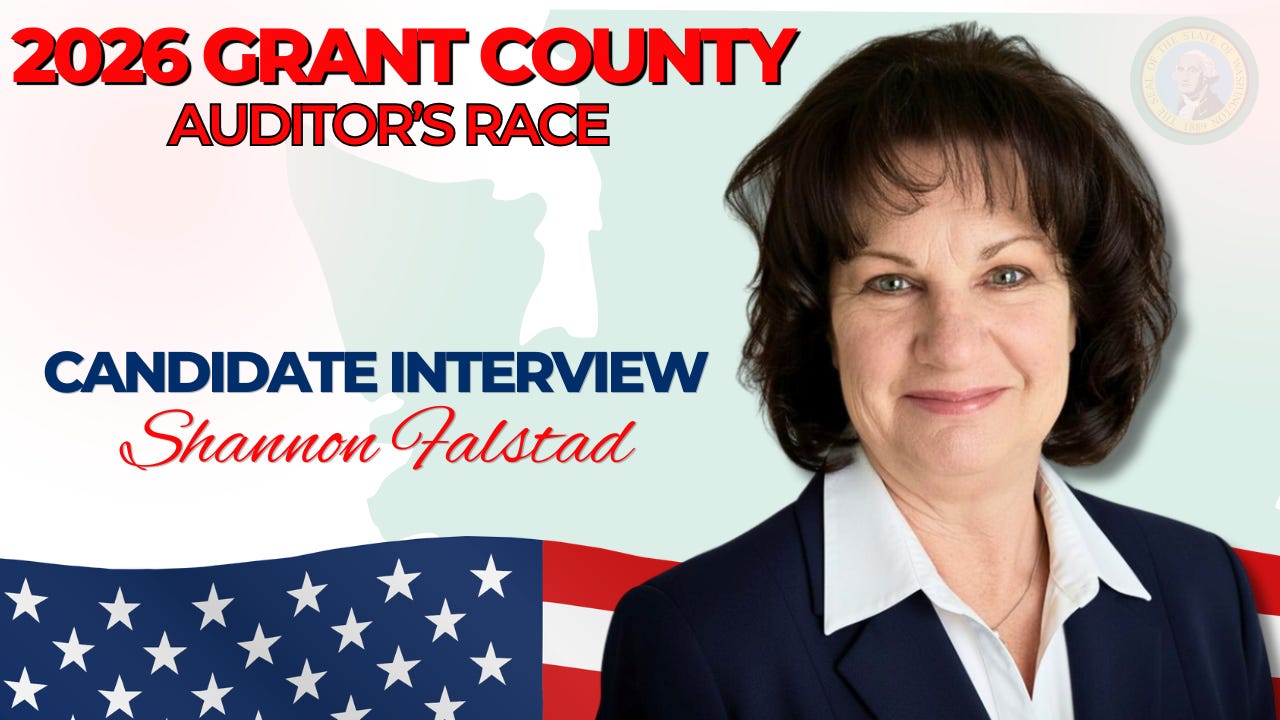
I interviewed 2 candidates for the Grant County Commissioner Auditor’s race for 2026.
All 3 Candidates were invited to be interviewed
2 Candidates that responded were asked the exact same 20 questions in the exact same order
They never saw each others answers
The answers have not been altered, edited, modified, editorialized, changed, or edited in any way by the staff, ownership, or affiliates of this publication.
For each I have posted the transcript, not a story, their words. (transcripts by AI)
For each I have posted the audio from the interview.
A full list of the questions
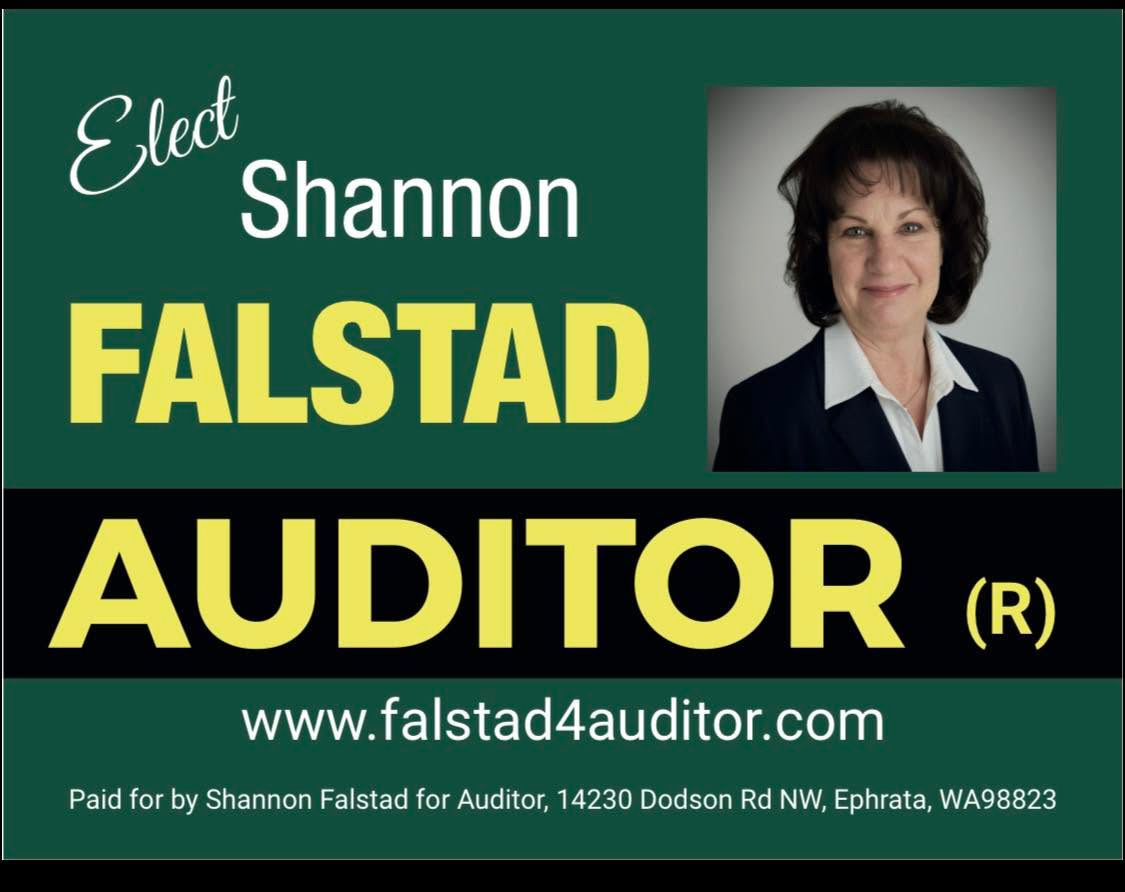
Below the interviews I will post their posted bio from their candidate website, their sign and a link to their website and or FaceBook
The Interview Begins Here
Shannon Falstad Interview Audio File
Shannon Falstad Interview Grant County Auditor
Race for 2026
Brent Dowlen: [00:00:00] Interview Shannon Falstad, Grant County Auditor question ends. Shannon, for people who may not know you yet, tell us a little about yourself, your background, and your connection to Grant County.
Shannon Falstad: So I was born and raised in Ephrata, so I’m a lifelong resident. I am married to Mark Falstad. He used to work for the pub, but is now retired.
I have two full-grown sons, and they followed in their father’s footsteps where they entered the electrical field. Um, I’ve worked at Grant, the courthouse, Grant County Courthouse, for 30 years. So- Wow ... my currently ten years i- in the Grant County Clerk’s office. Mm-hmm. But my first 20, 1996, was in the Auditor’s office as the recording deputy.
So I did that and then advanced to, um... Well, a little history because some people, when I talk to them, don’t realize that the Auditor’s office consists of four completely different offices. It has the recording department, the licensing department, elections, and accounting. So people are amazed when they hear that, or sometimes they confuse it and think [00:01:00] it’s the assessor’s office, so.
Um, but I started in recording- Mm ... as a recording deputy in 1996, and then I later advanced into the recording licensing lead deputy, so I oversaw both departments. I became certified as a licensing deputy ‘cause I wanted to not only just supervise, lead them, but I wanted also to be able to help them and help the customers as well.
As you all know that all of us are-- work eight to five, so we’re limited on time, so when customers come in, they’re limited on time. They’re on their lunch break, uh, break, so if I saw there was a backup, I’d get up and help that. Um, we will also... Anybody that works for the Auditor’s office would, uh, help in the election department.
So, so 20 years, I helped with the election department. I even helped, um, when Mr. Varney, the old auditor, great man, helped him run the tabulation machine back then, the, the big one, different than how they do it now. So I entered payroll for the recording licensing [00:02:00] lead, so I knew somewhat of the system in accounting.
In my current job, I enter payables- Mm ... into the accounting system, so I’m familiar with that. Um, they are getting a whole new system, so it’s-- I’m getting to know that system, so that’s gonna be beneficial.
Brent Dowlen: What experiences in your professional or personal life do you believe has best prepared you for this job?
Shannon Falstad: Well, I guess I kind of answered that working in the auditor’s office for 20 years, and, and working for the county, too. I mean, yes, I worked in the auditor’s office for 20 years, um, but working just in the courthouse, you get to know a lot of people, and being born and raised, a lot of those people I know I, I grew up with and friends with.
So I’m hoping that when I come in, having those professional and personal relationships, um, that we can come together and, and have conversations and be more cohesive. I think the more that we work together, the better [00:03:00] service we can give to the public, so...
Brent Dowlen: Tell us about your career path and the experiences that led you to this point in your life of public service.
Shannon Falstad: Like I said, I’ve been working there. Where I’m at right now in the clerk’s office, I am the accounting deputy, so I’m not on the front line. And I have to say, when I talk to other people who work at the courthouse who started, you know, across the counter from people working with the public and then go somewhere else in the county, and they’re not, it’s something that you actually miss.
I mean, you great-- you see them, at least in the auditor’s office with licensing. We got to see the same people over and over, so you kind of build a relationship with them. So I, I miss that, and I miss the people that I got to know. I’ve even had people, you know, when I’m out doing stuff say, “Oh, gosh, I really miss you in the auditor’s office.”
So, um, with the current auditor ending her term, I just, I felt that I was ready. [00:04:00] Um, learning the jobs and doing what I do in the clerk’s office gave me a, um, bigger, a better insight in the accounting side. So I, I feel like I’ve kind of hit all four of those departments, so... and I’m ready to be there. And some of the staff, most of the staff has even come to me and said, “Hey, we really think you should run.”
So that’s why I’m doing it.
Brent Dowlen: Outside of politics and government, what values in your life experiences have shaped the way you approach leadership and decision-making?
Shannon Falstad: I just really commitment, really committed to stuff that I do. Um, I-- over time, when I make decisions, I really think about how it affects people.
And so when I-- I think knowing that and my past experience and the leaders that I’ve That I’ve worked for other bosses, uh, Mr. Varney [00:05:00] and other people, they’ve just really helped develop what community service, public service is, and it’s really been helpful. It’s given me a broader, um, picture of how, how to be.
Um, there’s... We’ve always said, you know, when you’re working at a counter and you’re helping someone, that person, you should treat like it’s your mother. When you’re working for a business, you should treat that like it’s your own business. It needs to succeed. And when you are overseeing financials, you need to act like those are your financials.
That’s your account. That’s money coming out of your account. So that’s how over time and all the things that I’ve done has, has shaped me into those, those categories of how I see and, and, and work, so.
Brent Dowlen: I think we’ve already answered this, but what motivated you to run for Grant County Auditor specifically and why now?
Shannon Falstad: Yeah. We did cover [00:06:00] it, but yes, um, I think I’m ready. Being well-versed in all those four departments-
Brent Dowlen: Mm-hmm ...
Shannon Falstad: just the relationships I built and the staff that I’ve known for, for quite a long time. So I think they are really wanting that kind of leadership that I have to offer. So, and like I said, I, I miss the public, and I think that they deserve the best, best customer service we can possibly give them.
Brent Dowlen: Is the timing just about to step down for the current auditor? It’s just time or-
Shannon Falstad: Y-
Brent Dowlen: They’re not running again, right?
Shannon Falstad: They’re not running again, so yeah
Brent Dowlen: Was there a particular issue, experience, or moment that made you decide this was the right time to step forward besides them?
Shannon Falstad: Uh, well, besides her stepping down and, um, so just Wanting to make sure that those four [00:07:00] departments are being led in a way that the staff has someone that they can turn to.
I’m, I, my goal really is I wanna, um, I will be, not that I want to be, but I will be an active auditor. And having that background and working those departments, not only can I, will I lead, but I’ll be able to step in and help out, and I think that’s really important ‘cause when you’re working with staff and you show that, hey, I, I’m here to help, I’m here to answer questions, it’s a mutual respect.
You know, the commitment you give is the commitment you’re gonna get back, so.
Brent Dowlen: For people who are not fully aware, ‘cause I’ll, I’ll be the first to admit I had to look up what an auditor does, okay? Uh, for all of us who are not fluent in government speak, how would you explain what the Grant County Auditor actually does and why the office matters to everyday residents?
Shannon Falstad: Well, like I said, it, it covers... And I, you’re not the only one ‘cause my time working in the auditor’s office when I first started and [00:08:00] I’d tell people, I would tell them what it all entails, and now that I’m running, same thing, and I get the same thing. “What? Are you kidding? Uh, really?” So yeah, it’s the four completely departments.
So recording is your land documents, it’s your loan documents when you get a loan, issue marriage license, and then all those documents, um, are sent to state archives for permanent preservations. And then you have Department of Licensing for, really should probably be Department of Motor Vehicles ‘cause title transfers, tab renewals, farm permits, which is farm use or farm exempt, doing what you’re doing, and some people that’s over their head, so familiar with that.
And then the election department, I think everybody understands the election department. And then the accounting oversees all the financials of, of the county and, um, helps prepare with all the financials that they get in and all the accounts that go to prepare the county budgets and oversees the financials, so budgeting.
Brent Dowlen: See, I, I’ll admit, I had no idea the auditor had anything to [00:09:00] do with elections. At all. I, I thought that was a whole separate thing. Yep. So.
Shannon Falstad: Yeah. I get... It’s so, though, it’s funny ‘cause it’s usually people know that it’s elections or people know that it’s, you know, accounting, auditing because it’s auditor.
But besides the recording and licensing, they’re like, “Really?” And not only that, but people don’t realize also, um, the county has two sub agents. When I first worked there, it had three sub agents, Department of Licensing. So we have a contract with those sub agents. The two that are now, right now, is Moses Lake, which is Windsor Licensing, and then the licensing, Peterson Licensing here in Quincy.
Mm-hmm. So we’re contracted with them, so you have contract compliance is that you gotta make sure that they’re up to standard with, with those contracts and, um, they’re certified, so you gotta make sure people are doing the necessary steps, so.[00:10:00]
Brent Dowlen: See, I wrote all these questions before I met you. Now I feel a little silly on some of these. Why are you the best person in the job? Obviously, you’ve been with the county for a long time. Obviously, this is your background.
Shannon Falstad: It- it’s my background. It’s my background, it’s my
Brent Dowlen: commitment.
Shannon Falstad: Aside from that. I’m just a lifelong resident wanting to serve the community.
It’s, it’s, it’s home. So, you know, like I said, when I’m out and about and people are like, “Oh my gosh, I miss you. I don’t see you anymore,” and, “Loved coming in,” and it, it, it’s nice. So it’s like, okay, it’s time. Yeah, let me come back, and let me make sure that the office is being run like it was when I was there.
I mean, when I say back in the day, the commitment that we had, like in licensing, anytime there was some new rules, like when they started, um, the emissions stuff, you had to have a sticker, and you had to have proof. We’d go out. We would go out and go to their car [00:11:00] and show them where it’s at and help them fill out the documentations.
We’d have customers come in that were elderly and needed help with- Mm ... um, preparing or getting their, you know, p- disabled placard. We’d go out there. Sometimes we’d even go out and help them put on tabs. That’s the customer service that we provided, and that’s the customer service I wanna make sure we continue providing, so.
Brent Dowlen: Election integrity has become one of the most discussed issues in the country. How would you help to maintain public trust and confidence in Grant County elections regardless of political affiliation?
Shannon Falstad: Uh, working in them. There, I... People always ask, “Do you think there’s fraud in Grant County?” And I, I, I, I would say no.
Working in there, we get all the ballots in. I help, you know, when they come in from the mail and separate them all and get them all right. Watch the election deputies verify every single signature. There’s times that they’d have to call and say, “Hey, it doesn’t [00:12:00] match.” And, um, so I saw the process, and I can, I can tell you it, it’s, it’s...
The fraud is No. It, it’s sad ‘cause when people do that, it’s, it’s, it’s like how okay, so we have observations. People are more than welcome. So I say, “Well, have you come and watched any of the, the process?” “Well, no.” I’m like, “You come and watch.” And now they have live stream on it. Come watch. Watch for yourself and see for yourself ‘cause that’s the best way to ensure in your mind and how you feel.
I can probably sit here all day, but you know, until someone actually watches it and sees the process from beginning to end, I, I think it’ll open a, a bigger picture of, of how it is and that it doesn’t... It’s not as fraud as people think, as the news media wants, you know, the national news media wants to present, so at least not here in Grant County.[00:13:00]
Brent Dowlen: What steps would you take to improve transparency and communication between the auditor’s office and the public?
Shannon Falstad: Uh, I think we have a pretty good communication. Um, that’s been pretty much a standard since when I first worked there, a standard that’s continued through it. I would be more than happy to have open conversations for anybody that thinks that there isn’t, because that’s one thing I, I value and think is really necessary.
I mean, everything that the county does should always be transparent. So I would be more than happy to have any conversation with anybody if I was elected that they, they think there isn’t and, or if there seems to be a lack of communication. Um, communication, what they say top three, communication, communication, communication.
So I, I’d be more than happy to take any suggestions ‘cause that’s my goal. I wanna make sure that we’re... I have open communications and that we are transparent. So
Brent Dowlen: Many residents in rural communities across Grant County [00:14:00] feel disconnected from county government, especially if you live farther away from, like, Ephrata.
How can the auditor’s office better serve communities outside of Ephrata and Moses Lake, including our more rural communities that are farther out there, like Sunland Estates or Desert Aire or some of those that are a ways away from the county hub?
Shannon Falstad: Well, I would have to ask first, what, what is it that they’re looking for?
What, what, what do they think is services that aren’t being-
Brent Dowlen: I think that may be the hardest question of all- It, it is ... is figuring that one out.
Shannon Falstad: You know, we do, um, like I said, with the sub-agents in, in Moses Lake and the sub-agent in Quincy. We used to have one in Grand Coulee, uh, so we have that. People talked about the drop boxes for elections.
So, uh, I think we have quite a few. I don’t have the current list of how many we have, but I would say go online and, and make sure that you aren’t ... That, that we may have something, like, if [00:15:00] you wanna drop off instead of mail. Go online and check to see where those drop boxes are, because you may not be aware that we have one in your area.
So, and call. Say, “Hey, I think this needs to be done.” With- without suggestions, we, we can’t improve on, on that. So once again, I’m open for conversations and seeing anybody’s ideas and suggestions of how we could do that, so.
Brent Dowlen: The auditor’s office oversees elections, licensing, recording services, and financial operations, as we discussed.
What area do you believe needs the most improvement or modernization right now?
Shannon Falstad: Well, like I said, the accounting department is right now, I think we’re pretty modernized. First of all, the licensing is state, so we don’t have control of that, and they keep up on it as well. The recording side, it has, um, Eagle Recorder, and that was implemented [00:16:00] when I first started, and there’s many, many counties that are still running that system.
I f- I believe it’s still current and offers an... what we can do in recording-wise. Um, elections is fairly new also, and then like I said, the accounting department is currently in implementing their new system, which happens to also be Tyler Technologies, just a accounting called Tyler Hub. Um, and it’s funny because working in the clerk’s office, the module for the clerk’s office is from Tyler Technologies.
It’s called Odyssey. So a little bit familiar with Tyler Technologies. I, I, but I do feel that we are pretty current on it- Mm-hmm ... on all our systems. Okay.
Brent Dowlen: Technology continues to change rapidly. How should the county balance both modernization, online acce-accessibility, if I can say that word, while also protecting cyber-cybersecurity and sensitive public records?[00:17:00]
Shannon Falstad: Um, well, I think we have a, the IT department, which I’m sure you know of, Seth. They’re in charge of that, so that would be a, a, you know, on their side. But I feel like we are pretty... They do a really, really good job. So, and, like, recording is online. Um, people can, if they wanna record, they have e-filing. If they wanna look at documents, they can log o- log on, and they have to register, so that helps with that.
Um, I think, think we’re pretty current, and, um, have a pretty good IT department that makes sure that we stay secure.
Brent Dowlen: Even in our crazy AI era.
Shannon Falstad: I know. Yeah. You know, I, we always get stuff from them saying, w- warning us and, and keeping us informed of what to watch out for and, and what they will and will not allow us to have, like the AI copilot, whatever that may be.
And I think that’s a good, I think [00:18:00] that’s a good thing. It really is. Yeah, we have to be careful.
Brent Dowlen: I’ve issued a lot of those security bu- bulletins when I worked in IT.
Shannon Falstad: Yeah.
Brent Dowlen: No, no, no. Don’t play with those. They, they...
Shannon Falstad: Yes, yes. And, you know, they’re, they’re pretty good. We get... They send out any emails and keep us well informed and so
Brent Dowlen: Residents often become frustrated with long wait times, confusing processes- Yes ... difficulty navigating government web services, which, I mean, you obviously cannot totally control.
Shannon Falstad: Right.
Brent Dowlen: What would you do to improve customer service and efficiency within the auditor’s office?
Shannon Falstad: It does get frustrating. Um, I try to, when I work there, and it’s something that I’ll definitely make sure that the staff does too, is you really have to be investigative.
And I always, when a customer would come in, I say, “I don’t wanna sound like I’m, you know, snooping, but if I know exactly what you’re trying to accomplish, I can better help you.” [00:19:00] So asking questions, if you... And I-- the, the thing I did, if they thought, if having that discussion we thought they were to go to a different department, I wouldn’t just send them to a different department.
That’s where it gets frustrating for people. They hear-- Some people hear a keyword, and so they send them to that department. Well, that keyword is something they may have said because they’re not familiar. So you really need to pull information from customers and, and actually try to figure out what they’re trying to do.
And like I said, if I didn’t know for sure, I wouldn’t send them until I make call, an I call of the department, ‘cause we have public work that’s out up on the hill. We have planning across the street. And so I would make phone calls-
Brent Dowlen: Mm-hmm ...
Shannon Falstad: to make sure before I sent them, because I understand people would come into us and they would complain and be frustrated.
So that’s-- it’s very important to ask questions and, and communic- communicate. It’s, it’s a wonderful thing. And when people call-
Brent Dowlen: [00:20:00] Mm-hmm ...
Shannon Falstad: if I don’t know, I get their name and phone number. I says, “You know what? Let me investigate it for you. I will find out for you, and I will call you back.” So I-- it’s, it’s, it’s not that, in my eyes, to give that type of customer s- service is...
I don’t think it’s that difficult. So that’s something I wanna ensure that I make sure employees do. And quite honestly, other people that I know, they’re, they’re on that, so
Brent Dowlen: Public trust in institutions has been declining, as we’ve covered, in recent years. So how do you ensure the Auditor’s office remains nonpartisan, professional, and just focused on serving everybody fairly?
Shannon Falstad: Excellent question, because we are nonpartisan. When people come in, we serve everybody. And once again, it’s, it’s getting to know your customers, making that connection- Mm-hmm ... and helping them out. And like s- in recording and licensing, we do get a lot of the same customers, so you get to know them, and it’s [00:21:00] important.
It’s important to have that connection. Look up, make eye, make eye contact. The- sometimes that’s all it takes. It starts a conversation. You get to know them better. You get to know what they’re trying to do. But if your head’s down and you’re just typing away and doing that without con- making that connection, I think you’re really missing out, and you’re missing out on the opportunity to, to help them further.
Sometimes you can help them with what they’re doing, but another question arises that has nothing to do with your department, but you can still help them go, “Oh, yes, I know what you’re trying to accomplish. You need to go Assessors or Planning or Building or wherever it may be.”
Brent Dowlen: Mm-hmm.
Shannon Falstad: So... And I would-- It’s beneficial also that the employees know all the departments and what they do, so when people need to go to another department, you just don’t, “Oh, I don’t know.”
No, let’s help them. Let’s find out and get them to the right place.
Brent Dowlen: It’s cross-training.
Shannon Falstad: It is. And like you, like I said, they’re on a time limit. We all work from 8:00 to 5:00, [00:22:00] even the people at the courthouse. So when-- If they’re getting sent to the wrong departments because someone didn’t take the two seconds to find out-
Brent Dowlen: Mm-hmm
Shannon Falstad: you could-- then they have to go, “Well, now I gotta do this whole thing again tomorrow.” And then I can see their frustration and I’m, I’m not for that at all.
Brent Dowlen: I wanna work 8:00 to 5:00. That sounds fun. I don’t think I’ve ever done that in my life.
Shannon Falstad: Oh my gosh.
Brent Dowlen: I’ve been at work at 6:00 AM or earlier pretty much my entire life since I was 16.
Shannon Falstad: Yeah?
Brent Dowlen: Yeah. I don’t know what it feels like to start that late. That’s- Ah. Except when I was on graveyard, but yeah.
Shannon Falstad: Yeah, no.
Brent Dowlen: Washington State conducts elections almost entirely by mail. What safeguards do you believe are most important to protect election accuracy and voter confidence?
Shannon Falstad: I think the... I, I know people don’t like the mail voting by mail, sorry.
Um, but I worked there when we did it. I feel like it’s pretty secure [00:23:00] But I do what’s set in law, so whatever the people vote on, that’s what I-- that’s what we’re gonna do. But I s- I think it’s secure, and I would... If there’s a review procedures and if there’s anything that sticks out that might question that-
Brent Dowlen: Mm-hmm
Shannon Falstad: I would most definitely-- that’s, uh, something that would have to be reviewed to make sure that those standards and what I’m going to do are in line with state law.
Brent Dowlen: How would you approach concerns from residents who question election procedures or feel uncertain about how to handle ballots?
Shannon Falstad: Once again, observation.
Uh, c-come on in, talk to us, and when-- I think there’s a procedure on how many can be in there, so we’re more than happy to have-- welcome people to come and observe or s- go onto the live stream. Uh, it’s important. If, if people are really concerned, I think that would answer a lot of their questions. So [00:24:00] I would encourage people to do that.
Brent Dowlen: I love the fact that you guys have a live stream now.
Shannon Falstad: Yeah.
Brent Dowlen: That’s, that’s a good thing.
Shannon Falstad: Yep.
Brent Dowlen: Grant County continues to grow and change. What challenges do you believe the auditor’s office will face in the next five to 10 years?
Shannon Falstad: I don’t know. We’ve it’s grown since I’ve been there, and we’ve stayed pretty current on, on software and the procedures that we do and offering, you know, like recording online, um E-filing, the pick up the tabs, you can choose to pick up instead of mail. I, I think we’ve really kept up on it, so the only challenge that I think I wanna make ensure is, uh, keeping staff, making sure there’s not an overturn.
That way, you know, when I talk about having that, that communication and that one on [00:25:00] long- one-on-one with customers, that tends to get lost if you have a big overturn. So I’d like to make sure that whatever procedures we’re doing in office, we’re making sure that not only we give good public service, but we do what we need to do to ensure that our, um, staff stays in, in there.
So like I said, I think with me wanting to make sure I’m fully engaged, there to help, there to ask questions, jump in whenever I can, will build a, a rapport that will hopefully make people wanna stay and, and so... You know, they have to feel valued.
Brent Dowlen: Mm-hmm.
Shannon Falstad: So...
Brent Dowlen: If elected, what would be your top priorities during your first year in office?
Shannon Falstad: Um, well, it’s kind of a hard question in the fact that I won’t be... If I get elected, it won’t be until November, and a lot of things can happen because as of I see right now [00:26:00] with, um, the new system being implemented in accounting, it’s kinda thrown a loop into getting reports to departments, getting reports on time.
Brent Dowlen: Mm-hmm.
Shannon Falstad: But I’ve seen that could be resolved once it, it’s been implemented and things start progressing. Um, we’re sh- there’s only two election deputies. We really need three, so I’d like to make sure that that’s done and make sure they’re certified. Once again, retaining people, ‘cause if you don’t retain them and you get a new one, then you gotta go two years through a cert- certification process and then- Yes
same thing with licensing. They have to be certified. They have to have so many hours. So it’s really important to make sure you retain your employees- Mm-hmm ... appreciate and value them. It’s a home. I mean, you spend eight, nine hours there. So y- um, it’s va- it’s valuable to realize that your employees are valuable, and you want them to keep them there.
It’s beneficial not only to the office, but to [00:27:00] the public.
Brent Dowlen: At the end of your term, what would success look like to you, and what would you hope residents across Grant County would say about your leadership?
Shannon Falstad: Uh, success would be that they come in and say, “I’m so glad that you ran for auditor. We’re happy that we voted for you.
Um, you’ve communicated with all of us and, and shown great leadership, um, improved Customer service and communication, and that they’re happy with the service that they are provided, that they feel like they’re getting secure elections, and that all, uh, the departments of the- within the county are like, “Yes, all those accounting reports that we’re supposed to receive, we’re getting them when we need to.”
And, and, and make sure I build a rapport with all the county elects, that we can communicate and all work together, so.
Brent Dowlen: Last one’s for you. [00:28:00] What, what am I missing? Tell me what we need to know about Shannon going into this. I...
Shannon Falstad: Well, I hope I’ve covered it, but I just... Like I said, it’s- I think it’s very important that people know what...
That it has four departments, and I have those experiences in there, and I really value the public and giving them the best customer service possible, and I’m always open for communication. I, I f- I hope that people don’t feel like they can’t come in and talk or call or whatnot and, and see, express any concerns that they have.
‘Cause quite honestly, if you aren’t being told, can’t fix it.
Brent Dowlen: Fair enough.
Shannon Falstad: Yeah.
Brent Dowlen: Shannon, thank you for taking time to sit down with us.
Shannon Falstad: And thank you for inviting me. I appreciate it.

Website Bio (condensed)
Shannon Falstad is a longtime Grant County public servant with more than 30 years of experience in county government. Beginning her career in the Auditor’s Office in 1996, she has served in recording, licensing, elections, accounts payable, and payroll, developing a comprehensive understanding of county operations and finance. Throughout her career, Shannon has built strong relationships across county departments and earned a reputation for integrity, professionalism, and dedicated public service. She and her husband, Mark, have raised two sons, Gunnar and Leif, in Grant County.
Website: https://www.falstad4auditor.com
Back to Candidate Hub
Disclaimer:
This interview is presented as part of our commitment to providing accessible, local information to the community. All candidates in the 2026 Grant County Auditor’s race were given the same questions, in the same format, and the opportunity to share their perspectives directly.
The responses published here are the candidate’s own words, presented without editing, interpretation, or commentary beyond basic transcription. Audio recordings are provided alongside transcripts to ensure full transparency.
Welcome to Quincy WA News does not endorse, support, or oppose any candidate. Our role is to provide information so residents of Grant County—including the 98848 communities—can make informed decisions based on their own judgment.