
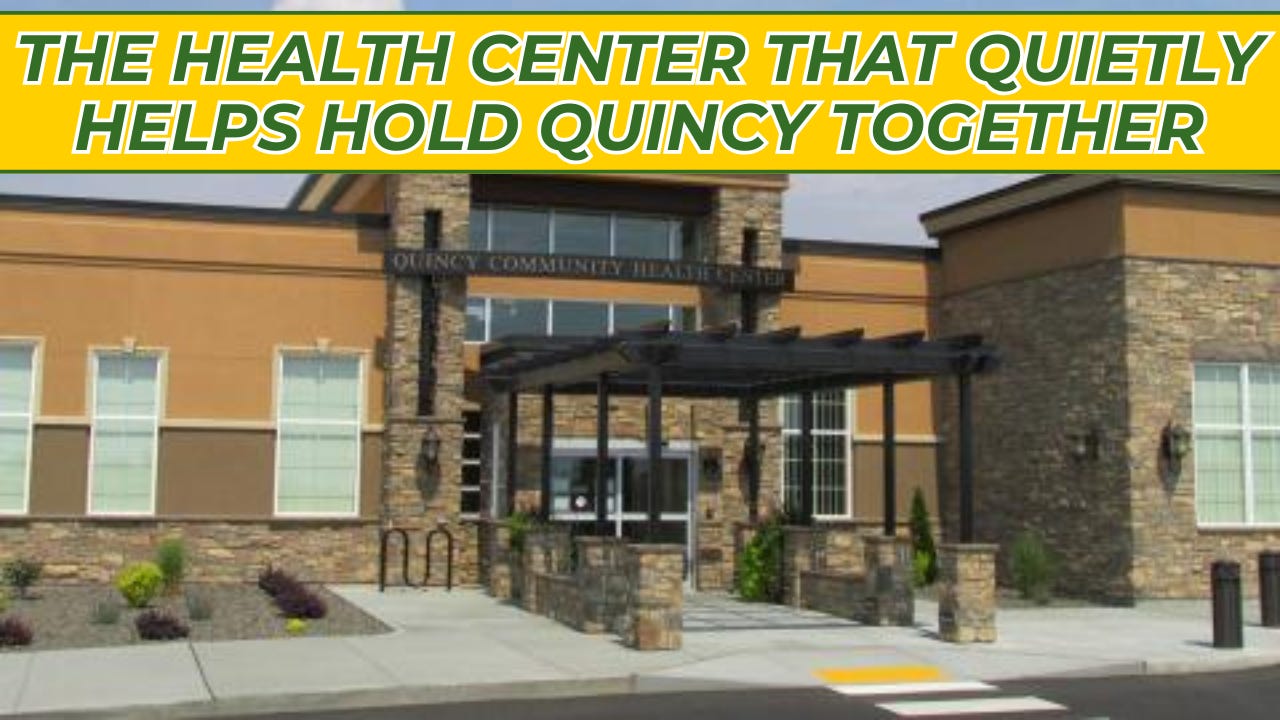
If you asked most people across the 98848 what Quincy Community Health Center does, the answer would probably be simple: it’s a doctor’s office or a medical clinic.
That answer isn’t wrong. It just isn’t the whole story.
Behind the exam rooms is a team working on mental health, housing, food insecurity, transportation, community education, environmental health, research and outreach. Over more than two decades, some of that work has reached well beyond healthcare and into larger challenges facing Quincy families.
After sitting down with Mary Jo Ybarra-Vega, who has spent more than 20 years working at Quincy Community Health Center, it becomes clear that the clinic has become something many residents may never have considered: an important piece of Quincy’s community infrastructure.
TL;DR
Quincy Community Health Center provides far more than primary medical care.
· Services available through the health center include medical care, behavioral health, dental care, maternity support, WIC, same-day care, pharmacy services and more.
The organization serves as a community connector, bringing services and specialists to Quincy that once required traveling out of town.
Outreach staff have helped address issues ranging from housing and food insecurity to wildfire smoke education and public health research.
The clinic has helped build partnerships with schools, universities, state agencies and local organizations that continue to benefit residents throughout the 98848.
Many of those efforts happen quietly, leaving many residents unaware of just how much work takes place beyond the exam room.

More Than Medical Care
Walking into Quincy Community Health Center, it’s easy to assume the building serves one purpose. Patients arrive for appointments, check in at the front desk, meet with providers and head home.
In reality, the clinic functions more like a hub than a destination.
That range of care is reflected in the services available at the Quincy location. According to the health center, those include medical and dental care, behavioral health, maternity support, WIC nutrition services, a pharmacy, a same-day clinic, medication-assisted treatment and a Sliding Fee Discount Program. Access also extends beyond traditional business hours, with the Quincy clinic generally open from 7 a.m. to 8 p.m. Monday through Friday and from 8:30 a.m. to 5 p.m. Saturday, although hours vary by service.
Medical providers, behavioral health professionals, dental professionals, pharmacy staff, outreach specialists and visiting specialists all work under one roof. Some patients receive care entirely at the clinic, while others may never set foot inside the main building because they receive services through the wellness center located at Quincy High School or at their office space across the street from the clinic where I met with Mary Jo Ybarra-Vega.
For Ybarra-Vega, Part of the challenge is simply helping people realize those services exist. As Ybarra-Vega put it, “A lot of people aren’t aware how much we do… People just don’t know.”
“I always tell people we’re like a Super Walmart,” she said. “We have everything inside one place.”
That comparison may sound lighthearted, but it reflects a serious goal. Rather than asking families to travel to Wenatchee or Moses Lake for every specialty appointment, the health center has spent years working to bring more care closer to home whenever possible.
For rural communities, that can mean the difference between receiving care and putting it off.

Solving Problems Before They Become Crises
During the conversation, Ybarra-Vega rarely spoke only about medicine. Instead, she talked about food insecurity, affordable housing, transportation, mental health and the everyday barriers that prevent people from staying healthy in the first place. Those issues, she said, often have a greater impact on health than what happens during a doctor’s appointment.
I went into the interview with questions of my own about the Wellness Center at Quincy High School. As a parent, I knew the clinic existed, but I did not fully understand how it operated, what services were provided there or how parents fit into that process. Ybarra-Vega’s explanation changed the way I looked at it.
“I think when that happened initially, there was lots of conversation, lots of concern,” Ybarra-Vega said. “Our CEO is really good about working with the school district and the community, and the people who had the greatest concerns… We had really great conversations about what we’re doing there and what we’re not doing there.”
She explained that for working parents, missing half a day of work for a medical appointment can mean losing wages needed for rent or groceries. For some workers, she said, missing work once or twice can even put their jobs at risk.
Rather than accepting those realities as unavoidable, the health center has built partnerships designed to reduce them. Ybarra-Vega used my own daughter as an example to explain how the Wellness Center can work for a family with a working parent. “So if you’re a working parent and your kid’s at the high school and you had to go do a story and you couldn’t take your kid to the clinic, you could sign a piece of paper ahead of time where she can be let out of class, she goes down, she sees her provider. You know that you made the appointment for her. After she’s done with the provider, she goes back to class.”
Ybarra-Vega also pointed to the Washington State Department of Social and Health Services’ CSO Mobile team as another example. The mobile team comes to Quincy and helps eligible residents handle benefits in person. In some cases, she said, someone eligible for food assistance can complete the process and leave with an activated benefits card rather than navigating the longer phone or online process. Specialists travel to town instead of requiring patients to travel long distances. Community outreach workers help residents navigate resources they may not know exist.
Ybarra-Vega described the clinic’s role as “being that bridge” to understand what people are saying, how they are struggling and what is happening in the community.
That philosophy extends well beyond healthcare.

Quiet Work That Shapes the Community
Some of the clinic’s biggest contributions have happened outside its walls.
During the interview, Ybarra-Vega described years of research partnerships with universities and other organizations. She said the team’s work has received regional, statewide and national recognition and has included efforts to identify local housing needs. She also discussed working alongside local governments and community partners to help advance affordable housing projects, environmental health initiatives and public education efforts.
One example Ybarra-Vega pointed to is housing. She said work involving the health center, Washington State University and young people from the community helped document local housing conditions and needs. That research eventually reached community leaders and became part of a larger effort involving the city, county and other partners.
Ybarra-Vega connected that work to subsequent ordinance changes and efforts that helped make developments such as Santa Marta Plaza and Casa Quino possible.
“People don’t know that history that our clinic has been involved with,” she said.
For Ybarra-Vega, that history illustrates a broader definition of outreach. It isn’t simply handing someone a brochure or telling them where to call. “Our outreach, I think, doesn’t just mean outreach into community, but also going back and changing systemically things and rules and laws to make things better for all of our community.”
Many residents may never connect those projects back to Quincy Community Health Center. That’s part of the story. Unlike ribbon cuttings or new buildings, outreach work often happens quietly through data collection, meetings, research and partnerships formed long before the public sees the results.
According to Ybarra-Vega, it is work measured less by headlines than by whether families have better access to services than they did a decade ago. Ybarra-Vega said the work has to be led by the community by what residents, providers and families say they actually need.
That approach has shaped everything from health fairs and wildfire smoke education to research partnerships and community resource events that continue to evolve with changing needs.

Built on Relationships
Perhaps the most striking part of the conversation wasn’t the list of programs or services. It was how often Ybarra-Vega spoke about trust.
Ybarra-Vega, a former school counselor, now works alongside women who were once her students and watches them raise children of their own. Outreach staff know neighborhoods, community leaders and the different languages spoken throughout the region.
Ybarra-Vega pointed to outreach staff who have built relationships within Spanish-speaking and Mixteco communities throughout the area, including families around George and the Royal Slope. Those relationships give the health center a way to share information and hear concerns from residents who may not be reached through traditional websites, flyers or public meetings. They know where people gather, how information spreads and, just as importantly, who may not be receiving it.
That local knowledge allows the clinic to reach people who might otherwise remain disconnected from healthcare, government services or community resources. Sometimes outreach is as simple as knowing which trusted community members to contact. Ybarra-Vega said the team regularly uses WhatsApp and relationships with local volunteers and community members to distribute information through networks that already exist. In a community as diverse as Quincy, those relationships matter every bit as much as buildings and equipment.
What This Means to You
It is easy to think of healthcare as something that begins when you schedule an appointment and ends when you leave the exam room, but the work Ybarra-Vega described offers a different perspective.
For Quincy Community Health Center, improving health also means helping families find resources, reducing barriers to care, connecting residents with partner organizations and working alongside schools, local governments and nonprofits to address challenges before they become emergencies.
Whether someone has ever been a patient or not, many people across the 98848 have likely benefited from work the clinic helped start, supported or coordinated behind the scenes.
That doesn’t mean every resident will use every service the clinic provides. It is easy to think of healthcare as something that begins when you schedule an appointment and ends when you leave the exam room, but the work Ybarra-Vega described offers a different perspective.
Looking Beyond the Waiting Room
Every community has organizations that become part of the background simply because they’ve always been there. Quincy Community Health Center may be one of them. For many residents, it remains simply the place where you go to see a doctor.
After spending time talking with Ybarra-Vega about the people and work behind the organization, it becomes clear it is also something more: a community partner that has spent decades helping connect people with resources, bringing services closer to home and working behind the scenes to strengthen the 98848 in ways many residents never see.
Sometimes the organizations making a difference across the 98848 aren’t the loudest. They’re simply the ones that keep showing up, year after year, doing work most people never see and helping hold a community together.
