

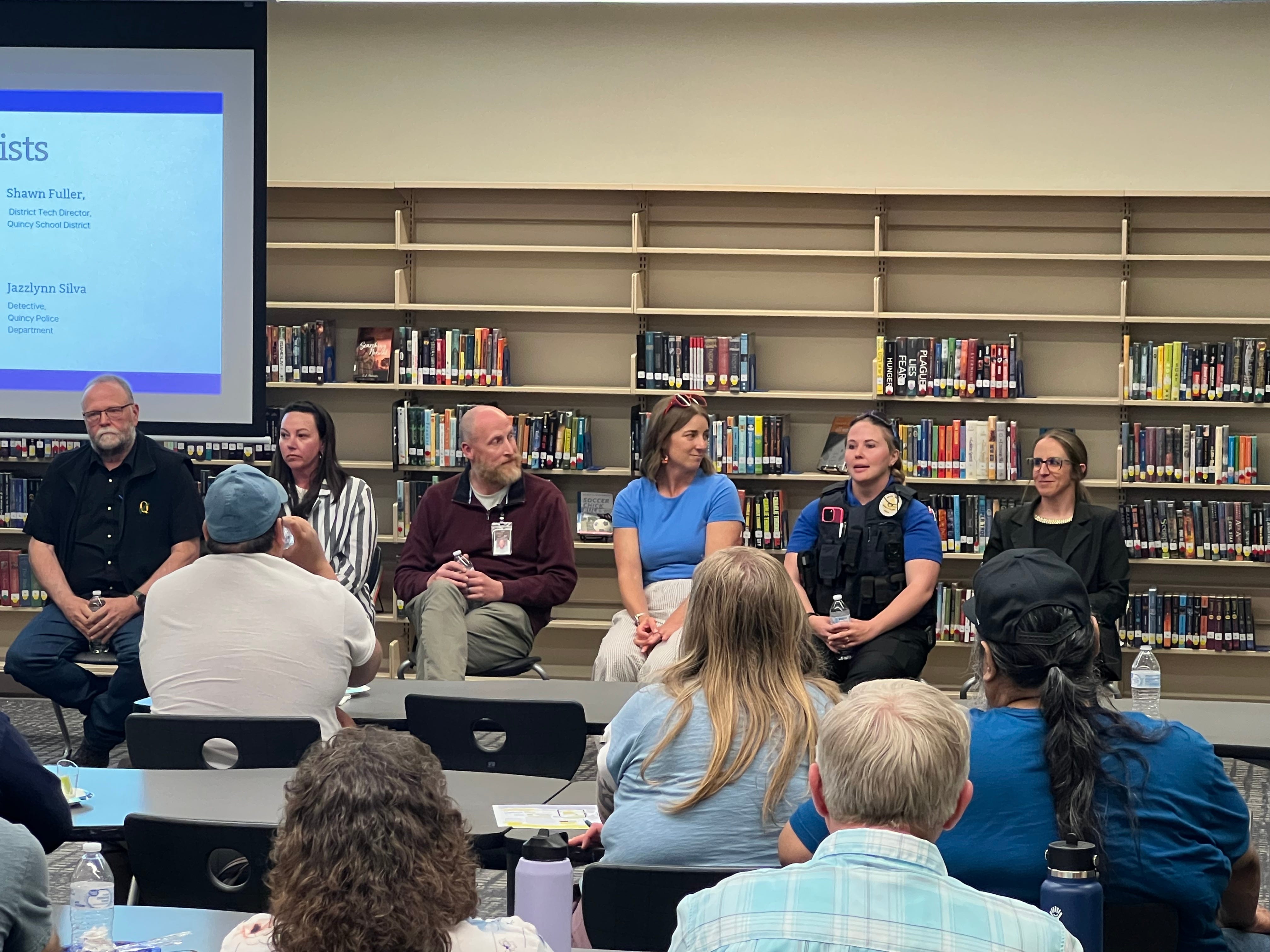
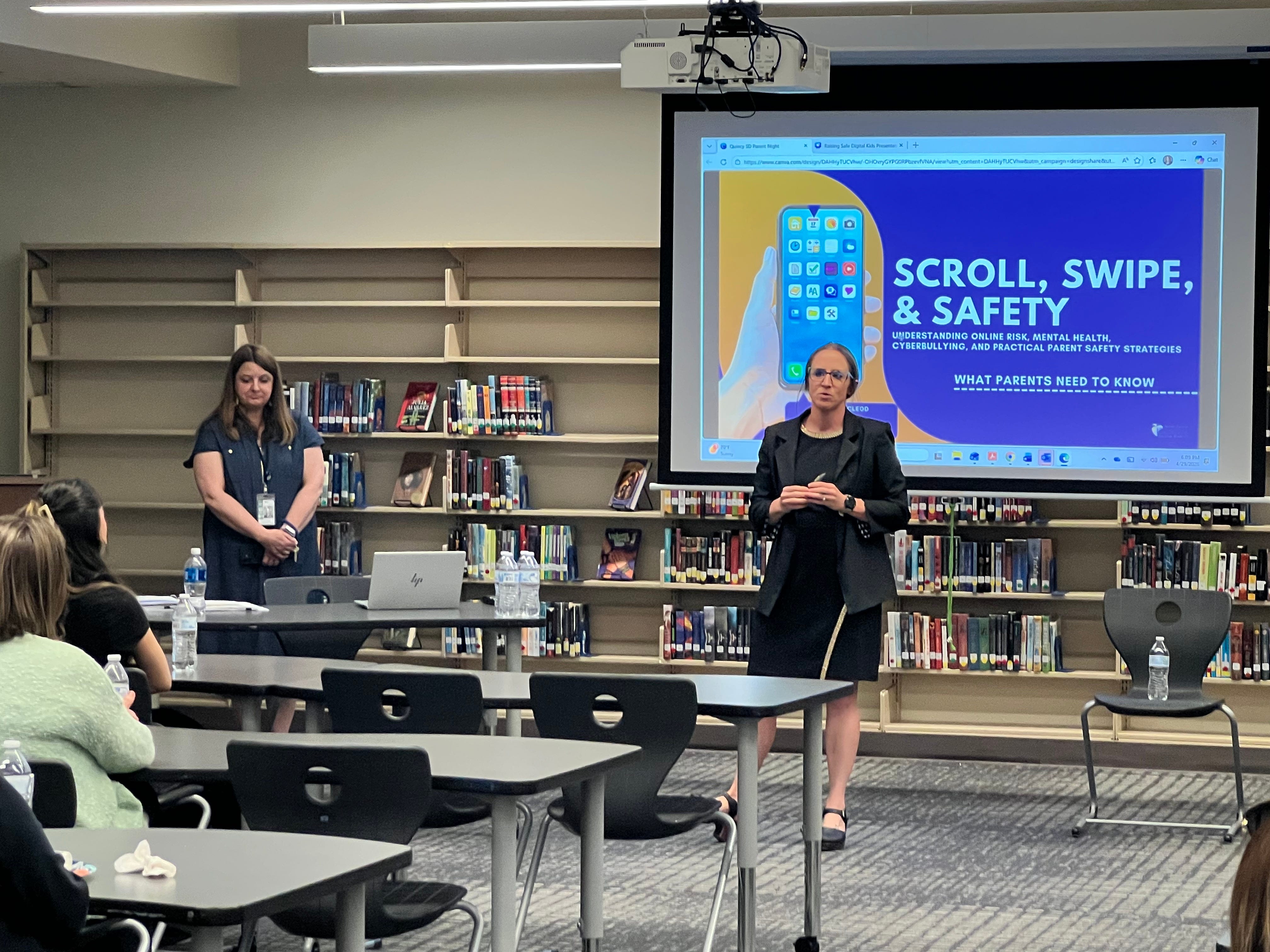
Last night, around 40 people gathered in the Quincy Middle School library for a conversation that doesn’t usually draw a crowd, but probably should.
No big production. No headline moment. Just parents, educators, and community members sitting down to try and make sense of something that’s moving faster than most of us feel equipped to handle.
The “Raising Safe Digital Kids” workshop, put on by Quincy School District, Quincy Partnership for Youth, and regional partners, focused on online safety, mental health, and the reality of what kids are navigating every day.
Hunter McLeod from NCESD 171 (the North Central Educational Service District) led the presentation, followed by a panel that included school leadership, law enforcement, and mental health professionals.
But what stood out wasn’t just the information.
It was the tone of the room.
People weren’t panicked. They weren’t dismissive.
They were trying to catch up.
Technology is moving so rapidly that most parents and other people working with young people are just scrambling to keep up. Evolving social media, gaming and AI all have their uses, but they also open up our young people to new threats that we have never had to face before.
This article will be a little different. I wanted to share some of the things we talked about at the event and more importantly some of the things we learned.
TL;DR
• Parents are still the #1 protective factor in kids’ digital safety
• Most risks don’t start as obvious danger—they start as attention and connection
• Apps change too fast to track—patterns matter more than platforms
• Secrecy, mood shifts, and sleep disruption are early warning signs
• No app replaces involvement, conversation, and consistency
• The goal isn’t control—it’s connection

This Starts Earlier Than Most People Realize
One of the first realities that hit the room:
Kids are entering the digital world earlier than most of us think. By age 4, more than half of children have their own tablet. By age 8, nearly 1 in 4 have their own cellphone.
That shifts the timeline.
This isn’t something you “deal with later.” It’s something that’s already part of how kids grow up. For me this was a mind blowing revelation, I have always tried to limit my daughter’s exposure to and use of devices. My children have no social media despite being 11 and 14. My wife and I knew we were a little more restrictive than some parents.
It was eye opening to find our that there are that many young people spending so much time online or on devices, much more their own devices and accounts.
Not Everything Is “Bullying” And That Matters
A big portion of the conversation focused on Harassment, Intimidation, and Bullying (HIB), and the difference between them.
Conflict is normal and often repairable
Mean behavior happens in moments
HIB is targeted, repeated, and harmful; designed to isolate or humiliate
The problem is that online behavior can cross that line faster than most parents recognize.
Group chats. Fake accounts. Screenshots. Private stories.
Things that feel small individually but compound quickly.
One of the adjustments that I didn’t hear discussed that need to be addressed is this. Parenting is shaped by your own lived experience, and times have changed. I was bullied at school in my younger years, 5th 6th and 7th grade had some rough moments. One critical difference is that it stayed at school, it didn’t follow me home via online and mobile communication.
There were no memes, no doctored pictures, no harassing DM’s or messages. As a parent I have had to realize (and admit) my daughter’s world is very different in some ways than when I was growing up. Sometimes we let our own experiences blind us to what our children are opened up to and possibly facing now.

Where Things Actually Start
One of the most useful reframes from the night:
Serious online issues rarely start with something obviously dangerous.
They start with:
Curiosity
Attention
Boredom
A sense of belonging
Then they escalate.
That’s what makes this hard. You’re not just looking for “bad decisions.”
You’re watching for subtle shifts.
The Concept Parents Should Pay Attention To: Digital Leakage
Kids reveal more online than they realize.
Sometimes directly. Sometimes indirectly.
The presentation called this “digital leakage,” and it shows up as:
Secrecy
Panic around devices
Sudden withdrawal
Sleep disruption
“Goodbye” or hopeless messaging
Unknown contacts or private accounts
These are often early signals.
And more often than not, they show up online before they show up anywhere else.
The Pressure Most Adults Underestimate
Phones aren’t just tools.
They’re constant demands for attention.
Notifications, streaks, messages, invites. There is always something asking for a response. For kids, that creates a pressure loop most adults didn’t grow up with.
This is an issue that a lot of adults develop because companies spend hundreds of thousands, into the millions of dollars a year designing everything about a mobile device to be addictive. For young people the pressure is even worse as their brain is still evolving and not fully developed for emotional control.
There is currently active lawsuits over this fact. Meta and Google have both already lost 2 suits over the addictive qualities of their platforms especially for youths. More states are currently bringing suit after these court rulings and so are a few countries.
Every app and device is carefully engineered to hold your attention as an adult and more importantly, they next generations attention.
In my opinion I liken it to the discovery made when I was a kid. Using undercover cameras, they sent junior high and elementary age kids in convenience stores, they found out that advertising and displays for things like tobacco and alcohol were frequently placed at the eye level of a 12 year old.
You are not the target…
So when it comes to your kids, a better question isn’t “how much screen time?”
It’s, “what does your child feel like they can’t ignore?”
That is a huge red flag and early warning sign that things need to change.
Apps Aren’t the Real Problem
There was a lot of discussion about specific platforms; TikTok, Snapchat, Discord, Instagram, Roblox.
One of the most practical takeaways, trying to track every app and know every technology is a losing strategy.
What matters is behavior:
Are conversations moving to private spaces?
Are there unknown people involved?
Is there pressure, secrecy, or isolation?
Are messages disappearing?
That’s where risk actually lives.
The Line That Shifted the Room
There was one line that people wrote down:
“Our children are only as safe as their friend with the weakest digital rules.”
That’s uncomfortable but real. Because your child doesn’t just operate inside your boundaries.
They operate inside a network.
I had to think about this idea good and hard. I have had conversations with parents of households where my children spend time outside my home, we have reviewed what movies and food they are allowed.
I am pretty sure we have never once discussed the difference in what I let my kids have access to online versus what they allow their children to do online. For example, my kids are not on Roblox or Minecraft. However, I know some of their friends parents let their own kids play both. It is not a conversation I ever would have thought to have. I didn’t have a video game system at home in junior high, but I sure played my friends Sega when I was at his house.
This Is Also a Mental Health Conversation
This isn’t just about safety, it’s about impact.
Online environments are tied directly to:
Anxiety
Depression
Sleep disruption
Social comparison
Emotional dependence on validation
Some of the signs parents were encouraged to watch for:
Mood changes after being online
Panic when devices are taken away
Avoiding school due to online conflict
Withdrawal or secrecy
These are not small things, they’re signals.

What Actually Works (And What Doesn’t)
There are tools. Filters. Monitoring apps.
But the message was clear; no tool replaces parenting and no app replaces connection.
What works is:
Consistency
Visibility
Clear expectations
Ongoing conversation
Not one big talk…. a lot of smaller ones.
What This Means for You
If you’re a parent, this probably confirmed something you’ve already felt:
You’re navigating something you didn’t grow up with, using instincts that weren’t built for this environment. It’s easy to feel like you’re behind and don’t have a clue.
But here’s the shift that came out of the room:
You don’t need to understand every app, every trend, or every risk.
You need to stay engaged.
Because the biggest gap right now isn’t knowledge, it’s visibility.
Most of the real issues aren’t happening out in the open. They’re happening in private chats, secondary accounts, disappearing messages, and quiet shifts in behavior.
Which means your role isn’t to control everything.
It’s to stay close enough that your child doesn’t feel like they have to handle it alone.
That looks like:
Asking questions instead of making assumptions
Being present without being overbearing
Creating space for honesty without immediate punishment
Checking in before something goes wrong—not just after
Maybe the hardest part; accepting that you won’t catch everything. But you can build a relationship where your child brings things to you sooner.
That’s the goal.
This Doesn’t Stay Online
This wasn’t a packed auditorium.
It was a room with a few dozen people who chose to show up and lean into something uncomfortable, because they know it matters.
And it does.
Because the challenges kids are dealing with online don’t stay online.
They show up in classrooms.
They show up in friendships.
They show up in sleep, in stress, in confidence, and in the way kids see themselves and the world around them.
They show up in our homes.
And they’re not slowing down.
What last night showed is that this community isn’t ignoring that reality.
We’re just in the process of figuring out how to respond to it together.
And maybe that’s the real takeaway.
You don’t have to have all the answers.
You’re not supposed to.
But you do have to stay close enough to your kids that when something does happen, they don’t feel like they’re dealing with it alone.
Because in a world where so much is happening out of sight…
Your presence is still the strongest safety system they have.
