
If you want to know how a school district is doing, there are plenty of numbers available.
Test scores. Graduation rates. Attendance reports. Enrollment counts.
Those numbers tell part of the story.
The Quincy School District’s annual climate survey looks at a different side of the equation.
Instead of measuring student performance, the survey asks teachers and staff what they are experiencing inside classrooms, hallways, offices, cafeterias, playgrounds, and meeting rooms every day. What is working? What is improving? What challenges still need attention?
District leaders reviewed the 2025-26 survey results during the May 26 School Board meeting, giving board members a district-wide snapshot of how employees view their schools, leadership teams, working environments, and student support systems.
The results revealed a picture that is neither overwhelmingly positive nor overwhelmingly negative.
Instead, the survey showed schools making progress in many areas while continuing to wrestle with challenges that educators believe deserve additional attention. Among those challenges, one theme appeared repeatedly across multiple schools: student behavior and student respect for staff.
For families across the 98848, the survey offers one of the clearest looks available into what educators are experiencing throughout the district and where they believe the next improvements need to happen.
Unlike some school board topics that generate immediate debate, the climate survey discussion was relatively brief. Board members received the report, reviewed the data, and agreed the information deserved a deeper conversation at a future meeting.
TL;DR
• Staff across Quincy School District reported many positive experiences related to leadership, communication, and workplace culture.
• Student behavior emerged as one of the most common concerns identified across multiple schools.
• Several buildings also reported concerns regarding student respect toward teachers and staff.
• Schools have already developed building-specific action plans to address concerns raised through the survey.
• School Board members will continue reviewing the survey data during a future meeting.

What Staff Said is Working
One of the most important takeaways from the survey is that many employees reported positive experiences within their schools.
At George Elementary, staff identified equitable treatment among programs, grade levels, and employees as one of the school’s strengths. Staff also reported that coworkers generally listen to and respect diverse opinions and address issues professionally.
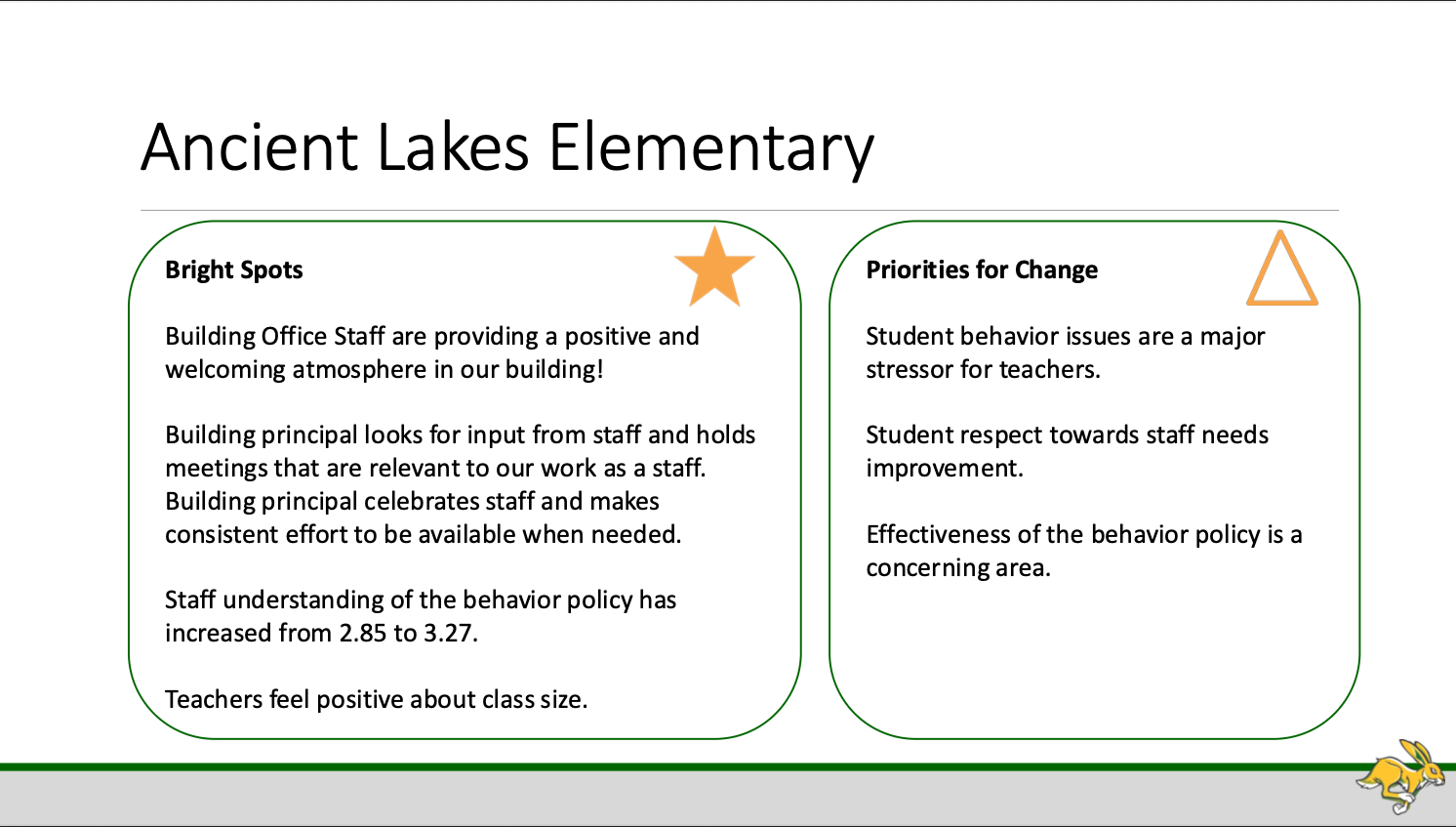
Ancient Lakes Elementary staff highlighted the welcoming atmosphere created by office staff and reported positive perceptions of building leadership. Teachers noted that administrators seek staff input, hold relevant meetings, celebrate employee accomplishments, and remain available when needed. Staff understanding of behavior policies also improved compared to the previous year.
Mountain View Elementary reported strong scores related to administrator support. Staff indicated they feel respected by building leadership and believe decisions affecting the school are discussed with employees before they are made. Staff also reported confidence that administrators consistently support and enforce schoolwide behavior expectations.
At Quincy High School, staff identified administrator support and protection of planning and collaboration time as significant strengths. Teachers also reported improvements in relationships between teachers and paraeducators and noted increased parent presence in the building compared to previous years.
Several schools also reported improvements in areas that had been concerns in the past. Monument Elementary identified building maintenance as a bright spot after previously viewing it as an area needing improvement. Quincy Middle School reported gains in building cleanliness and work-order completion. Quincy Innovation Academy reported substantial improvement in staff perceptions of student respect and administrator support of behavior expectations.
Taken together, those responses suggest many employees believe positive progress is happening throughout the district.
I would love to stop right there, but that wouldn’t be honest.
The Concerns Showing Up Across Multiple Schools
While each school reported its own unique strengths and challenges, one theme appeared repeatedly across multiple buildings.
Student behavior continues to be one of the biggest sources of stress for educators.
George Elementary staff identified student behavior as a significant concern. Pioneer Elementary reported concerns related to student behavior and student respect toward adults. Ancient Lakes Elementary identified student behavior as a major teacher stressor while also raising concerns about student respect and the effectiveness of behavior policies.
Monument Elementary staff pointed to student behavior, student respect, and discipline enforcement as growth opportunities. Quincy Middle School reported that its highest staff stressors revolve around student behavior and students following school expectations. Special Education and Health Services staff also identified behavioral supports as an area where additional collaboration and resources could benefit both students and employees.
What makes these findings noteworthy is not that they appeared in one school. They appeared across multiple schools serving different grade levels, student populations, and communities.The consistency of those responses suggests educators throughout the district are encountering similar challenges, even while many other aspects of school culture continue to improve.
It is also worth noting that staff concerns were not limited to student behavior. Some schools identified concerns related to communication, trust among staff members, building maintenance, paperwork requirements, and administrative availability. However, student behavior was the issue that surfaced most consistently across the district.
I will be interested to hear the discussion go further in the next school board meeting, but for now, here are some of the thoughts going forward that were presented in the report.
What Schools Plan to Do About It
One of the strengths of the climate survey process is that schools are not simply asked to identify problems. They are also required to develop plans for addressing them.
Those plans vary from building to building, but several common themes emerged.
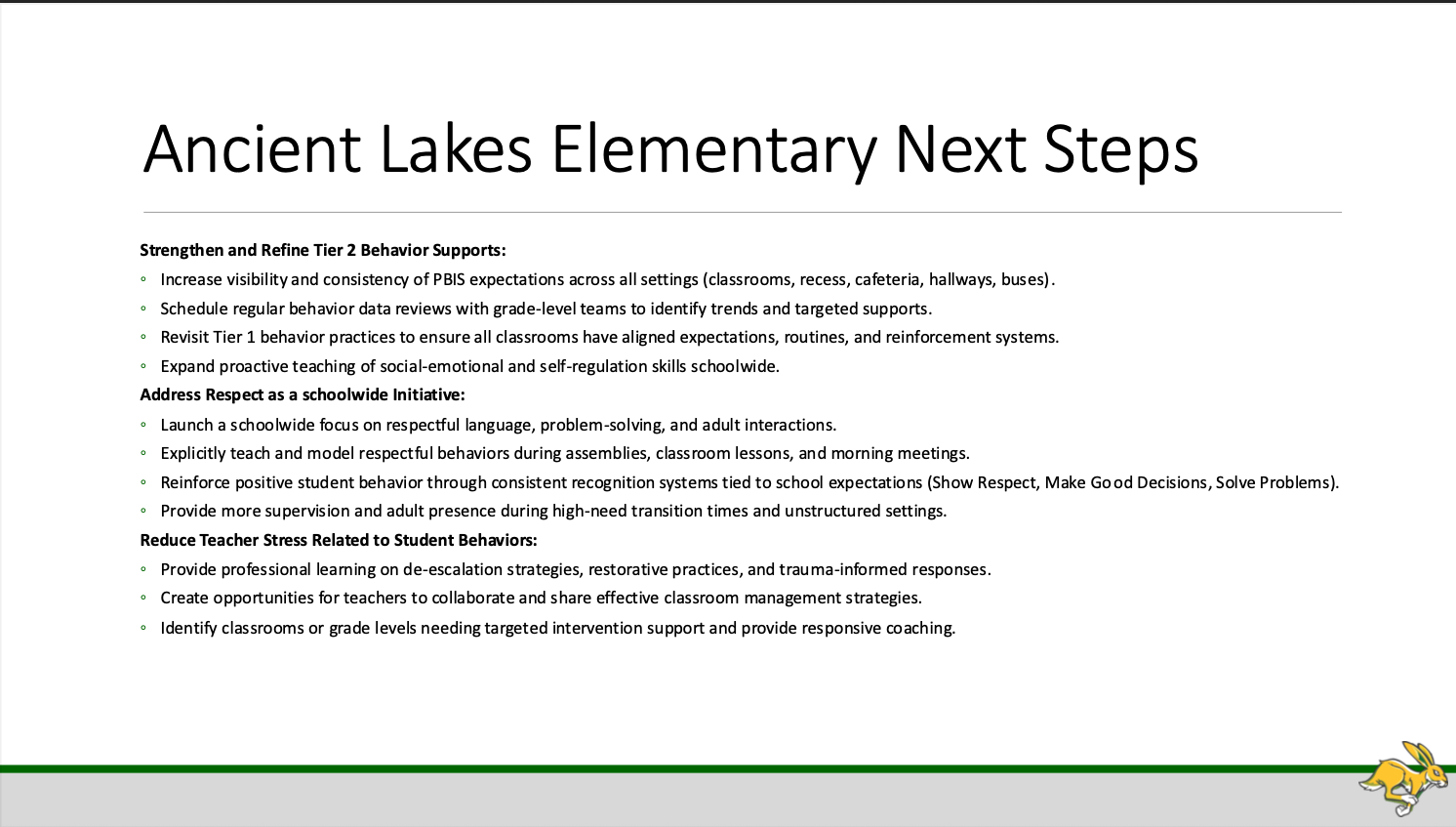
Many schools are focusing on creating greater consistency around behavior expectations. Staff discussed teaching and reteaching expectations, improving intervention systems for students who need additional support, increasing communication with families, and strengthening schoolwide approaches to positive behavior.
Several schools plan to provide additional professional development related to de-escalation strategies, restorative practices, classroom management, trauma-informed approaches, and behavior interventions.
Other schools in the district are also focused on increasing supervision in high-need areas, improving communication among staff, strengthening relationships, and creating clearer systems for addressing concerns when they arise.
A common thread throughout the action plans is that schools are looking for proactive solutions rather than reactive ones. The focus is less on punishment and more on creating systems that help students succeed before problems become larger disruptions.
Whether those efforts produce measurable improvements will be something we find out in the 2026-2027 school year, but the survey demonstrates that schools are actively planning responses to the feedback provided by staff.
Why This Matters to Families
For many parents, their view of school is naturally shaped by their own child’s experience. A student may love school, struggle in school, thrive socially, or face challenges that are unique to them.
The climate survey provides a different perspective.
Instead of looking at a single classroom or individual student, it offers a district-wide view of what educators are experiencing across multiple schools at the same time.
The survey does not suggest Quincy schools are struggling across the board. In fact, many of the results point toward improving relationships, stronger leadership, better communication, and positive school cultures.
What it does suggest is that educators continue to see student behavior as one of the most significant challenges affecting classrooms and learning environments.
That challenge is not unique to Quincy. Districts across Washington and across the country continue to have conversations about student engagement, classroom behavior, social-emotional support, and school expectations.
The difference is that Quincy now has local data showing what its own educators are experiencing and where they believe attention should be focused.
As a parent of two teenagers, I admit I have some reservations about how frequently the term “trauma-informed” is used in modern education and culture. Real trauma absolutely exists, and I worked with young people facing very real trauma during my years in youth ministry. My concern is that the term has become so broadly applied that it sometimes loses meaning. Not every disappointment, boundary, rule, or consequence is traumatic. Communities need both compassion and healthy expectations, and finding the right balance is an important part of these conversations.
In my opinion, the survey may be pointing toward a larger issue than what happens inside school buildings. Schools can reinforce expectations, but many of the habits that shape student behavior begin long before a child walks into a classroom. Respect, manners, accountability, and how we treat other people are lessons that start at home. Teachers play an important role in helping reinforce those values, but they cannot carry that responsibility alone.

What Happens Next
The School Board’s discussion of the climate survey on May 26 was intentionally brief.
Board members received both the presentation and the underlying survey data. During the meeting, district leaders indicated that the report would return for additional discussion, giving board members time to review the information more thoroughly and develop questions about the results.
That next conversation may ultimately be more important than the survey itself.
Gathering information is only the first step. The more important question is what changes occur because of what staff shared. It is a story I plan to follow closely because the next discussion could take us in very different directions.
For residents of the 98848, the survey serves as a reminder that schools are constantly evolving. Every year brings a new group of students, new challenges, new opportunities, and new expectations from families and the community.
This year’s survey suggests Quincy schools have made progress in several important areas which should not be a surprise. Covering the school district regularly, I can say without a doubt that our educators are committed to our kids and our schools. It also suggests that our educators know there is still work to be done.
As we celebrate the Class of 2026 this week, it is worth remembering that our educators are already focused on the Classes of 2027, 2028, 2029, and the decades of students who will follow them.
That brings us back to where this story started. Test scores, attendance reports, and graduation rates tell part of the story of a school district. The climate survey tells another part.
It reveals what the people working inside those schools experience every day.
For a community that invests heavily in its schools and cares deeply about student success, understanding both perspectives may be one of the most important conversations happening in the 98848 today.
Want to see it yourself?
