

Most school board meetings are filled with budgets, policies, and reports that can feel removed from everyday life. But on June 9, Quincy School Board members spent a significant portion of their meeting discussing something that touches nearly every family in the 98848: whether local students feel connected, safe, hopeful, and emotionally equipped to handle a world increasingly shaped by screens and digital relationships.
The conversation was driven by new results from Quincy School District’s Spring 2026 Student Survey and the statewide Healthy Youth Survey. The numbers themselves were not alarming. In many cases, they were encouraging. Students reported strong relationships with trusted adults and peers, safety scores remained high, and many risk factors compared favorably with state averages.
Yet as board members and district leaders dug deeper into the data, several questions kept resurfacing. Why are emotional regulation scores declining? Why are students reporting high amounts of screen time? And if schools are seeing strong relationships inside their buildings, what happens to students once they leave campus each afternoon?
Those questions turned what could have been an ordinary presentation into a much larger conversation about the well-being of young people throughout the 98848.
TL;DR
• Quincy School District reviewed results from its Spring 2026 Student Survey and the 2025 Healthy Youth Survey.
• The district surveyed 1,404 students through its local survey and received strong participation rates in the statewide survey.
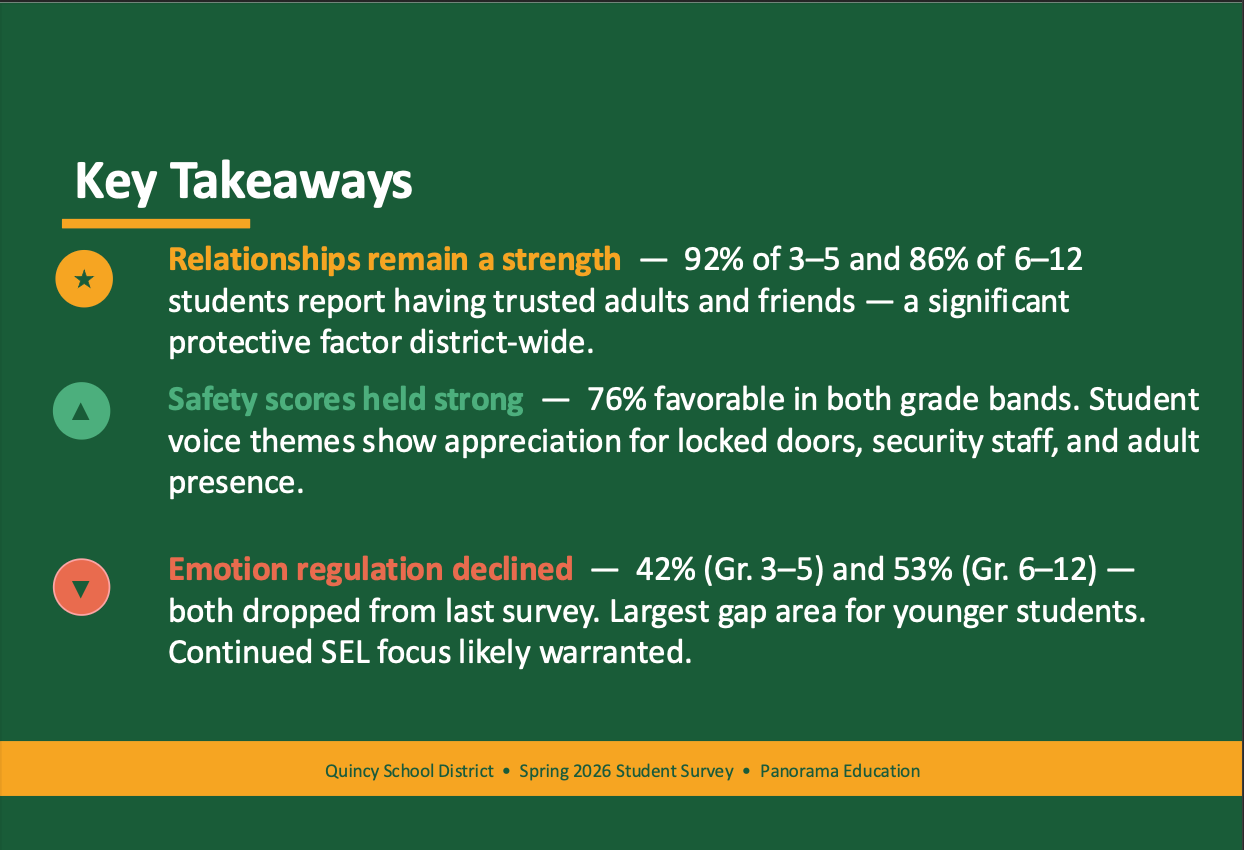
• Supportive relationships remain one of QSD’s greatest strengths, with 92% favorable responses in grades 3-5 and 86% in grades 6-12.
• School safety scored 76% favorable in both grade bands.
• Emotional regulation declined in both younger and older students and emerged as one of the district’s biggest areas for growth.
• District leaders said screen time remains a concern and will continue to be studied.
• Students reported strong connections with adults inside schools but lower levels of connection with adults in the broader community.
• District leaders said many of the issues identified in the survey cannot be solved by schools alone and require partnership between families, schools, and the community.
Relationships Remain One of Quincy Schools’ Greatest Strengths
If there was one area of the report that board members could celebrate, it was relationships.
According to the district’s student survey, 92 percent of students in grades 3 through 5 reported favorable scores for supportive relationships, while 86 percent of students in grades 6 through 12 did the same. Students also reported high levels of trust in adults and friends at school. Survey data showed that 93 percent of younger students reported having a trusted adult at school, while 82 percent of older students said the same. Student belonging also showed modest improvement in both age groups.
Student comments provided context behind those numbers. Younger students frequently mentioned caring teachers, friendships, recess, and fun learning opportunities as things they appreciate about school. Older students pointed to supportive adults, safety, extracurricular activities, clubs, electives, and feeling respected and included.
During the discussion, district leaders noted that Quincy students appear to have strong connections to adults within the school system. Teachers, counselors, coaches, and support staff continue to serve as important protective factors for many students.
Those relationships matter because decades of educational and mental health research show that one caring adult can significantly change a young person’s trajectory. The survey suggests that many Quincy students already have those connections inside their schools.
Safety Scores Are Strong, But Students Are Still Pointing Adults Toward Areas of Concern
Safety was another bright spot in the report.
Both grade groups recorded a 76 percent favorable rating for school safety, and elementary scores improved by eight points since the previous survey. Students frequently cited locked doors, security staff, cameras, and adult presence as reasons they feel safe. Many also simply said they already feel safe at school and would not change anything.
At the same time, student comments reminded district leaders that safety is about more than physical security measures. Some students raised concerns about bullying, fighting, harassment, and whether reports of inappropriate behavior receive adequate follow-through.
Board members discussed the possibility of combining future survey information with school safety and security data to better understand what students are experiencing inside school buildings. The discussion suggested that district leaders view student feedback not as criticism, but as a roadmap for where additional attention may be needed.
The message from students was not that schools are unsafe. Rather, it was that students notice the details. They notice whether adults are present, whether concerns are taken seriously, and whether systems work as intended.

Screen Time Became One of the Evening’s Biggest Conversations
One of the longest discussions of the evening centered on screen time.
The Healthy Youth Survey asks students about spending three or more hours per day on screens outside of school-related learning, including social media, videos, games, and internet use. District leaders clarified during the meeting that the question does not specifically measure classroom technology use. Instead, it reflects students’ overall digital habits.
Board members expressed concern about how much time young people spend on screens and how technology may be affecting relationships, behavior, and emotional health. District administrators said the district’s Digital Education Committee plans to study how much time students spend on screens during the school day and may eventually offer recommendations.
The conversation highlighted a challenge facing communities everywhere, including the 98848. Schools are expected to prepare students for a world increasingly dependent on technology, yet many parents, educators, and health professionals are simultaneously concerned about excessive screen exposure and its impact on attention spans, emotional regulation, sleep, and social interaction.
District leaders acknowledged that this issue cannot be solved by schools alone. The devices students carry home each day place the conversation squarely in the shared space between families, schools, and the broader community.
Emotional Regulation Emerged as the District’s Largest Area for Growth
The most concerning data point in the presentation involved emotional regulation.
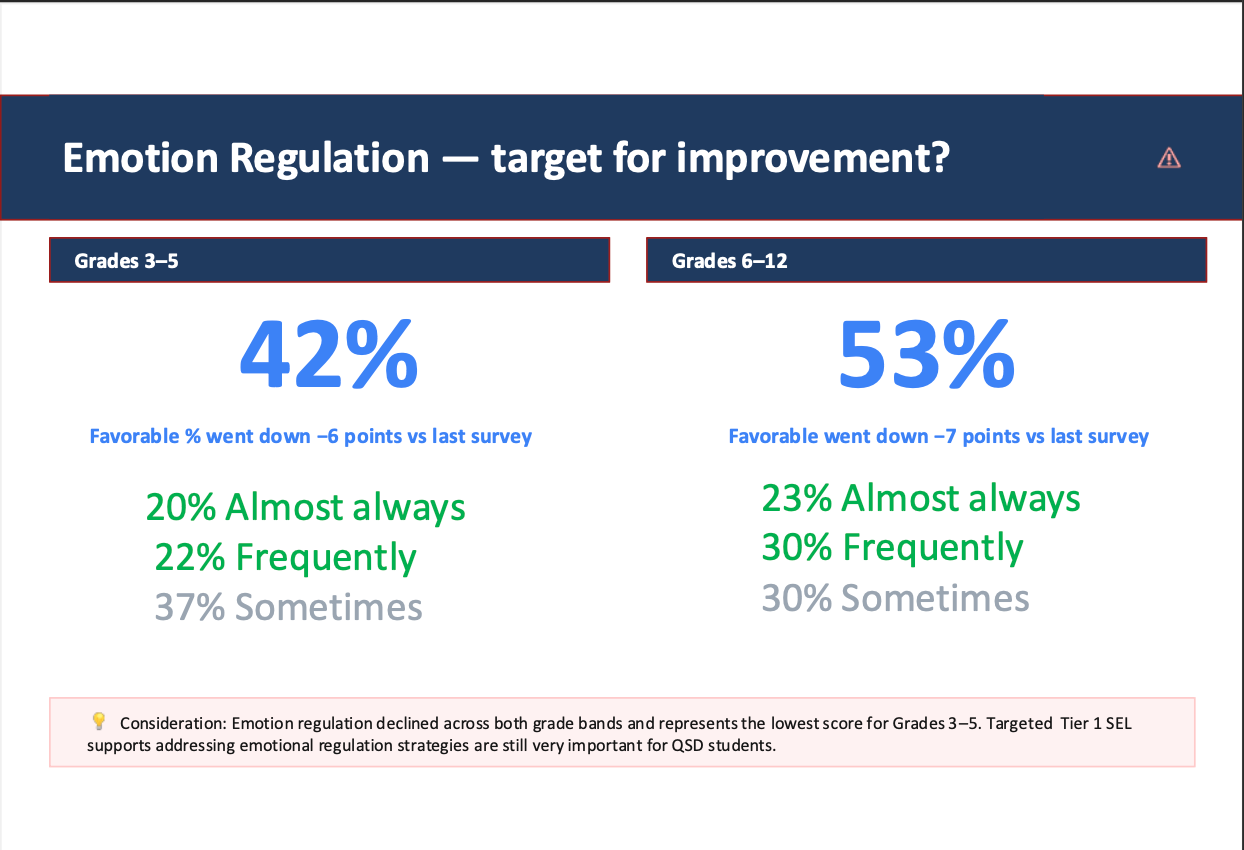
Among students in grades 3 through 5, only 42 percent reported favorable scores in emotional regulation, a decline of six points from the previous survey. Among students in grades 6 through 12, favorable scores dropped seven points to 53 percent. For younger students, it was the lowest scoring category in the survey.
Board members asked what emotional regulation means in practical terms. District leaders explained that it is not about whether children have emotions. Everyone experiences frustration, disappointment, anger, embarrassment, or anxiety. Emotional regulation is the ability to pause and think before acting.
A child being told no for the first time, a middle school student embarrassed by a social media post, or a teenager frustrated after an argument all face the same challenge. Can they stop, process what they are feeling, and make a decision before their emotions make the decision for them?
District leaders said both the student survey and other climate data suggest social-emotional learning remains an area that deserves continued attention. They also noted that emotional regulation difficulties are increasingly visible when young children enter school, particularly among students who have spent significant time in highly digital environments.
The decline in these scores does not point to a crisis, but it does serve as an important warning light. If students are struggling to regulate emotions, it can affect learning, relationships, discipline, and overall well-being.
The Healthy Youth Survey Offers a Window Into Life Beyond the Classroom
The statewide Healthy Youth Survey provided a broader picture of student experiences.
The survey, administered every two years to students in grades 6, 8, 10, and 12, showed that for most risk factors, Quincy students rated at or below state averages, while for most protective factors they rated at or above state averages. Several indicators also showed improvement since the previous survey cycle.
District leaders noted that eighth-grade students were sometimes an exception, reporting less positive ratings on several factors. The report also found that student ratings involving depression and low levels of hope were not as positive as state averages.
Another finding that drew discussion involved students’ connections outside of school. While district surveys suggest students are highly connected to adults inside school buildings, the Healthy Youth Survey found fewer students reporting that they have an adult in their neighborhood or community they can talk to about something important.
For the 98848, that finding may be one of the most significant in the entire presentation. Schools see students for roughly seven hours a day. The rest of their time is spent with families, friends, employers, churches, sports teams, and community organizations. Those relationships may ultimately shape a young person’s sense of belonging and hope just as much as what happens inside a classroom.

What This Means to You
The June 9 presentation was not simply a collection of statistics. It was, in many ways, a mirror held up to the community.
The survey data suggests Quincy students generally feel safe, supported, and connected at school. Those are strengths worth celebrating. They represent years of work by educators, support staff, families, and community partners.
At the same time, the report points toward challenges that extend beyond school walls. Screen time, emotional regulation, hope, and trusted relationships outside of school are not issues that belong solely to educators. They belong to all of us.
Every coach who checks in with a player, every employer who mentors a young worker, every youth group leader, pastor, grandparent, neighbor, and parent who takes time to listen has an opportunity to become another protective factor in a student’s life.
More Than a School Conversation
The June 9 school board meeting could have easily been remembered for policies, contracts, or end-of-year business. Instead, much of the evening focused on relationships, hope, emotional resilience, and whether young people have trusted adults guiding them toward the future.
The presentation offered a reminder that schools are often the first place where communities notice broader social changes. Rising screen time, declining emotional regulation, and questions about hope are not challenges unique to Quincy. But they are showing up here, in the experiences of local students.
The survey may have been presented in a school board meeting, but its biggest questions belong to the entire 98848. If Quincy students are telling adults they need relationships, guidance, and help navigating an increasingly digital world, then the responsibility does not rest solely with schools. It belongs to families, neighbors, community organizations, and every adult who has the opportunity to become one more trusted person in a young person’s life.
