
There’s something different that happens when a kid gets to sit across from history instead of just reading about it.
Not a textbook. Not a worksheet.
A conversation.
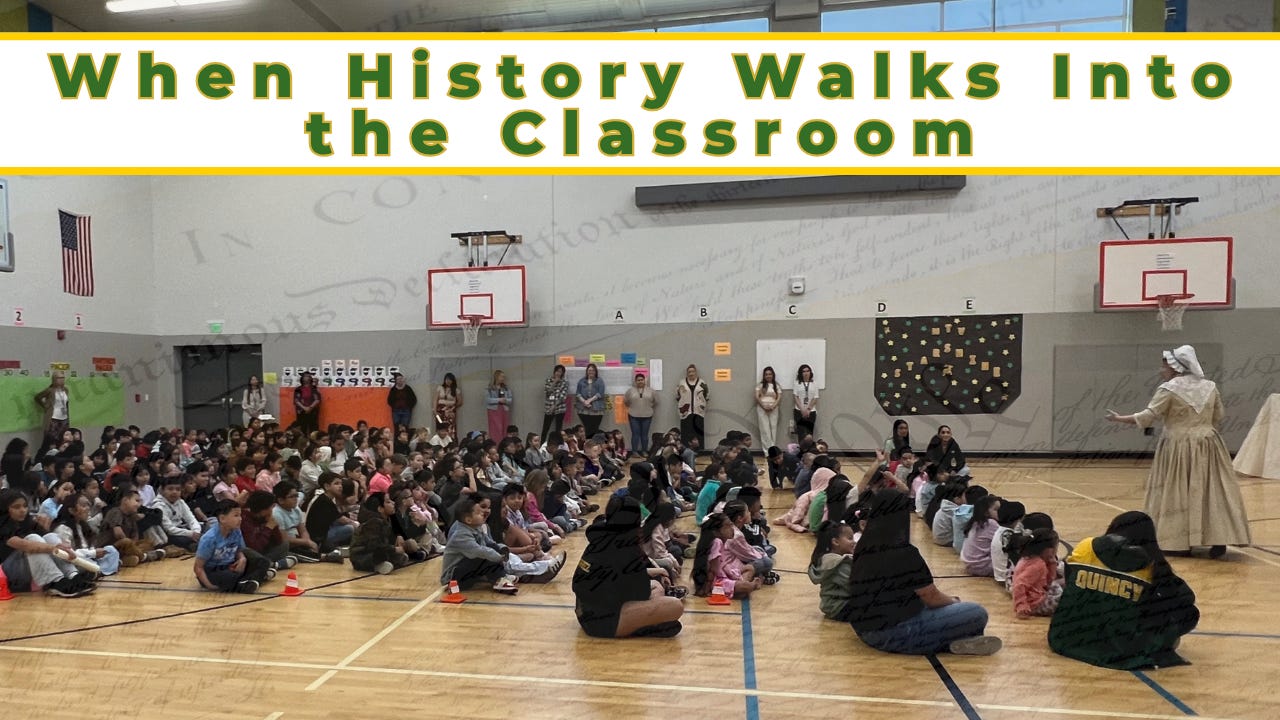
That’s what I walked into today at Mountain View Elementary, where the Quincy Valley Historical Society & Museum rolled out their “Philadelphia: 1776 Traveling Exhibit” for the first time.
“Tell me and I forget, teach me and I may remember, involve me and I learn.” - Benjamin Franklin
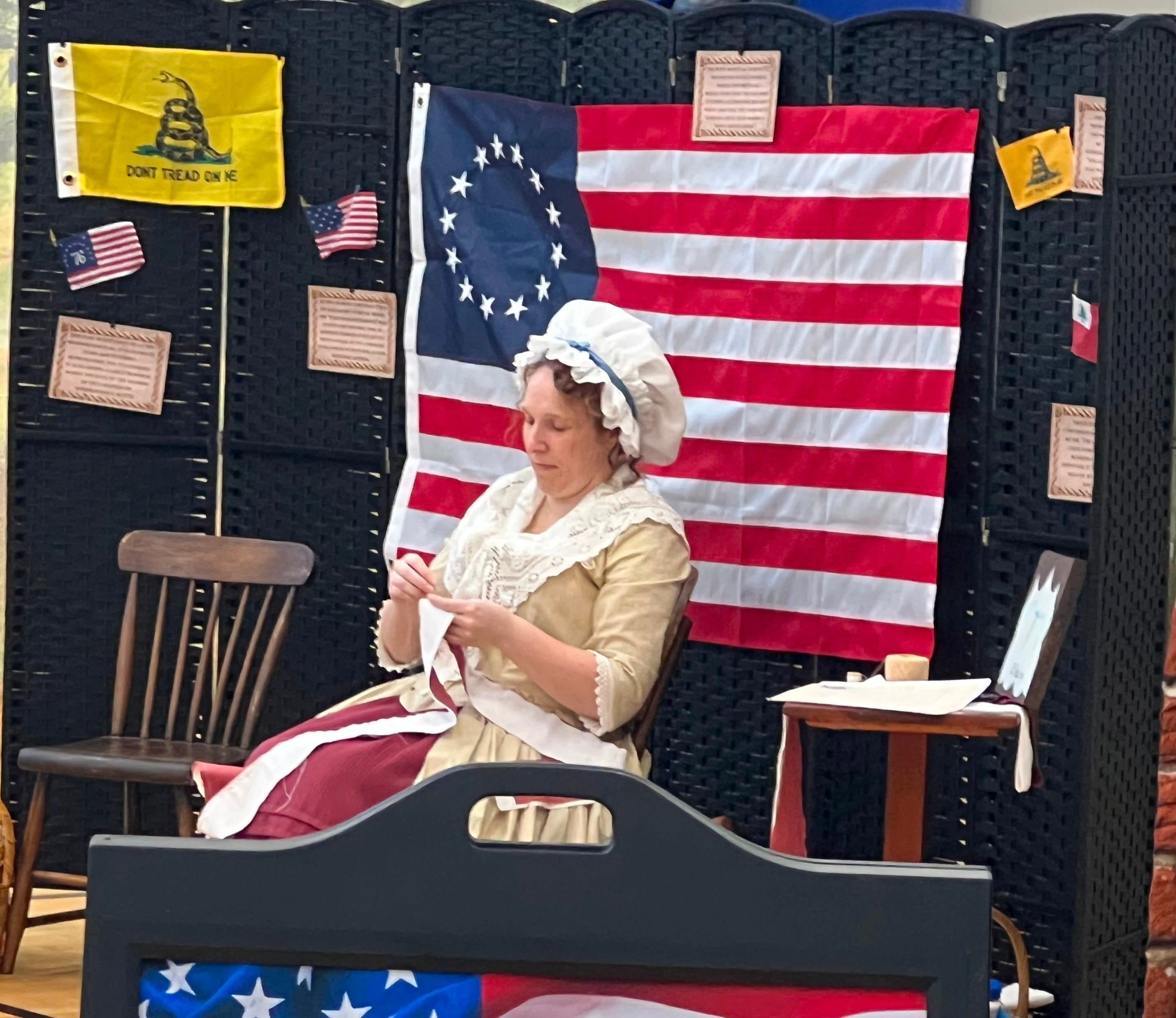
Are you familiar with the story of Betsy Ross? How about the story of how Thomas Jefferson penned the Declaration of Independence and what they wanted to accomplish with it?
These are stories you likely learned at some point in elementary school, which was a long time ago for some of us. You might have done little patriotic plays even. You touched on some of it really briefly in your school’s mandated U.S. History class.
Truth be told, for a lot of us, we might be able to recall a few random trivia facts about some of it. We move forward in our lives and only really think about it some when we celebrate the 4th of July or see a movie that takes place in that time period.
I was raised by a family of history buffs and I have to admit I don’t know it as well as I probably should. (Sorry Grandpa)
It was a critical time period in our history, something as Americans we should all hold to and celebrate because it is the story of our past, present and future.
But today wasn’t about remembering facts. It was about watching history become real.
As we move into America’s 250th Anniversary Celebration this year the Quincy Valley Historical Society & Museum has been working to bring pieces of our country’s founding to life here in the 98848. Starting with the beautiful new banners you see around Quincy and now, bringing some of the moments to life for our young people.
History Brought to Life
I sat inside an impressively quiet gym as all of Mountain View Elementary came in and took their seats this morning. Their eyes were searching the scene before them, trying to guess at what was about to happen. Principal Manuel Ramos walked to the front and the small amount of whispering died down quickly.
Huzzah to the very respectful and well behaved students of Mountain View, we were never that well-mannered in assemblies growing up.
After the introductions the students were pulled into history as they were taught the era-correct way to cheer and the characters of the exhibit came out to greet and meet them in costume.
You didn’t need a research paper to explain what was happening in that room. You could see it in the way kids leaned in instead of back. In the way they responded to questions that didn’t sound like they were trying to get the “right answer,” but like they were actually trying to understand.


The Philadelphia: 1776 Traveling Exhibit
Today I had the honor of being present to observe the first public outing of the “Philadelphia: 1776 Traveling Exhibit” at Mountain View Elementary as a handful of volunteers make history real for our young people.
Let me ask you a question
If you are reading this article and you feel like you learn better by doing something than by hearing about it or reading about it, raise your hand.
I know it is silly….
There is a point.
We learn best when we don’t just hear it—we see it, do it, and experience it all at once.
Good teachers are always trying to do just that to help their students. Always trying to solve that puzzle of combining learning modalities and senses to help their students retain information and learn.
The Quincy Valley Historical Society & Museum’s “Philadelphia: 1776 Traveling Exhibit” is going to great lengths to bringing that experience to our young people. They are helping them learn about the founding of our nation and will be coming to all of Quincy’s elementary schools.
In this incredible experience and through the work of an incredible team of volunteers our kids can sit down with Betsy Ross and learn why our flag has 5 pointed stars instead of 6 which was part of the original design.
They can sit in the study of Thomas Jefferson as he works on penning the Declaration of Independence and ask him about why it says what it says. They will also get a chance as a class to write their own declaration of how they envision their class should be for everyone.
Do you know who Nathan Futrell is?
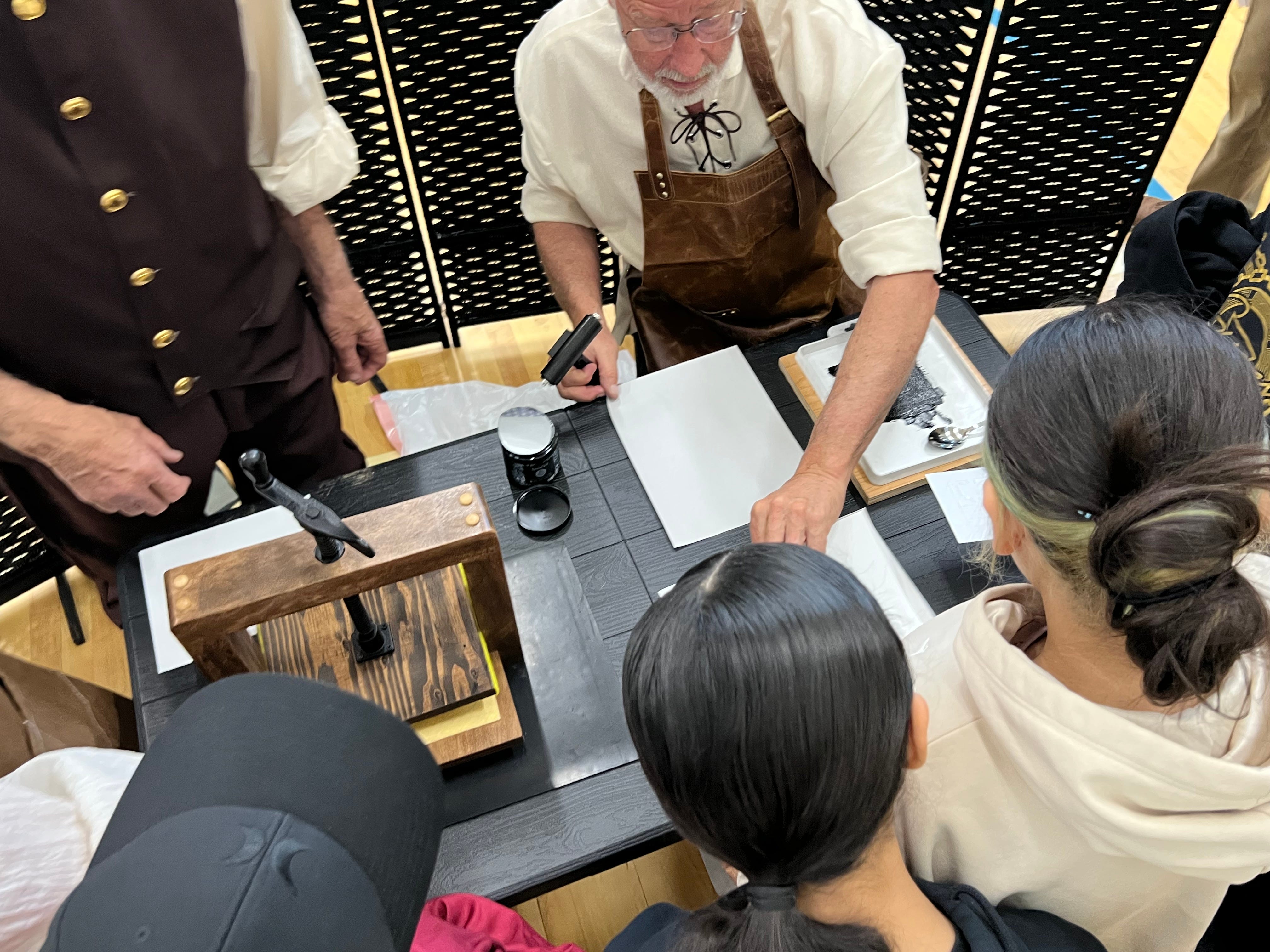
What about John Dunlap, do you know who he is? I didn’t until today. John Dunlap printed the first copies of the Declaration of Independence on his press. Today the kids printed copies of the original American Flag on paper using the same type of hand operated movable type printing press that John Dunlap used to shape history.

Making History Come Alive
You may ask “Why is it important to make history come alive for the next generation?”
Because if history feels dead, it gets ignored and when it gets ignored, we repeat it.
Making history come alive isn’t about memorizing dates or names. It’s about helping the next generation understand that real people made decisions, faced pressure, failed, adapted, and shaped the world they’re now living in. When history becomes human, it becomes useful.
Kids (and honestly, most adults) don’t connect with abstract timelines. They connect with stories. When they can see themselves in the people who came before them; their fears, their courage, their mistakes, that’s when history starts to matter.
Two hundred and fifty years isn’t just a milestone; it’s a reminder that the United States is an ongoing experiment, not a finished story. If we don’t make that story come alive for the next generation, we risk raising people who benefit from the country but don’t understand it, and that’s where things start to drift.
History has to feel real because the country itself is built on ideals that only work if people understand and participate in them.
If you’re wondering why something like this matters for your kids, it comes down to this:
1. It reminds us this country was built by imperfect people
The founding generation wasn’t made up of flawless heroes. They argued, compromised, disagreed deeply, and still chose to build something together. When you bring those stories to life, it strips away the myth and replaces it with something more powerful: ordinary people can do extraordinary things under pressure.
That’s a message this generation needs.
2. It shows that freedom isn’t automatic
The rights Americans enjoy weren’t handed down fully formed; they were fought for, debated, expanded, and sometimes restricted over time. When history is alive, you can see that tension. You can see the cost.
And when you understand the cost, you treat it differently.
3. It builds informed patriotism, not blind loyalty
If history is taught as propaganda, young people reject it. If it’s taught honestly with both the achievements and the failures, they respect it.
Real pride comes from knowing the full story and still choosing to invest in it.
4. It teaches responsibility, not just identity
The American story isn’t something you inherit like a trophy, it’s something you step into. Every generation has had to decide what to do with it.
When young people see that clearly, the question shifts from “What is America?” to “What am I going to do with it?”
5. It connects the national story to local life
The American story didn’t just happen in Philadelphia or Washington, D.C. It happened and is still happening in places like Quincy, in small towns, farms, businesses, schools, and families.
"You're a Grand Old Flag" by Mountain View Elementary
When you make that connection, history stops being distant. It becomes personal. That’s really the point of the 250th anniversary. Not just to celebrate what’s already been done, but to remind the next generation that they’re holding the pen now.
If we make history come alive, they see themselves as part of the story.
If we don’t, they see it as something that ended before they arrived and something they have no responsibility to carry forward.
That’s really what stood out to me walking out of that classroom today.
Not just that kids learned something about 1776.
But that for a moment, history didn’t feel like it belonged to someone else. It felt like something they could step into.


In the coming weeks the Quincy Valley Historical Society & Museum‘s “Philadelphia: 1776 Traveling Exhibit” will be coming to all the elementary schools in Quincy. Homeschool families will be able to attend at the museum on May 22nd.
As we head into America’s 250th anniversary, there’s going to be a lot of celebrating. Flags, events, speeches. All of that matters. But what matters more is what happens in rooms like this, right here in the 98848.
Because the story of this country doesn’t live in Washington D.C. or Philadelphia.
It lives in classrooms in Quincy.
In the way we teach our kids.
In whether they see themselves as part of it or not.
The Quincy Valley Historical Society & Museum didn’t just bring in an exhibit.
They gave our kids a chance to sit down with history…. and realize they’re holding the pen next.
Acknowledgment
I want to take just a moment and thank Dr. Bergman and the school district for allowing me to come on campus so that I could observe this presentation to share with you. I also want to thank Jessica Blancas, the communications coordinator for the district, for walking me through the proper procedure for visiting a school. My thanks as well to Principal Manuel Ramos and the incredible staff at Mountain View Elementary for their generosity in allowing me to observe this presentation with the incredible students at Mountain View.
I also want to express my deep gratitude to Harriet Weber from the Quincy Valley Historical Society & Museum and the incredible volunteers who are putting in large amounts of time to bring these presentations to our young people. You are bringing our country’s founding to life and making it real and tangible for the next generation in our community.