
I interviewed all 3 candidates for the Grant County Sheriff’s race for 2026.
All 3 Candidates were asked the exact same 22 questions in the exact same order
They never saw each others answers
The answers have not been altered, edited, modified, editorialized, changed, or edited in any way by the staff, ownership, or affiliates of this publication.
For each I have posted the transcript, not a story, their words. (transcripts by AI)
For each I have posted the audio from the interview.
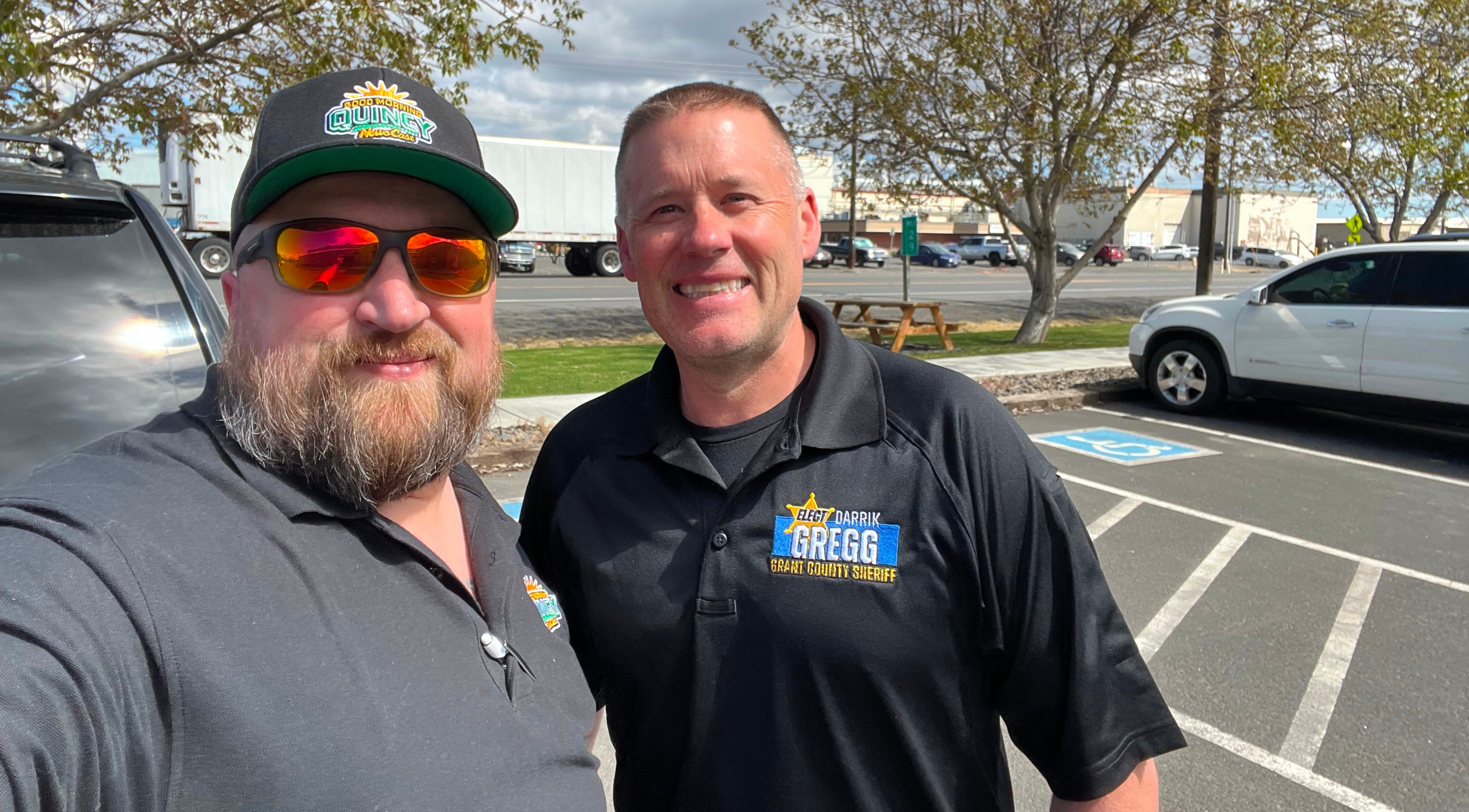
A picture with them to show we did this in person
A full list of the questions
Below the interviews I will post their posted bio from their candidate website, their sign and a link to their website and or FaceBook
The Interview Begins Here
Derrik Gregg Interview Audio File
Derrik Gregg Interview Grant County Sheriff’s Race 2026
Brent Dowlen: [00:00:00] Grand County Sheriff’s raised candidate Derek, Greg. Derek, we’re gonna go through the questions, we’re just gonna get your answers, and that’s what we’re gonna give the people. Okay, good for you.
Darrik Gregg: Sounds great.
Brent Dowlen: Residents in the more rural communities in Grand County often feel a little bit isolated from county level services.
What does a strong, visible sheriff’s presence look like out in the 99848 specifically?
Darrik Gregg: Yeah, that’s a great question. Uh, I think I have a different aspect and different view on what policing looks like now for me, starting in a small town in Grant County in rural city. I was there three years, and then I lateraled to the sheriff’s office for 16 years, and now I’ve gone back to another municipality for almost four years.
So I feel like I have a, a vast, I guess, look into what, uh, policing looks like, not just in a county setting, in a rural county setting for the Quincy area, that 98848 zip code. Um, but, like, working in the cities is, is different. Police work is police work when it comes [00:01:00] down, you know, to signing in service and handling calls for service and hol- holding people accountable and serving the community.
Uh, but I think that when you get into a municipality like Moses Lake, uh, it’s very busy. Uh, it’s the busiest agency in the county call volume wise. Mm-hmm. Uh, although the, the sheriff’s office has the, the county entirety of itself, 2,791 square miles, so it’s big. Um, but I think that getting out into ... I think to answer your question, I wanna give that background a little bit to know that what I see differently that I don’t think the other two candidates are gonna be able to speak to is working in a, in a busy city setting versus the county.
Um, but I think getting the deputies out into the county more prevalent and being seen, that omnipresence of law enforcement is huge. Uh, going around and putting up campaign signs and talking with the community from Grand Coulee to Desert Air in east and west of those areas, the common theme is, is that they just don’t see anybody.
Um, [00:02:00] and, and that, that is hard. I mean, when you look at how big the county is, the response times could be big. I mean, you could be ... So the north section of the county is roughly 400 square miles, that north beat that the deputies work. So you could be here in Quincy, George area, and then get a call up in Delano and Grand Cooley, and even running with your lights and sirens, it’s gonna take you 35, 40 minutes, maybe even longer.
So, I mean, the, the call times are what they are because the county’s so big. Um, but I think doing a little bit of a redirect and getting the deputies to be more present in those rural areas and, and seeing go out and do traffic stops, be seen, let the lights come on and let the community know that you’re there and that you’re present.
So I think getting, getting to, you know, if ... When I’m the sheriff, um, I think that having a talk with the, the patrol lieutenant that kinda oversees the patrol division along with that patrol chief deputy and really ki- sitting down and looking at what change needs [00:03:00] to happen to make the people in the rural communities, um, the Quincy and across the county feel like that they see law enforcement and that they can rest easily knowing that there’s someone out there driving around and being seen.
And I think that in itself would lower property crimes and make people feel more safe in those areas.
Brent Dowlen: What is one area you think needs improvement or more attention?
Darrik Gregg: Valuing the employees at the Grand County Sheriff’s Office. I think that right now, the, what I see is an outsider now looking in, and talking to not just the deputies on the road, but the staff inside the, the correctional facility, and the
So that, that’s inclusive of the, the commissioned staff and the non-commissioned staff, is they don’t feel valued. They’re unseen, they’re unheard. Um, everything from sending emails up the chain of command to the administration and they don’t hear anything back, falls on deaf ears and they’re frustrated.
They [00:04:00] want change. Uh, that’s one of the reasons that, that I am running for sheriff, is that I had a handful, uh, of employees come to me, uh, middle of last year, kind of towards the end of summer saying, “Hey, we’d really love it if you’d come back. Uh, we need a change in leadership. We’re not going in the right direction.
We don’t have a roadmap. We don’t know where we’re going each and every day.” So I think the change that’s needed that I would change is making sure that when those employees come to work, whether you’re commission staff or non-commission staff, that you feel valued every day and that you are seen and heard and as a sheriff, I would, I would work the road.
I would go into jail if it’s needed. I would learn the booking process in its entirety so if someone’s short or they’re, they’re inundated with bookings, I could run over there and my entire administrative staff would be held to that same standard of knowing that job and that we could help out. And I, I feel like that speaks volumes to what a leader should do because leading is an action, it’s not a physician.
[00:05:00] Sitting in an office all day long is not what is needed for this county. You need a sheriff that’s, shows action in leadership and is a servant leader. So I’m all about servant leadership and taking care of the people.
Brent Dowlen: What is the biggest challenge you think you’ll face if elected sheriff?
Darrik Gregg: Ooh, I think the, there’s a lot of big challenges, you know, that whoever, whoever ends up in there, and I’m, I hope it’s me, because there’s change that is needed.
I think the, one of the biggest challenges, you have this brand new facility and you can’t, you can’t operate it efficiently right now because there’s not enough people to do it. Um, I feel like there’s been a lack of focus on hiring the, the appropriate staff for that correctional facility to open it.
It’s 512 beds, so it’s big. And, and from what I’ve heard, I’ve gone to a town hall meeting and I’ve heard, uh, Joey Creech say that, that, you know, when they open it in August, they’re only opening it to half capacity, um, in a, in a tiered response, I [00:06:00] believe. Um, that’s not a quote. That’s what I remember him saying that, um, there’s a lot of training that needs to happen, but I feel like talking to the, the staff in there, they just haven’t hired the, the adequate staff to open it and run it.
So again, I know that takes dollars. Um, it takes money, but you’ve had ... I mean, I was still at the sheriff’s office and I was going around the county and, and pitching the three-tenths of 1% law and justice tax that the voters approved. And I don’t know why we don’t have enough ... I know it costs money. I get that.
It’s expensive to hire employees, but I think in the last four and a half years, you should have had adequate staff or at least been bolstering that a little bit each year, adding people. And I don’t know, I don’t know why we haven’t to get that thing to open up and actually use the facility for what it’s meant for.
So I don’t ... I think the big challenge is gonna be that in itself is opening that up and, and being able to put criminals in jail and hold them accountable and get the [00:07:00] community to where they feel safe. And we’re not just arresting people and letting them, letting them walk down the road because we can’t, we can’t hold them accountable.
If I arrest somebody, I did happen the other day. One of the ... So, uh, for me, a big problem is just that, is, is a law enforcement officer, I’m gonna hold somebody accountable, I’m gonna put you in handcuffs, and then I’m told no, that I can’t bring you to jail because there’s no room. That’s not okay. Not only for law enforcement, but for the community.
If someone comes to your house and steals something, and, and it means ... I mean, it could be something anywhere from $500 to $20,000, like I just had in a warden theft that they were scrapping metal. That’s huge to you, not, not as a business owner, but a community member. You want someone to be held accountable.
You wanna have to look at you and say, “Well, I’m taking the handcuffs off and letting them walk down the road because I can’t book them into jail.” That is a problem. So that’s gonna be a challenge is, is getting that to where we can operate that, that, that jail efficiently and effectively and hold people accountable.
But I’m, I’m all in to do it and whatever it takes, you know, sitting down with the county commissioners and finding [00:08:00] funds to hire those, that staffing, I’m, I’m all in.
Brent Dowlen: Response times can vary widely across Grant County. How would you work to ensure communities like Sunland, George, Desert Air, Cooley City, Crescent Bar receive timely emergency responses?
Darrik Gregg: Yeah, I think it goes back to, um, I, I believe, uh, that they have eight person crews now on each, each four, of the four patrol crews.
I believe they’re up to eight. If they’re not eight, they’re really close. It’s seven, seven to eight. Uh, when I started, when I was a sergeant on the road at the sheriff’s office, there was days where we had four people, and that was the minimum was four across the county. You can’t do effective law enforcement services for the county at 2,700 square miles of four people.
We did it. We did it. I, I don’t know that it was efficient, but, uh, we, we managed. So now with crews of up to eight people, that’s a, that’s amazing. Um, so I [00:09:00] think if, to, to do that efficiently, I mean, we have 13 cities in the county, uh, and looking at those cities, it’s very, it is. It’s long, we’re a long county.
We’re, we’re very, very dense and open area. So I think that to do it, you would have to sit down with the patrol sergeants and really focus on what rural policing looks like. It’s, it literally is a total redirect of what is probably ever seen when I was there. Nobody ever sat down with us and said, “Hey, this is rural policing.
This isn’t King County where you’re, you’re in the downtown busy areas of these municipalities.” Um, I think you’re gonna have to sit down with the sergeants and really come up with a plan and get their buy-in and say, “This is what we need to do moving forward, and we need to push this down to the deputies to say, this is the new model of what Grant County Policing looks like at the Sheriff’s Office, and, and making sure that we’re being seen.”
It’s just, it’s getting out. And I get it, like, being in the city, Moses Lake’s busy, we’ve got a lot of stuff happening, a lot of in- progress [00:10:00] stuff, and you can get there. I mean, nine times out of 10 when there’s a in- progress call, whether it’s a fight or a robbery or a drive-by, we’re getting there when it’s still happening and people are running around.
In the county, you could be, like I said earlier, you could be in George or Quincy and get up to Delano for a fight and there’s nobody there anymore because it took you 40 minutes. So I think getting back to being in your patrol areas, and everybody wants to go where it’s busy. I get it. You know, guys wanna go where the stuff’s fun and happening, and so when Moses Lake’s super busy and, and, uh, the hot calls are coming out, they wanna gravitate towards that and go help.
And I get it. I mean, that’s fun, but at the same time, the sheriff’s office should be focused on taking care of the, the community in those rural areas as well. I mean, I’m all for teamwork. I mean, the only way we’re gonna do it effectively and safely is to, to back each other up. And that, that’s huge here.
I would never take that away. I’m not saying don’t go into the, the cities because they rely on us and they, and we rely on them for help. Um, so that’s a great partnership and I would never [00:11:00] wanna erode that or take that away, but I think it’s, again, getting back to sitting down with the patrol sergeant, say, “Hey, I, I really want the deputies to be seen out in these rural areas.
You have to. “ Um, that’s, that’s what the service they’re paying for with their taxes, and I’m all about taking care of the community. So it’s just getting, redirecting and getting, getting back down to what patrolling looks like. Those are long questions, sorry, are long answers to your
Brent Dowlen: questions. No, that’s fine.
You have however much time you need.
Darrik Gregg: Okay.
Brent Dowlen: What is your plan to recruit and retain deputies, especially to ensure consistent coverage in smaller communities?
Darrik Gregg: Man, recruitment, recruitment and retention is huge anymore in this, in anything that you do. I don’t care if it’s law enforcement, if you’re a business owner, you know, you as a business owner, um, I feel like getting the right people in your organization is huge.
And when you find those right people that fit the, the mold of what you’re looking for, that come into that culture of what you have, you gotta keep them. So again, it goes back to, I’m gonna say it a lot, valuing [00:12:00] your people, making sure that they know that when you come to work, that you’re the, the important part of the day and that what you bring every day is important to the organization, to the mo- to the, to, not just to Grand County, but Moses Lake.
Every law enforcement agency should be valuing their people. But I think that if you can do that, you’re gonna, you’re gonna retain your people. People don’t wanna leave. You know, I’ve, I’ve heard things from Joey Creed about that, you know, he’s, he’s hired, I think, when I went to the Royal City Town Hall, he’s hired 70 people in, in the time, and since 2023.
To me, that, that’s a bigger problem. There, there’s something else going on. I mean, my time when I was there for 16 years, you had some, you know, people that retired and maybe one or two that had gone somewhere else, but it was rare. Like, nobody left. When everybody was happy and excited to be there, I feel like hiring 70 people, I mean, if you’ve hired 70 people, I feel like that should have been the staff that was going in the jail.
So I’m not sure. I say that kind of tongue in cheek [00:13:00] as far as I don’t, I haven’t looked at the 70 people and where they went in the organization, but, um, I think to, to, to keep people happy, people aren’t leaving for money. I’ve heard that too, that people, they’re just chasing the dollar and they’re not.
I’ve talked to, there’s, there’s four and maybe a fifth going that have gone to the state patrol and yes, they make more money. That to me is a kicker for them because when I talked to them one-on-one, it wasn’t about money, it was about not being happy and being valued where they were, so they left. So the, to me, the, the money and talking to them was just the kicker of, “Hey, man, this is amazing.
I get to go to another agency and make more money and I get to go do the job and feel valued every day.” So that’s, that’s ... When you talk about retaining people, you gotta, you gotta look out for your people and let them know they’re valued. The recruitment side of things, like I said, I don’t know if it was recorded before we started the conversation, but the, the
Back when I looked, think back 23 years ago when I was getting into this, it was, it was competitive. And it’s still competitive to an [00:14:00] extent. Not like ... I don’t feel like it was back 23 years ago, but, um, I think it’s a ... When you look at the generational change in, in, in people, it’s a, it’s different. The cops are different that, that are coming into this career now.
Um, a lot of good people. We got a lot of good people coming into Moses Lake and the sheriff’s office, really, across the county. So I think recruitment side is really getting the Grant County Sheriff’s Office to a point where they know that that’s, that’s a place where they wanna be and they wanna stay.
I mean, there’s a, there’s a lot of negativity right now that I hear, um, with people not wanting ... They’re not happy. So how do you recruit people when they’re like, “I don’t wanna go over there,” you know? Um, I don’t think that there’s any other agency in this county that has lost people to the state patrol.
State patrol’s a great agency. My brother-in-law retired there, my nephew works there. I’m, I’m just using them as an example that I don’t think there’s any other agencies in the county where people have left go to the state patrol because it’s, makes more [00:15:00] money. They’re leaving because they’re not happy.
People follow good leaders. They, they wanna lead bad leaders. So I think just the recruitment and retention side is huge. I mean, like again, in any organization, if you don’t, if you’re not hitting that, that mark on both of them, you’re gonna struggle as an organization.
Brent Dowlen: How do you see the sheriff’s office working alongside local departments like Quincy, Africa, Moses Lake to avoid overlap and to strengthen cover at the same time?
Darrik Gregg: Yeah. That’s funny that you say overlap. Um, I feel like sometimes in Moses Lake, because we do get busy, so like we do a little bit of, uh, have you ever seen, like, fifth grade soccer where they kinda go around that they’re all clumped together.
I feel like we do that, you know, and I, I, I started my career being solo in Royal City. You know, we had, we’d have a little bit of shift overlap, um, with the next guy either coming on or going off, but you’re by yourself for the most part. Mm-hmm. Um, and then go to the sheriff’s office, and again, you’re, you’re pretty much by yourself [00:16:00] unless back in the day you’re in Moses Lake, you had a shift partner, but the north and south, you’re by yourself.
You’d have a rover, like a sergeant or a corporal that would pop, you know, pop in and out and help you out with calls. But, um, the overlapping, um ... Let me back up. So the, like, help, helping out the other agencies is huge. Um, growing up on the west side and having friends that work in law enforcement over there, um, a lot of those agencies, those big agencies, whether you’re a county or city, they don’t play nice together.
And I’m, what I mean by that is they don’t help each other out. Um, it’s like, “Hey, you take care of your area, we’ll take care of ours.” When it’s really, really bad, yeah, we might have you come give us a hand. Here in Grant County, it’s not like that. Everything from state, uh, locals, municipalities, and the county, we all help each other out.
If you go by somebody, you stop or you slow down and say, “Hey, are you good?” You know, on a traffic stop and they’ll either give you, you know, “Hey, we’re, we’re four. We’ve got four fingers. We’re good.” Um, so I think just that, that camaraderie and that teamwork is [00:17:00] really unlike anything that I’ve seen and or I’ve heard from, you know, my friends that are in law enforcement on the west side of the state or other agencies.
So I think we, we do that very well here. So I don’t know that that has changed or that needs to change. I think that’s really well embedded in what we do in Grand County. Um, but I think, um, as far as, I think overlapping, was that the second part of the question?
Brent Dowlen: Yes.
Darrik Gregg: So yeah, I mean, overlapping, um, were you, are you asking about, like, overlapping in, in
Brent Dowlen: Yeah, how you avoid overlap where you have a bunch of officers bunched up, like you said, in Moses Lake and we’ve got areas of the county that we’re having scrambled to get to?
Darrik Gregg: Yeah. I, again, I think that is, is maybe sitting down with the patrol sergeants and having a good conversation, you know, checking in constantly.
It’s not a, a once a quarter. It’s constant check-in, um, with your people and saying, “Hey, how’s it going? What things do we need to change as an administration to help [00:18:00] you guys do your job on the road?” And if that’s, um, bringing up more time, I mean, I, again, I feel like the bodies on the road, on the crews are awesome at eight, that’s huge.
Um, Moses Lake, we’re, we’re six right now, and it’s busy. I mean, there’s days where you feel like you need six more, you know, because you’re just getting, you’re getting hammered. So, um, I think the overlapping, just making sure that guys aren’t doing that, that little soccer kit, following each other around and kind of really spreading up.
And I think maybe get, even in what we do sometimes, what I do as a patrol sergeant is like, “Hey, we already have two or three going to that. Let’s, let’s break off a couple and make sure that we’re being seen in other parts of the city.” So, you know, when, the last thing you wanna do is have on a hot call, like if it’s in Quincy, you got guys coming, sometimes we’ll send one from Moses Lake, the Sheriff’s Office, you might get one from the north section or south coming up and helping, and now you’re, you’re leaving the other parts of the county vulnerable.
So really, you have to get your people to say, “Okay, what’s, what’s the priority here? Do they have enough people with the sheriff’s office in Quincy [00:19:00] PD and maybe state patrol? Um, let’s, let’s make sure we’re not doing that. Let’s make sure that we keep our, keep our, uh, patrol areas manned with our staffed, I should say, with, with, uh, people.
So if there’s something that pops off down South County, you’re, you’re not stuck up here, and now you’re asking, now you’re asking Mattawa or someone else to go when we should be down there. So I think it’s just making sure that you’re accountable to those areas of the county and, and focusing on that.
Brent Dowlen: Our area is growing a lot, data centers, agriculture, tourism’s growing. How should the sheriff’s office adapt to that growth around the surrounding areas?
Darrik Gregg: Yeah. I think that, um, when you have the growth that the Grant County as a whole, but specifically, you know, when you look at Quincy, you do have a lot of data centers, uh, and they continue to grow because it’s a great place for them to be.
I think partnering with that industry is important. Um, getting with those industries, I mean, they ... Most of, [00:20:00] most of them like Microsoft and the other data centers have their own security. However, I feel like it’s a good opportunity to introduce yourself as law enforcement and Chief Green here in Quincy.
Um, I would ... Uh, I haven’t talked to him personally about that, but I think that he’s probably, uh, very in tune with, you know, talking with them and making sure that they have what they need. I mean, if, if it’s extra patrols, I mean, they have ... I think internally they have their own security, but just being seen on the outside and just driving around, I think is, is a good partnership with those industry, um, partners that you could, uh, make sure that you’re taken care of as well.
Um, and then just the housing and the, the influx in population is crazy in this county as a whole. I mean, just in 23 years that I’ve been here, it’s, it’s really just blowing up. Like, you can’t even ... In Moses Lake, you can’t even drive across the fill at five o’clock. I mean, I’m, like, it’s backed up all the way to Valley Road and it’s crazy.
So, um, again, I think just engaging in community events, [00:21:00] um, especially getting out and doing things. Like, one of the things that, that I see as a lack of is you see a lot ... Uh, you’ll see all, all three of us out doing events and meeting with people like you, right, for interviews. This is, that’s gotta be all year long.
You can’t just do it in campaign season as a sheriff. You have to be present throughout the year. You have to go to these events, you have to be seen. It’s not, “Hey, I’m, I’m the sheriff and now I get to just sit back and not engage in the community anymore.” So I think making sure that you show up at these events and be seen and help out and be a part of that is really what needs to happen and give back.
Law enforcement’s giving back to the community a different way other than just, you know, going out and doing that police work. I think it’s twofold. You have the community involvement that law enforcement should be at and supporting, and then you have the other side of it where you’re holding those people accountable that are out, you know, committing crimes and doing that.
So, um, I think just getting out and being seen and getting involved as much as you can in [00:22:00] community events.
Brent Dowlen: How will you build trust and maintain peer communication with the communities that may not always feel directly connected with the county leadership? Ooh.
Darrik Gregg: Yeah. Again, that, I’m gonna go back to, um, it’s not a one and done. You know, you can’t go, you can’t go ... When you look at the term of a sheriff, it’s four years.
So you can’t go three years or three and a half years and knowing that your, your election year’s coming up and then start getting involved in the community. That, that doesn’t, there’s no trust there. It’s like, okay, you just want my vote again. So, uh, me, if, if I was elected from day one, I would, I would be accountable to reaching out to the community.
I have an idea of putting together a, an advisory board, uh, which would be four deputies, four business owners and four community members, and I want feedback. I want constant feedback from the community. Um, not just, not just once a quarter or twice a [00:23:00] year on town hall meetings. And town hall meetings are good.
You get to hear from the community that might not reach out on social media. Um, they’re gonna show up and they’re gonna let you know what you’re not doing right, and that’s fair. I think that, that should happen. Um, but I, I want something that’s, that’s constant throughout the year where, you know, you could even
I mean, it’s, that’s my idea and what I will put into motion is that advisory panel, but I think that getting it to be something that the community can voice their opinions and be heard, I think is huge. I mean, if we go along for a year and we don’t listen to what the community has or what the problems are, you’re not doing your job and you’re not doing a service to the community that you should be as a sheriff.
So, um, I think just get back down to really interacting and hearing what people say and trying to fix things that are, that are broke is where I think we need to be and what’s lacking right now.
Brent Dowlen: What trends are you [00:24:00] seeing in Grand County? What would be, and what would be your top enforcement priorities? Hmm.
Darrik Gregg: In Grand County as a whole or just in the cities or what?
Brent Dowlen: In Grand County as a whole, what are you seeing?
Darrik Gregg: I see a lack of accountability withholding criminals accountable. And I know that goes back to the jail, the current jail to where we’re at.
I know that, that it, it doesn’t have the adequate beds to, to put people in, but I, I know I as a citizen of the county and as law enforcement, I’m, I’m tired of the revolving door of, of, you know, arresting people and then them getting out the next day and, and we’re dealing with them again where you’re, they’re going to victimize the next person down the road or the next business.
And it’s like, what are we doing? Like, I want, I want ... I would like to see not just the sheriff, but the prosecutor, um, and the [00:25:00] elected, so the electeds that are, that have some pull and some ... They can change some things with, with the criminal element in the county. Hold people, let’s hold people accountable.
Why are we just arresting them and making a revolving door? I know there’s other things. I know people are saying, “Hey, that’s, that’s great to say. Um, you can say this, that, and the other thing, but we gotta try. We gotta sit down at the table and I feel like everybody’s going in their own direction.” You know, you got the sheriff’s office going this direction, the prosecutor’s going this way because they have certain things that they’re trying to accomplish, the judges are doing their thing, and everybody has an important role in that accountability piece, uh, with the criminal intent.
So for me, it’s, it’s getting the, the crimes of whatever it is. It could be property crimes, it could be felony level crimes, could be drive by shootings. I really want to put a dent in the crime in this county. I want people to know that, that if you commit a crime in Grand County, we’re gonna hold you accountable.
The sheriff’s office, we’re gonna come find you and you’re gonna go to jail. It’s not gonna [00:26:00] be a, “Hey, well, we don’t know. “ No, we’re gonna come. We’re, we’re gonna do everything that, that we can do to come find you and hold you accountable because I’m all about accountability. If any, if anybody knows me, I’m accountable to what the job is and what we should be doing, and I’ll do it every day.
The Sheriff’s Office core values are professionalism, integrity and accountability, and I, I, when I was there for 16 years, I, I lived and breathed those on duty and off duty. So I think they’re, they’re very ... Those three core values are amazing and the communities should hold us accountable to those.
Brent Dowlen: What role should the Sheriff’s Office play in working with schools and youth programs in the community to prevent issues before they start?
Darrik Gregg: That’s really good. That’s great. Um, I know that I think Matawa does the SRO spot now, uh, for Walduke High School. Sheriff’s office had it for a while, for several years.
I, I, I’m not 100% sure, but I [00:27:00] think Matawa does that now, but I love the interaction with the schools. Like being in, in Moses Lake, seeing the SROs interact with the, the kids is very important, getting in front of the kids and letting them know that they can come and chat with you and have a conversation and not to be hesitant to come up to you.
So I think that in itself is awesome, but, um, getting to, um ... I’ll use Moses Lake, they have street, safe streets, uh, have you heard of that? So, uh, a couple people in the, the police department put together the safe streets. It’s getting in front of the kids at the Boys and Girls Club and really making an impact in their lives and showing them, you know, “Hey, this is the path you want to go down.
You don’t wanna go down, you know, the gang, gang path and getting led in a, in a negative direction where you’re gonna be, um, put in places where you wish you didn’t.” So that’s been very successful. They just did a street cleanup and they were covering up graffiti. Um, so I think getting programs like that across the county, um, is awesome.
And, and I [00:28:00] think giving back to the community in that way that you can get the youth and grab onto them and making sure that you have that partnership with them. So I think, you know, I mean, you look at the, um, the interactions that we do have with the juveniles or the, you know, the under 18 ... Well, actually, I’d say even under 21.
I mean, there’s a lot of misguided youth, and I think if we can get in front of them and show them that there’s a different path and a different way to do things, I mean, that’s, that’s amazing. That’s what we should be doing in law enforcement is interacting at that level with the kids.
Brent Dowlen: How will you ensure transparency in the sheriff’s office and keep residents informed about decisions, incidents, and priorities?
Darrik Gregg: Yeah, I mean, ooh, social media, um, believe it or not, I didn’t have social media until February 1st of this year. So, um, social media is, is actually, it’s pretty, it can be impactful in the way of reaching out and, and being [00:29:00] transparent.
Um, I think, uh, the sheriff’s office does a great job at, at, you know, sharing what’s going on. Um, however, I, I think that’s a good question. As far as the transparency piece, I think that you need to be transparent in everything that you do do. Um, whatever, whatever you’re deciding to do, I mean, there’s, there’s some things that I’ve heard about this new facility that I don’t like, and I don’t think it’s been transparent.
Um, I mean, when it comes down to taxpayer dollars, right? Me as a citizen, you as a citizen and everybody else in this county, they wanna make sure that you’re being physically responsible with taxpayer dollars. And there’s been some things that have been put into this new building that I’m not okay with as a taxpayer, um, and that transparency piece should be out there.
When those things happen, the community should know, like, “Hey, this is what’s going on. “ And I don’t think anything should ever be hidden. When you’re, when you’re talking about if, if we’re gonna be transparent and hold people accountable, you better be sure that you’re doing the same thing back, [00:30:00] is if not, you’re gonna get called out on it and it’s not gonna be fun.
So I think just being transparent in everything that you do, um, is where we need to be in law enforcement. Um, I mean,
outside of social media to, to reach out to people, there might be some other platforms that you could use, um, to make sure that you’re pushing stuff out. But I, how many, how many platforms are people gonna follow, right? I mean, you have, you have Instagram, you have Facebook, I mean, all these different ... I know it’s just, it, it’s, it gets overwhelming.
So I think, um, I’d probably sit down and look at a different way to reach people. Um, maybe it’s, maybe it’s a monthly, you know, putting out something monthly on transparency, you know, like I know that, um, Moses Lake PD weekly the chief puts out like an update, “Hey, this is what we’re out, this is what we’re doing.”
Um, maybe we sit down and do that. We come up with like a, a letter that goes out to the community and say, “Hey, this is where we’re at. This is what we did this week. This is the things that we’re...” [00:31:00] But I don’t wanna be redundant with Facebook, so I think I’d have to sit down and really look at what would be something that people would go, “Hey, that’s really cool.”
Um, and I think maybe getting back to that advisory panel to pull on people and say, “Hey, what is the best way that you think we could be transparent in pushing out information so everybody knows what’s going on all the time?” So I’d probably look at doing something like that, is really getting the input from the community and seeing what they think is valuable, um, so they’re, feel like they’re in the loop all the time.
Brent Dowlen: What kind of culture would you build inside the sheriff’s office and how would that translate into the way your deputies serve the communities like ours?
Darrik Gregg: That’s a good question. That’s really good. Uh, I think that the people that I’ve talked to, um, I haven’t, and again, I haven’t touched everybody at the sheriff’s office, but the ones that I have had conversations with, and they don’t, they don’t feel valued, and I think that, um
[00:32:00] Can you read that one to me one more time?
Brent Dowlen: Yeah. What kind of culture would you build inside the sheriff’s office, and how would that translate into the way deputies serve community?
Darrik Gregg: So I think, um, making sure that people are valued in, in the servant leadership piece for me is, is huge. I’m gonna put myself last every single day, and if that means me not getting a piece of equipment because somebody on the road or in the jail or somebody else needs that piece of equipment, it, you, you come first, I come last.
So making sure that people have what they need and the trainings that they need to go to first is more important to me than making sure that I have something. So I think, um, serving at that level and, again, going and, and being on the road and being present, there’s nothing better than having your, your leaders show up and working side by side with you.
And I’m not talking about, “Hey, every Tuesday I’m coming out from four to six,” then they expect it. You should show up when they least expect it. You should, as a citizen, if I come to your door because you’ve been impacted by a crime and the sheriff shows up, you shouldn’t [00:33:00] expect that. But when it happens, you should be like, “That, that’s, that’s what we need.”
And I’m gonna do that. I’m gonna show up when people least expect it and I’m gonna do my job because I know where I came from. I know that I came from the patrol side and I know what leadership looks like, what servant leadership should look like, and I’m gonna bring it every day. I’m gonna show up and I’m gonna do what it takes to make people feel valued and change the culture because the culture now is a culture of, I don’t feel valued, I don’t feel heard, I’m unseen.
And at the end of the day, people go home and they’re just like, “Oh, all right. Well, I can say to go back and do it again tomorrow.” So I wanna change that. I mean, that’s not a ... I want people to be excited to come to work. I want them to be, you know, “Hey, I’m gonna go to work. I’m gonna have fun. Um, and I’m gonna go chase bad guys with people.
We’re gonna, we’re gonna get, we’re gonna go do the hard work and I’m gonna be, be there with them when it
Brent Dowlen: matters.” What does leadership mean to you?
Darrik Gregg: Leadership, to me, means, again, showing [00:34:00] up every day and willing to, and being willing to put in the work. Um, I’m not above doing anything. I’ll, I’ll go in and I’ll, I’ll back up somebody in the jail if, if they have an incident in there, I’ll be on the road when, when things are getting busy.
If a crew’s short and we don’t have manpower, you’ll, you’ll expect to see me on the road as a leader. Um, leader to me means, like I said it earlier, um, leadership is an action, not a position. Just because you get to a level of leadership doesn’t mean that you’re done doing what you do. To me that you should be putting in more work than you did before because if you want people to trust you and follow you, they got, they gotta, you gotta show them value.
And if they don’t, then nobody’s gonna trust you. They’re not gonna follow you. So I think that leadership is very broad. People have different styles of leadership, but to me, servant leadership is ... I mean, if, if we’re all servant leaders, we would be putting people before ourselves and it would just be a better place everywhere.
Um, but again, people lead differently and I don’t [00:35:00] think that ... So I think there’s ... I see two things and when you talk about leadership, leadership, they’re like ... Either get one or two things. You need to get people that wanna manage. You should never manage your people. You should always lead your people. Um, I see people take the stance of, “Well, I’m gonna manage.
I’m gonna manage.” You can’t manage people. You manage processes and you manage programs, but you gotta, you gotta lead your people, and that starts with being present and s- and standing up and, and having their back every day. So I think that leadership means that, uh, you show up every single day ready to work no matter what it is.
It might change. Law enforcement’s pretty fluid, so you might come to work one day and there’s not a whole lot going on, you might come to work the next day, and you’re just, you’re busy, so just be ready to go. You’ll always see me in a uniform, you’ll always see me wearing a vest, and I will have a patrol car that is set up for patrol.
It’s gonna have a shield in it. I’m gonna ... If I go out and do patrol work and I catch something, I’m gonna take it from the start, from the point that I arrest somebody, I’m gonna take them to jail. I’m not gonna [00:36:00] expect anybody to do my job for me. That’s not a good leader. I’m not gonna do half the work and then expect you to come in behind me and clean it up.
So I’m gonna lead, I’m gonna lead the way that, that everybody ... I feel everybody should lead, so that’s what that looks like.
Brent Dowlen: Live Nation in the Gorge are major tourism sources for Grand County and the traffic around the condos and the shenanigans and the can grounds can sometimes be a source of frustration.
How you work with the Live Nation and the local community to handle these frustrations?
Darrik Gregg: Yeah, when I was at the Sheriff’s office, um, I, I was the ... It’s kinda, it’s the position that I was at. You kinda had special operations, so you were kind of the liaison between the Sheriff’s office and the Gord. That’s been a kind of a, a bone of contention with the community, especially Sunland.
You know, you get these big EDM concerts and, um, [00:37:00] uh, what’s the country one?
Brent Dowlen: Oh, the one that canceled this year?
Darrik Gregg: Yeah.
Brent Dowlen: Yeah.
Darrik Gregg: Oh my gosh. Anyways, um, can’t believe I can’t think of it. Um, but yeah, I mean, those, those big ones that come in, um, they, they really take over that, that small community down there. My aunt and uncle lived down there.
They recently moved, but, um, I would get calls from them and, uh, yeah, they were like, “This is crazy down here.” So I think being, you know, they, I think towards the end of me leaving and they did a pretty good job. The Live Nation was putting dumpsters down there trying to help out with the, the influx in garbage that people were leaving behind.
Um, and I, and I think they still do it. They would assign on those big ones, those EDMs, Watershed, that’s what it was.
Brent Dowlen: Watershed that?
Darrik Gregg: Watershed. Um, but yeah, they would put those dumpsters down there and then, um, they would have a deputy down there kind of crew. We would rotate a guy, “Hey, you’re going down from, you know, two to six and you’re gonna be driving around just to be [00:38:00] seen to help out with the, the people that are trespassing or parking cars in front of driveways.”
Um, because they all wanna go down that hill in Sunland where you go into Rattlesnake, uh, Cove and you wanna swim. But if the cars are on the road and they’re blocking the roadway, we’re towing them. So, um, I think just sitting down with them before the gorgeous season, really, and I think, and they probably do do this, but I would make sure that you would sit down with the, the leadership in Sunland and Live Nation, grab them and say, “Hey, let’s go sit down.
Let’s go run down there real quick and have a conversation. What can we do to help you out? “ I know we’re doing the garbage. I know we’re adding a, uh, Live Nation was paying for that extra body to be down there driving around. So Live Nation was doing their part on the financial side of things to say, “Hey, put a, put another guy on the schedule to go down there and drive around.”
So, uh, I think just having those conversations and making sure that you’re engaged with what their concerns are because if you don’t, then again, you’re, you’re not getting the trust of the community to say, “Hey, you, we’re, we’re getting impacted down here and nobody cares.” And that, that’s a way [00:39:00] to lose trust, you know, with the community.
So I think just getting down there and talking to them. I was down there a couple weeks ago chatting with one of their board members and, uh, yeah, they’re excited for the year. They got a good thing coming up for 4th of July weekend, so that’ll be fun. Um, but yeah, I think, I think, man, just sitting down and having conversations with people and saying, “What can we do to serve you and what can we do better?”
You know, over the years past, has it worked? Has it hasn’t worked? Like, what can we add that’s gonna make it easier on you? Um, I know that we did a couple times have closed Sunland Road. Like, when it was so crazy busy down there and there was nowhere to park anymore, we would just put it up there with lights on unless you lived down there or had a, a, a place, you know, where there’s an Airbnb, if you can show us the year down there, it was just like, “Hey, if there’s no more room, it’s not safe, you can’t go down there.
Go, go down to the old Vantage Highway and go down to the boat launch down there and swim around.” So ...
Brent Dowlen: Communities like Crescent Bar and someone to say it’s Quincy George see direct impact from the volume of visitors and that increases the risk of [00:40:00] wildfires and things like that during concert event weekends.
Will you elevate improving safety and reducing wildfire risk in the areas impacted by the concert goers?
Darrik Gregg: Yeah, that, that’s, uh ... So when I was at the Sheriff’s office, I was emergency management, so I did ... I was pretty engaged with the fire districts and the fire departments across the county and really looking at that, that wildfire piece and mitigating that.
Uh, I think that that’s a huge piece when you get that many people. You get 30,000 people in one venue and they’re, and some of them are rural camp and they’re doing, you know, they’re doing a campfire. I mean, that ... And it gets dry. Everybody knows that here. I mean, Quincy’s seen it on the, on the ridge line back here.
I’ve been up here many times with wildfires all through the night and it’s crazy. So I think that mitigation part and making sure that people are being responsible, yeah, absolutely. You have to. You can’t just assume that people aren’t gonna set a fire. I mean, probably not intentional, but again, you gotta, you gotta put out, I think putting out some social [00:41:00] media stuff, you know, saying, “Hey, it’s dry,” and making sure that people are aware that, that’s going on.
And when the deputy’s out driving around, if you see it, someone camping out somewhere, it means, one, is it on private property because that happens a lot out in that gorge area that rule the rural areas. Um, you know, people just find a spot and they just camp and, you know, “Hey, do you have permission to be here?
And if not, one, we have a burn band in effect, so you can’t burn.” Um, so that, that starts early on in the year and goes through the end of, uh, summer, into the early fall. So, you know, again, holding people accountable to that. I mean, there’s a burn band you can’t burn. So, I mean, they don’t even do it in the, in the campgrounds.
Some people do. I think if you have the little propane ones, you know, by your camper, that’s okay. But if someone actually has a wood fire going in, that’s an ungo. So, you know, holding people accountable to that and saying, “Hey, you need to put that out and two, you’re trespassing.” So, um, again, being visible and, and getting out and you gotta drive around, uh, I think that that’s important to the, not only to Live Nation in, [00:42:00] in Sunland, um, so that, that’d be bad.
There’d be, everybody knows that’d be a bad day and, and if that fire came ripping down that hillside into Sunland, there’s nowhere to go. There’s one way out unless you get on the water. So that, that’s something that does need to get mitigated and needs to be thought about. Um, so I think that, again, I know that beginning of this season, Live Nation ends up having a big meeting with, with all the, the stakeholders from CMS to Live Nation, uh, I think AMRs out there still, they probably have the contract, the sheriff’s office, um, but you should be bringing in someone, you should be bringing in those people that are affected by, you know, the live nation influx throughout the, the concert season.
So getting everybody to the table and sitting down talking, communication is huge.
Brent Dowlen: The newly passed controversial Washington State Senate Bill 5974 that was signed the law at the beginning of April is a source of concern for a lot of people. Where do you stand on the bill?
Darrik Gregg: I [00:43:00] highly oppose that bill. Um, that’s a direct attack on the Constitution and our voting rights as citizens.
Um, the Office of the Sheriff is one of the oldest elected positions that you could probably find, and I don’t think that Olympia or the bureaucrats over there should be telling us how we need to vote and who needs to be the sheriff. That, that is for the people to decide, and I stand firm on that. Um, I support the Constitution fully, and I would never encroach on someone’s right to vote for whatever elected position that we have.
And there’s many of them, um, especially I feel like the sheriff is, is, is unique in the way that ... It doesn’t matter what you believe in, what side of the aisle you’re on on politics, the sheriff’s for everybody. So, um, as a, as a sheriff candidate, I support every single person in this county. Again, I don’t, I, I don’t care what your, your views are, I’m gonna be there to support you when it matters, and that, that’s just what the job is.
So don’t ... [00:44:00] I’m getting fired up over the bill, so I gotta ... I gotta calm down for a sec. Um, I think that you wanna put together an unelected board on the west side of the state, because to the extent you don’t feel that the sheriff over in Grand County is doing what you want them to do, I don’t, I don’t work for Olympia.
I work for the people of Grant County. I wanna hear what the people in Grand County want me to do, and we’ll work together to, to bridge those gaps, but I don’t wanna hear someone from Olympia telling me how I need to do my job as an elected official. So I, I oppose it. I don’t ... I think it’s, it’s a, it’s a, a grab, it’s a reach, and I’m not for it, and I know a lot of people aren’t.
Um, so again, for me, it comes back to making sure that we’re doing the right things for the citizens of Grant County, and, and if I’m not doing my job and I get removed, you’re gonna get someone that has no idea what Grand County’s about, what the, the farming community’s about, the business is about, the citizens, what we, what’s best for us, you can’t [00:45:00] grab somebody from Olympia or somewhere else and say, “You’re the new sheriff.
That doesn’t work.” So, yeah, I, I highly oppose that. I think that’s, that’s, uh, that’s a bad idea.
Brent Dowlen: What branch of government does the sheriff’s office fall under executive, judicial, or legislative? Ooh,
Darrik Gregg: that’s a good question. Judicial? That’s a great question. I, I feel like, um, when we, you know, when, what we do in, in law enforcement, um, I mean, you can look at executive leadership for the sheriff’s office, but when you look at what we do on a daily is judicial.
We’re gonna make sure we uphold the law and that we’re doing what is needed for the community.
Brent Dowlen: How long have you been in law enforcement and in what capacity?
Darrik Gregg: Uh, 23 years. I started my career in Royal City in 2003. I was a patrol officer from 2003 to 2006 and [00:46:00] wanted to do more of my career. I wanted more opportunity, so I, I lateraled to the Grand County Sheriff’s Office in 2006, worked patrol from 2006 to 2012, and then in 2012, I was promoted to patrol corporal.
Held that position from 2012 to 2014 when I was promoted to patrol sergeant, and held that position from 2012 to 2000, or sorry, excuse me, 2014 to 2016, and then I was appointed as the chief deputy of emergency management, and I was there until 2021, uh, as, as a chief deputy in the administration, the sheriff’s office, and then left in 21, and now I’m at Moses Lake Police Department as a patrol sergeant.
So my entire 23 years has been spent in Grand County law enforcement.
Brent Dowlen: What do we need to know about you?
Darrik Gregg: I think that if you don’t know me, have a conversation with me, come find me, [00:47:00] send me an email at derekgregg@gmail.com. It’s D-A-R-R-I-K-G-R-E-G-G at gmail.com. Uh, reach out. I, I love ... I, I prefer to have a one-on-one conversation with people like you and I are doing right now.
Um, again, I feel like there’s a place and a platform for social media. I’m much more of a ... I want to talk to you in person or I’ll talk to you over the phone if that works for you. I like to have conversations with people. Um, I’m not much of a, a blast all over social media. Again, I, I feel like there’s a place for what, what social media is for, but, um, I’m all about taking care of people.
I show, I show high levels of compassion for people. Um, if someone’s in need, I’m gonna help you. Um, I think bo- Bluebridge, if you’re familiar with that, Bluebridge is a, a program that we have the opportunity to go out and help people in the community. If someone’s, comes into town and they don’t have gas money, we, we get [00:48:00] $100 a month on our card and you get to decide as the officer where you spend that money.
Um, if someone needs a meal, you, you can bless them with a meal. Um, I’m all about taking care of people. I am, that’s my, that’s my goal in life, is to, to take care of people. And if I can do it in a leadership level in, in, in law enforcement, I’m all in. Like, I want to make environments better for people. I want people to know that, that it’s gonna be fun and you can come to work and do a good job.
Um, I’m, I’m strong in my faith as a person. Um, I’m, I’m all about making sure that, that my life is led by my faith and that when that happens, good things come of it. So, um, I think that putting faith first and then your family and work, that’s, that’s my priorities in my personal life. So, um, I just want an opportunity to give back to the sheriff’s office again.
I wanna come back and I wanna change things, uh, for the better. And I want it to be a place where people wanna, [00:49:00] where they wanna stay and they wanna come to work. And I wanna, I wanna take care of the community. I love this community. I love Grant County as a whole and it’s been the best, best place that I’ve lived and raised my family for the last 23 years.
So, um, I mean, I keep talking, um, but I feel like it, it gets hard talking about yourself, but I mean, again, I would, I would, I would follow it up with, if you have specific questions for me, I would rather do a one-on-one with you. I’ll come find you. I’ll meet you for coffee. I’ll talk to you on the phone. Um, so yeah, I, I would much prefer that to get to know me and what I’m about and what things I wanna do.
So, yeah, give me, keep, reach out to me. You can send me a message on social media, Facebook or Instagram, or you can send me an email at that address that I provided, so ...
Brent Dowlen: What is one accomplishment you’re proud of in the last year?.
Darrik Gregg: Hmm. [00:50:00] I feel like the ab- the ability to look at law enforcement as a whole in Grand County and me taking on the opportunity to be the next sheriff, I feel like it’s been, has been a blessing for me. It’s been, it’s hard. I mean, it’s very busy, but I want that to be an accomplishment. I know accomplishment is something that you’ve already done, but I guess me look
I mean, I, doing, doing my what I do every single day, I, I love it. I do. And I, I’ve, I’ve loved it for 23 years. I mean, I tell people all the time that even with the changes in law and the things that we’re held to, the standards that have changed and the things that, that we have to focus on now because of the changes in law, I still love my job.
I love it every single day. It brings new challenges. You deal with the same people over and over, but again, you have the ability [00:51:00] to impact those people and their lives. If, if someone will listen to me, whether you’re on your way to jail, if you’ll listen to me, I’ll talk, I’ll talk to your off for 20 minutes to the jail and try and get you on a different path.
So, um, so I guess there’s a couple things that I, that I think of is that taking care of people, no matter where you’re at in life, if I can give back to you and I can get you on a, on the right path, I’ll, I tell people all the time, “Hey, come find me. If there’s something I can do for you to get you on the right path, just find me and, and, and I’ll help you out where I can.
Um, and again, getting, getting to be the sheriff of this county is, is humbling and it’s an honor and I would do it in a way that gives back to the community every day. So that, that’s, that’s the accomplishment that I want moving forward and we got some time. August 4th is the primary, um, and then o- November 3rd is the general.
So I feel like it’s gonna take a long time, but man, it’s flying. So, um, I think that, that’s where I’m at on the accomplishment side of thing is consistently giving [00:52:00] back to the community every day. I mean, that is broad, but I mean, that, that’s what we should be doing in law enforcement is giving back to everybody that we come in contact with and doing your best job every day.
Brent Dowlen: Why should the people of Grand County trust you specifically to service sheriffs someone, well, opposed to overtime and candidates, see how you thought?
Darrik Gregg: Yeah, you’re good because I’m accountable, I’m transparent, um, I have high levels of integrity. Um, if I, if, if I have a conversation with you and I tell you that I’m gonna do something, I’m gonna do it.
There will be follow through. Um, I know that at the end of the day, if someone’s in need, I’m gonna be there for you, employee-wise, citizen-wise, um, I’m not, I’m, I’m, I’ll always be accessible all the time. Um, I hear [00:53:00] stories ... I shouldn’t say stories. I hear ... I’ve had statements said to me that people call the sheriff’s office now and they wanna talk to the sheriff and it, it, they don’t hear anything back.
I mean, that’s from people from Desert Air to Sunland to cross the cities and the county as I’m going up putting up signs. I’m like, “Hey, what needs to change? What, what doesn’t work?” Well, I call and I wanna talk to the sheriff and ask a question, but I don’t get a call back. I call and leave messages and I’m just not gonna call anymore because nobody calls me back.
So if you have a question, you, you should have a direct, direct line, whether it’s through the administrative assistant saying, “Hey, this person wants to hear from ... You should call that person back.” Not two days, not four days, not a week later, you should call them back within a reasonable amount of time. Um, so I, I feel like with all of that, the, you have to have high levels of trust and I want people to trust me that I’m always gonna do the right thing, um, and I will, and I’ve showed it.
I’ve, I’ve proved to the community that I, I will [00:54:00] do the right thing all the time, and I’m not gonna stand by, whether it’s people in the community, I’ll hold accountable, and my teammates, I’m gonna hold accountable, I’ve done it, and I’ll continue to do it. I’ll do it again. If I have to hold somebody accountable for doing the wrong thing, I’m the guy.
I’m all about accountability. So if you’re not, if ... Yeah, I mean, that goes for everybody in the sheriff’s office. If you’re not doing your job, I’m gonna hold you accountable. Th- th- this job is very honorable, and it should be held to the standard of doing the right thing every single day. So I think that those, those core values, um, again, the sheriff’s office has, I feel like they’re a little loose.
We need to be tightened up a little bit when you talk about the professionalism integrity and accountability, um, like we need to get back to those core values and really sh- sharing that across the county.
Brent Dowlen: What is your vision for the next term of the Grant County Sheriff’s Office?
Darrik Gregg: I think the vision needs to be community [00:55:00] oriented and based about the community and making sure, again, accountability.
Accountability across the county, I think my vision is being that servant leader that holds people accountable. I, my vision of this county is one that, that people feel safe. You can go out into the, the city parks and Moses Lake, you can go out to any rural boat launch or you go out into the, go out to the, um, the hiking areas out here off of, uh, White Trail.
Um, and you, you should be able to feel safe anywhere in this county. And I feel like there’s so much lack of, of holding the criminal element accountable that I don’t know that I would, I wouldn’t let my, my kids just run around, go out in these rural areas, like on these ... I mean, there’s, there’s people out doing drug deals and, and people shooting guns and I just want to feel safe having my kids out there.
I want it to be a place where people feel like you can go out at any given time with your family, [00:56:00] anywhere in this county and know that it’s safe. Um, and if you see a deputy, I want the deputies to get out. My vision is having the deputies get out and really interacting with the community too, you don’t see that anymore.
Um, getting out and if you’re out in your yard, you should be able to stop and get out and say, “Hey, I’m Deputy so and so. I’m, I’m Sheriff Greg. I’m Sheriff Derek Greg. I’m Deputy, you know, X.” Um, I think getting out and interacting at that level is huge. You just don’t see it anymore. You should be able to go talk to the, the people.
They love it. Like I’m, I’m finding myself going out and talking to people, putting up signs, they wanna have conversations and they love it. Just that five minute interaction, they’re like, “Man, that’s amazing. Thank you for stopping and talking to me and hearing what, what my needs are. “ I think you find out so much if you just take the time to stop for a second and have a conversation with somebody, you’re gonna get lots of insight that you might not know.
I mean, they might tell you something about the neighbor down the street that’s selling drugs, you know, and you can clean, clean the streets up that way. [00:57:00] That happens all the time, but if you don’t take the time to stop and listen, um, you, you won’t know what’s going on in your community. So vision-wise, I think just getting back to that patrolling element and, and having good leaders across the board, not just at the administrative level, but creating that vision of what good leadership looks like.
So the overarching vision of leadership, I think is gonna redirect what, where the sheriff’s office is and where it needs to go and put a really, a good map of, um, moving forward and, and I think that leadership model is gonna come all the way down through the sheriff’s office and out into the community.
If I come to work and I’m not in a good place, I’m not happy where I’m at, that, that negative energy is gonna go out into the community, right? So if you come to, if I come to work and I’m unhappy because of the direction or the lack of direction where we’re going as a organization, I’m gonna be unhappy and then when I go to that first call of the day or the second or third call of the day, that, that’s gonna reflect on that person that you’re having contact with and that’s not okay.
You [00:58:00] should be able to go out and, and have a good day and feel like you’re being supported by your organization. So yeah, leadership is the overarching goal of the vision that I see moving forward.
Brent Dowlen: Thank you so much.

Website Bio
With 23 years of dedicated law enforcement experience, Darrik Gregg has built a reputation in Grant County as a leader of integrity, fairness, and unwavering commitment to public safety. Known for being tough on crime while treating people with respect and dignity, Gregg believes effective policing starts with trust, accountability, and strong community partnerships.
Throughout a distinguished career, Gregg has worked across every level of law enforcement, earning firsthand experience that shapes a practical, common-sense approach to keeping Grant County safe. Whether responding to critical incidents or mentoring the next generation of officers, Gregg leads with calm resolve, sound judgment, and a deep respect for the law.
Gregg is an active member of the Behind the Badge Foundation’s line of duty death response team. Gregg is also an active member of the community who believes law enforcement should serve with the people, not above them.
Known as kind, fair, and approachable, Gregg balances compassion with firmness, ensuring victims are protected and criminals are held accountable.
Honest to the core and guided by strong moral principles, Gregg is the kind of sheriff Grant County can trust, today and for the future. Vote Darrik Gregg for sheriff on August 4th, 2026.

Website: https://www.dgregg4sheriff.com
Facebook: https://www.facebook.com/dgregg4sheriff
Back to Candidate Hub
Disclaimer:
This interview is presented as part of our commitment to providing accessible, local information to the community. All candidates in the 2026 Grant County Sheriff’s race were given the same questions, in the same format, and the opportunity to share their perspectives directly.
The responses published here are the candidate’s own words, presented without editing, interpretation, or commentary beyond basic transcription. Audio recordings are provided alongside transcripts to ensure full transparency.
Welcome to Quincy WA News does not endorse, support, or oppose any candidate. Our role is to provide information so residents of Grant County—including the 98848 communities—can make informed decisions based on their own judgment.