
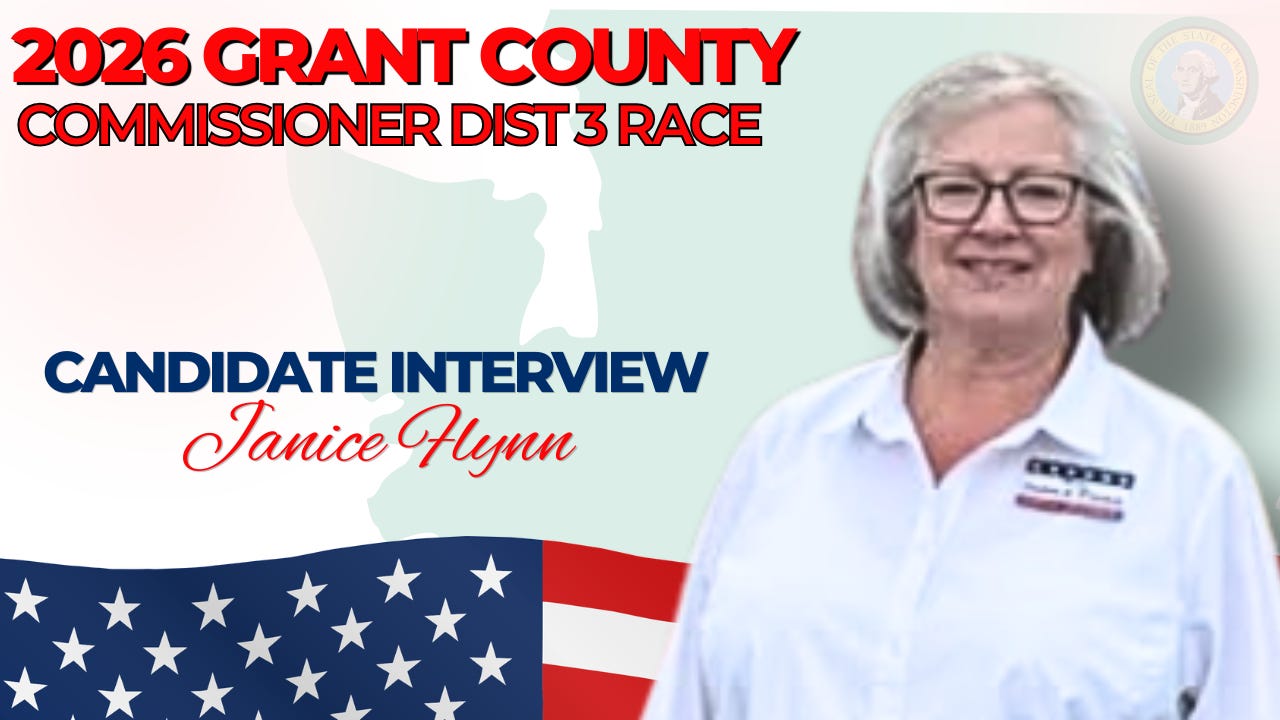
I interviewed all 4 candidates for the Grant County Commissioner District 3 race for 2026.
All 4 Candidates were asked the exact same 20 questions in the exact same order
They never saw each others answers
The answers have not been altered, edited, modified, editorialized, changed, or edited in any way by the staff, ownership, or affiliates of this publication.
For each I have posted the transcript, not a story, their words. (transcripts by AI)
For each I have posted the audio from the interview.
A full list of the questions
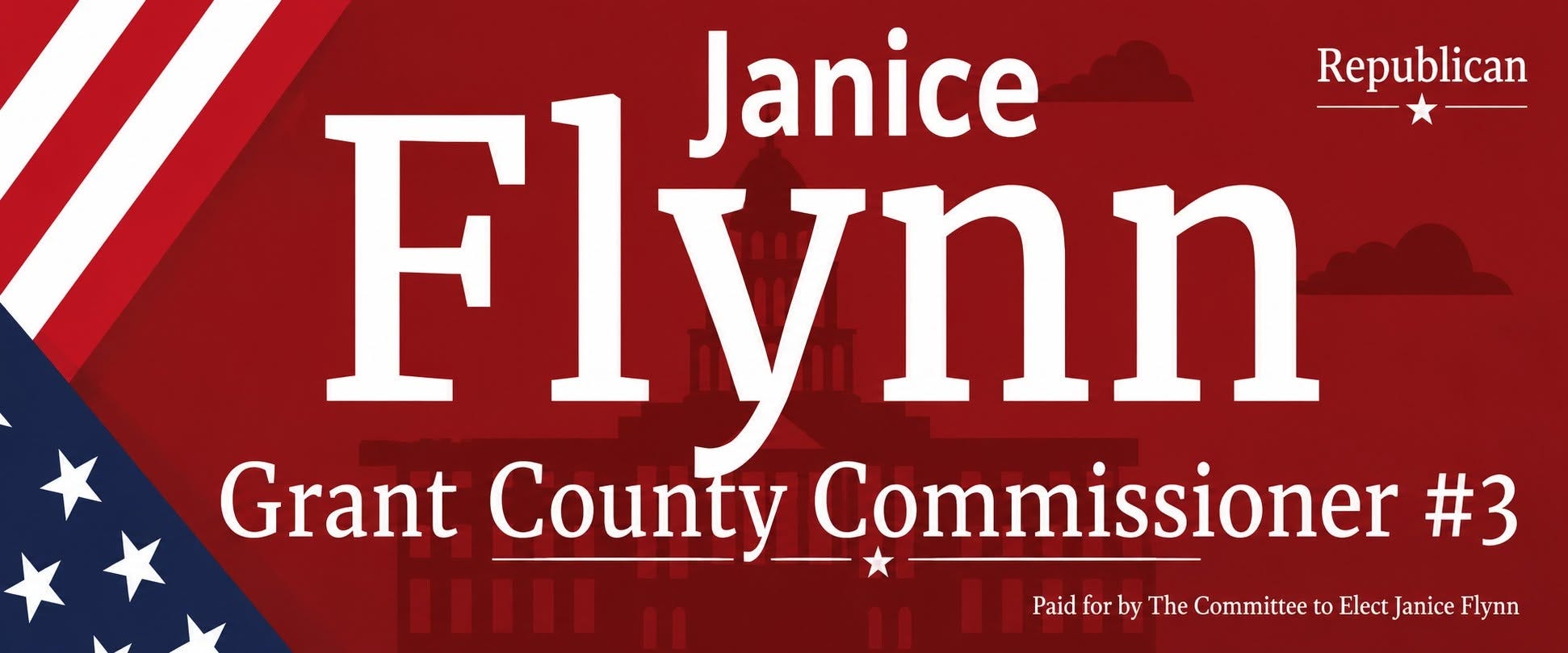
Below the interviews I will post their posted bio from their candidate website, their sign and a link to their website and or FaceBook
The Interview Begins Here
Janice Flynn Interview Audio File
Janice Flynn Interview Grant County Commissioner District 3 race for 2026
Brent Dowlen: [00:00:00] Janice Flynn interview, Grant County Commissioner District three candidate interviews. Janice, tell us a little about yourself, your background, and your connection to Grant County and communities in District three.
Janice Flynn: Well, I was born in Quincy. I was actually born in the Quincy Hospital. My parents are Eldon and Donna Flynn.
They’re long deceased. I grew up in Quincy, and I graduated from Quincy High School. My dad managed the local Chevy dealership for forty years, and my mom was a baker for the schools. Uh, we also had a small herd of cattle, like twenty, thirty head. Grew about ten acres of alfalfa. And my parents-- my dad raised all our own meat.
They had big, big gardens. And, and something I would say that people could relate to is many people probably knew my sister, Gayla Peterson, also known as the Tab Lady, before she passed away a few years ago. Uh, so I was gone for a while, but I have spent most of my life in the Columbia Basin. My son, Tony Flynn Martinez, [00:01:00] also grew up in Quincy, and he and his wife, Abigail Holt, still call Quincy home.
Uh, he’s a contractor and specializes in finish work, so a lot of people know him there. In my spare time, I like history and antiques. That’s, that’s a fun thing for me. I like to host little tea parties for a growing group of girls here in Royal City and teach them something about history because I think history is important.
We learn from history, and history often repeats itself.
Uh
I was, like I said, I raised my son in Quincy. He grew up there, graduated from Quincy High School. And, uh, used to serve on the board of Quincy Valley Allied Arts for quite a few years, spent a lot of time there. My son and daughter-in-law both still serve on that board.
So anyway, grew up in Quincy. Grew up... It was, it was easy for kids to find work back then. And so as a teenager, I did the typical thing, hoed weeds and thinned [00:02:00] apples, picked cherries, cut seeds bud during spring break, and, uh Just worked in the, the ag industry like most of us do. And in 2005, I went to work for Martin Morris Agency in Quincy.
It was an insurance agency, and I worked there for 15 years, and I learned a lot. I learned a lot from Kurt Morris and Dave Street, the owners, and I learned a lot of-- more about farming and the farm industry because I worked on so many farm policies. And then 2020 took me to the Grant County Commissioner’s Office.
And so I worked at the commissioner’s office as the administrative services coordinator and was there until 2023 when I took a job with the City of Royal City as the finance director. And so I’ve been there since. I live in Royal City, and so that’s my, my basic history and my connection to the-- really the Columbia Basin, though I live in Grant County, I really consider the Columbia Basin as a whole my home.
Um, [00:03:00]
it’s just home.
Brent Dowlen: All right. What experiences in your personal life or career best prepared you for public office and county leadership?
Janice Flynn: I think I would go back actually to my very first office job, and that was at the Quincy Inn, which no longer exists in Quincy. It was a congregate care facility, and most of the residents who lived there, so I-- my recollection is a fifty-six-bed facility.
Most of those residents came out of the state hospital, Eastern State Hospital. So there were a lot of people with issues. And one woman thought she was Joan Crawford. And, um, there were people there, there were a couple of young men there that were barely older than me. They were probably eighteen when they came in and, and just had issues.
No one had no memory. He would come out of his room in the middle of brushing his teeth ‘cause he couldn’t remember. Anyway, I go back to that because [00:04:00] that taught me a lot of patience. It taught me to get used to people making accusations, as one person always thought we were stealing his money, and learn the importance of Of taking care of being a fiduciary for other people, taking care of their funds and their money and watching over them.
So I really feel like that, that job prepared me early on because the commission, the commissioner’s office, as a commissioner, you are serving people. People are contacting you. People want you to listen. People want to tell you the issues that they have. And so I think from there, uh, I would probably jump up to Martin Morris Agency and working with, working with Kurt and seeing the magic he works.
I learned a great deal from him and then also learning, learning farms because this is an ag industry or [00:05:00] an ag area. Most people directly or indirectly are employed because of the ag industry. And so that was, that was, uh, important there. And then again, in the commissioner’s office, working for them, I handled many millions of dollars in grants for them, and I also administered the strategic infrastructure program and as well as handled the county’s insurance because I had worked in that industry for so long.
And so between that and then being the finance director for the City of Royal City, which is more mostly finance, sometimes it’s more akin to city administrator dealing with attorneys and engineers to keep contracts and projects moving along. But it’s the, the budgeting process and monitoring the budget.
It’s preparing and submitting the annual report each year [00:06:00] that’s due to the state. It’s getting used to understanding more regulations, understanding infrastructure a little better. I learned more of that from the, from the city. And it’s also gave me the-- between the two of them, the county commissioner’s office and the City of Royal City has given me the opportunity to work with several other agencies, because in government, agencies work together a great deal.
It could be for because of funding, could be because of regulation. It might be just because it’s a mutual aid situation or they’re helping each other out. So I’ve had the opportunity to work with USDA for rural development, the US Treasury Department, Department of Ecology, Department of Health, Transportation Improvement Board, the Department of Commerce.
And I think all that knowledge is what will give me the opportunity to work at the county and fill that position because there’s gonna be [00:07:00] a void, a huge void with the, the number of people we’re, we’re losing at, at this time
Brent Dowlen: What do you believe people misunderstand most about Grant County government and the role of the county commissioner?
Janice Flynn: I think people-- a lot of people think that the commissioners can do anything they want, and they run everything in the county. When I was at the commissioner’s office, I would see p-people come in and make demands on schools. Say, “Hey, you’ve gotta stop what’s going on in the schools. This is a problem.” Well, they have no jurisdiction over schools.
Or they would come in and say, “I don’t like what my city is doing.” Well, they don’t really have jurisdiction over the schools either. I mean, over the cities. You have to go to your city council for that. There is some overlap with regulations, I guess, for building and planning some of those things. But for the most part, the cities get to run their own cities, and the schools run theirs.
Um[00:08:00]
Uh, let’s see, what... I ca- I’m trying to remember the... I feel like I’m forgetting part of the question.
Brent Dowlen: What do you believe people misunderstood about- Oh ... misunderstand about Grant County government and the role of county commissioner?
Janice Flynn: Yes, and the budget. People think that the commissioners are over everything.
They are not over other elected officials. Other elect- elected officials answer to the, the people, the public. And so the budget, for example, is the, the commissioners do adopt the final budget, and they work together, but they’re going to, they’re going to send it back to, at least that’s what I would do, if we need to cut a budget or need to make some changes, send it back to those elected officials or those department heads and say, “You know your, your department.
Figure out what you need to do so we can reach that final, um, goal of what is needed.” Also, the [00:09:00] commissioners can’t change state laws, and they have to abide by state laws. Oftentimes there are people who feel like the commissioners just need to say, “No, we’re not doing this,” or, “We are going to do this.”
There are laws in place. They can’t break the law. There are commissioners in the state that have been prosecuted for making decisions that someone felt was illegal, and, and that, and that’s a criminal offense and, and they get prosecuted personally. And so we try to work with and put pressure on legislators for the things that we need or things that we want to see, but we don’t, we, the commissioners do not have total control over that.
They can’t... They don’t make the state laws, and they can’t break the state laws.
Brent Dowlen: What values or principles guide your decision-making when you’re dealing with difficult issues or public pressure?
Janice Flynn: Values. Could you [00:10:00] repeat that one again, please?
Brent Dowlen: What values or principles guide your decision-making when you’re dealing with difficult issues or public pressure?
Janice Flynn: I, I think first of all, we have to listen.
I, I personally don’t see everything as every issue as, uh, something I need to win. I see myself as more of a facilitator often, and I need to listen, and I need to gather the information, listen to both sides, and then at some point you just have to make a decision and, and go with that decision. Um, you know, and just not be a- afraid to do what we have to do to, to explain.
And I guess we have to have a thick skin because not everybody’s going to be happy with every decision. Uh, the example I always give, somebody asked me about that the other day, [00:11:00] “Well, why would some people be unhappy?” I said, “Well, you have a neighborhood that comes in, half the neighborhood comes in and says, ‘I want the speed limit in the neighborhood changed to twenty-five.’
And the other half is saying, ‘I want it left at thirty-five.’” Somebody’s gonna be unhappy, but you just have to gather all the information and do what you think is right, right? And go with, with the best decision and, and live with it
Brent Dowlen: All right. Outside of politics and work, what keeps you grounded and connected to community?
Janice Flynn: And I think my, my community service over the years, i-it’s, it’s varied. It’s been different. Uh, my, my very first community service was with Greater Quincy, which doesn’t exist anymore. It was, uh, for the, for the... Greater Quincy did Canal Days, which was the local... And now it’s FCAD, Farmer Consumer Awareness Day.
Before that, it was Canal Days. [00:12:00] And when I was still in high school, as soon as I turned 18, they, they put me on the board as the secretary. And so, uh, service in the community, being involved in the community, uh, so that was a long time ago. Like I said, I was involved in theater group for many years. I know when I worked at Martin Morris, on the days of the, the days of the, of a community’s, uh, celebration, like FCAD in Quincy, that office got to close at noon.
We’d have a half a day off. And so I would try and go and do... help set up, do something just, just to serve the community. Like I said, I have here in Royal City, I have tea parties and luncheons for some of the women, um, and just staying involved. Before I was went to work for Royal City, I would from time to time, not always, but go to council meetings and try to stay in tune with, with what’s happening in the community.
Um, I [00:13:00] try... I attended a Farm Bureau meeting the other day to try and stay on top of, of what’s happening, and ‘cause we all have a little different approach, and we all see things differently, and we’re all busy, and we can’t be going to meetings all day long, all the time. We’re working jobs, and we have soccer games to go to and different things to do.
So I try to stay in touch with people and, and see what’s going on out there, and then tackle it if there’s an issue, or sometimes it’s just encouragement. Be involved. Go to your, go to your Summer Fest or your Spring Fest events
Brent Dowlen: Why are you running for Grant County Commissioner District 3 specifically, and why now?
Janice Flynn: Well, I am running to be of service because I see a need With a long-term commission, like Cindy’s been in office for 20 years. [00:14:00] She’s leaving. Daryl Pheasant, the treasurer, has been in office, I believe, 36 years. 35, 36, a long time.
Michelle Jaderland has been at the county for probably 30 years, and the auditor for 12 years, I believe. And then the assessor is changing also. She’s leaving. There’s just so much knowledge walking out the door, and so I never, never thought I would run for an elected office. But more and more people started talking to me about it to see if I would because...
Well, first it just started with Cindy stepping down. She’s-- That’s gonna be a big void for a, a-- with a commissioner of 20 years stepping down, and I want the county to continue to run smoothly. Um, county government doesn’t get to pause because of turnover. And so I feel like I could be of use. [00:15:00] I, I... This is not a stepping stone for me.
I don’t plan to ever become a legislator or anything like that. I’m just trying to fill a void and be of service
Brent Dowlen: What do you believe qualifies you to lead Grant County through the next several years of growth and change?
Janice Flynn: Again, my experience so that I, I feel like I can hit the ground running. I can, I can get right to work. Um, again, involvement in the community, trying to make honest decisions, being a listener, not being afraid to make decisions, um, will all help with those things. I understand... It’s like I, I can understand the budget.
I can understand, um A lot of these regulations, and there, there’s so much, it’s unbelievable. There’s more than I [00:16:00] will ever be able... I think than any one person could ever know in a lifetime. But, um, again, the e- the experience and the willingness to put myself out there, because anyone who knows me knows I’m happy to stay in the background, but there’s just a need.
And again, uh, um, like I said, experience. I can, I can look at the budget and, and know that, oh yes, this expense seems too high and it needs to be cut back, but understand that you can’t cut that one back without cutting back this other one, and you’re not gonna wanna cut back this other one. And because there are certain issues in place that, that, that’s a result of a lawsuit, a judgment against the county from a lawsuit 20 years ago, that these accounts have to run parallel.
You can’t increase one without increasing the other, vice versa. So l- knowledge is key because we have over 100 years of knowledge [00:17:00] walking out the door. It’s just, it’s going to be gone very soon. And like I said, I don’t know everything that they know, but I can hit the ground running and make the decisions when they need to be made
Brent Dowlen: What is the biggest issue you believe District 3 is facing right now that isn’t getting enough attention?
Janice Flynn: Hmm, District 3 specifically
I’m gonna think about that one for a second. Uh, maybe The Gorge. The Gorge has issues. I know just this last weekend, I believe they implemented a new, what would you call it, new, um... Uh, uh, because of the issues they’ve had there, they now have more security, and it’s slowing down the process. And so they, they had, I think they had a drug-sniffing dog, or [00:18:00] may- I think is what it was looking for.
And so it slowed the process way, way down, way down. Uh, which meant the roads were blocked, and people couldn’t get through. You have people who live in that area that need to get down those same roads. Y- you have farmers that need to be able to get to their circles. And so I see that as an issue we have to figure out, or The Gorge needs to figure out how to accommodate that traffic storage, as you would call it.
They need to have an area where they can... people can get off the road. They’re on their property as they handle the security. Um, we have, you know, the, we have a power shortage, or I don’t know if shortage is quite the right word, but we need to be able to accommodate growth. And, um, and if we don’t [00:19:00] have the power, we can’t accommodate it.
And so, and, you know, that’s, that’s something that has to be worked out with the PUD, but we need to continue to work with them on, on that. There’s also the housing shortage, the affordable housing. It’s something the state has regulations on, and they’re really, really pushing and pushing for, for housing.
Of course, we all want everyone to have sufficient housing, and so that’s something we have to, we have to try to stay on top of and plan for. This is an ag area, and so the ag economy can be tough at times. Um, we at least have to make sure we’re maintaining roads and working with the entities that s- specialize in economic stability for those that are-- that for the ag industry, like Farm Bureau, like Columbia Basin Development League, like Grant [00:20:00] County EDC
I would see those, I think as the-- that’s what, that’s what comes to mind when I think of District 3 and some issues. I think... Oh, here’s another one I, I think we need to really look into and stay on top of the emergency services. I think we’re probably pretty well covered for fire. But I, I know there was a man last year who in Mattawa was having a heart attack, and his wife tried to get him to Kadlec Hospital, I believe, in Richland, because felt that was the closest one, and he died on the way, and I don’t want to see those things happen.
Um, wanna make sure that we work together to make sure they have sufficient services, ‘cause Mattawa’s kind of out there, it’s like Royal City. So those are some of the things I see.
Brent Dowlen: Okay. Quincy and the surrounding communities have been seeing rapid industrial and population growth [00:21:00] over the last decade.
Do you believe the county infrastructure is keeping pace, and what would you prioritize first?
Janice Flynn: Hmm. Industrial, there has been. We have all the data centers. Um, I think it’s gotta be power. Um, again, we have-- there are a lot of solar farms going in, and we have to work with the PUD ‘cause they’re, they’re really in control of the power.
Um,
so we would have to try and continue to work on that and, and see what those solutions are, and see how we can accommodate that.
Um, roads, we’ve gotta keep the roads, uh, going. We have about twenty-five hundred... about twenty-five hundred miles of roads, county roads here. We put-- line them all up, you could get to Louisiana. And so it’s a lot of roads, and we need to continue to, to prioritize those ‘cause they’re important. So you have to-- [00:22:00] They’re important for emergency services.
They’re important so everybody can get to work and school. They’re important so farm equip-equipment can move, the... so farm product can get to market. Uh, we need to make sure we continue to try and expedite the permitting process for development, for, for building. And, uh, and infrastructure, infrastructure has to be in place for industry.
And so we have-- the county has the strategic infrastructure program, which is a tax that comes in, and about, about half of it is given to other entities like ports and cities, hospital districts or hospitals for infrastructure development in the county. And I think that’s important. That, that’s... Like I said, it’s a tax.
The RCW controls that, determines how that’s gonna be spent. People [00:23:00] apply through us. We’ll keep that, that program going because with, with industry and growth, you have to have a long-term vision. You have that long-term vision, and infrastructure is key. It is absolutely key. Um, I don’t, um-
It, it could take a long, long time to get permission from a railroad to run a pipe under a, a railroad. Um, so you have to be planning, you have to be working with the ports, with the cities, those entities that are bringing in that industry, tho- or those industries. Um, so we would... That’s, that’s of importance.
I would say that the long-term vision and the, um, the infrastructure is very, very important. And then we’re always [00:24:00] having to try and mitigate the damage from regulations from the state, and that’s a case-by-case basis. You know, the regulation comes in in dribs and drabs, and you tackle it as it comes
Brent Dowlen: Housing affordability and housing availability continue to be major concerns across the district, as we touched on. What role should county government play in addressing housing challenges while still protecting rural communities?
Janice Flynn: Housing challenges. Well, we do have We do have entities that the county works with, like the Housing Authority of Grant County, Hope Source, New Hope, that kind of address special, special needs, specific needs for affordable h-housing. Um, so we would continue to support them. They get grant funding through the state [00:25:00] and through, um, through the county, runs through the county, those grants.
And so we need to ke-continue to help those. But in terms of... Th-those are kind of special, um, people with disabilities or people that are temporarily homeless or having some struggles. So that’s part of it. That’s part of it. But i-in terms of building homes, which is mainly going to be in the cities, I think the affordable hous-housing is gonna be in cities.
There’s constant regulation that’s just getting difficult, and it’s making things more expensive. You have... So here in Royal City, for example, you have a development going in, but that was considered to be shrub steppe area, okay? So that meant that had to be... I-it basically drives up the cost with this, w-now that you’re getting into the delicate ecosystem of shrub steppe, and are you going-- you’re gonna have to find some other land somewhere else [00:26:00] that you can put into the system that you’re gonna agree never to touch, that, that type of thing.
It, it, the regulation gets outrageous. And sometimes energy credits. People wanna build, wanna put a, a tiny little addition onto their home to accommodate family, and they can’t hardly afford it because of the, all the energy credits that are required. Well, you can do that, but you’re gonna have to do this, this, this, and this too.
And the, the regulation, I think, is difficult. And so we’ve got to stay on top of the state. Again, that’s not coming from us. That’s coming from the state, and we do have to continue to work with them, put pressure on legislators to try and get those, those things eased up Um, housing. Now, when you’re-- when a housing development’s going in, you can pretty much...
I, I’m not even sure it can be. I don’t know all the regulations exactly, but I don’t think you can just have all single fa- family houses. You have to plan for [00:27:00] multi-family houses as well. That’s something that’s considered. You have to offer all of those scenarios, and you have to offer them as well in terms of being able to get to work, access to work.
So there are a lot of components now that we have to stay on top of. It is mostly the-- Like you said, I believe that’d be mostly the cities that would be dealing with, with affordable housing, but we just have to assist them as much as possible. And again, strategic infrastructure is out there if that’s for-- If it’s infrastructure, there’s some money there that can help.
Brent Dowlen: District three includes farming communities, industrial development, and grow- growing residential areas. How do you balance economic growth with preserving the character and identity of rural communities?
Janice Flynn: Hmm. Ag, industrial and residential. [00:28:00] How did they preserve
Well, ag is the backbone of the area. I, we, most of the industry is ag related, and the residents are here because of ag. So that has got to be a priority. Um How do we do that?
Um
Yeah, like I mentioned before, we have to continue to work with the, um, with the, the entities that specialize in ag stability, like Columbia Basin Development League, [00:29:00] Farm Bureau, BDC, and, um...
And then we have to continue with the infrastructure. So we’re gonna have to help all of the, all of the industries and make sure the infrastructure is in place. Again, there’s money to try and do that, try to get that word out to people, um, since we have to really invest in all of the, the area. Um, but, but ag is absolutely the backbone.
But to try and, try and stay on, on top of that regulation so it doesn’t, um, break the backs, I guess, of the, the area. W- Things are diversified more and more. Uh, again, I think a way to help preserve is simple things like [00:30:00] remembering the history and, um, promoting that history, supporting the local celebrations
And protecting ag lands. Of course, there are regulations for that, and we’ll continue to... Uh, the county stays on top of that, and we’ll continue to do that
Brent Dowlen: Okay. Road conditions and transportation infrastructure are a constant concern throughout Grant County, as we’ve discussed. What would your priorities be for the county roads maintenance and long-term infrastructure planning?
Janice Flynn: Well, the county has a 10-year roads plan that is in place for maintenance, for improvement.
I would try to improve the roads. I try to get a few more paved every year if it’s [00:31:00] possible, so we have those all-weather roads that can be accommodating, uh And all throughout the, all throughout the year. Um,
we have... Yeah, there’s, th- th- they call them gravel to oil projects, uh, to, to get more roads paved. At one time, the county had a, what I would call a cost share program, and they ended that. They ended that when I was at the county, and I didn’t like that. I’d like to see that come back. I’m not sure why that was ended, and basically that is an owner, property owner along a road, if they wanna help share the cost, and it’s pretty significant, they could do that and then the county would, you know, do, do their part.
It was, it was, uh, an effort on both parts and it was a way, in my mind, for the county to get [00:32:00] more paved roads and especially if the, um, if the homeowners are willing or the property owners are willing to participate in that. And I would be looking into how we can bring that back. And again, I didn’t... Not sure why.
Well, I do know why, but I didn’t agree with why. Uh, but it wasn’t... That’s just something I observed while I was there. Wasn’t something that affected me, so I stayed out of it. But I would be looking into that too, see if we can get more paved roads. And then we stay on top of the safe roads programs. So as things come up, like we put rumble strip, strips in about eight years ago throughout the county, and th- they help.
They help a, a, a great deal to keep the roads safer, and so I think that... But that was new. New, I don’t know if you’d call it technology, but that was a new idea at the time, and I think those new ideas will continue to come, and we need to address them. And then there are [00:33:00] situations like an intersection gets busier.
Do we need a roundabout there? Do we not need a roundabout there? Is there money to pay for that? Can we get funding to pay for it? Do we need a flashing stop sign? Do we need to change an intersection to a four-way stop? All those things have to be considered, and they’re, they’re constantly evaluated. Like I said, the county has a schedule and a, the 10-year roads plans, road plan that, uh, that is there as the basis and we just move along from there
Brent Dowlen: Water is one of the most important long-term issues in Central Washington. What concerns do you have about water infrastructure, water access, and future planning in the county?
Janice Flynn: Well, water’s, water is an issue and it’s, it’s of concern. I think that goes through the Department of Ecology or Department of Health if you’re look- looking at city wells and things like that.
But I think Ecology’s involved with it in some. There’s a [00:34:00] lot of... There’s a, a, I don’t know if a study is quite the right word, but the cities in the area, in Grant County, are forming a coalition to work together to try and figure out a, a solution to water. Some of it has been, well, maybe, maybe we need to get-- when we’re designing homes, maybe irrigation or sprinkler water needs to be coming from the, the irrigation district and, I don’t know if it’d be the irrigation district, but, um, from a lake or something so that it’s not, um, not all coming out of the wells because the aquifers are declining.
And I know there’s a project to try and get more and more farmland off of the aquifers and onto, into the Columbia Basin, the bureau system for irrigation water. There’s, there are some other programs I’m not very familiar with. There’s a rehydration program, I [00:35:00] think, where you’re injecting water in the ground.
I don’t really know much about that, but, but I know it’s out there. People are trying to do what they can in terms of conservation, and I think we have to defer to the, the engineers and the experts on that as more information becomes available because it is a concern, and I’m glad it’s being looked at and addressed now.
Brent Dowlen: Many residents feel disconnected from county government because decisions are often made in Freda while impacts are felt all over our county. How would you improve communication and transparency with the communities you represent?
Janice Flynn: Go to their meetings. You need to, well, first of all, have an open door policy and they can contact you.
Every commissioner has a cell phone that is issued by the county and the phone number is published on the website. So I believe every mayor needs to have that number. Well, anybody could grab it, but they need to know they can reach out. And [00:36:00] I think attending those meetings regularly, you don’t have to attend every one, but attending them regularly and having the door open so they know they can contact us and trying to keep them informed of what’s out there and what’s available.
So they know that there is strategic infrastructure money available. Or I know at the county, they will get notices from, say, the Department of Commerce that say, hey, we’ve got this grant money available. Or maybe we help them with letters of support and contacting legislators to say, we believe in this project.
We want to be helpful. And we think you should support this project and give them funding for that. And so we just need to make our presence known and then tackle the situations when they come up.
Brent Dowlen: Publi- [00:37:00] Sorry. It’s been a long day already. Public safety remains a major concern across the county. How should commissioners work with the sheriff’s office, fire districts, EMS providers, and local cities to improve safety and emergency response?
Janice Flynn: Okay, how to improve public safety. I think it has been getting better. Um, there is... I believe the county right now is looking at funding for that, uh, and, and... ‘Cause m- money comes in specifically, tax money comes in specifically for different aspects of public safety, and I think they are reevaluating that right now.
Um, we need to... I, I think a great program, it’s not a county program, it’s just the farmers out there doing their Farmers on Patrol. They’re keeping everybody involved. And so people can report something, “Hey, someone in a black pickup just stole my bicycle,” and you can report that, and people can be [00:38:00] watching.
It’s kinda like the community, um, block watches that, that they used to have. And so we, we need that involvement. We, the public needs an easy way to, to contact people. There’s, there’s 911, and people don’t always wanna call 911. But there is an emergency dis- a non-emergency dispatch number that, um, we need to get out there and get published so people feel like they can, they can, they can have that contact with people, and even if it’s not an emergency, but something they need to, to get out there.
Um-
Are the fire districts properly manned? Um, ambulances, you know, um, do people have, do the emergency services have what they need? I know when, I know when I was at the county [00:39:00] handling grants, in fact, in fact, I have to say that was my idea to give every fire district a hundred thousand dollars of ARPA money, which was American Rescue Plan, part of the COVID plan.
And so they could continue to make sure they have the sufficient trucks or equipment or whatever it is they need. So we need to, to help them as much as we can. They are, they being the hospital districts, the s- the fire district have their own, they’re junior taxing districts, and so they have their own monies that are coming in.
But from time to time, the county can assist with those things. And so we need to keep our eyes open to where we can help
Brent Dowlen: Okay. What are your thoughts on the pace of data center and industrial growth around Quincy and the surrounding areas? What opportunities and challenges do you see coming with that growth?
Janice Flynn: Well, the data centers provide a lot of income, which is great. The [00:40:00] issue is, is the power. Um, that’s what I see as a challenge, and we have to have sufficient power so we... so other industry can come in. And, uh, that’s, that’s what I see as the biggest, the biggest challenge. But they do... You, you, if you just looked up data centers, you’d see the pro is they generate a lot of revenue.
The con is they take so much power, and we’ve gotta find a way to, to work with the PUD and to figure out a balance there so we’re not stopping the industry that needs to come in for ag, because that is who employs most people. The data centers don’t employ lots and lots and lots of people, like a food processing, processing plant would or a freezer facility.
Um, so we need to, to look at those. But Quincy has benefited greatly. [00:41:00] I can’t deny that. And, um, es- and even the county because of the property tax that comes in. Huge, huge amount of property tax coming in because of the assessed value of those buildings, those data centers. But yeah, power is the big, the big issue there
Brent Dowlen: Small towns often struggle to make their voices heard compared to larger population centers like Moses Lake.
How would you ensure communities like George, Royal City, Mattawa, and the unincorporated areas remain represented?
Janice Flynn: Again, communication and contact. I think making contact with them and, and their boards, and if, and letting them be on board. There are a lot of county boards, and we need people to, to represent those small communities.
So if people from those small towns or those small communities [00:42:00] step up, they can be on the Solid Waste Advisory Committee or maybe the, uh, the Fair, Fair Advisory Board, uh, the health district. There are Board of Equalization, there are just a lot of boards, and I think that’s a good way for... that would keep them involved.
They need to, to be involved, and then we need to reach out as well.
Brent Dowlen: What role should county government play in supporting local economic development while making sure growth benefits residents and not just outside investors or corporations?
Janice Flynn: I think, again, a lot of that comes back to infrastructure, a- and that goes back mainly to, I’d say, would say ports and cities to make sure that they have what they need for development. Uh, we don’t want, just [00:43:00] want outside, um, outside people un- unless it is benefiting the local community. If you had a food processing plant in Mattawa, it’s going to employ a lot of people.
Um, that would benefit them even if it is someone coming from outside the area, I guess. And then if you had a freezer facility in Royal City, again, that’s going to benefit the community w- community with, with jobs. And so, um So again, Rural City needs to be supportive of the, the projects that can come in and, um And work with those entities that specialize in that.
Brent Dowlen: We’re almost there. Just a couple more questions.
Janice Flynn: Okay.
Brent Dowlen: County commissioners are responsible for major budget decisions. Where do you believe [00:44:00] taxpayer dollars are being spent effectively currently, and where do you believe the county could improve?
Janice Flynn: Where, what is, what’s, uh, effective and where to improve
On the budget, you really have to look at, look at each line item, um
What’s effective? Most of the money that’s coming in is probably coming in from taxes, of course, of one sort or the other. And you have, you have the, um
You have current expense, which is the general fund [00:45:00] and law and justice or the sheriff’s department, basically. It’s also probably gonna include judges and, um, courts, the jail, all those things use a majority of those. I think that’s money well spent. Uh, that doesn’t mean we can’t look to make improvements there if we need to.
Um Um, improvement, sometimes you just have to look individually at, um, at the separate line items to figure out where you can cut back. Yeah, anybody is gonna immediately go and cut back. Well, training is not mandatory. It’s, um Overtime possibly, but keeping in mind a lot of overtime is probably in the sheriff’s department and probably [00:46:00] reimbursed by, say, the Gorge.
So that’s something to consider. You don’t wanna just cut it if you’re getting reimbursed for it. And, um, you can look at vehicles. You can-- to see if we, we, we can cut back on vehicles. I think as technology increases, we might start seeing some attrition. May-maybe we don’t replace people as they leave.
Maybe we don’t need to as things change. But I see other areas as probably growing at the same time. I don’t see really the sheriff’s department or jails or courts getting smaller. So I think there’ll be a shifting of things, and we just have to look at it one line item at a time and defer to the elected officials because they are their departments and, and the department heads that run those departments that aren’t under other elected officials and just, um, tackle each one.
You know, you can always [00:47:00] look at things like the ways to cut, like, um, make sure you’re processing surplus items that will generate a little bit of revenue. If you sell them and get rid of them, you can look at deductibles, insurance deductibles to cut back on premiums
Um, I think, I think we out- did outsource youth services already, and so, uh, because the fact is you don’t have enough people, enough youth in the system to pay for, I mean, the guards, the cooks, the, the counselor, whatever e- has to be there. So I think sometimes you have to look at those, those items. That’s one that’s already happened.
I, I think we just have to take it as it comes. So that would be my answer to that.
Brent Dowlen: Final question. Mm-hmm. If you’re elected, what would you want residents of District 3 to say about your leadership four years from now?[00:48:00]
Janice Flynn: Well, I would like them to say that I was a problem solver, a facilitator, that I listened, that I addressed the, the situations or the problems, and that through a positive influence, I made a positive impact.

Website Bio (condensed)
Janice Flynn is a lifelong South Grant County resident, public finance professional, and current Finance Director for the City of Royal City. With experience in county government, grant administration, insurance, and municipal finance, she has overseen more than $40 million in state and federal grants while maintaining clean audits and strong fiscal accountability. A Quincy High School graduate with deep community roots, Janice brings practical government experience, financial stewardship, and a commitment to keeping local government effective, transparent, and responsive to the people it serves.
Website: Votejaniceflynn.com
Facebook: Janice Flynn for Grant County Commissioner
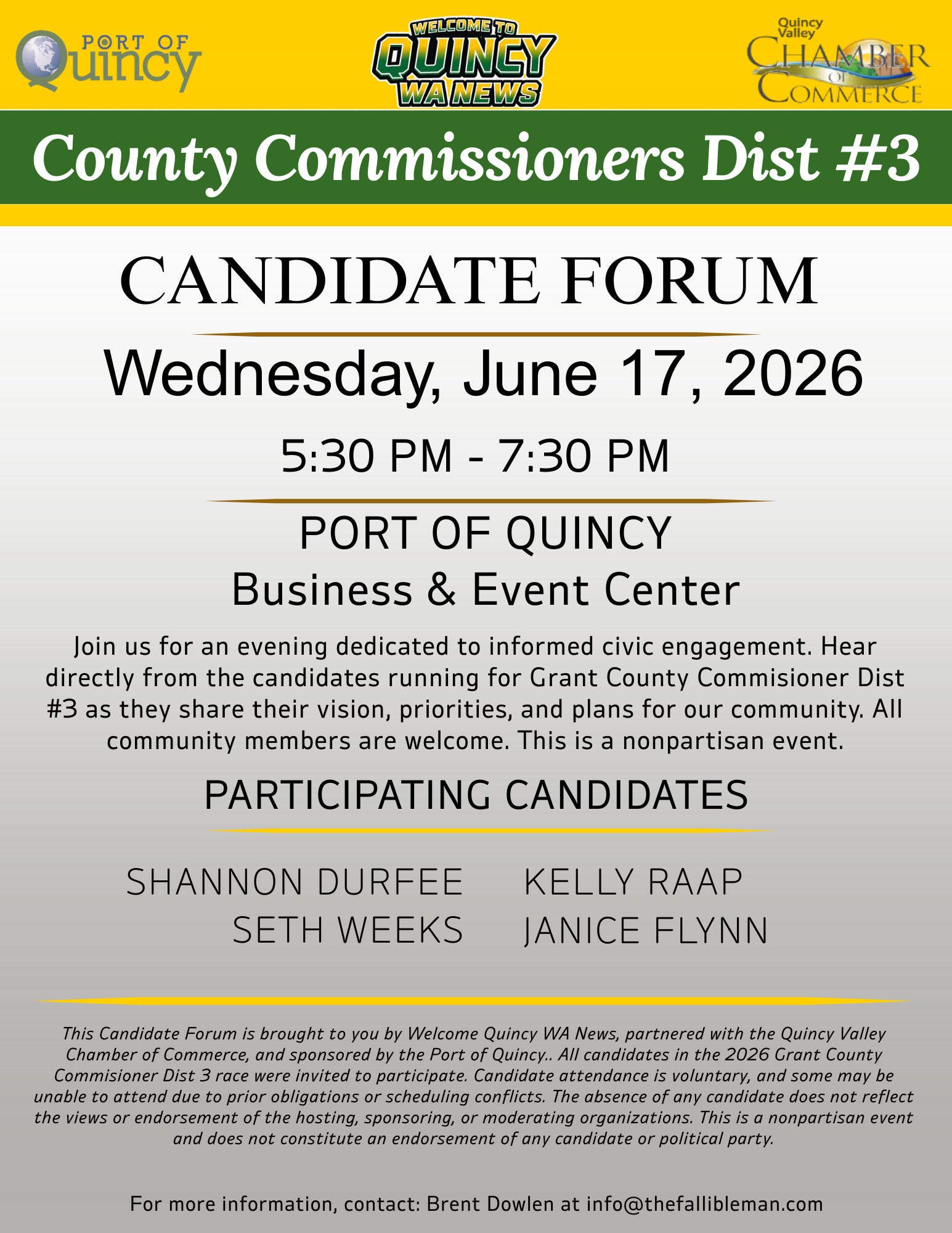
All 4 Candidates will be present for the County Commissioners Dist #3 Candidate Forum Wednesday June 17th at 5:30 PM at the Port of Quincy Business & Event Center
Back to Candidate Hub
Disclaimer:
This interview is presented as part of our commitment to providing accessible, local information to the community. All candidates in the 2026 Grant County Commissioner race were given the same questions, in the same format, and the opportunity to share their perspectives directly.
The responses published here are the candidate’s own words, presented without editing, interpretation, or commentary beyond basic transcription. Audio recordings are provided alongside transcripts to ensure full transparency.
Welcome to Quincy WA News does not endorse, support, or oppose any candidate. Our role is to provide information so residents of Grant County—including the 98848 communities—can make informed decisions based on their own judgment.