
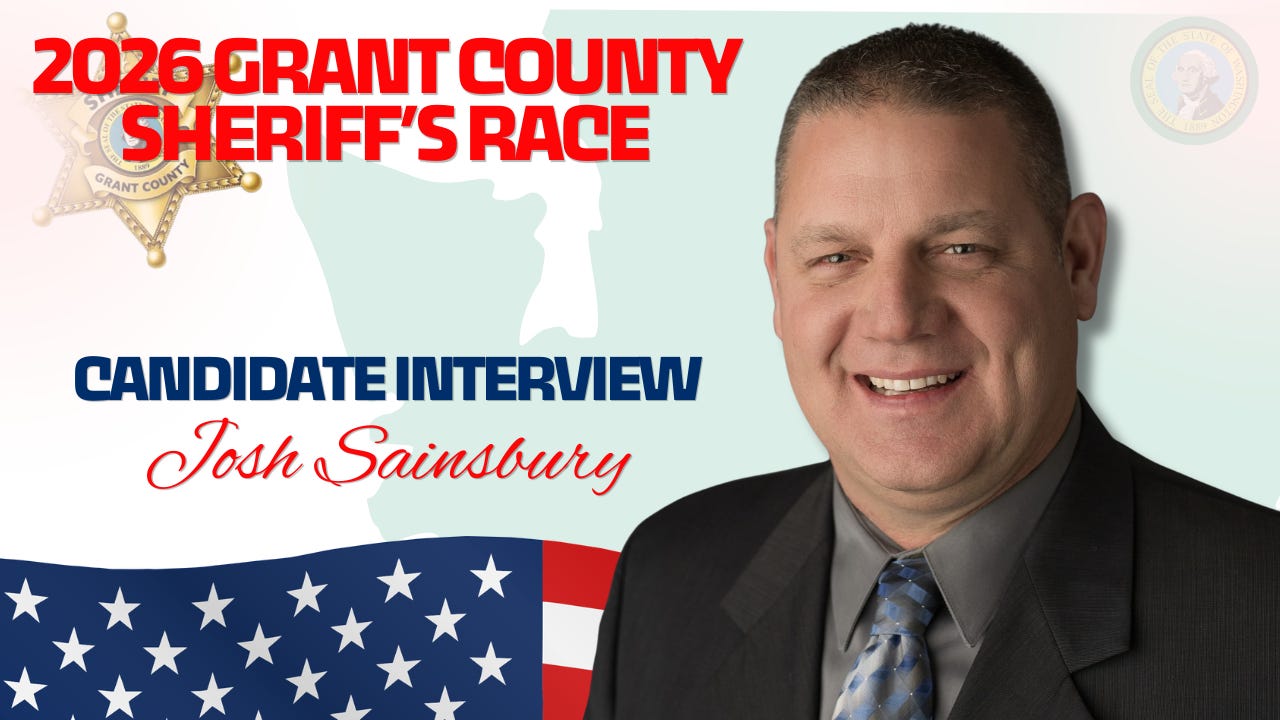
I interviewed all 3 candidates for the Grant County Sheriff’s race for 2026.
All 3 Candidates were asked the exact same 22 questions in the exact same order
They never saw each others answers
The answers have not been altered, edited, modified, editorialized, changed, or edited in any way by the staff, ownership, or affiliates of this publication.
For each I have posted the transcript, not a story, their words. (transcripts by AI)
For each I have posted the audio from the interview.
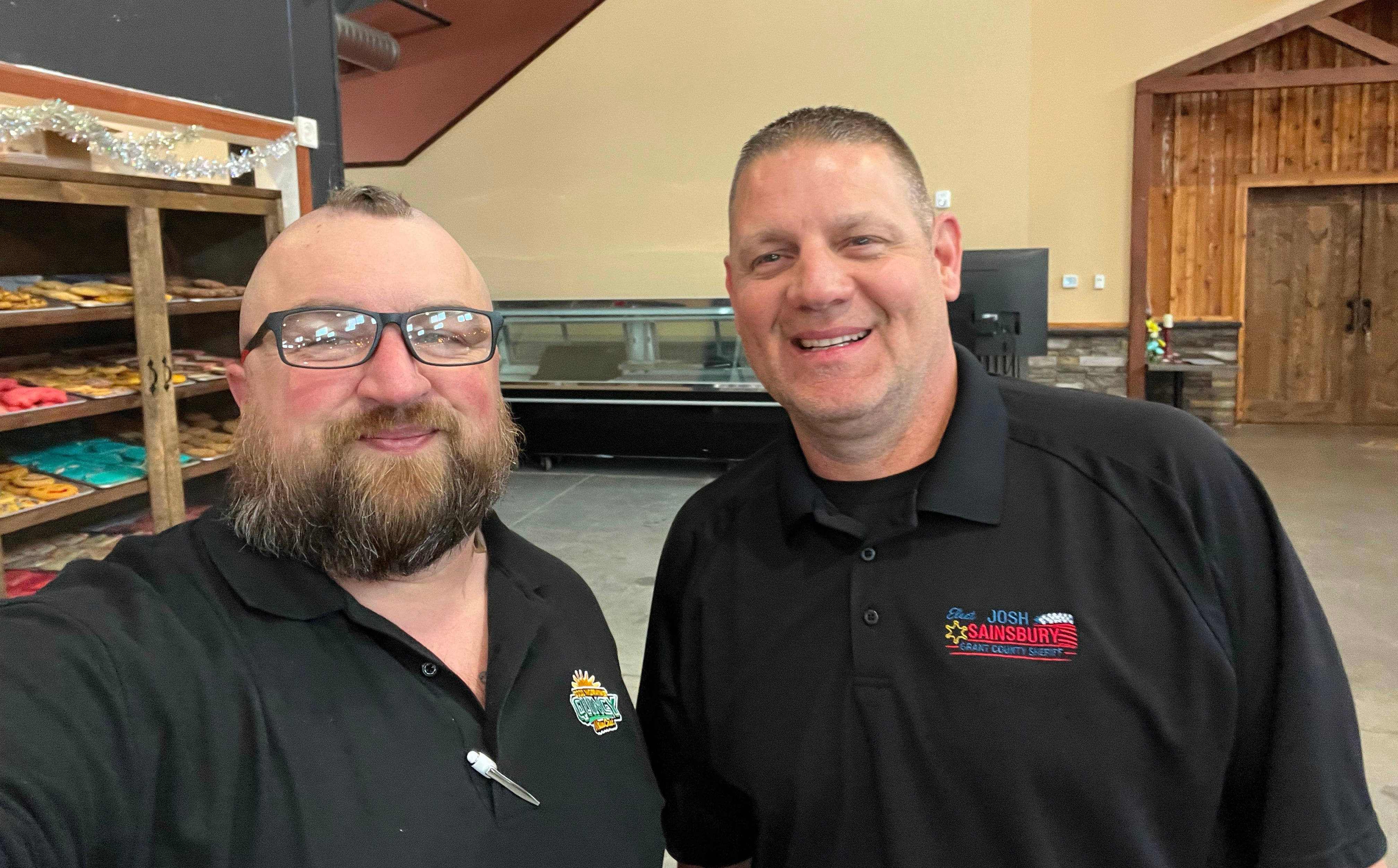
A picture with them to show we did this in person
A full list of the questions
Below the interviews I will post their posted bio from their candidate website, their sign and a link to their website and or FaceBook
The Interview Begins Here
Josh Sainsbury Interview Audio File
Josh Sainsbury Interview Grant County Sheriff’s Race 2026
Brent Dowlen: [00:00:00] Residents in more rural communities and Grant County office feel a little bit isolated from community level services. What does a strong visible sheriff’s presence look like in our specific area?
Josh Sainsbury: We have a very large county, and so to get a strong presence, um, it’s being fully staffed and that’s been a, a battle for probably five years now.
Um, getting, once we’re fully staffed, having everybody in their assigned areas, so we have a north beat, a south beat, and an eastbeat. Our eastbeat is our busiest. Our north beat is our biggest and our south beat, um, it’s spread out and there’s only one way to get to Royal, from Royal City to Matawa. So, um, just staying, staying active, proactive, being all over.
Everywhere from, uh, stopping cars, going to calls, doing all kinds of things. Um, sorry. No, it’s a who’s who and there. It’s [00:01:00] okay. Right. So, uh, I think it’s important to have all the cars marked. So when you see the cars, you, you know, is that a cop car? Is that an not a cop car? Mm-hmm.. Um, there’s some cars that are unmarked for certain reasons and that is also important as well depending on the, um, situation.
But also visiting the establishments, going to the, you know, the coffee shops, the sandwich shops, the tacos, uh, shops, being everywhere and stopping in and talk to farmers. And it takes, it takes everybody. Yeah. The public is the eyes and the ears for law enforcement and we have to, um, be every, try to be everywhere all at once and it’s very hard to do.
And, you know, we’re 122 miles tip to tip from the Vernita Bridge to the Grand Coulee Dam. Wow. So it’s, it’s a lot. And we, we also rely on a lot of our partners, the city police agencies throughout the county to assist us. Mm-hmm. [00:02:00] And we’re coming, we just, how quick can we get there?
Brent Dowlen: What is one area you think needs more proven and more attention?
Josh Sainsbury: I’d say retention and culture, um, kind of together. Uh, our retention, we’ve lost some people. Uh, recently in the last 18, 19 months, we’ve lost five of the state patrol for various reasons. Um, we’ve had two others that applied and it didn’t work out for them and then one other that pulled those application out.
So we need to have a, a culture change and change things for the better. Um, there’s, there’s situations where, um, you know, make it a positive environment. Um, not, not that it’s, it’s not negative every day and that’s not what I’m trying to say, but people be inspired to come to work and, uh, when you’re, when [00:03:00] your culture is happy, you have good customer service.
So, and our customer service, I wouldn’t say it’s horrible, but you can always be better. And, and so with retention, when you’re fully staffed, that makes a difference in your, um, crews at work. Right now, I’m on a crew of five for, because of circumstances. We have four that are on administrative leave from a situation back in February.
Mm-hmm. We don’t have any control over that. That’s just, that’s a normal process. And so you, some days you feel drained because you’re working with five every day and you’re covering the entire county. And when you have a crew of eight, which normally our crews are full with eight, when you have a full crew of eight, there’s that relief that you know your backup’s gonna be there quicker, you know that you’re, um, gonna be going to more calls with a partner.
That really helps where you might be going down to Matawa and your [00:04:00] backup’s 25, 30 minutes away, and maybe you’re getting a, uh, getting one of the city guys to help you and, and depending on what their calls load is as well.
Brent Dowlen: What’s the biggest challenge you think we’ll face, you’ll face if elected or sheriff?
Josh Sainsbury: I’d say the first year is learning, learning the dynamics of being the sheriff. So you have that internal working with your county leaders, working with the commissioners, working with the auditor’s office or specifically payroll and, and, uh, um, chief financial officer, learning the budget. And then the other part is being out involved in the public and getting to know
You have all the community partners and you have the people you know, but now you have the people you don’t know that want to get to know you and you’ve got to serve everybody. And so [00:05:00] spreading your time out, I, I had a, uh, sheriff friend of mine said, “If you ever run for sheriff, just remember that it’s not, you’re not campaigning for one year to get elected.
You’re campaigning every year because that’s what a sheriff does.” And I thought it was great advice because you, you have to be out in the public. You go to the community events, you go to the, you, you meet farmers, you meet business owners, you meet citizens, people come in to see you. And so, um, learning how to spread that out throughout the first year and manage the budget, it’s a, it’s a large budget and having the right people in place to help manage that and, and putting a good team together.
So, and bringing a team together, because when you’re starting out and you bring an administrative team together, you’re, um, getting to know each other. And so you have to, everybody has to figure out each other and be cohesive.[00:06:00]
Brent Dowlen: Response times can vary widely across Grand County. How would you work to ensure communities like some of the states, George Desert Air, Cool City, Crescent Bar receive timely and urgent responses?
Josh Sainsbury: Our response times are, I, I feel are decent. We want to be better. Mm-hmm. Um, like the North Beat, it covers some of the states to Grand Coulee. Now, you may have the south, the, the north guy might be on a call up in the Cooley City Grand Coulee area, and your south guy might be in the George area.
Everybody’s really good about just bumping up. And just because you’re assigned to one beat doesn’t mean you can’t go to another beat and help out. So they would bump up, everybody’s helps each other. Um, when you’re fully staffed, I like the idea with eight people on, you have a north deputy, a south deputy, I like the [00:07:00] idea of two south deputies.
And then you have a north deputy, you have a rover, north, south rover, and then you have three east deputies. And then you’ll, you’ll have a, with two rovers, you’re bumping around and we don’t wanna just keep everybody in the east beats. That might be where people get drawn to because that’s where the calls for service, but we also have to remember our small communities and getting to Sunland States, getting the Crescent Bar.
There’s little challenges because there’s only one way in and one way out, and it’s not a straight road going in. So it takes a little, you know, the, the road causes a commute. In the wintertime, it’s gonna slow down because of slick roads, whatever it may be. You know, the road between Wenatchee and Quincy is very busy.
And so if you’re going to a call for service and it doesn’t, policy doesn’t allow you to run code, that’s gonna be a delay. And, and as we know, there’s a lot of traffic nowadays. So just [00:08:00] trying to be everywhere at once, but, um, if we have two south deputies or su- making sure the supervisors keep that north-south rover in the north-south area, that improves our response times.
Brent Dowlen: What is your plan to recruit and retain deputies, especially to ensure consistent coverage to small communities around the 98848 area?
Josh Sainsbury: We, we wanna cover everything. Um, and I think improving the culture, making it a positive environment, the Grant County Sheriff’s Office was always known as the agency that everybody wanted to come look for. Um, law enforcement in 2021 took a big turn because of some legislative changes and people didn’t wanna do it.
I think the pendulum is starting to swing back the other way, and so creating that environment where people wanna come work here [00:09:00] and making it a positive environment, one of the things that we’re not gonna do, I, I’m not a fan of the bonuses, sign-on bonuses. Um, there’s a lot of people in the state that will go work for an agency for three or four years, and then jump to the next agency, work for three or four years, because that’s the requirement.
And so you get 20 grand here and you get 20 grand there, but they’re not committed. I like the lifelong ... I’ve been with the agency for almost 24 years, I’ve had no desire to go anywhere else, um, but creating that culture where everybody wants to be there and, and people enjoy the atmosphere that they’re working in, and that’s where the best recruiters are.
It’s your deputies that are recruiting outside. Um, there’s certain things we can’t change. We can’t change that, “Hey, we’re not gonna have ... We’ll be able to pay your, your, uh, bon- your, not your bonuses, your, um, benefits. [00:10:00] 100%. There’s some agencies that the cities pay 100% of it. “ We can’t guarantee anything like that.
Our pay, it’s very competitive. Um, I think, I, I believe we get paid pretty well for where we live, and so keeping the pay competitive and, um, making the agency ... One of the things we have is we have a lot of opportunities with the sheriff’s office. You could be a motor, you can be ... Most agencies can be a part of the SWAT team, the tactical response team.
Um, you can be a canine handler, you can work, uh, in the Marine division, you can work an ORV. Um,
I think, uh, we can be ... A detective is a promotion and that is a permanent. It’s not just a three-year stand or a five-year stand. So with the different opportunities, that helps attract people to our agency, but, um, I think culture’s gonna be a big one, creating that positive environment.[00:11:00]
Brent Dowlen: How do you see the sheriff’s office working alongside the local departments and like Quincy Ephrata or Moses Lake Police to avoid overlap and strengthen coverage?.
Josh Sainsbury: Those, um, those relationships are very important. Sometimes, and I think this is a standard across the board everywhere, sometimes administrations might see visions differently, but the patrol guys, uh, work well together and get along and, and we all wanna back each other up and we can call
I know I’ve dealt with Quincy and we’ve called them, said, “Hey, we’re looking for somebody.” And they’ll go sit on the house, we respond to the area, we get, “What have you done?” Keeping that communication open. Um, if it’s in the city, having the respect that we call them and say, “Hey, we’re coming in the city, this is who we’re looking for.
If they come out in the county, they call us. Just having open communication, open relationships where we know we can back [00:12:00] them up, they can back us up, and always knowing that you’re there for your partner, that’s very, very important. You know, some of the small agencies like Matawa, uh, Royal City, Grand Coulee, and Warden, they don’t always have 24 hour coverage, and so we cover some of their calls.
They might go out in the county and cover something real simple and 911 hang up or whatever. If it’s a major call, we obviously take it. We’re always responding, but they normally can get it handled before we get there, because if you’re the North guy and you’re in Quincy serving a civil or, or on a call for service and a call breaks out in Grand Coulee, that’s a long response and Grand Coulee might be able to get there, handle the call and clear before we even get to Efreda.
So maintaining our communication and our relationships with all the agencies and being a good partner.
Brent Dowlen: Our area is growing with the data centers, agriculture, tourism, how should the Sheriff’s [00:13:00] office adapt to that growth and the surrounding, around the surrounding areas?
Josh Sainsbury: I think it’s been pretty good. Um, budgets as a whole, it’s hard to grow as a sheriff’s office. It’s, you know, we’re limited by a budget and the budget is like anywhere else is not great. The state budget is having some struggles, which in turn hurts the county, and so it’s not like we can go in and say, “Hey, we’re gonna add 10 people to the road or 10, 10 deputies because we gotta prioritize within the sheriff’s office where those additions need to be.
Um, I think the priority, if you were gonna add people would probably be the jail before the road. We just need to get everybody back from injury and back from, uh, maybe baby leave or, um, out of, [00:14:00] back from the academy. And so getting fully staffed is, is this first step to being able to help grow, um, developing relationships with the, you know, a lot of the data centers are in the city, so our partnerships with them is limited.
The city has more, um, partnerships, but we still deal with them and, and these data centers are generous and they do, uh, they do help out the sheriff’s office, they help Quincy PD, they help all the community groups. So getting to know them and knowing that, “Hey, we’re in need of this piece of equipment, how could you help us out?
And maybe they can give a donation or whatever it may be. But having, um, again, uh, that comes back to the relationships, having all the relationships and trying to keep up with the times and stay within the budget.
Brent Dowlen: How will we build trust and [00:15:00] maintain clear communications with the communities that may not always feel like they’re directly connected to leadership in the region?
Josh Sainsbury: Being involved, um, one of my four reasons that I’m running is community engagement. I wanna be, uh, have coffee with the cops, a coffee with the sheriff, and I wanna spread that throughout the county. So maybe the Quincy Public Market will be here for three hours, two or three hours and have some of the administrative team and maybe a deputy and maybe, maybe even a corrections deputy come and sit down and tell us what we’re doing well and where can we improve and get to know people.
When they see, you know, some people, they see somebody in uniform, they wanna talk to them, but they don’t know, wanna ask quest- you know, they’re maybe afraid to ask questions. Just come up and talk and, and find out what’s going on, get the vibe. You know, there’s certain things we can’t, we can’t talk about internals.
Uh, if it’s an active investigation, we can’t release those details, but just small [00:16:00] talk and getting to know who the law enforcement is. And we also have some members of our agency that are bilingual and putting messages out in Spanish is an important thing by our PIO and reaching out to the, uh, Spanish speaking community because they’re just as important and, and we do everything we can to reach out to them, but continue to reach out to them and be in those environments.
So coffee with the sheriff, uh, town hall meetings, but I wanna spread those two out, um, because if you have a coffee with the sheriff in, in, in Quincy, then the town hall meeting needs to be in Moses Lake or Matawa or somewhere. Keep them separated by about six months because it, like, again, it’s a big county and you wanna do
I’d like to do at least once a month doing the coffee with the sheriff, but spread them out so that, you know, the same month I don’t come to Quincy and there’s no change. They don’t have a change, [00:17:00] uh, a chance to observe anything or see anything and they can’t make any changes. So they come in and they’re just as frustrated the second time as they might have been the first time or maybe they’re just as happy depending on what the situation is because when we deal with people, it’s not always the best of, of situations.
And so it could be anything from a, affordable night within the family to maybe we’re delivering the news they don’t ever want to hear or, you know, somebody had a bad day and, and that’s what we deal with is people on their worst days where six months later they come back and they’re like, “You know, it wasn’t so bad or everything worked out.
So having those two community, um, events separated and then be involved in the community parades, the community events and getting to know the people and, and showing my face everywhere, showing the team, um, so that people know who we are and, and that they’re free to come up and talk to us. Are we [00:18:00] gonna always tell them the answer they wanna hear?
No. But being open and honest and, and communicating with them will help them be able to put that name with that face. Um, the sheriff, everybody sees that face all the time, but do they see all the other people that make the office run and try to get some of those people out so that they, you know, if they call the office, maybe they are talking to the clerk and they’re like, “Oh, I know who that is.
And farmers, you know, they only see a cop when somebody gets, something gets stolen from their property or, you know, they were involved in a crash. They see a cop just because he’s driving by and he stops in. So being, being everywhere, you know, trying to be actively, uh, engaged with the community is important.
Brent Dowlen: What trends are you seeing in Grand County and what would be your top enforcement [00:19:00] priorities?
Josh Sainsbury: So it’s kind of, uh, goes hand in hand. Fentanyl, drug overdoses. Excuse me. In 2025, Grant County had more overdose deaths than we’ve ever had. I, I believe it was 35 or 36 overdose deaths. A lot of those were fentanyl, um, and a variety of ages. So the drug addiction goes hand in hand with the homelessness, the thefts, the burglaries, and so I would like to, when elected, I wanna work with legislators to make drugs a felony again, and to make drugs a felony, it’s not to put people in prison, it’s to hold people accountable.
Washington State does a terrible job of holding people accountable. We’re, uh, really good about [00:20:00] enabling people. We’re just slapping them on the hand, and that’s not working. So, and we’re, the overdoses throughout the state are up. So if we made drugs illegal and make them a felony, these people go get rehab, and then they stay clean for 18 to 24 months, you know, the, the legislators, I would be satisfied with 18, talking to recovering addicts.
They say 18 is about that lucky number that if you can stay clean, you can continue on the rest of your life, but getting these people clean, getting them back into society, now they’re gonna start renting homes, they’re gonna start working, they’re gonna find jobs. Um, then if they can do that for 18 months, that sentence gets deferred.
So we’d have to work with the prosecutor as well, and again, all the legislators to get that sentence okay, “Hey, you went 18 months, that’s, that charge is being deferred. [00:21:00] You’re not gonna be charged with, uh, possession of fentanyl or possession of a, some type of drug.” Now, marijuana’s not gonna change, but all the other drugs, right now, you know, you can be in possession of fentanyl and if you have just personal use, we take it, we log it in and it’s destroyed and you’re given a car and told where to go get rehab.
That’s not working. And, and, and we do nothing to help the people. So making that, making people understand that most cops don’t really care if somebody goes to prison because they were in possession of drugs. I would rather see them get help and get back into society. And there’s some people that are not gonna figure it out and they’re probably gonna go to prison for drugs.
That’s, you know, they control their destination, but if we give them the opportunity to get the help that they need and push forward in life, it, sometimes it is, [00:22:00] people are slow learners sometimes. There’s some people that figure it out and they come, bounce back really well, and there’s other people that just can’t get away from that, uh, way of life.
Brent Dowlen: What role should the sheriff’s office play in working with schools and youth programs in the communities to prevent issues before they start?
Josh Sainsbury: That one’s hard. Um, we can be involved in schools, but it’s limited on how much we’re involved with the schools because most of the schools in the county are in the city jurisdictions.
So we have some, you know, we do get involved with some of the school programs the cities invite us in. Um, we ... Matawa has half of their schools that are out in the county, but they actually control the schools. Uh, at Myra Coulee Hartline, we are responsible for the law enforcement activity, law [00:23:00] enforcement in Cooley City, so we have some involvement there, but being involved in the schools, teaching kids that law enforcement are not bad people and that they can come talk to us and that maybe they’re, somebody in the family told them that, oh, see those guys over there, see those gals over there in uniform, they’re bad people.
That’s not the case. We’re humans just like everybody else. We put our pants on one leg at a time, and we just wear certain tools to protect ourselves and the citizens, but being involved with the schools, I know we’re involved with the Boys and Girls Club in Moses Lake. Um, again, it’s hard to say we have this person committed because we’re, you know, we’re running thin staff at times, or some of those events happen, and it’s also happens to be the prime time when a lot of calls come in.
So we might have the guys that go to Boys and Girls Club and hang out, and in the middle of them hanging [00:24:00] out, they gotta leave because there’s a call for service and the, and the calls take priority over hanging out with the kids. And then there’s other times that it goes really well. But, um, Quincy’s got an SRO, Moses Lake has SROs, Mattawa has SROs, Royal City has SROs.
Um, we don’t get to get involved too much in the schools, but it would be nice to get involved more. I’ve had opportunities where I’ve been able to speak to schools throughout my career, and it was a positive, um, experience for me, and I felt it was really positive for the kids because they got to see that the two cops that came in, um, the guy that I came, that w- went with me was a trooper and he’s much bigger than I am, that they realized we’re just two humans and that we really care about people.
It’s not about intimidating, it’s not about scaring them. We told them the realities of drunk driving and reaching out to those kids and showing that [00:25:00] we’re human and that we care is important. So finding a way to get into the schools, but we don’t have any, we only have one school we’re responsible for in Grant County.
Brent Dowlen: How do you ensure transparency in the sheriff’s office and keep residents informed about decisions, incidents, and priorities?
Josh Sainsbury: I think that’s something we do very well. Uh, we have a full-time PIO and he controls our Facebook page. He’s getting the message out there. He’s, um, keeping the communities engaged and that program started out pretty well, but it’s improved and a lot of that has to do with, uh, the supervisors keeping the PIO informed, keeping the PIO engaged, “Hey, we have this call.
We have our emergency management division.” They put the, [00:26:00] a lot of the, uh, Nixles out to let the community know that there’s activity in this area or there’s a crash in this area or avoid this area because of maybe it’s a dust storm or maybe it’s, maybe it’s road construction and this is not a good place to, it’s gonna slow your commute down.
But having that team continuing to put all that, uh, messaging out on Facebook and because the Spanish speaking community is over 5%, we’re required to do it in Spanish as well, and that’s been a really good program, and one of our emergency management specialists is bilingual and fluent in Spanish, and so he can help with that message getting out there quickly.
And so, um, continuing to grow that program, our PIO, he’s, he’s got [00:27:00] years of experience and he’s built the program and he’s brought people in to help him. He’s got bilingual, uh, volunteer PIOs, he’s got other PIOs, plus he’s got a network in Central Washington and down into the Tri-Cities, but he’s kind of the state expert and does a really good job and will continue to do a good job.
It’s just a matter of getting him the information and keeping him informed, and that’s keeping that relationship, internal relationship to be able to put it out to the community. Now, there’s certain things that the community wants to know, and they can’t because by law, we, we can’t share certain information, and it has nothing to do with hiding.
It’s, it’s, um, as humans, we all have rights, and so internal investigations cannot be disclosed, um, when it’s done, and if somebody wants to get the report, that’s different. But while that internal’s going on, um, not only is it the public [00:28:00] not knowing, but the agency itself doesn’t know. Just the people that are doing the internal, the administration will know, but the patrol deputies, um, the support staff, corrections, n- no matter what division you’re in, you, you don’t know what’s going on.
It’s something that’s kept quiet because that’s, you know, the person that’s being investigated, they have that right to have their privacy as well. But, um, our PIO, keeping him informed, will help us spread the word.
Brent Dowlen: What kind of culture would you like to build inside the sheriff’s office and how would that translate into the way the deputies serve the communities?
Josh Sainsbury: I’m, I’ve always been a leader that wants to lead from the front, be out there working alongside the deputies, being, uh, present with them. Now, am I gonna be there every day handling calls? No, the sheriff’s got a big responsibility, the administration has a big responsibility, but being out there, um, [00:29:00] handling, you know, handling calls or sh- especially the big calls, being there to help grow leaders and help guide them.
It doesn’t, just because the sheriff shows up, doesn’t mean the sheriff has to take over. Just because the sergeant shows up doesn’t mean that necessarily the sergeant has to take over. You can go there and help a younger deputy who wants, has aspirations to be a supervisor, “Hey, you’re in charge, and if you have questions, you can ask.”
As the sheriff, you can help your, your sergeants, your corporals, whoever, let them be in charge. And that’s something that I’ve prided myself on is to go to a scene and I’ll look at somebody and say, “What can I do to help?” And they kind of look at you funny because they think, “Okay, you’re the sergeant or you’re an administrator, but they have all the details and there may not be enough time when you get there to take that scene over And what good does it do to be in charge of a scene if you don’t have all the details yet this person knows all the details?
Now at some point, [00:30:00] maybe it’s a large scene and you have to transfer that, that supervisory role over to the supervisor or the administrator, but, um, there’s other times you can help grow somebody, whether it’s a small scene or a complex scene. I know I have two members currently on my patrol crew who are TRT members.
On a tactical situation, it makes more sense to have them in charge than it does me. I understand it, but they know everything about the, their active members on our tactical response team. So why not let them make the decision? I have trust that they know what they’re doing. So I’m willing to allow that and I’ll stand up for the decision they made.
There’s times that, yeah, you gotta step in and make a quick decision, but being, um, creating that positive culture where you’re out leading from the front, working alongside the guys, they like [00:31:00] seeing that. I’ve had guys tell me that they, they, uh, they wanna see the admin out there handling calls sometimes.
And, and working alongside doesn’t necessarily mean I have to take the call, but if an administrator’s out there helping them with the call and saying, “Hey, I’ll take containment on the back,” or whatever it may be, and guys realize, “Okay, they’re not here to take this over. They’re not here to judge me.
They’re here to help.” That really goes a long ways with the culture and creates that positive environment for the agency.
Brent Dowlen: What does leadership mean to you?
Josh Sainsbury: Leadership is, um, not being in charge. It is, um,
guiding people in the right direction, teaching them how to be leaders, teaching them how to replace you, because we’re all replaceable. No matter where we’re at, every one of us can be [00:32:00] replaced. Um, some positions are harder, but
teaching your person, your people to be your replacement and showing, doing the right thing for the right reason. That’s something that I’ve always believed in is doing the right thing for the right reasons. And sometimes if that’s violating policy, then you look at that policy and you’re saying, “Hey, are we, do we need to change the policy to match how we’re doing things?”
And if it’s be- best practice, then let’s change the policy. As long as we’re not violating people’s right and we’re doing the right thing, let’s do it. But teaching people how, you know, treating people well, um, having everybody’s equal and
taking care of your people. Um,
I pride myself on being the same person all the [00:33:00] time, and I want my crew to be the same way. They’re the same people all the time and, and
teaching them, or guiding them to be my replacement and setting them up for, for success is a good leader.
Brent Dowlen: Live Nation and the Gorge are major tourism sources for Grand County. The traffic around the concerts and the shenanigans of the cam- campgrounds can sometimes be a little frustrating how we work with Live Nation and the local community handle this.
Josh Sainsbury: So in the last couple years, uh, I was overseeing the Gorge liaison as the chief deputy, and then last year I was the Gorge Liaison. And here a couple years ago, frustrations boiled over and Live Nation community leaders, excuse me, the Sheriff’s office, Grant County Public Works all got [00:34:00] together and looked at different ways to improve the incoming traffic, because that was typically the problem, the incoming traffic near the Gorge.
And I think that Grant County Public Works made some really good changes, and it, it affected the locals in a positive way. They were able to get home, they were able to get to someone to states, get around the area, um, without major delays of hours. It might take you maybe 10 or 15 minutes longer. That is, unfortunately, that’s a reality of life.
We have a big area, um, but the Gorge also brings a lot of money to this county, um, to the communities, so the community of George, Quincy, Moses Lake, Epreta, they thrive from the Gorge people coming in because they shop there. The Gorge itself makes a lot of money, which in turn, you know, that the county makes money.
So I think the Gorge [00:35:00] has made its staple in Grant County, but we have to work together to, to make improvements. And I know that the county’s looking at some other options, um, nothing that is public yet, but they’re still looking at some other options to improve the traffic flow coming in. We’ve been able to work with Live Nation directly as the sheriff’s office to change things.
There’s been some really good additions in the campground to be able to get cars off the road. I wanna say last year during concerts, we only had three times where the traffic made it beyond baseline on Silica Road. Now, some of the one day shows or some of the, like Dave Matthews band, a lot of people stay in VRBOs or at hotels.
They don’t necessarily camp. So incoming traffic for the show might back it up for maybe an hour or two. [00:36:00] We’re trying to get that traffic flowing faster, but there’s only so much room and, and so we go out and the sheriff’s office actively help direct traffic as it’s coming in to try and speed the process up.
We’ve worked with the, uh, CMS to change how they do things and I’ve been able to influence them and improve the traffic flow and that in turn helps the, the surrounding neighbors to get to their place better. We just ask that, you know, one of the things I’ve had to deal with is because they’re a community member and they’re not going to the gorge, some people feel like they can pass cars, they can pass a line of cars or they can do certain things and it’s like, no, you need to stay in line.
You’re only 10 minutes away from getting to where you’re gonna be able to turn left or you’re ... But don’t pass people. And some people don’t understand that, but when you explain that if we allow you to do it, now other people are like, “Well, I’m [00:37:00] late too,” and they, they’re all online for the same thing, but the people that pull out to pass, maybe they’re trying to go to Sunland, if we allow one, then we allow other, next thing you know, and we’ve had this happen where, or it’s workers at the Gorge, they pass.
“Well, I work here. So now you have a road that’s backed up and it’s two rows of cars going the same direction, and emergency vehicles can’t come or go, so you cleaning up that mess. So that’s where we communicate with the companies that work at the Gorge, we communicate with the Gorge, we communicate with, um, the surrounding communities, and we try to keep everything smooth, and we know that there are certain weekends that it’s gonna be busy, and we do our best to, to control the chaos.
Brent Dowlen: Communities like Crescent Bar, Southern States, Quincy and George see direct impacts in the volume of visitors and increased risk of wildfires during concerted and weekends. We elevate improving [00:38:00] safety and reducing wildfire risk in the area, impacted by concert goers.
Josh Sainsbury: We have a good relationship with Grant County Fire District three, so we’ve done exercises to plan for wildfires.
We’ve done exercises, um, to plan for other, you know, major events out at the Gorge, in the area. Um, we also have the tools to be able to notify everybody in the area if there’s a, a major wire, wildfire, because, you know, with a little fire and a lot of wind, it can become a major fire and the Grant County has a great relationship as far as the fire districts, fire departments working together and getting, responding to those scenes, and we do what we can to support the fire districts to make sure that we get those fires under control in a timely manner.
Obviously, we’re not fighting the fire, but if we can manage the roadblocks [00:39:00] and we can do all the notifications and allow the fire department to get those fires handled, it works out well, but I can tell you that it’s on a regular basis, the sheriff’s office, the emergency management division has, uh, worked with the fire districts and done exercises that involve fires to be able to be prepared for an event when it comes, not if it comes, but when it comes and, um, make sure that the, the citizens of all the communities are kept safe.
Brent Dowlen: Where do you spend on the bill?
Josh Sainsbury: I completely disagree with it. Um, I don’t understand ... I shouldn’t say I understand. Um, I don’t agree with taking the right to vote a sheriff into office and then having a committee be able to remove them because of one reason or another. There’s always people doing a job that we don’t care for, but [00:40:00] that’s why we vote.
It’s our constitutional right to be able to vote somebody in, and when it happens in four years, then you, you know, go to election again. But I feel that that is gonna go to the Supreme Court, and I think the Supreme Court will deem it unconstitutional. Um, I think that’s a targeted bill at some individuals, and I completely disagree with it.
I, I, I am, um, 100% for the people should be able to vote in their sheriff, and that’s the sheriff serves for that four year term.
Brent Dowlen: Which bridge of government does the sheriff’s office fall under? Executive, judicial, or legislative?
Josh Sainsbury: Legislative.
Brent Dowlen: How long have you been in law enforcement? You already mentioned, but how many, what years have you been in law enforcement in what capacities?
Josh Sainsbury: So I’ve been [00:41:00] in law enforcement for about 25 years.
Um, 24 in June, it’ll be 24 full-time. Um, I started, I was a reserve for one year. I did seven months with Soak Lake Police Department, then I did five months with the Grand County Sheriff’s Office. I got hired by the Grand County Sheriff’s Office in June of 2002. Worked as a patrol deputy for about three years.
Then I was a public works deputy for a year. Then I, uh, moved over to the motor traffic unit, and I did that for, uh, five years, and I promoted out to patrol as a sergeant, did that for a year, and then I went back to the traffic unit as a supervisor for a year, excuse me, uh, back to the supervisor of the traffic unit for about eight years, [00:42:00] and then I was moved over to the special operations sergeant, and I did that for about 10 months, and then I was appointed a chief deputy of emergency operations, which is emergency management and special operations.
I did that for, uh, under Sheriff Jones till he retired, and then Sheriff Rectenwald, when he was appointed, kept me on for the five months that he was there, and then Sheriff Creed appointed me as the Chief Deputy of Emergency Operations until January of this year, and when I announced that I was running for sheriff, I was demoted to patrol sergeant.
Brent Dowlen: What do we need to know about you that I haven’t asked you?
Josh Sainsbury: Uh, I’m passionate about my job. I, I believe that I work for the best agency in the state of Washington. Um, I care about people. I love to help people, and that maybe to [00:43:00] a fault, um, sometimes I’d probably overextend myself, but I’ve learned to have more compassion as I’ve gotten older in this career, and so I just, uh, wanna serve Grant County and, and, and grow the agency and make it a, a positive inviting agency for everyone.
Brent Dowlen: What’s one accomplishment you’re proud of in the last year?
Josh Sainsbury: Um,
I guess I didn’t think about that. You know, you try to prepare yourself for, uh, an interview and you, you, uh, you want to [00:44:00] brainstorm all the questions that could be asked, and that was one of them.
Uh, being married for 25 years, uh, last July was my 25th wedding anniversary with my wife and, and, uh,
law enforcement’s not typically a profession that everybody stays married. Um, the divorce rates are pretty high in law enforcement and to stay married for 25 years is fantastic. I have a great wife, great family, and I have two kids that are in college, so that was a big accomplishment, and, and 25 more to come or more.
I’m, I’m, uh, yeah, something to be proud of.
Brent Dowlen: Yes, it is. Why should the people grant crown [00:45:00] county trustees specifically to serve as a sheriff?
Josh Sainsbury: I am true to who I am. I am proud to serve. I want to get to know more people. Um, not always gonna tell everybody what they wanna hear, but I’m gonna stand up for what is right and I’m gonna be a, an actively engaged sergeant throughout, or excuse me, sheriff throughout the county, um, for the community events in law enforcement all the time.
Brent Dowlen: What is your vision for the next term of the Grand County Sheriff’s Office?
Josh Sainsbury: My vision is to get the agency fully staffed, um, on the patrol side, corrections side. I think we need to add some people for the corrections in the new jail and support [00:46:00] staff. I would like to, um,
and get the culture where, you know, it’s not always a great thing, but if you have to turn people away because you have that many people wanting to come to work here, that’s a good thing. I don’t know if that’s realistic this day and age because not a lot of people want to work in law enforcement. It’s, it is growing, but my vision is to get fully staffed, um, and make, work with the legislators to be able to get, have a compromise to make drugs illegal, to improve the homelessness and get people help they need so that we can have a safer community throughout this county.
Brent Dowlen: Thank you so much for taking the time with us.
Josh Sainsbury: My pleasure. Thank you for giving me the time to [00:47:00] sit down with you.

Website Bio
For over two decades, I’ve served Grant County in law enforcement—starting as a reserve officer in Soap Lake, then making a lateral move to the Grant County Sheriff’s Office as a Reserve Deputy, before getting hired in 2002, During my career I have worked as Deputy, Public Works Deputy, Motor Traffic Deputy, Patrol Sergeant, Special Operations Sergeant, Chief Deputy of Emergency Operations prior to being reassigned as a Patrol Sergeant. I’ve spent my career on the road, on scenes, and in leadership roles where decisions matter and accountability counts.
My experience includes 8 years with the Central Basin Traffic Safety Task Force as the Regional Law Enforcement Liaison, 15 years as a Nationally Certified Drug Recognition Expert, and managing large-scale incidents and public events as the Gorge Liaison for the Grant County Sheriff’s Office for over 2 seasons. I’ve led deputies, coordinated with partner agencies, and trained extensively in supervision, emergency management, and leadership—including completing the FBI LEEDA Leadership Trilogy in 2025. Earlier this year, I was selected to serve on the Memorial Committee for the Behind the Badge Foundation.

Website: https://www.sainsburyforsheriff.com
Facebook: https://www.facebook.com/JoshSainsburyforSheriff
Back to Candidate Hub
Disclaimer:
This interview is presented as part of our commitment to providing accessible, local information to the community. All candidates in the 2026 Grant County Sheriff’s race were given the same questions, in the same format, and the opportunity to share their perspectives directly.
The responses published here are the candidate’s own words, presented without editing, interpretation, or commentary beyond basic transcription. Audio recordings are provided alongside transcripts to ensure full transparency.
Welcome to Quincy WA News does not endorse, support, or oppose any candidate. Our role is to provide information so residents of Grant County—including the 98848 communities—can make informed decisions based on their own judgment.