

I interviewed 2 candidates for the Grant County Superior Court Judge race for 2026.
Both Candidates were invited to be interviewed
Both Candidates responded were asked the exact same 16 questions in the exact same order
They never saw each others answers
The answers have not been altered, edited, modified, editorialized, changed, or edited in any way by the staff, ownership, or affiliates of this publication.
For each I have posted the transcript, not a story, their words. (transcripts by AI)
For each I have posted the audio from the interview.
A full list of the questions
Below the interviews I will post their posted bio from their candidate website, their sign and a link to their website and or FaceBook
The Interview Begins Here
Kenneth “Ken” Chadwick Interview Audio File
Kenneth “Ken” Chadwick Interview Grant County Superior Court Judge Race for 2026
Brent Dowlen: [00:00:00] For voters who don’t know you, tell us about yourself, your connection to Grant County, and the experiences that led you to seek a seat on the Superior Court bench
Kenneth “Ken” Chadwick: All right Well, I started off my adult career as a police officer and police sergeant. Spent 15 years doing that. Actually went to law school while I was a police officer, and I came over to, uh, Grant County in 2007, uh, on purpose.
My family had... We, we had, um, recreational property at Blue Lake. We’d come over on the weekends, and my wife and I decided there was no reason to only come here on the weekends, so we made the move in 2007 and would never consider going back. I’ve spent, uh, 24 years, alm- nearly 24 years as, as a, uh, litigating attorney on top of the law enforcement, so that gives me [00:01:00] about 40 years in the courts.
Uh, I’m a business owner now. I’ve had my law firm with different partners since 2009. I’ve had different businesses before that that were not law-related. Um, as a, uh, attorney in Grant County, I’ve done literally everything in the Grant County court system, um, civil and criminal, and District Court and Superior Court.
I’ve been appointed by the s- Grant County Superior Court over, uh, from time to time as a pro tem commissioner. It’s like a part-time judge, um, on the Superior Court. Uh, been appointed as an arbitrator numbers of times where I would act as the decider on litigation cases that are taken out of the regular trial schedule.
I’m regularly appointed as a settlement guardian ad litem, uh, by [00:02:00] the Grant County Superior Court. That’s a person that helps to make sure, for the court, advises the court whether a settlement made on behalf of a minor is reasonable to protect the rights of the minor. Um, since I’ve been in the county, I’ve done a lot of pro bono work.
Uh, I’ve done, um, a lot of work with animal rescues. Uh, I’ve... That’s kind of been a pro, uh, issue of mine is helping animal rescues. They don’t have any money, and they do run into legal issues from time to time. I also do pro bono work for veterans through the Washington State Attorney General’s Veterans Program.
Those people have served their country, and sometimes they get jammed up and they need some help. Uh, I talked about coming over with my wife. I’ve been married 43 years. That’s a long time. It is. I have two, two adult sons, um, three grandsons. So we’ve got a handful. Uh, [00:03:00] that is the- That brought me over here for, to do my legal career.
It’s, um, my legal career but for a few years, um, starting in a Seattle law firm Has been in Grant County. I have-- I was-- been asked by a number of people over the years to run for Grant County Superior Court judge. Um, and this time I was recruited and said I would do it.
Brent Dowlen: Oh.
Kenneth “Ken” Chadwick: So I’m gonna bring my nearly 40 years of experience in the law and both in law enforcement and as an attorney, uh, to bear in the Superior Court
Brent Dowlen: What part of your legal career has best prepared you to handle the broad range of criminal, civil, family, juvenile... Nope.
Kenneth “Ken” Chadwick: I could not- Okay ... I could not hear that.
Brent Dowlen: That’s fine. What part of your legal career [00:04:00] has best prepared you to handle the broad range of criminal, civil, family, juvenile, and other cases that comes before the Grant County Superior Court judge?
Kenneth “Ken” Chadwick: Well, I would say that my legal career itself has handled, has caused me to be able to handle those. I handle complex civil litigation, um, involving small amounts of money or large, in the millions of dollars. I handle criminal cases, um, a number of, number of felony cases in the superior court. Many ca- many cases in the superior court.
I’ve handle, uh, family law matters, which is broad. I mean, that covers issues involving parenting, uh, or parental rights and guardianship, so forth. And I’ve also worked in the juvenile system handling, uh... I represent juveniles who are charged with crimes in Grant County. Okay. So each of the areas you’ve discussed, I have extensive experience in.[00:05:00]
Brent Dowlen: Excellent. What do you believe is the proper role of superior court judge, and just as importantly, what is not the role of the judge? I’m gonna start with what’s not the role of the judge. The judge
Kenneth “Ken” Chadwick: is job is to interpret the law and apply it. The judge should not, as often you hear, litigate from the bench...
Uh, uh, I should say, uh, legislate from the bench. In other words, a judge should not make law. That’s not the judge’s job, particularly in a superior court, ‘cause it’s a trial court. Trial lever, c- trial-level courts are below the appellate division in Washington, they’re below the Washington State Supreme Court, and of course, they’re below the United States Supreme Court.
So when a d- issue comes up in a court in Grant County, for instance, in a superior court, the judge is required to look at a [00:06:00] statute, if that’s applicable. What does it say? It’s ... The judge is required to look at civil or criminal rules or juvenile rules that are set down by the Supreme Court that tell judges how to operate within the c- superior court.
The judge is required to follow precedent, in other words, decisions made by either the Court of Appeals, the State of Washington Supreme Court, or the Federal United States Supreme Court. Only if none of those apply, for example, if there’s a statute, and we call it an issue of first impression comes forward, say it’s a new statute, and there simply is no appellate case.
There’s ... It’s never been litigated in an appellate court. Then the court has to decide what the statute means and how it should be applied. Again, though, there are canons of interpretation that the judge should follow. Uh, [00:07:00] they, for instance, is the, is the plain language of the statute subject to more than one interpretation?
If it’s not, then you apply exactly what it says. Um, but that’s the only time a judge would step out of the following the rules, is if, in fact, it’s a case of first impression that’s never came before a court, so no other court’s ever ruled on it, and the issue before is novel and/or the statute is subject to more than one interpretation
Brent Dowlen: H- how would you describe your judicial philosophy, particularly when law, legal precedent, and your own personal beliefs may point in different directions?
Kenneth “Ken” Chadwick: That’s an easy one for me. I have a contect- a constitutional textual approach to the law. The Constitution of the United States governs [00:08:00] everything.
The Washington Supreme Court... I’m sorry, the Washington Constitution governs anything that’s not applicable to the U- US Supreme Court, and then statutes passed by the state legislature are the law. Uh, it’s important that a judge, and this is my philosophy on the law, is that a judge follows what is written down.
Uh, the people decided what the Constitution would say, people either of the United States or in Washington. The people decided what the statutes would say by electing their representatives. The judge should only be looking at the textual nature of both documents and making a decision based on that. Uh, there’s no, you, you...
So you probably hear people talk about a living constitution, for example. [00:09:00] I would say that’s nonsense. Um, a living constitution approach is where the courts should change their view of what the law says based on the social mores of the day. That’s simply inappropriate. Um, our Constitution, particularly the United States Constitution, was written nearly 250 years ago, and it still can be applied to very different things that are available to us now that were never even thought of at the time, um, issues that never were under consideration.
Maybe issues with, um, privacy related to cell phones, for example. W- when they wrote that, they didn’t know what phones were, let alone cell phones, but they did write a Fourth Amendment. You don’t have to change what the Fourth Amendment says to apply that to a cell phone. That’s the genius of [00:10:00] our Constitution, actually
Brent Dowlen: Judges sometimes have a significant discretion within the boundaries established by law. What principles should guide a judge when exercising that discretion?
Kenneth “Ken” Chadwick: Discretion has to be based on the facts before the judge and the associated law. Because judges still, even when they are in an area of discretion, there is s- there are statutory or court rule boundaries on that. Uh, for instance, in sentencing a person to, on a felony crime conviction, the statute would tell the judge that based on this particular, uh, crime that the person’s convicted of, and based on this particular person’s criminal history, that there is a [00:11:00] range of time that the judge should sentence the person.
It may be, for instance, 108 to 121 months So the judge’s discretion in that aspect, for example, would be between 108 and 121 months. Where should you put-- Where should the sentence be? That’s where my background, my unmatched in this race depth and breadth of experience comes into play. Deciding just that, deciding where that should fit.
Having been a police officer, I’ve seen the harm of crime. I have been the victim of crime. I’ve been attacked by bad guys. I’ve put bad guys in jail. I have a real-life understanding of how the law affects people. Same as in non-criminal areas. [00:12:00] Uh, I would say in family law areas, for example, the judge probably has some of the broadest discretion because the court is sitting in what’s called a court of equity rather than a court of law.
Um, the court in a court of equity is supposed to do justice. It’s pretty a bleak statement, but that’s what it is. So a judge has to, for instance, decide the visitation timing between the mom and the dad, for example, in a parenting plan. Well, I have been married forty-three years. I’ve raised two children through adulthood that are doing well as citizens, uh, solid citizens, and they have given us the fortune of three grandchildren.
There’s very little in that familial setting that I haven’t seen either personally or in law enforcement, where I’ve been in the [00:13:00] homes of very dysfunctional families. I’ve seen the effects of domestic violence or alcohol on children. Again, that breadth of ex- of experience allows me to make decisions within the discretionary zone, for example, child, um, parenting plan orders.
So to sum up, I would just say that it, it requires the judge to know what the area of discretion is, what is the area the judge can work within, and then apply the judge’s real-time experience and background and legal acumen to the decision-making.
Brent Dowlen: What does judicial temperament mean to you, and how would people who have worked with you or against you describe your temperament when circumstances become contentious or stressful? [00:14:00]
Kenneth “Ken” Chadwick: Judicial temperament is how the judge appears to others in the courtroom or outside the courtroom. Is the judge a fly-off-the-handle, yell-at-people judge?
Trust me, I’ve seen those. Or is the judge a milk toast, sit in the corner and make believe nothing’s happening judge? I’ve also seen that. I’m neither of those I will approach every issue with compassion, empathy, fairness
while at the same time requiring accountability and integrity from people within the court. Everybody that comes into the court, whether they be attorneys or litigants or witnesses or jurors, should feel like they belong there. They should feel like their voice is important. [00:15:00] They should feel like they’re being heard and listened to.
It doesn’t mean that I would be Accepting everything someone says, because I would not. Uh, my background and training is unique. Um, I’ve been trained by the FBI to interrogate people, for example. I’m, I have special skills in, in deciding whether people are honest or to be, or, or I should say, whether people are expressing honest statements when they talk.
Um, I use those skills all the time. Uh, sometimes it’s a detriment because sometimes I wish I didn’t know,
Brent Dowlen: or I
Kenneth “Ken” Chadwick: wish I didn’t have the impressions that I have. But I think you will find that talking to people about me, that I’m curious and I’m fair. I’ve-- As an example, when I’m dealing with a new prosecutor, [00:16:00] I tell them I have two rules.
Um, one is, I will never lie to them, ever. And two is, I will never ask them to do something I wouldn’t do if I were in their position. And that’s kind of how I act always. Um, the lawyers are professionals, whether they’re adversarial to me or not. Um, they need to be treated with respect. Again, it doesn’t mean I would be everybody’s friend.
It doesn’t mean I would be everybody’s enemy. People will like and dislike my decisions, I expect. That’s the nature of the business, because in some ways, it is just a zero-sum game. Uh, if a matter comes before the court, one side is gonna be happy with the decision, the other side’s not gonna be happy.
What’s important is that the side that’s unhappy with the decision understands where it came from. Like, that’s what frustrates lawyers a lot, is when, one, a judge [00:17:00] just makes a decision that really isn’t very well-based, or the judge doesn’t do enough to assure that their, uh, statements to assure that their decision is from the right decision-making process.
And I will make every effort to make sure that’s very clear.
Brent Dowlen: Superior court judges may make decisions that profoundly affect someone’s freedom, family, property, or future. How do you approach that responsibility in making a consequential decision when reasonable people could reach different conclusions? Again, I’m gonna go
Kenneth “Ken” Chadwick: back to a basic fact. I have the deepest, broadest experience, period, in this race.
That is a s- matter that cannot be contested, and it can’t be changed. Um, we all [00:18:00] know , uh, the longer we do things and the more complicated things we do tend to guide us to make better decisions each time forward. Um, we... Everybody knows we’ve made decisions we wish we wouldn’t had made before, but the smart people don’t make them twice, and I try to make sure I’m one of those people.
I’ve had enough life. I’ve had enough career in law. I did enough study in law school. I was very high in my, in my law school class. Um, I was fortunate to have good mentorship as a new attorney because strangely enough, the one thing they don’t teach you in law school is how to be a lawyer. They just teach you how to think like a lawyer, which is probably the one thing that irritates most people, ‘cause lawyers do tend to think like lawyers, which is, um, I joke, I think it’s abnormal, quite honestly.
It’s, uh... And [00:19:00] I say that having had a prior career that was not being a lawyer. Uh, I know that five different people looking at the same set of circumstances will likely have five different views of what just happened or what should happen. They will likely all be in some general range, but they’re gonna be different.
Um, we see this, uh, most recently in this Clancy case with the jury, where they had a hung jury. Apparently 11 people believed one thing, and one person didn’t. Undoubtedly, they all sat in the same courtroom, saw the same evidence, but they also brought their own individual life experience to the table when they were in the jury room, and that life experience will determine your decision-making.
Um- So I will [00:20:00] recognize that people will agree with my decisions and will not agree with my decisions. I th- that I think that’s part of human nature, especially when we’re talking about areas of discretion. Um, I will do everything I can to make sure that it’s clear why I’ve made a decision, and I will do everything I can to make sure that I am following the law so that it’s not a decision made imprudently because of the law.
Making a decision different because of opinion or background is a substantially different thing than making a decision that’s actually an error of law. So I, I think I’ll leave it at that.
Brent Dowlen: What is the appropriate balance between following legal precedent and inde- independently interpreting the Washington and United States Constitutions and statutes?
Kenneth “Ken” Chadwick: Okay. Firstly, Superior Court judges don’t interpret, in [00:21:00] most circumstances, if not nearly all circumstances, do not interpret the Washington State Constitution or the US Constitution The Superior Court is required to follow prior court’s decisions, period. If there is a decision that says X, and there’s another decision that says X, then the judge’s decision must be X.
That’s pretty clear. If it’s Y, then the Court of Appeals will most certainly turn that back around and tell the judge, “It’s X, dummy. We already told you that.” Um, now There are areas, I suppose, where there could be an area of first impression that, um, in other words, an area where a prior court has [00:22:00] not interpreted a part of the Washington State Constitution or the Federal Constitution.
Now, granted, after 250 years almost of our, of our s- na- of our Federal Constitution and, well over 100 and change on our Washington Constitution, um, there’s not a lot of those areas. Most things have been litigated, but some things haven’t been. So in the event that a case comes before the court on first impression, that there is no precedent, then the court is gonna be required, and this is how I would handle it, is going to be required to apply, um, canons of interpretation to the Constitution.
Uh, there are particular things that a court should do, um, in these canons, things they shouldn’t do. Um, I won’t go through all of them right now because, quite honestly, they’re minutiae to most people [00:23:00] and confusing. Um, but they’re, they’re braided because they are logical, and we try to follow a lot of Aristotle logic in our law.
Also, though, the court could also look to analogies, things that aren’t exactly what’s before the court, but something that kinda seems similar to figure out how to apply or how to interpret an uninterpreted part of the Constitution. Uh, you could be looking at an issue, for instance, about a red Volkswagen, but there is ac- there’s no cases on red Volkswagens under this, under this part of the Constitution, but there is one about an orange Volkswagen.
So then the court could look and see how closely is orange and red in that particular circumstance, and may have some guidance and interpretation. Um, whatever [00:24:00] decision a court, a trial court, like the Superior Court makes, uh, on a novel argument on the Constitution will undoubtedly be appealed- Mm-hmm ... and an appellate court will look at it.
And an appellate court will have a broader, uh, ability to, um, decide, um, and certainly the Supreme Court of Washington or the Supreme Court of the United States can simply say, “Uh, this is what it means.” Even if there’s been a prior interpretation, the superior courts can, uh, sorry, the supreme courts can tell you what it means.
That’s their job. But as far as the Superior Court, that’s not the job
Brent Dowlen: What role should a judge’s personal values, life experience, and understanding of the community play in judicial decision-making, and where should the boundaries be?
Kenneth “Ken” Chadwick: In the areas of discretion a court’s working with, [00:25:00] the judge’s personal experience and values are where the decisions are coming from, period. And provided that the judge is applying the law properly and coming to an area after proper application of law where there is discretion for the judge to make a decision, the judge will bring forward exactly that, their experiences, um, education, training, and so forth.
Again, um, I go back to my nearly 40 years in, in the courts, 15 in, as a police officer- Yeah ... and sergeant and nearly 24 as an attorney. Um, my background as a business owner of a law firm and other businesses, my marriage of 43 years to my wife, my raising children, [00:26:00] my owning homes, my selling homes, um, these things will formulate my, or should say will help formulate my decision-making in areas of discretion, and that’s irreplaceable.
You simply can’t replace experience and training. It, it’s impossible, um, provided that the person with the experience and training is still growing. And I would suggest that, um, my, um, vast endorsements really do tell you more than I can tell you about my decision-making and my experience. I’ve been endorsed by Washington State Supreme Court Justice Barbara Madsen.
She’s just recently retired. I’ve been endorsed by Washington State Supreme Court Justice Robert [00:27:00] Stevens, who is also retired. I am re- I am, uh, s- endorsed by, um, a local Quincy judge, um, Supreme w- Grant County Supreme Court Judge John Nodell, who retired recently. I am endorsed by three other sitting Supreme Court, uh, uh, sorry, uh, Superior Court j- judges, um, Kittitas County Superior Court Judge James Kirkham Kititas County Supreme Cour- or Superior Court Judge, uh, Chris Herrion, Mason County Superior Court Judge David Stevens, who people may recognize.
He is on the ballot this November for, um, uh, a Washington State Supreme Court justice position. I’ve been endorsed by Grant County sitting District Court Judge Nick Wallace. I’ve been endorsed [00:28:00] by a lot of ... Dr. Lowell Allred, MD, who I know is a very ... Like, everybody in Ephrata knows Lowell. He’s a great guy.
I’ve been endorsed by the Washington State Farm Bureau, and I was just as of last week, I received the recommendation of the Grant County Republican Party. Uh, so I, I think those endorsements speak loudly about my experience and background, um, louder than I can say myself
Brent Dowlen: Good one, Keith.
Kenneth “Ken” Chadwick: Can we stop?
Brent Dowlen: Yeah Criminal cases require judges to consider public safety, defendants’ constitutional rights, victims, statutory requirements, and in some circumstances, rehabilitation. How do you approach balancing those responsibilities while remaining impartial?
Kenneth “Ken” Chadwick: Again, I’m going to start with my extensive [00:29:00] experience, both as in criminal, both as a lawyer defending people. I’ve not now, nor have I ever been a government lawyer. Um, and while I’m on that, people often ask, they’ll ask me, “How can you defend a bunch of guilty people?” I hear that a lot, and it’s interesting because apparently that’s been a comment people have made for years.
‘Cause, I don’t know, had to be 30 years ago, I read Alan Dershowitz’s book, and Alan Dershowitz said, “Whenever I go to parties and everybody’s asking me, ‘How can you defend all these guilty people?’” I’m like, “Wow, nothing’s changed.” And I adopt Alan Dershowitz’s response. While I am defending a defendant, I am also defending the Constitution of the United States of America.
I don’t wanna live in North Korea, where everybody we bring to [00:30:00] the court is guilty. That’s North Korea. Fortunately, we’re not like that. Um, so dealing with the balancing, as I stated before, I’ve w- I, I was a, I’ve been a victim of violent crimes. I was a police officer. I had a literal ax murderer try to kill me one time.
Um, he knew he was an ax murderer, and I didn’t. So I know what it looks like on the other end of the arrow, so to speak I also have, in my experience, both as a police officer and as an attorney, dealt with people that have severe mental illness problems that affect their behavior. So I also recognize that, um, could be a complicating [00:31:00] factor.
Fortunately, our system has a way to address that, um, and we do our best, uh, to address that. I also have seen the ravages of drugs and their relationship to crime. Um, I’ve often told people who don’t realize that they’re paying... they’re buying drugs all the time, I say, “Well, of course you are, because you’re buying insurance.”
If you’re buying auto or house insurance, you’re bu- you’re buying drugs, because auto and house insurance is largely what covers burglary and car prowling thefts, which are almost exclusively because of drugs
So in our system, it’s important for a judge to understand those issues, but the judge is not an advocate. [00:32:00] The judge is a neutral. The prosecutor’s job is to prosecute people. The prosecutor, in most cases, is gonna want the harshest of harsh when they start, and the defense lawyer is gonna want the least harsh.
Uh, at the time a person is either convicted at a trial or comes to the court on a plea to plead guilty, which is the same as a conviction, both parties then, the State of Washington through the prosecutor and the defense lawyer, present to the court reasons why the court should adopt, for instance, an agreement between the parties for sentencing, or if there is no agreement, why the court should sentence at the high end of the range available to the court or at the low end of the range if it’s the defense.
Whether the court should sentence under one of our, um [00:33:00] Alternative sentences. One of them is called DOSA. It’s a drug offender’s, uh, alternative sentence, sentencing alternative DOSA, D-O-S-A. And that allows kind of a medium. That allows a person who demonstrates they’re addicted to drugs and accepts that they’re addicted to drugs and accepts that they will also participate in drug rehabilitation to spend a shorter sentence in jail or the prison and be released home sooner, um, to get them reintegrated.
Um, oftentimes I see the state and defense agreeing to those kinds of things because I think most reasonable people see that drug addiction drives a lot of crime. It’s not an excuse for the crime. Person commits a crime, [00:34:00] they commit a crime. But it is an explanation, and if we could remove the drug addiction, we likely can lower the recidivism, which is really the problem for society.
We don’t need to have people released from prison doing their sentence and getting picked up two weeks later doing the same crime because they want more drugs, right? That’s not helpful to anybody. Um, and it’s not soft on crime by any means to suggest that as alternative sentences are a good method for handling drug offenders.
Um But as a neutral, the judge doesn’t make these recommendations. The parties do, and they advocate for their position, and the judge has to decide whether they’re gonna accept it or not, because there is discretion for the court whether it will allow a dosa sentence, for instance, um, or not. Um, so it requires good advocacy [00:35:00] and good lawyering to get to the spot where a good decision is made.
Um, as a judge, quite honestly, I will rely on, in a lot of cases, good advocacy. I’ll rely on the parties arguing their positions factually and on the law to help me make the decision. But then again, it goes back to my experience, which is the broadest, deepest experience in this race. It’s the nearly 40 years in the courts.
It’s the 43-year marriage, raising two children to adulthood, having grandchildren, owning houses, selling houses, being a police officer, facing criminals straight on, going to victims’ homes and seeing what’s happened. Um, unfortunately, going to dead bodies and seeing what’s happened because of the criminal.
I will [00:36:00] bring all of that experience to bear when I’m deciding on a criminal matter. Um, but again, only within the discretionary ability of the court, because the Sentencing Reform Act in Washington for felony crimes sets out the rules that the courts must follow. Uh, so that’s how I will find my way there is the statute, my experience, and advocacy of the parties to help me understand how I should decide in a, um, area of discretion
Brent Dowlen: Family law, dependency, and juvenile cases can involve highly emotional circumstances and decisions with long-term consequences for children and families. What experience and approach will you bring to these cases?
Kenneth “Ken” Chadwick: I have [00:37:00] a vast experience in family law cases, in child issues and parenting plans, in divorce trials, um, in negotiated resolutions of divorces.
I can tell you that in all the cases I’m involved at, in, they are without a doubt the most emotionally charged. People As I’ve said many times, when a person’s emotions go up, their intellect goes down. They simply make poor choices if they’re emotional. Um, that’s why husbands and wives will say things to each other in an argument that they would never have said if they weren’t angry.
Um, my job as a litigator in representing people in these matters has always been to be the objective person, even if my client is [00:38:00] unable to. And I’m not saying that derogatorily towards the client. It’s just that in areas particularly involving children, emotions can run right over the top of logic. And I’ve always made it a, um, standard to be the one that creates the objectivity, to be able to explain to my client that although they see it one way, it could be seen a different way.
As a judge, I will bring that to bear because in the family law court, which is a court of equity, not a court of law, meaning that the judge’s job is to do justice, has the broadest discretion of all the issues in a court. The court has to decide how is property gonna be separated, and that may well [00:39:00] change the lives of the parties forever.
Well, likely will, because everybody will have a different starting spot once the divorce decree comes in. The entry of a parenting plan will define the parental relationship with the children and the relationship between the parents until the children are out of high school or turn 18. This has a dramatic effect.
I’ve dealt with those. I understand those issues. I’ve litigated those issues. I’m completely prepared to take on those issues on day one and make decisive act- acts. Um, one of the things I often hear is, “How will you make tough decisions?” Well, my answer to that’s pretty simple, frankly, is I’ve always had to make tough decisions.
I don’t know that anybody makes tougher, quick [00:40:00] decisions than police officers. Police officers are faced with a set of facts that’s often only partly known, that is Somewhat evident and somewhat not evident, and that is fast-moving, and that requires an immediate solution to stop whatever’s happening.
I’ve made those decisions for a living. Um, being a judge, you’re making a decision, but fortunately you’re not making it in a split second. You’re getting more information, and if you don’t have enough information, you can ask for more. Um, so the decision for the judge, frankly, is actually easier than a police officer’s decision in most cases, because there’s more information available.
Uh, but making decisions is just something that I do. It’s in my nature. Um, I recognize that everybody won’t like my decision. Some people will, some people won’t, but I will just hope that they understand my [00:41:00] decision, which I think is more important than whether they like it or not
Brent Dowlen: Many people enter Superior Court without an attorney and may have little understanding of court procedures.
What responsibility does a judge have to make the courtroom understandable and accessible while remaining neutral and not becoming an advocate for either side?
Kenneth “Ken” Chadwick: People do bef- come before the court in what we call pro se, means without a lawyer. A person that appears pro se before the court is expected, and under the law, required to follow the same rules as an attorney.
Now, that’s difficult because they don’t know the rules usually. Now, I don’t say, I don’t say that with a broad brush because I’ve seen some pro se litigants that are really sharp, and they have obviously done their homework and studied it, and they get it. But most of the time, it tends to be a problem of [00:42:00] the pro se litigant not knowing what they don’t know, which is how you get in trouble.
It’s like a blind man walking through a room full of torches and trying not to run into them. But on the other side, you’ve got a lawyer that has the lights on and can see all of the torches- Mm ... because he knows the law. Now, it’s important that the court, particularly in a criminal matter, um, that the court makes sure that the defendant’s rights u- under the Constitution are protected.
Because those rights are there whether they have a lawyer or not. Um, it’s important in a civil case that the procedures are followed, um, whether they have a lawyer or not. It’s also, in my opinion, important for the party that has the lawyer that the pro se person is [00:43:00] held to the same standard. Because what can happen, and I’ve seen this, is a person without a lawyer frankly does not know the system, which I wouldn’t if I wasn’t a lawyer either, and they do things that can derail the process and cost the other side who has a lawyer more money.
Mm. Because they’re having to have their lawyer come back to more, more, um, hearings that shouldn’t have been necessary, that wouldn’t have happened if the person had a lawyer. Um, so I think it’s also important that courts do require that pro se persons meet the standards of a lawyer and the rules of a lawyer, because that’s the law.
And it’s fairness. Uh, I once had a law professor, um, talk about what is fairness. And I think she had, [00:44:00] in my opinion, the best description of it. Because fairness is unmeasurable in most people’s thought. I mean, know that we, we raised our children, when they would say, “That’s not fair,” we would tell them, “The fair is in Puyallup in the summer.”
Right? Because life’s not fair, right? But fairness under the law, as this professor said, and I think it’s a great explanation, is justice is done if the rules are followed and the evidence laws are followed. Whatever the result is, is justice. It’s fair. You don’t have to like it, but that’s fairness because we’ve spent...
In the United States, we’ve, our, our, our laws go back 600, 700 years on common law into England, and so we’ve had centuries to develop what’s fair. But you gotta follow the rules to get there. Not following them is not fair, and you- [00:45:00] court can’t allow a pro se person to not follow the law But like I said, with a criminal defendant, there are other issues.
Uh, in fact, with a criminal defendant, the law requires that a judge have a colloquy or a discussion with the person advising them basically that, yes, they have a right to represent themselves, but it’s not a very good idea because the prosecutor is a lawyer, and... But yet some people still say they’re gonna do it themselves.
Um, and that’s their right. But it should not get in the way of justice for either side because one person, one side or the other does not wanna hire a lawyer
Brent Dowlen: Justice requires careful consideration, but lengthy delays can also have serious consequences for defendants, victims, families, civil litigants.
How would you balance thorough-thoroughness with the need to move the case through the [00:46:00] Grant County court system efficiently?
Kenneth “Ken” Chadwick: I’ll go back to the rules governing the Superior Court, whether in civil, I think we’re talking about here, there’s a whole set of civil rules. There’s a set of local civil rules that are adopted by the Superior Court. The state civil rules are set down by the Washington State Supreme Court. Every Superior Court has to follow those, but each Superior Court gets its own, um, ability to make its own local rules, provided they’re not inconsistent with the state rules.
So you can’t... A, a local court can’t change something, but they can expand on it or make it more explanatory, um, which I would suggest is helpful. Um, our court in Grant County over the last year has introduced some new rules that are set to [00:47:00] local rules that are intended to make things more efficient. I will continue that process.
I’ve litigated in Grant County for nearly 20 years. I know intimately the things that bottleneck the system, and there are ways to, um, relieve that, which could also reduce the cost of litigation to litigants. Um, something that I’ve noticed in my, um, nearly 24 years of law is that the courts are always talking about judicial efficiency, the cost of legal, the cost of, uh, legal representation, but they’ve not always done much to help that.
Um, and there needs to be, and there are some rules that could change that. For example, some Superior Courts in our state, uh, don’t [00:48:00] allow oral argument on general motions in civil court. Motions for things related to discovery or things, you know, not, eh... They just have the lawyers, um, file briefs on a time schedule, and then the judge can review them and make a written decision.
There’s no oral argument. On important issues, like something called summary judgment in a civil matter, which is called a dispositive motion, it could end the case. So a defendant may move for summary judgment saying, um, “Court, we have no liability to this person. Please dismiss.” Or a plaintiff could say, um, “Judge, the defendant is a mat- as a matter of law res- liable to us.
Please find that they’re liable, and then we’ll go find out how much to a jury.” [00:49:00] So it can stop or All or part of the case. Those cases should have oral argument because they’re effectively the litigant’s day in court to some extent, because everything could end, right? And we wouldn’t wanna ever take that away.
Um, but potentially looking at not having oral argument on non-dispositive motions would free up the court and would save tens of thousands of dollars. For example, a simple motion in a s- in a civil case, say a motion to, um, compel the other side to give you materials that you’re entitled to under the law, probably costs around three to fi- $3,500 to $4,000.
By the time that the lawyer has drafted all [00:50:00] of the pleadings and has then appeared at court and argued it, the docket may have 10 to 20 to 25 things on it the court has to address. The, the litigant’s lawyer would have to be there at 9:00 in the morning. They may not even get heard until, till 11:00. So two hours they’re paying their lawyer to sit and look at the walls.
But the lawyer’s entitled to that because they’re not doing something else, so it is what they’ve bargained for, but it’s money that could be avoid, avoid being spent. Um, so I think those are ways to address the bottlenecking. Things I don’t have enough information about yet, but I will, are how the dockets are arranged and if there is any tailoring that could make them run more smoothly.
[00:51:00] But in our court, there are three judges, and there’s a presiding and superior... in, uh, criminal and a presiding in civil and a presiding in juvenile. But, um, I have a, a good relationship with the current elected judges. I expect that I would be able to work with them very well to bring forth any changes that I think are appropriate or at least get them to consider my, my views
Brent Dowlen: If elected, what changes, if any, would you want to explore in the administration and operation of the Grant County Superior Court, and why?
Kenneth “Ken” Chadwick: All right. The Grant County Superior Court’s administration is generally guided by the Washington State Supreme Court. The Washington State Supreme Court issues [00:52:00] rules that govern superior courts. The, in the case of our court, that would be the civil rules, the criminal rules- ... the juvenile rules, and then there’s a series of other rules for special issues, for instance, family law or minor guardianship settlements and things like that, that are different.
Then the local court can itself publish local rules that are just as enforceable as the state’s, and the local rules can be used to tailor a particular county’s administration. So for instance, what works in Seattle may not well work in Grant County, and what works in Grant County may not work in Asotin County.
So it allows the local courts to create rules to be more efficient and to fit what the judges think would [00:53:00] be the best way to handle the court. I should mention that if the Superior Court, it does have authority to issue rules. When it does, it generally, or every time I’ve seen, actually, publishes the proposed rule to the local bar association, the Grant County Bar Association, to ask the lawyers, “Do you have any input on this?”
Because a lawyer might look at it and go, “Well, that doesn’t make any sense. You know, did you consider this?” Right? Because it’s always better to have some different perspectives, but it doesn’t take the right of the court to make the decision away, but it gives the court an ability to address things it may not have thought about.
Now, our court has done well over the last year of adding some new local rules that I think will address some of the efficiency and administration issues. But there are other things I think could be addressed. [00:54:00] For example, um, the court currently in the civil arena, civil court, um, has a motion calendar that lawyers handling civil matters file motions.
Excuse me. And then-
The, after all of the pleadings are filed by both sides, there’s an oral argument, uh, at, before the judge. Some counties have local court rules that don’t have any oral argument. So it reduces the cost to the litigants because you don’t have to pay your lawyer to appear at court for you. Excuse me. And where our court, for instance, is in, um, Ephrata, say a Moses Lake lawyer is gonna have an hour round trip drive, plus they may spend two hours or more [00:55:00] at the court waiting to have their order heard.
Uh, their, actually their motion heard. And when you add up all of the cost of the motion, it could be 3,000, 3,500, $4,000 for a motion. It’s very expensive. By having non, uh, no oral argument on non-dispositive motions, I’ll talk about that in a minute, um, it does two things. It could reduce the cost of litigation, which the courts always preach that they want to have efficiency in the law and reduce cost of litigation, but they seldom do anything about it, and that’s not a shine on our Grant County Court, that’s just courts in general.
And in fact, as I said, the Grant County Court has actually taken a couple shots at that recently to help.
Excuse [00:56:00] me. So that’s a way to move that forward. Now, in the criminal... Oh, let me go back for a minute. One of the other advantages to something like that is it takes a docket away from the court, so it makes the court’s ability to address issues more efficient. Mm-hmm. And it, at least it could well do that.
And because the court doesn’t have to wait until Friday at 9:00 to answer, uh, its decision on a motion. Um, in counties that have those types of rules without oral argument, the litigants can set a hearing date, quote-unquote, ‘cause there’s not actually a hearing, for any day of the week and file all the papers on a particular schedule.
Then it goes to the judge that’s handling them, and the judge makes a decision and enters a ju- decision on the motions without having a hearing. So that could [00:57:00] happen any day of the week. At the same time, removing that requirement to the judge be in a courtroom on that day. Something that people, and I think sometimes lawyers miss, is that while a judge, um, is only maybe in the courtroom for a couple hours, they may have spent eight hours preparing, reading everything, trying to get prepared for the hearing.
Uh, that’s time that they can’t schedule anything else. Now, I said I would come back to, like, dispositive motions. I would never want a rule that adjusted argument on dispositive motions. Those in civil law are called summary judgment motions. Those are the parties’ day in court. That’s where one party or the other is asking the court to dismiss the lawsuit or to dismiss parts of it or to, uh, find for the plaintiff on parts of it without a trial.
Um, [00:58:00] so on a motion for summary judgment, you have oral argument. That may well be that litigant’s only time to be in court. Mm-hmm. And we would never wanna take that away from a person
Brent Dowlen: A voter is sitting at their kitchen table with a ballot and has never met you. What do you want the voter to understand about the kind of judge you would be if entrusted with the Grant County Superior Court Position 3?
Kenneth “Ken” Chadwick: Well, I’m gonna be a judge that is going to work from the broadest, deepest experience level in this race.
I have an experience level that is unsurpassed in this race. I was a police officer and sergeant for 15 years before becoming a lawyer. I’ve been a lawyer for almost 24 years, always a litigator, so I’ve always been in the courts. I have been a lawyer in Grant County since 2007. Mm-hmm. [00:59:00] I’ve owned a law firm or been in partnership in a law firm since 2009.
I have done literally everything there is to do in Grant County courts, um, Superior and District Court, whether it be criminal felony matters, high l- high-valued civil matters, juvenile matters, family law, divorces, parenting matters. I’ve done all those things. I’ve also practiced in the Court of Appeals in Washington.
I’ve also practiced in both, uh, federal courts in Washington, the East- Eastern District of Washington and the, um, Western District of Washington I’ve been, besides a law firm owner, I’ve also just been a business owner prior to my legal career. So I understand how the world works. I understand what faces people.
I [01:00:00] understand what’s important to people. I’ve been appointed by the Grant County Superior Court over the years as a pro tem commissioner, meaning that it’s a part-time judge handling Superior Court matters. For example, I’ve handled matters in the, um, uh, domestic violence arena and the, um, parenting matters with the parental rights issues.
I’ve also been appointed as an arbitrator regularly to, uh, handle matters as an arbitrator, which is kind of like a relaxed courtroom. We literally have the arbitration at my office. The litigates, litigants come in, make their arguments, call their, I call their witnesses. I swear people in. I listen to the testimony, and I make a decision, just as a Superior Court judge would.
And the s- and the decision is binding unless the, uh, litigant chooses [01:01:00] to ask for a trial thereafter, and there’s some restrictions on that. I have also been appointed numerous times by the Su- uh, Superior Court in Grant County to be a guardian ad litem in settlement matters for minors. I, I have... In my personal life, my background is law.
It’s, uh, not only law enforcement and the legal profession in my adult life, but I’ve also been married forty-three years to the same woman who I met in high school. And there’s a lot of those around, but we’re one of them. We have two boys that are, when you say boys, they’re men now, and they’re forty and thirty-nine.
Um, they’ve brought us three grandchildren. Um, I’ve experienced life. Uh, I’ve experienced it completely. The voters should recognize that my, uh, look [01:02:00] at the law is constitutional textual approach to the law. I think the Constitution means just what it says. Judges should not be legislating from the bench.
They should make decisions on the law. I will display empathy, compassion, and fairness in my decision-making. I will require integrity and accountability to the court. I will treat all people that come to the court as valued, whether those are lawyers, uh, litigants, jurors, witnesses, or what have you. If they’re in court, they’re important.
If they have a purpose in court, they need to be heard, and I will afford that My real-world experience has caused me to be privileged enough to get numerous [01:03:00] endorsements that I would suggest say more about my background than I could ever say. I am endorsed by two Washington State Supreme Court justices, Barbara Madsen, who just recently retired, and Richard Stevens just retired.
I’m endorsed by four Superior Court judges, um, John Nodell, who’s right here from Quincy, um, who’s retired from the Superior Court bench. He’s one of my, um, biggest supporters. He’s actually participated in the parades with me, and he’s a great man. I am endorsed by two sitting, uh, Kittitas County Superior Court judges, James Kirkham and Chris Herrion, who I have known for, as a litigator, I’ve known for years, James.
I’ve known him for a long time. And by Mason County Superior Court Judge David Stevens, who people might recognize his, uh, name [01:04:00] because he is currently a candidate for the Washington State Supreme Court. I am also endorsed by a sitting district court judge, Nicholas Wallace, Grant County. I’m endorsed by Dr.
Lowell Allred, MD, who people in Ephrata certainly know him. I’m proud to have his recommendation. He’s a good man. Because of my background, particularly in ag work and agricultural work and working with farmers and ranchers, I’m endorsed by the Washington State Farm Bureau. And I just last week received the recommendation of the Grant County Republican Party Central Committee as their, uh, judge candidate of choice I am proud and humbled by those endorsements.
I am proud that they have recognized my life’s work [01:05:00] and my dedication to the system, the court judicial system, uh, and recognize that I’m prepared to be a Superior Court judge. That’s important to me, and it should be important to voters. Judge races are difficult. Uh, ask any attorney, because all attorneys are asked by their friends and family, “Who should I vote for for judge?”
Because nobody knows judges. And judges are unlike other candidates. They can’t make statements about their positions, so to speak, because it’s not legal. Judges can’t say how they would decide things because it’s not legal and it’s not proper. Um, judges can only tell you about their background and experience and their view of the law, and they should be judged on who endorses them, because those are the people that actually [01:06:00] know.
And in this race, my endorsements are unmatched, uh, by my opponent, who my opponent is a good man. He’s actually a friend. But he’s just simply not... does not have the degree of preparedness that I do on any standard that one would apply. So I would just ask that the voters, um, look at my background, look at my experience, and look at those people that have endorsed me and their backgrounds to come to the conclusion that I am the right candidate for this position.
Thank you.
Brent Dowlen: Thank you
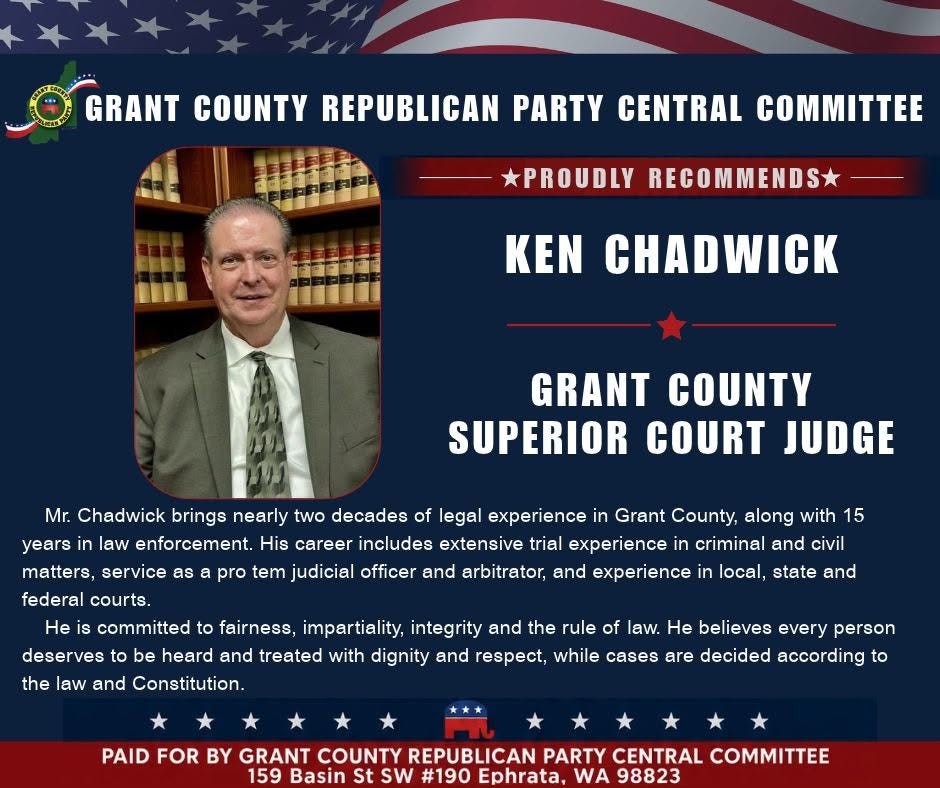
Website Bio (condensed)
Kenneth “Ken” Chadwick has lived and practiced law in Grant County since 2007. Before becoming an attorney, Chadwick spent 15 years in law enforcement as a police officer and sergeant. He has nearly 24 years of experience as a litigating attorney and has owned or partnered in a Grant County law firm since 2009.
Chadwick’s legal experience includes criminal defense, complex civil litigation, family law and juvenile cases in Grant County District and Superior Courts. He has also practiced before the Washington Court of Appeals and federal courts in Washington. The Grant County Superior Court has appointed him to serve as a pro tem commissioner, arbitrator and guardian ad litem in settlement matters involving minors.
Chadwick has been married for 43 years and has two adult sons and three grandsons. He also provides pro bono legal assistance to veterans through the Washington State Attorney General’s Veterans Program and has provided legal assistance to animal rescue organizations. He is seeking election to Grant County Superior Court Position 3.
Website: https://kenchadwickforjudge.com
Facebook: Facebook
Questions for Candidate

Back to Candidate Hub
Disclaimer:
This interview is presented as part of our commitment to providing accessible, local information to the community. All candidates in the 2026 Grant County Auditor’s race were given the same questions, in the same format, and the opportunity to share their perspectives directly.
The responses published here are the candidate’s own words, presented without editing, interpretation, or commentary beyond basic transcription. Audio recordings are provided alongside transcripts to ensure full transparency.
Welcome to Quincy WA News does not endorse, support, or oppose any candidate. Our role is to provide information so residents of Grant County—including the 98848 communities—can make informed decisions based on their own judgment.