
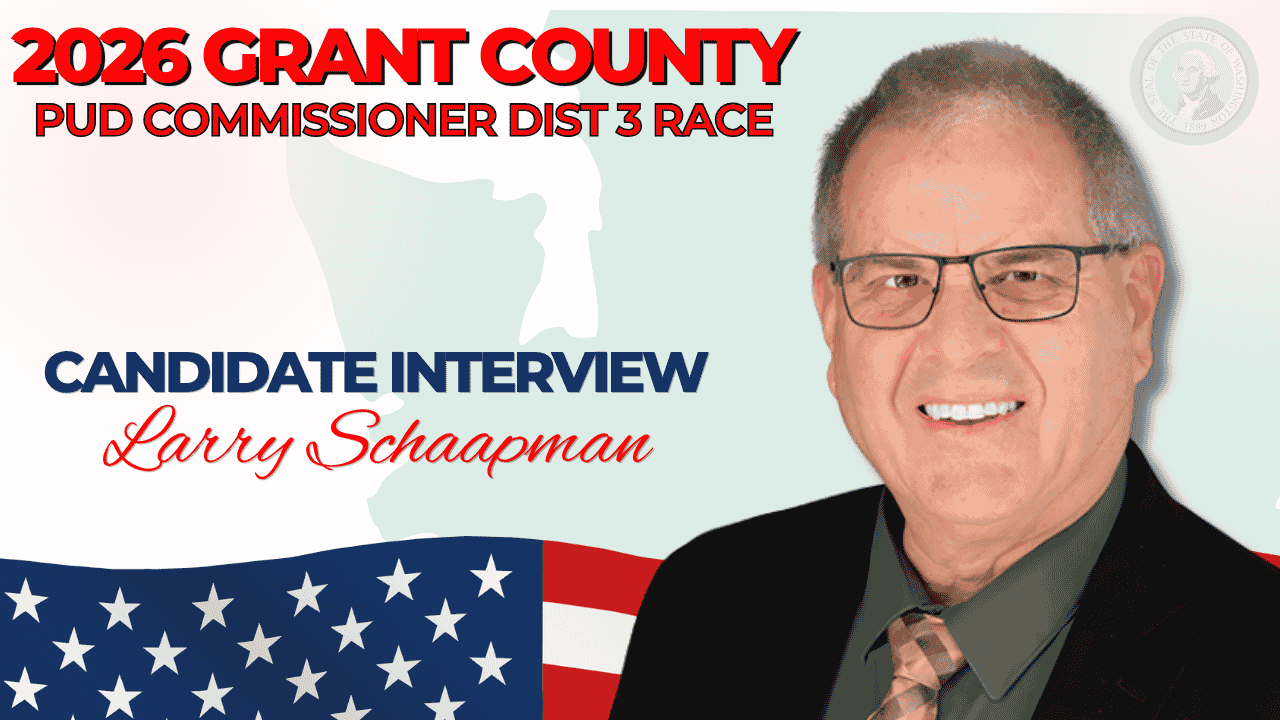
I interviewed 2 candidates for the Grant County PUD Commissioner Dist #3 race for 2026.
Both Candidates were invited to be interviewed
Both Candidates responded were asked the exact same 18 questions in the exact same order
They never saw each others answers
The answers have not been altered, edited, modified, editorialized, changed, or edited in any way by the staff, ownership, or affiliates of this publication.
For each I have posted the transcript, not a story, their words. (transcripts by AI)
For each I have posted the audio from the interview.
A full list of the questions
Below the interviews I will post their posted bio from their candidate website, their sign and a link to their website and or FaceBook
The Interview Begins Here
Larry Schaapman Interview Audio File
Larry Schaapman Interview Grant County PUD Commissioner Dist #3 Race for 2026
Brent Dowlen: [00:00:00] All right, Larry, tell us a little bit about yourself. What should voters know about you, your background, and what led you to seek, uh, to a seat on Grant PUD Commission again?
Larry Schaapman: Yeah. Well, thanks, Brent. Um, so I’ve lived in Quincy for 53 years. I’ve been married for 44 years, uh, married a neighbor girl down the road.
We have three children, uh, nine great- nine grandchildren and, uh, five great-grandchildren. So we’ve made Quincy our home for a long, long time. Julie, my wife, was born and raised here. Um, so got, you know, roots, longstanding roots. Been Been involved in a lot of things through the course of my career on different boards and such.
Um, started out my career, I guess, with, uh, Grant County Farm Bureau here at, uh, in 1993, and I was chairman for the-- on the board for three years. And then I s- continued to serve on the board, but I went on to the state board after that. [00:01:00] And I also served on the Potato Growers of Washington board for over 20 years, um, which our son has followed in my footsteps and has taken my place on that board as I bowed out of that because I had become Grant County Commissioner at that time back in 2012, and I just couldn’t do everything.
And then I also was on the CHS Sun Basin board here for, in-- Well, it’s kind of in the g- it spans all the way down to the Tri-Cities. But, um, I was on that board for about nine years, and I was chairman for seven of those years. So I’ve had, I’ve had a lot of board experience, had a lot of leadership experience.
Um, got intrigued and fascinated with, uh, the PUD through a conversation with a commissioner that was on there. Uh, there was a vacancy, unfortunately, that had happened, um, with, um, one of the commissioner in our district that took ill, and so he had to resign. And so state law says that you have to, uh, when that goes into resignation mode, you got [00:02:00] 90 days to fill that spot.
So there were seven of us that interviewed for that spot. And, uh, a sitting commissioner at that time, Dale Walker, had gotten me interested in, in the PUD and in public power, and, uh, it was pretty fascinating. So I went ahead and filed and just thought, “Well, I’ll just see where God takes me on this journey,” and, uh, ended up prevailing, uh, against, uh, the other seven candidates.
And, um, so it’s, it’s been a good spot for me to serve for local control for our customer owners that we have. It’s also been a good, uh, spot to represent public power. So, um, I guess that’s kind of it in a nutshell as far as my leadership goes and my, my tenure here in the community and also on the PUD board.
Brent Dowlen: Yeah. Every commissioner brings a different background to the board. What experiences in your career or personal life have prepared you to oversee a complex public utility with large budgets, critical [00:03:00] infrastructure, and long-term planning responsibilities?
Larry Schaapman: Yeah. So I think, you know, being I’ve been farming for about 44 years, uh, it’s, um There’s, uh-- I mean, my humble beginnings were back to, you know, a few acres of hay, and then, uh, started my career in potatoes, and it’s-- there’s a lot of budgeting that goes into that, a lot of, uh, money that goes into, uh, farming potatoes and just farming in general.
So it, it taught me obviously the value of, uh, of, um, the dollar. It taught me the value of a work ethic. Um, it also taught me that, um, you have to put a budget together, and you have to follow that budget, and you have to-- the, the budget’s a roadmap for, for what you do in your business. So I felt like of the-- at that time, it would’ve been 32 years, and when I became a commissioner then I had a lot of expertise just from running my own business to be able to carry that into the utility and in the grand PUD world.
[00:04:00] And then, uh, you know, operating, um, as a board member on the Potato Growers of Washington, I gained a lot of insight, a lot of, uh, of, um, I guess being able to, uh, negotiate with large businesses, the large three processors that we have here in our neck of the woods, which is gonna be Lamb Weston, Simplot, and McCain Foods.
And I served on all those negotiating committees for almost that whole 20-year career that I was on Potato Growers of Washington. So, um, you know, you’re working with multi-million dollar companies on that level, and you’re negotiating your contract, the fate of your livelihood with them. And, uh, so there’s, there’s a lot of things that I gleaned business-wise from those experiences.
Brent Dowlen: How do you define the role of PUD commissioner? Where should governance end and management begin?
Larry Schaapman: Yeah, that’s a good question. [00:05:00] So the role of a PUD commissioner really is to give oversight and, uh, direction to our general manager. That’s, that’s the only individual that we really have, if you will, uh, control of, control over at the PUD.
They re- uh, they report to the commission, and then they go ahead and they, uh, oversee the management of the business after that. Um, but you need to be astute enough to be aware of what’s going on at the utility and understand the business units that are there, uh, to be able to give the influence that you need to to your general manager, uh, to make the utility function in the fashion that it was designed to function, and that’s deliver power and, uh, stay on budget and watch your capital projects that you have going on, um Just to keep things on track so that the, you, you meet your targets [00:06:00] that you, that you have designed, uh, to meet from your, your goal setting that you have through your budget on an annual basis.
Um, I think the governance, I kind of spoke to that. That’s, that’s all part of the governance piece of overseeing the, the manager, um, and watching the functionality of the utility, make sure it doesn’t, you know, get out of, out of control. But with all that being said, you really, at, at the forefront of my mind anyway, being a good commissioner is making sure that you have your customer owners’, you know, their, their true interest in mind.
Um, you wanna protect them in the rates that they have. We’ve had a lot of industrial, large industrial growth that, um, has, you know, caused some concern for folks, and it’s caused some questions about, you know, running out of power and, um, how everybody’s gonna have power and, and what’s gonna happen if we run out.
And that’s, [00:07:00] that’s really not the case here. We have, as a commission, and this dates back to 2015, we passed a resolution that protected our core customer owners. And so what that means is that you will always get your power, both, uh, residential and irrigators. Uh, you’re guaranteed that power. If there’s any power outages that might have, the curtailment will come on the large industrial side, but they have backup generation that they can use too if there’s, you know, a, a hiccup on the market, if you, if you will.
Um, and I’m gonna quote the Martin Luther King event that happened about two years ago. It, um, we were pretty close to the grid having some blackouts, and there was enough transmission and there was enough power swaps that could happen to keep the lights on for everybody here in Pacific Northwest. And we were, we were just extremely close to somebody in our [00:08:00] grid area, which is the nine western states, that there could have been some outages, and particularly in Washington.
So It, um, it, it just showed the resiliency of the importance of the grid, the importance of transmission, getting power to where it needs to go, and, and the functionality really of the grid itself and all that’s involved in that, whether it’s, um, public power swaps that you’re doing with people or just swaps on the market.
There’s, there’s-- I don’t wanna get into the minutiae here, but there’s some things that, um, we’re, we’re involved with where other utilities, they, they have certain responsibilities of making sure that they’re supplying a certain amount of power to the grid, and if they fail, somebody else has to make it up.
And of course, if they fail, then there’s penalties that come along with that failure, fines and stuff that come along with that as well. So, um, kind of a long answer, but, um, it’s kind of all tied in, uh, in governance [00:09:00] and, you know, we, we can’t think just Grant County. You gotta think a little bit more, I don’t wanna use the word globally, but, um, at least the Western energy grid has to be taken into consideration ‘cause you’re sort of a partnership in all this as well
Brent Dowlen: What qualities do you believe are most important in evaluating or working with a general manager or CEO?
Larry Schaapman: Yeah. Well, it’s all about relationship, right? You have to, you have to have a good working relationship, you have to trust, um, and that comes through building that relationship. It’s just kinda like having, if you will, a good friend, so to speak, or I suppose you could use a business partner as an analogy.
But if you don’t trust your partner, um, it, it-- the relationship is, is, uh, destined to fail. Um, so you have to trust who you have in that leadership position that’s doing that, that they’re transparent with you, [00:10:00] um, that there’s nothing that maybe they might be, uh, keeping from you. And, and, and you can f- you can kind of...
If you’re involved in the utility and you’re involved with some of the players in the, in the business units that are in that utility, you, you know if your general manager has a good pulse on what’s going on with the business ‘cause people have a propensity to complain, right? And so, uh, we’re, we’re not exempt from getting complaints from employees either, just like we would customers, so...
And you work through those things, and there’s processes to do that because we can’t-- that’s not our job to field complaints of PUD employees. I mean, there’s a, there’s a order, uh, to that, uh, to the way that business is done, and there’s a process that’s used through supervisors and managers and, and then on up to vice presidents and then ultimately to the general manager.
But if you’re aware of what’s happening to [00:11:00] utility, if you’re spending some time with the folks that are there, you can, y- you can have a pretty good pulse on what’s, on what’s going on if your general manager’s being upfront and leading, leading by example and, uh, leading with transparency
Brent Dowlen: What technical experts, engineers, financial staff, and community, community members...
Sorry, let me rephrase that. When technical experts, engineers, financial staff, and community members all have different opinions, how do you make a decision?
Larry Schaapman: Yeah. Um, at, I guess at the end of the day, you know, you, you, you look at the technical information that’s been given to you. Uh, you have to look sometimes at the political will of the people because we’re, you know, I’m, I’m elected by, by the, uh, the, my constituents, the people of this county.
So y- you, you gotta be in touch with what their desires are. [00:12:00] Um, and you just gotta look sometimes, uh, step back and look at the, the 10,000-foot look and the, and the greater good for the utility. And, and when I talk about the utility, I don’t want folks to think that it’s all about the utility. I want folks to understand that they are the utility.
They are the customer owners. So when we’re making decisions on what might appear to be the utility, it’s things that we see, things that we know, things that we understand because of history, um, or historical events maybe that have happened that are gonna make, uh, an outcome more successful than not. So, um, there, there’s just a, there’s, uh, there’s the myriad of things that go into there, kinda like a bunch of bubbles around this circle, right?
And you just kinda, you weigh all those out and you... At the end of the day, you know, it’s, it gets to be a financial decision on what’s, what’s the best economics, best [00:13:00] economic outcome for your customer owners and for all your owners. Let me back up. I don’t wanna just discount our large industrials. They have a, they have a huge impact to our budget.
They’re, um, they’re a, they’re a great asset for us to have in here in Grant County because of the value that they bring, the return on investment that we get from them, which, which helps offset our rates and keep them low and predictable
Brent Dowlen: What do you believe is the single biggest challenge facing the Grant PUD over the next 10 years?
Larry Schaapman: Yeah, well, that’s gonna be resources, resources, resources, okay? And then right on its heels is gonna be the transmission to get those resources to where they need to be delivered. So let me break that down a little bit. So we are, we are at a crossroad now where we are pursuing feverishly, and we have been for about four or five years already, uh, new resources.
So we’re taking a look at small modular reactors. [00:14:00] We are, uh, exploring geothermal. Um, we’ve, we’ve talked about some gas turbine generation for peaking, which in this state is kinda taboo because we have our Clean Energy Transformation Act that we have to comply with, which by 2045, everything’s gonna, everything’s gonna have to be totally green.
And then the other thing we’re looking at is, um, some fusion as well, which is in all practical senses is, is kind of a version of, uh, fu- is, uh, nuclear. So, uh, those things, you know, they’re, they’re typically 10 years out. Um, so we’ve been working on some of these for a while. I think, you know, geothermal, we have a interlocal agreement with both Chelan, Douglas, and ourselves, where we’re doing some test holes around Douglas County, Chelan County, and Grant County, um, exploring, you know, how much capacity we might have if geothermal did become, um, [00:15:00] a deal, if you will, a big deal.
Um, and it’s, you know, it’s green, it’s clean. It’s, uh, very little water usage, um, to, to add back to it ‘cause it, it’s, you’re not steaming anything off. It’s a closed loop. So there’s some real promise that’s there. Um, not typically intrusive to folks, um, as far as land mass, if you will. Uh, and small modular reactors don’t take that much land mass either.
You can build a 320-megawatt, um, nuclear reactor on about five to 10 acres. Um, so they’re, they’re pretty small. They’re pretty compact right now. Um, that’s still kind of in its infancy. There’s a couple of-- There’s two companies ahead of us that are in the queue for, uh, one of the outfits that we’ve been working with.
Um, and so they’re kinda helping perfect that and move it along, um, because for a long time it’s just been at the Department of Energy, kinda hung up and stranded there for a little while doing all the, all the research and, and, [00:16:00] uh, studies that needed to be done on it. But, so yeah, those, those are the big things that we have.
Those are the big things that we have, only from the standpoint if, if this county wants to continue to grow, um, it’s gonna-- we’re gonna have to find new energy sources for that growth to happen. And in the case of like geothermal, for example, you, you’re just not gonna drill a hole anywhere in the ground and find out where the hotspot’s at, where you could actually generate that kind of steam that would come out to run the, the generator.
So, you know, it might be that, you know, you’re gonna be potentially talking about more transmission and to get things to where they need to go. You talk to almost every city or port district in this county, every one of them wants to grow. I mean, every one of them wants more industry because they want the tax base, they want the jobs, they want all the things that go along with that growth, and energy is, is, is the, really the main component.
If you don’t have that, the wheels don’t turn for, for [00:17:00] businesses, right? So to speak. So, um, yeah, energy is the top, the top thing that’s on our mind today, and it has been for the past five years.
Brent Dowlen: So
Grant County has become a national hub for data centers and infrastructure because of its affordable electricity. What role should Grant PUD play in supporting economic development while ensuring local residents continue to benefit from low-cost hydropower?
Larry Schaapman: Yeah. Well, that’s a good question, only because it’s-- the debate gets kinda going back and forth on, uh, what Grant County’s role should be in economic development.
And I’m-- Let me, let me just be clear that we are not in economic development. We only deliver energy to the folks that, uh, port districts might attract, um, that cities might attract, and, uh, it’s our responsibility to see if [00:18:00] we can provide them the energy that they need. Um, for us to go out and do all these things on speculation, if you will, um, could potentially be suicide.
It could be detrimental to our core customers, our customer-owners. And, um, we have, as I said earlier in the interview, we have gone through great pains to make sure that our core customer-owners are protected, which is our residential, uh, irrigators and, uh, small commer- small commercial. I forgot to put that in the first, the first answer that I gave.
So, um, w-we kinda get, we kinda get pulled into this whole, uh, economic development picture, and it’s really not our picture to get pulled into. We, we are a supporter of that, right, by what we do and what we provide, just like cities would maybe be with their water and some of their other services that they have.
But it’s not our job to go out and, and, [00:19:00] uh, generate interest in folks, uh, on an economic development level. Our job is to deliver power
Brent Dowlen: How should Grant PUD balance the needs of residential customers with the growing demand from the data centers and other large industrial resource resources users?
Larry Schaapman: Yeah. Okay. So kind of answered that a little bit, but I’ll answer a little bit different maybe this way. Uh, for starters, um, the one-- I can’t stress enough that our core customer owners are protected.
Um, they will always have the lowest resource power that’s available. And let me clarify that. Um, we had put that into that resolution because there’s always been a lot of talk about dams and fish passage and people wanting to take them out. And we had decided at that time that it would be prudent for us to put in the lowest possible resource for the core customers because there might come the day, [00:20:00] 50 years, 100 years from now, where dams are gone.
Well, what are you gonna do, right? What’s the next lowest resource? And we know that solar’s not firm, wind’s not firm, but they’re a part of the equation, right? And they’re complementary to, uh, the resource that we have with, with the hydro facilities because you can use those resources during the day or during the wind, and you can store your water, you can store your fuel, if you will, uh, behind your ponds, behind your dams, um, to use that later to generate and to supply people when it’s dark or when the wind doesn’t blow or so, so they complement each other, right?
Uh, data centers, um, we, we know as we’re going forward, and we have taken, um- I guess, um, I’m gonna use the word position. That isn’t quite the word I’m looking for, but we, we have explored what it’s gonna cost to serve them going [00:21:00] forward with some of these ne- new resources that are coming on currently. So we have quite a bit of solar that’s coming on probably over the next four to five years.
We’re looking at 3 to 400 megawatts of solar. We’ve already got one online that’s down in Moxie, and, uh, we’re the offtaker of that. Then you go, “Well, how do we get it up here?” Well, we don’t. We do power swaps on the lines and take some here, and you add it down there. Um, we have the Quincy Solar Project that’s being developed over by Moses Lake.
Not sure how it got the Quincy name, but anyway, um, there’s supposed to be, I think that it’s around 120 megawatt project when it comes on. We will be the offtaker of that. Um, and that’ll get added into the transmission farther down the line, which will be useful for, let’s say, the Moses Lake area, for example.
So when you can put more energy on farther down the line, it’s kinda like a, it’s like a ditch, right? When water’s going down it. If, if you got another place to add more water later on, you can take more water out earlier, farther upstream. So might be [00:22:00] able to take more power out at Afrada or more power out in Quincy to supply the data centers or whoever the industry might be.
The thing is, is we’ve-- I guess what I’m getting at here is we’ve looked at those resources. As we’re layering them in, as we go forward, we know the costs that are gonna happen ‘cause we do contracts with these folks. And so we have already developed the new rate schedule that’ll take for tier one and tier two rates, tier two being the new resources that are coming on.
Tier two would be the available hydro resource that’s available that, that, uh, g- as it continues to shrink, they get less and less and less of that, so then they’re gonna be dependent more on the tier two. So their rates, their rates are starting to look like they’re gonna be double digits, somewhere anywhere from 9 to 12% on an increase on average, uh, o- over the next 10-year trajectory where our rates for our, uh, core customer owners are gonna be in that 3 to 3.5% range.[00:23:00]
And people say, “Well, why is our power going up?” Well, you know, I, I guess every- everything goes up, right? I mean, your groceries are higher, your gas is higher, your cars cost more. I mean, we’ve had-- Since COVID, we’ve had, uh, 30-plus percent increases on materials that, uh-- You’re talking transformers, you’re talking poles, you’re talking wires.
All this stuff costs more money, and we have 4,400 miles of line going out around this county that we have to maintain. The poles, you know, they get older. They have to be replaced and refurbished and, you know, rehabbed And, uh, I mean, all that costs money and that pole that maybe was, you know, back in the, in the ‘50s might have been $100 to get a pole.
I don’t know. Last quote I heard on a pole was north of $3,000 for a pole, you know? So, um, it’s, it just costs money for maintenance. I mean, maintenance on your home, you know, costs money. You just go down to the hardware store and go, “Boy, that didn’t cost that much last year,” you know? But it, it, it’s just a fact of life that...
But I think, I [00:24:00] think, uh, capturing what we’re capturing from the large industrials and not putting any burden, any, uh, rate pressure on our core customer owners, um, we’ve been very successful at, and we’ve managed to keep the rates for our core customers at a, at a livable increase. When you look at what other utilities around us are doing, and they’re, they’re running in the double-digit increases on other utilities.
And I’m talking Avista, Seattle City Light, Puget Sound Energy folks that are in our state, right? So
Brent Dowlen: Grant County continues to grow rapidly, especially in areas like Quincy. How should Grant County PUD plan for the growth while avoiding unnecessary costs for existing rate payers?
Larry Schaapman: Now, would you repeat that last part again?
Brent Dowlen: Yes. How should Grant County PUD plan for the growth while avoiding unce- unnecessary costs for the existing rate payers?
Larry Schaapman: Yeah. Well, I kind of alluded that, too, a little bit in the earlier question. So as we add on more [00:25:00] resources, obviously the cost-- You cause the cost, you bear the cost, right? And that’s the philosophy that we have at the PUD.
Um, and, and the, uh, large industrials are well aware of that, and they’re aware of it on the national level, too, because they’ve signed the, uh, letter of intent that says, you know, they’re, they’re willing to pay their freight. They’re willing to pay their way, uh, to stay wherever they’re paying and playing, playing and paying, right?
So, um, we
We, uh, we are very specific, very intentional about protecting our core customers to make sure there’s no, none of this drift from cost drift that comes from the growth that we’ve experienced. So I ca- I can’t stress that enough. I try to tell that to as many folks as you can, as I can. Um, but you just don’t always have a large audience, right?
To tell that to. And you can, you can [00:26:00] send out flyers, you can send out mailers, you can do whatever, but, uh, you can’t make people read stuff either, right? You’re probably well aware of that.
Brent Dowlen: What does keeping rates affordable mean to you, and what trade-offs are acceptable to accomplish that?
Larry Schaapman: Hmm.
Yeah. Well, I think keeping rates affordable really are based around the m- the methodology of cost of service, right? And so you, uh, you really have to know what each one of your classes is costing you, and we have quite a few between residential, small commercial, irrigators, large commercial, small industrial, um, large industrial.
You got ag processing, and now we’re developing a new rate, which is basically the data center rate. It’s gonna be rate schedule 20. Um, so with, with that being said, uh, we’re very cognitive of, of [00:27:00] what each class is costing us, what it takes to keep them As not whole because w- ‘cause residential and irrigators, we don’t even come close to collecting what the cost is to serve them.
Um, but we do, we do consider being the customer owners that they should have a social benefit for what this utility brings, being public power, right? So with, with that being said, we, we apply an, an adder, if you will, that- that has the large industrials paying more than it costs to serve them, and that’s really what is the social benefit to the customer owners in the residential and irrigators, ‘cause that’s offsetting the[00:28:00]
Kinda like a-- I’m trying to think of the right word here, Brent, but that’s, that’s offsetting what it would actually cost them to pay if they were to pay full cost
Brent Dowlen: Grant PUD manages billions of dollars in public assets. How would you approach making investments that may not pay off for 20 to 30 years while still keeping today’s rates affordable?
Larry Schaapman: Hmm. Yeah. Well, you know, so I’m gonna use this as an example. When... You’re right, we have billions of dollars. I mean, the dams themselves are billions of dollars worth of assets, let alone all the infrastructure that we have running through the county.
But when I first became a commissioner in 2012, um, the day I sat down in that seat, they were doing, uh, they were doing a rate increase, and they... And it was a room full of people. There was, you know, 50, 60 people in that room, and rates were gonna go up 8% on a three-year basis. And, um, people were not happy about that, obviously, and that was a huge increase.
And it didn’t take me very [00:29:00] long when I was on the commission and started looking at the budget and looking at our debt and realizing that, hey, we had, we had this resource that we had just gotten re-licensed in 20-2007, I believe it was, and we had debt with a peak that was peaking out in about 2014, 2015.
And it was really putting a lot of rate pressure on, on what was happening at that time, which was the cause for the 8% increase year over year. And I remember looking at our general manager and I says, “You know,” I said, uh, “we’ve got a license that goes out to 2052. We’re rehabbing these dams.” And one of them was done, and we were just getting ready to get started on Priest Rapids Dam.
And I said, “It, it makes apl- absolutely no sense that our debt is gonna peak out and then, like, almost fall off a cliff and that folks 20, 30 years down the road really aren’t gonna have this rate pressure, um, [00:30:00] because we paid all the debt for them.” And I said, “It seems to me like we should go back out to market, and we should restructure our debt for a more fair and equitable generational fairness on how rates were charged.”
So surprisingly enough, that advice was followed. Um, we did a lot of restructure of our debt, and that brought our rates back down into that 2% category. Um, and then of course, as the large industrial started growing from that time forward, um, we were returning quite a large return from them, which helped keep our, uh, core customer rates low as well.
So, um, that’s the best example that I can come up with is, you know, you- when you, when you look at assets, you gotta look at a generational fairness, right? So it’s, um, we’re, we’re not mom and dad like our kids think maybe we are, right? Our, our kids, our kids can be responsible for some of the debt ‘cause they’re gonna get to use this asset, so they should be responsible, and [00:31:00] grandkids, for what it costs for the upkeep of that.
Brent Dowlen: So Beyond keeping electrical rates low, how should Grant PUD measure success?
Larry Schaapman: Hmm
Yeah. Well, f- I guess for me success is that you have a, you have managed your rates well, you have
Gotten a return on those that have come after the fact, if you will, you know, and are using your assets that you, that you currently have, um But I think probably most of all is the, is communication. Communication, communication, communication. We just need to figure out how to get out in [00:32:00] front of the-- our, our constituents, our customer owners more, to tell them the success stories that we have to tell about where we’re at financially.
I mean, we have a debt-to-net-asset ratio is, you know, probably somewhere in the neighborhood of 40, 42% is all. Um, we’ve managed these assets well and have gotten some good returns on some of our load-growing customers that we’ve had. Um, and all that has helped pay down debt. All that has helped keep core customer rates low.
And y-you do-- You know, life’s kinda funny. You do one thing that upsets somebody or upsets one group, and then you’re, you’re under attack, and everybody forgets about all the wonderful things that you did, right? So, um, it’s from, from my perspective, we could-- if we could find more ways [00:33:00] to get ourselves re-engaged back into the communities in this county to just share with them what’s going on at the utility and what we’re doing to help take out some of the concern, some of the fear, um, you know, the fear of we’re gonna run out of power, the fear of, are my lights not gonna come on?
Um, the fear of, well, are, are they paying their fair share, you know? And a lot of people will look at the kilowatt, uh, charge that comes out on each one, and what people don’t understand, and this is one reason why communication would really assist in that, is that it costs a lot more to produce-- or not to produce.
It costs a lot more to deliver power to residential and to irrigators. I mean, when you think about the 4,400 miles of line we got running around, three-phasance infrastructure that’s all over this county that feeds irrigation equipment everywhere, right? Um, Chelan and Douglas County don’t have [00:34:00] those kind of miles of lines, right?
That they have to, that they have to deal with. They got trees they gotta deal with in Chelan. That’s a whole ‘nother issue. But the, the price, the price that the large industrials are paying is less than what the residentials are paying. And the disconnect is that they take that power on a transmission level, and we don’t have to break it down with miles and miles of lines.
They come-- When they have come in, they have, uh, it’s called a construction and aid in Kayak. It’s construction and aid of cons- of cost and construction and aid, aid Anyway, it-- they, they pay for the substations and the infrastructure that goes into all that goes to building that, right? So they’re putting the money up front to do those, and then they take it at the-- to, to build those facilities, and then they take it at a transmission voltage, [00:35:00] which is a whole lot different.
So let’s-- let me break it down for you. It’s-- You bring it in at 230 volts, um, and that’s what a, a, a large industrial will take it from, from there through the transformers into their facilities. When we-- By the time we get it out into the county, it comes to us through two different ways. One is gonna be through a 480-volt system, which is for irrigators, so that’s three-phase.
That’s three wires that go out on each pole, and each one of those are going out with about 13,000 volts on each one, and then your transformers come off of there and reduce it down to the 480. When it comes... Now, that’s irrigators. When it comes to your house, you’re gonna see sometimes only a single wire on a pole because it only takes a 13,000-volt line to bring it, string it through, hook up to your transformer, your little round, clunky thing that you got hanging out maybe in your, in your alley or out by your front yard or out on the street or wherever it might [00:36:00] be out on the road.
Um, and then that breaks it down to you into 220 volt. So you’ve got two legs that come to your house, two 110s, two 120s to make 240 volt. And so it costs more money. There’s more wires, there’s more poles, there’s more transformers to get that all reduced down so that you can take it. So it does cost more to serve residential and irrigators.
And so when you look at the cost of what a kilowatt hour is between residential and, uh, large industrial, everybody goes, “Well, they’re not paying their fair share.” Well, they’re, they’re paying more than their fair share, but that’s just the way that it’s delivered to them. It doesn’t take as much to provide them power
Are you learning anything, Brent?
Brent Dowlen: Commissioners hear from homeowners, farmers, businesses, industrial customers, and environmental groups who have competing priorities. Those interests conflict. What principles guide [00:37:00] your decision-making?
Larry Schaapman: Yeah. Well, first and foremost, core customer is always gonna kinda trump everything.
Um, they’re the customer-owner. They’re the ones that we need to keep in mind. Try and find the balance in it all. Um, and but at the end of the day, y- you know, you just need to be cognitive of the fact that people, they, they wanna tell you their story. They wanna tell you the concern that they have, the problem that they might have, and you just have to be open, and you have to take the time to listen to what they have to say.
And I just operate on the principle that people don’t care how much you know until they know how much you care, right? So if, if I’m not gonna give anybody the time of day, um, it’s gonna communicate that I don’t care, and then I, I, I can’t listen to all of these people and find, you know, the balance. And I, and I’m willing, I’m quite, I’m quite willing, and I’ve been plenty vocal with, uh, with...
I, I guess kind of with both sides, [00:38:00] the, the benefit that large industrials might, might bring. But I’m also been very vocal with the fact that I am not gonna put our core customers at risk, our customer-owners. You know, they’re, they’re the public. They’re the voting public. They’re the ones that own this utility.
And yes, some of them come here after the fact, after things were built, but they’re still the public. And any, any county, any city that’s gonna grow, you just... those people just become part of the city. They come become part of the county. They become part of the utility. They’re just... When I first came on the commission, I wanna say, don’t quote me, but we were probably somewhere, and this is 2012, we were probably somewhere around 35,000 meters, and today we’re 55,000.
So, and our large industrials are probably When I say large, I’m probably data center ‘cause there’s some other industries that are out there. They probably only make up about 15 [00:39:00] to 20 of those meters. So a lot of that growth has come through. People have come in because jobs have happened. Um, there’s been other businesses, so there’s other meters, but they’re, um, they’re here and you have to listen to ‘em all
Brent Dowlen: One of the biggest issues facing Graham PUD today is the controversy surrounding acquiring private property and easements for new transmission lines. How do you balance the need to build infrastructure that services the public with protecting property rights of individual land o- landowners? Under what circumstance, if any, do you believe that use of eminent domain is appropriate?
Larry Schaapman: Yeah, that’s, um, that’s kind of a sticky wicket when it comes to talking to some folks, especially with property owners on a, on a particular route. Um, you know, growth in this county, growth in this country, um, you can, you can look anywhere and you don’t have [00:40:00] to look very far, and everything is built on either easements or right of ways.
And so you have to be appreciative, in fact, of the folks before us, generations before us, that were willing to give easements to allow progress to happen. Now, some of that was, was progress that was wanted, right? So I mean, when, when this utility first became a utility back in 1938, um, the reason why it became a public utility, uh, was because of what the Granges did over in the legislature in 1931.
And they lobbied for public utilities to be formed because quite frank- frankly, the, the, the rural residents were still burning candles and oil lamps, and all the city folks had power. And that’s all the farther that, uh, the folks wanted to serve them was just in the cities ‘cause it cost too much money to string wires out in the county.
[00:41:00] So when we became a public utility district... Well, there was Public Utility District 1, which was in the ‘30s, and then in 1938, uh, Grant County PUD District Number 2 formed and absorbed number 1. And so number 1 was up in Coulee City, and so that was taken over, and then they were-- they bought, um, Soap Lake Power or Soap Lake Electric, I think is what it was called.
And then the office, the main office moved to Soap Lake, and then in, uh, 19... In the fall, I think, or,
uh, I don’t have my notes in front of me, but in ‘30, I believe it was in ‘38 as well. They all kinda happened quickly. It was January, February, so Coulee City, Grand Coulee s- or Coulee City was bought, Coulee City Power, and then Soap Lake Po- Electric was bought. The office moved to Soap Lake, and then [00:42:00] by fall it was, um, it was moved to Ephrata because that ended up being the county seat.
So
When that happened, there was that natural progression that people wanted power, right? And power, they welcomed poles out. You know, we welcomed poles out when the irrigation project came and we needed power to go run pumps and things of that nature. And then we had growth. Um, we had some, uh, we had BPA lines that we, uh, corridors that we assumed or that we purchased back in the m- early ‘70s, ‘73, um, which gave us a lot of, uh, transmission lines that kinda went throughout the county.
So then as the county matured, right, and as the infrastructure was used up, we needed more, um, more infrastructure, more transmission lines that needed to come in. Uh, before I was a commissioner, there [00:43:00] was a, there was a transmission line that was, uh, going in, proposed to go in across the north side of Quincy from Columbia, uh, gener- or not Columbia Generate, but Columbia, um, switchyard over by Palisades that went all the way over to Rocky Ford, which is the dip that goes from Ephrata to Moses Lake.
It was about a 13 or 14-mile line. Uh, that went in, and from that they tapped off and took a line from down Road P, which came on down into Quincy, and, uh, kinda went into the eastern Quincy part where Yahoo was being built and, um, some other ones started to come out there, eventually H5 and some of the other ones.
So I gave a t- a transmission easement for that line that came down P Road, and it was right by our house. And I didn’t bat an eye. I just... You know, I knew Quincy was gonna grow, and it needed to grow, and these businesses wanted to come here, these data centers at that time. And, um, it [00:44:00] just, it was just part of progress.
Um, so those are tapped out now, right? And so you have, you have to figure out how you’re gonna get more power to where you need it. I don’t care if it’s Quincy, Moses Lake, or wherever it might be. And on every route, there’s always been challenges from folks There was. I became commissioner in 2012, as I said, and that line was just starting to be built, and we still had a couple of holdouts on the one line that went across the north side.
And, you know, went up, had conversations with them, um, and it was a matter of we were able to move a pole... And the-these were transmission poles, there was no distribution that was tied to them. So we, we had a variance that we could go a few feet one way or the other. So we made a, we made a move for the one, and, um, the other one ended up getting past whatever the impasse was with them.
So that line cleared up and was able to go in without any [00:45:00] condemnation. Uh, so to bring power, let’s say for example into Quincy on the contested line that’s happening there, um, there were a few different routes, but the fact of the matter is, is when the initial concept was floated out there about, uh, it w- it was only transmission, so we’re-- they were talking about bringing transmission in and how we were gonna get it to Quincy.
So there was, there was three different routes that was taken a look at. Uh, two routes to the west, uh, went through the Ancient Lakes area. Uh, it was, uh, we had some state lands, some federal lands that we were gonna have to deal with, which the permitting process is a little bit more challenged, but it’s still challenging, but it’s doable.
Um, but we’re also, uh, we’re gonna be faced with some culturally sensitive issues there. And when you start getting close to the river and you start, um, doing things, um, you get the tribes and other agencies involved in that because of the traversing of the [00:46:00] Indian tribes up and down the river way back in the day, right?
So, um, it’s, it’s really hard, like when we had the fracture at the dam and we drew down the river, we had to, we had to patrol that river and protect all the culturally sensitive areas that were there so that they didn’t get looted, right? And so there’s, there’s a lot of responsibility that we have when it comes to protecting, um, the culturally sensitive areas, which are usually obviously tied to the tribes.
So, um, but when... On this particular route, I mean, I’m just gonna speak to the 4B route and just be upfront and, uh, when, when we were looking at that route, it was one of the straighter shots that was gonna come into Quincy. We were gonna be able to utilize, tie into it down by George and use the line, uh, existing corridor that we had from George to Quincy almost all the way until we got close to town, then we took, we took a, a left-hand turn and went west [00:47:00] So that was a benefit.
The other benefit was the fact that, um, we had the, we had the distribution corridor out there, and we were gonna dismantle that, and we were gonna couple both the transmission and distribution together. So it made sense, um, for us to do that route. It was a straighter shot, uh, for us to go from there than to go up and over the hill and through Ancient Lakes.
And one thing that we never did do when we, uh, the two routes that went through Ancient Lakes was we got it up here as far as the hill there by, um, where the rest area’s at going toward Wenatchee, but we never finished the route into Quincy, and it still had to come into Quincy. So we were gonna have impacts coming to landowners coming in through Quincy as well.
So that never got addressed. We just talked high level what transmission would look like. So when the coupling of the distribution with the [00:48:00] transmission was put together, it became a lot more palatable for, um, us as a commission to take a serious look at that route and, um, and vote that as the best alternative that we had to do.
You are always going to have folks that are unhappy with some of your decisions that you make. It doesn’t matter what they are. In this case, it was transmission. We had one little short segment out there, about less than a half a mile, that didn’t have any poles at all. Um, and we had some conversations with those folks there, but they were pretty resistant ‘cause they didn’t have poles there at all, although there was poles on both sides of their circle that they had.
And then we went through some great pains of closing over two miles worth of canals, working with the Bureau of Reclamation and the irrigation district, and that project’s gonna be a little over a million and a half [00:49:00] to get those canals closed. But that allowed us to move poles that were Originally kind of they are, uh, pinned to be about 40 feet out from the road.
Well, that-- when we closed those canals, we were able to co-locate into that Bureau of Reclamation right away. It’s called co-locating. So, um, that brought the poles right back up to the road. The impacts to the irrigators just went away. Their circles were able to pass on through. Um, we took it out of one landowner’s field that, uh, they pastured and didn’t have to Mickey Mouse around with their fence.
And they had some issues with induction. Induction is a concern that happens with transmission that can transfer, uh, some a, a, a current, if you will, from the transmission line down to a wire that’s energized, not to a dead wire that’s grounded, but to a wire that’s energized ‘cause you [00:50:00] can’t ground an electric fence or it doesn’t do its job, right?
So, um, so we corrected that and did it through what’s called a caustic cure so that those folks will get a five, five-strand barbed wire fence around their, around their property now for their cattle to be able to graze without having induction issues. So, we had a few that have said, have said no. Um, we’ve tried to work through things, you know, as best as possible, um, and, uh, have just kind of arrived at the conclusion that there’s just sometimes you’re gonna be at an impasse.
And so unfortunately, eminent domain on the state books and the state law, um, allows you to, and, and this is a last resort, but allows you to, if you have folks that are not willing to work with you and they have, um, [00:51:00] you have no recourse except to go ahead and exercise that eminent, eminent domain, then it goes before a judge and the judge decides whether it’s for a public benefit.
And in this case, the judge determined, um, that it was for a public benefit and the ruling was in favor for Grant PUD to, uh, receive eminent domain and, and proceed forward with the project. We’re waiting for some other legal hurdles to go through on that, but, um, you, y-you know, I don’t have any examples, Brent, but I can only imagine as highways were built, as roads were built, as other, whether it was canals that were built that came through here, there was people that said, “You know, you’re not coming through my property” or, “You’re not gonna be on my property.”
And, and that’s really, I mean, this, this law is on the books from way back in the ‘50s, okay? Or maybe even earlier than that. Um, just because that’s the vehicle that you al- at the end of the day when you be- [00:52:00] when you come to an impasse that you have to exercise to be able to make something happen, right? I mean, could you imagine if you were driving down I-90 and all of a sudden, uh, George didn’t want I-90 to go through there, so they had to loop up and do an L shape or something to go around.
You know, it’s just, so, uh, um, that, that law was put in place for things to move forward
Brent Dowlen: Grant PD conducts much of the business in public meetings, yet many residents don’t follow these meetings closely. What would you do to improve transparency and help the public better understand major decisions before they’re made?
Larry Schaapman: Yeah, that’s kind of gonna round back up to, um, what I talked about earlier in our interview, and that was I think we could do a better job of probably going out and getting in front of the people of Grant County more. And what does that look like? You know, I’m not sure. There’s, there’s, um, there’s Rotary, there’s Lions, there’s Kiwanis, there’s city council meetings, [00:53:00] um, there’s port meetings.
I mean, I’ve invested myself a little bit, not much, but some in trying to stay connected with the port commissioners here in Quincy, and, uh, just making sure that, you know, we got some sort of open dialogue that goes on, things that maybe they’re planning. You know, let them know our constraints that we might have, because it’s been a big deal for them, obviously, to run out of power because it’s, it’s kinda shut them down, right?
I mean, they can’t, they can’t grow right now ‘cause we don’t have any power to supply with. So, um, we, we just need to figure out and be m- maybe-- we need to be more intentional about how we’re gonna get out before our, uh, folks in the county and, and try and inform them. There’s been-- I, I know, I get that.
There’s been some complaints about even us having our business meetings, you know, during the day. But I mean, we all come in in the morning, we’re there all day long. It’s like our job, right? We’re-- we show up, we show up at 8:00 and, you know, we’re there till 4:00 and 5:00 in the afternoon sometimes every Tuesday.[00:54:00]
And You know, folks, they’re either gonna take off or there’s virtual options obviously that have happened, and they- if it’s something that’s important to them. Our website’s always got all the information on it if people, you know, wanna get on and find out what the meeting’s about, what’s happening at the meeting.
And we-- And, you know, our, our large industrial folks are pretty astute. They know what’s going on, right? So it’s kinda like, I, I... You can lead a horse to water, but you can’t make him drink. So it’s, it’s-- There’s, there’s things out there that are opportunities for people to go, and even go later to listen to a commission meeting that’s is recorded.
The business meetings are all recorded, so you can listen to those online. And, you know, just reach out to us. I mean, don’t... Reach out to me. Uh, don’t, don’t d-don’t go grumble about it and then, uh, I don’t know about it. You know, talk to me. Come, come see me. It’s, it’s, it’s a two-way street too, [00:55:00] right?
Brent Dowlen: How will you yourself stay connected with people in your district so you’re hearing from more than just the loudest voices?
Larry Schaapman: Yeah. I think, uh, you know, as I live in the community and I get around, and of course I’m gonna say it’s predominantly Quincy, um, I’ve, I’ve found that, um, I’ve probably gotten a little lax. And, and I don’t wanna blame this necessarily on COVID, but I think we’ve all got a little laxidasical after COVID.
You know, we d- we weren’t... We didn’t get out there for a period of time and, and I don’t know if we got out of the habit of doing some of those things. But it’s been good for me to get, like, invited down to, uh, South Grant County, uh, Chamber of Commerce, uh, forum that they had. It was nice to get connected with some folks down there.
Again, folks that I knew, um, and to meet some new folks, right? So looking for opportunities to, to get out, to see people, to, uh, let them know. I just need to be more intentional about that again. So this, this, uh, election has made me [00:56:00] aware of maybe the disconnect that I or we as the PUD have had and, uh, what we need to do to kinda make that a little bit more robust.
Brent Dowlen: Is there one current grant PUD policy or initiative that you believe is working well? And is there one area where you believe the commission should consider a different approach?
Larry Schaapman: Well, that’s an interesting question. I don’t know if I’m gonna have a really good answer for you outside of the fact that we have a-- we have our legal review department now that has kind of been stood up, and they’re, they’re all about policies right now, and they’re going through all the policies that we have, and they’re looking at the policies that work and the policies that don’t work.
And the ones that don’t work, you know, why don’t they work? What do we need to change them? And the policies that are no longer needed, why do we need to still have them on the books? So it’s, it’s, um, uh, with our new general manager, John Mertlik, our-- uh, there’s been a changing in the guard, and it’s been really refreshing, and, uh, we’re seeing [00:57:00] some things that are starting to happen that we used to just kinda do, uh, status quo.
And, um, so I’m, I’m very appreciative of the, uh, initiatives that he’s taking on trying to streamline things and make better business practices, better, better business management practices.
Brent Dowlen: Finally, if voters only remember one thing from this interview, what do you they-- what do you hope that it is, and why should they trust you to continue to serve as their Grant County PUD Commissioner?
Larry Schaapman: Hmm. Yeah, well, you know, trust, that’s a big word, and you just-- you would like to think that people trust you, right? I, I would just have to say, you know, if, if, if you have the time to research and talk to some folks, I’m not gonna give you specific names right now, but, um, just, just talk around and ask about me and the work that I’ve done, my body of work that I’ve done for the last 14 years being your commissioner.
The [00:58:00] people that I’ve gone out and helped with, uh, power issues that they have with getting connections. Uh, people that, um, I’ve helped with on this line route where there was impacts that were gonna affect them. People that I went out and visited with and, um, on, on the previous line that was built, you know, trying to get things resolved for them.
And, and the fact that, you know, I, I just-- I, I have-- I believe I have an open door. I just want people to know that my door is open. Um, obviously, my life is public, um, except when I go home. You know, that’s where I shut it off, and I, I wanna have time with my family. I wanna have time with my wife. Um, there’s a time and a place to do everything.
But I mean, I’m on Facebook. I’m in-- Uh, I’m on the webpage. I mean, my phone number is public. My email is public. Um, so there’s no reason why they can’t get ahold of me as well. Um, but [00:59:00] just look at what I’ve been doing. Just, um, go back in history. Just understand that, you know, I was, I was a driver with trying to help with, uh, our core customers being protected.
Um, I’ve been a big proponent of talking about our customer owners and changing Our culture and how we think about our customers, um, that they’re ju- they’re just not meters. They’re, they’re people. They’re people that we have a responsibility to and, uh, people that we need to inform on what’s happening and, and to just settle their nerves on what’s going on.
So I would appreciate, you know, your vote, uh, going forward for, to continue on this charge and, and to, uh, help figure out ways for us to reinvent ourselves with the new resources that we’re taking a look at and how we’re gonna get those resources de- delivered in a, in a reasonable way and, and, uh, in an equitable way that doesn’t impact people.
And, and hopefully, um, when we start our next line, our [01:00:00] communications will be a little bit different than what they were before. We’ve had some what, you know, we’ve, we’ve talked about maybe some of the things we could have done differently on this one. Um, but we also did things in a normal fashion that we always have too, and that had, that has been successful.
So, um, can’t make people read their mail. Can’t make people, um, read the paper. Can’t make people go to the website. Can’t make people go to the webpage and, and, uh, look for those kind of things on their own. So, um, yeah, there... Are there things-- There’s always room for improvement. Continuous improvement is, is really what, um, I want my main focus to be, and, uh, I want us to be about at the PUD with, with, uh, continuing to improve our communication with our customer owners better.
Brent Dowlen: Thank you for taking the time
Larry Schaapman: You are quite welcome. Thanks, Brett.
Website Bio (condensed)
Commissioner Schaapman was appointed to fill a vacancy on the commission in 2012 and successfully ran for a six-year term in 2013. He has been a resident of Grant County for 40 years and has operated several businesses in the area during that time. He currently owns and manages a family farm in the Quincy area and served on numerous agricultural boards in the region, including the Washington State Farm Bureau.
Website: Facebook
Questions for Candidate

Back to Candidate Hub
Disclaimer:
This interview is presented as part of our commitment to providing accessible, local information to the community. All candidates in the 2026 Grant County Auditor’s race were given the same questions, in the same format, and the opportunity to share their perspectives directly.
The responses published here are the candidate’s own words, presented without editing, interpretation, or commentary beyond basic transcription. Audio recordings are provided alongside transcripts to ensure full transparency.
Welcome to Quincy WA News does not endorse, support, or oppose any candidate. Our role is to provide information so residents of Grant County—including the 98848 communities—can make informed decisions based on their own judgment.