The balloon archways were over the top.
In the best possible way.
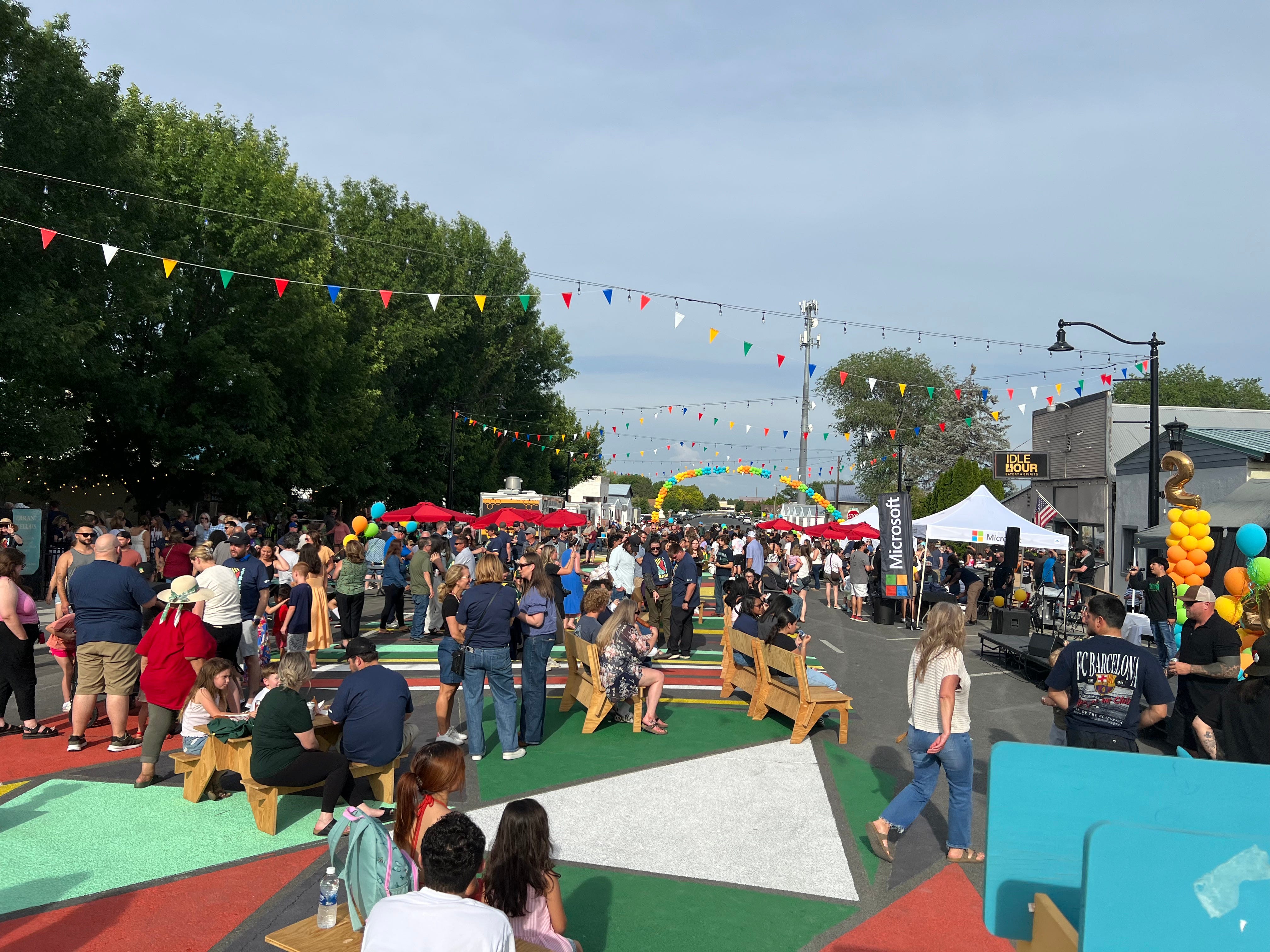
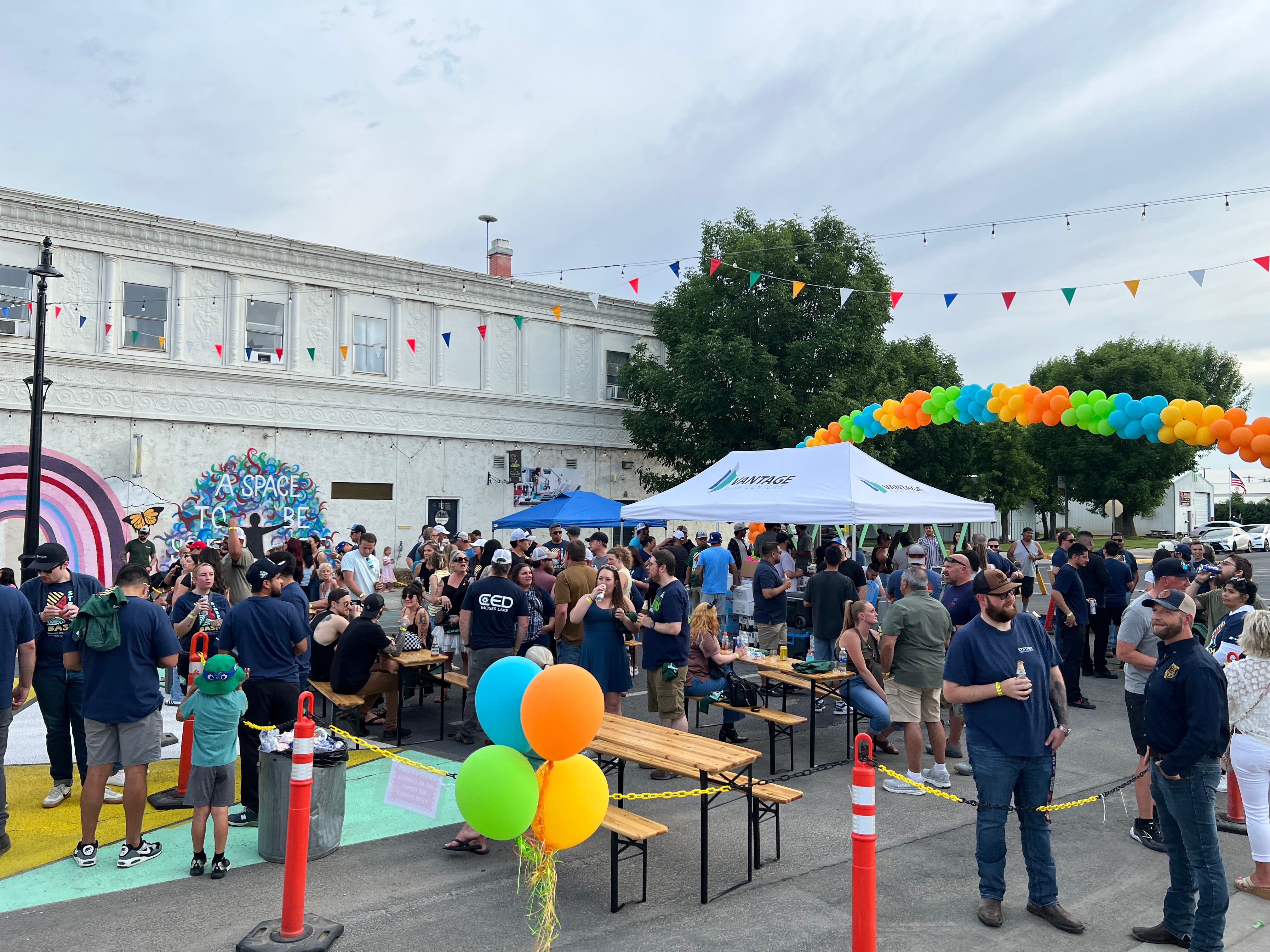
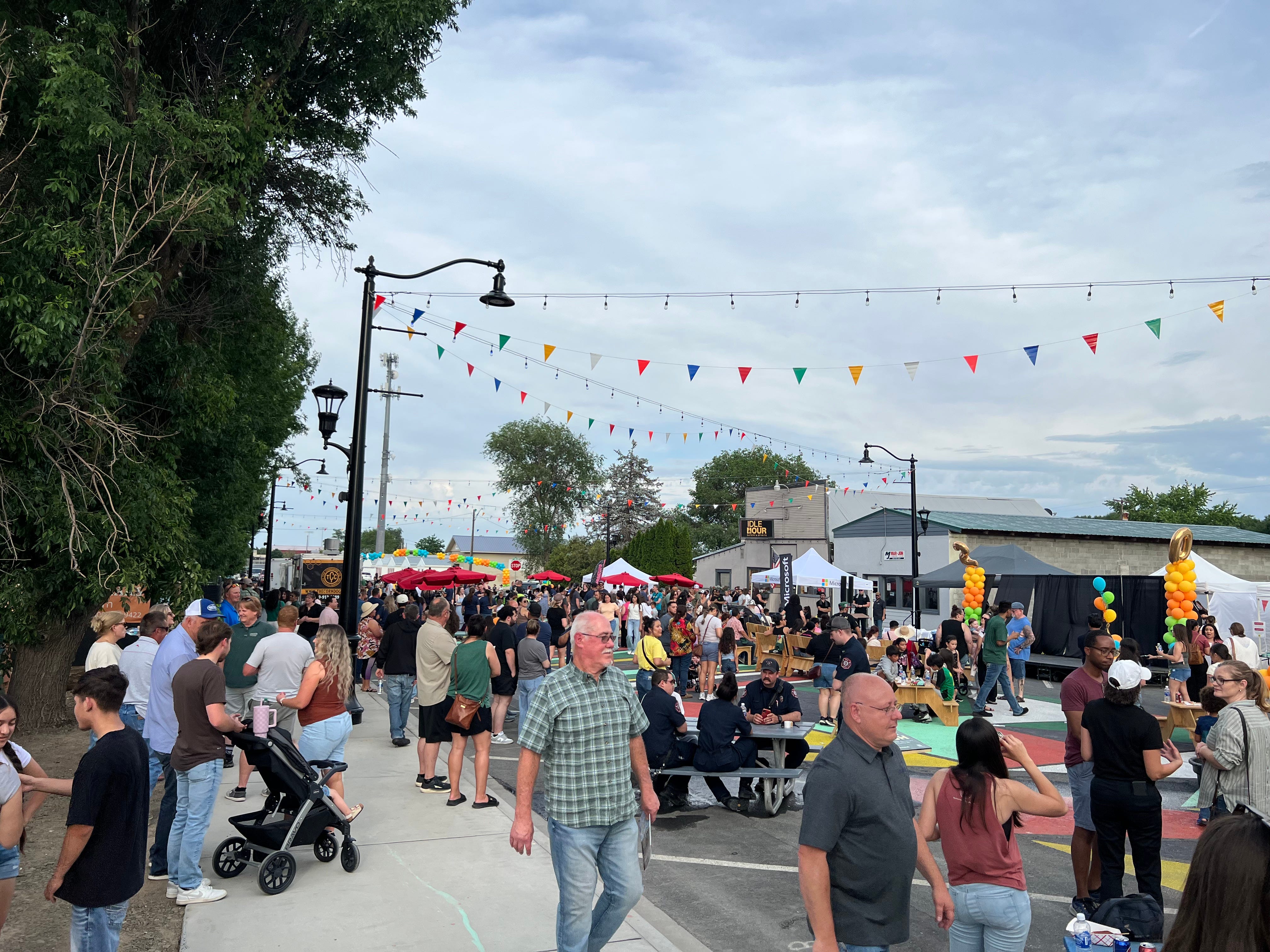
Turning onto B Street Thursday evening, it was hard not to stop for a second and just take it in. People were everywhere. You could not see clearly from one end of the event to the other because the street was so full. Families were packed into downtown Quincy, standing in food lines, visiting with neighbors, watching kids run from one activity to the next, and taking in a celebration that felt much bigger than a simple block party.
For one night, B Street felt like the front porch of the 98848.
There was music in the street, food vendors serving steady lines of people, a beer garden on one end, a stage set up in the middle of the road, giant games, cornhole, face painting, kids laughing, adults catching up, and Microsoft employees spread throughout the crowd in matching shirts so people could tell who was helping make the evening happen.
Microsoft knows how to throw a party.
But as impressive as the B Street Bash was, last night was never really just about the party.
It was about twenty years.
Twenty years of Microsoft in Quincy. Twenty years of jobs, construction, community growth, school partnerships, nonprofit support, local investment, and families building lives here. Twenty years of a relationship that has shaped this town in ways that are easy to see from the outside and in many more ways that most people never hear about.
Then Microsoft made the night even bigger.
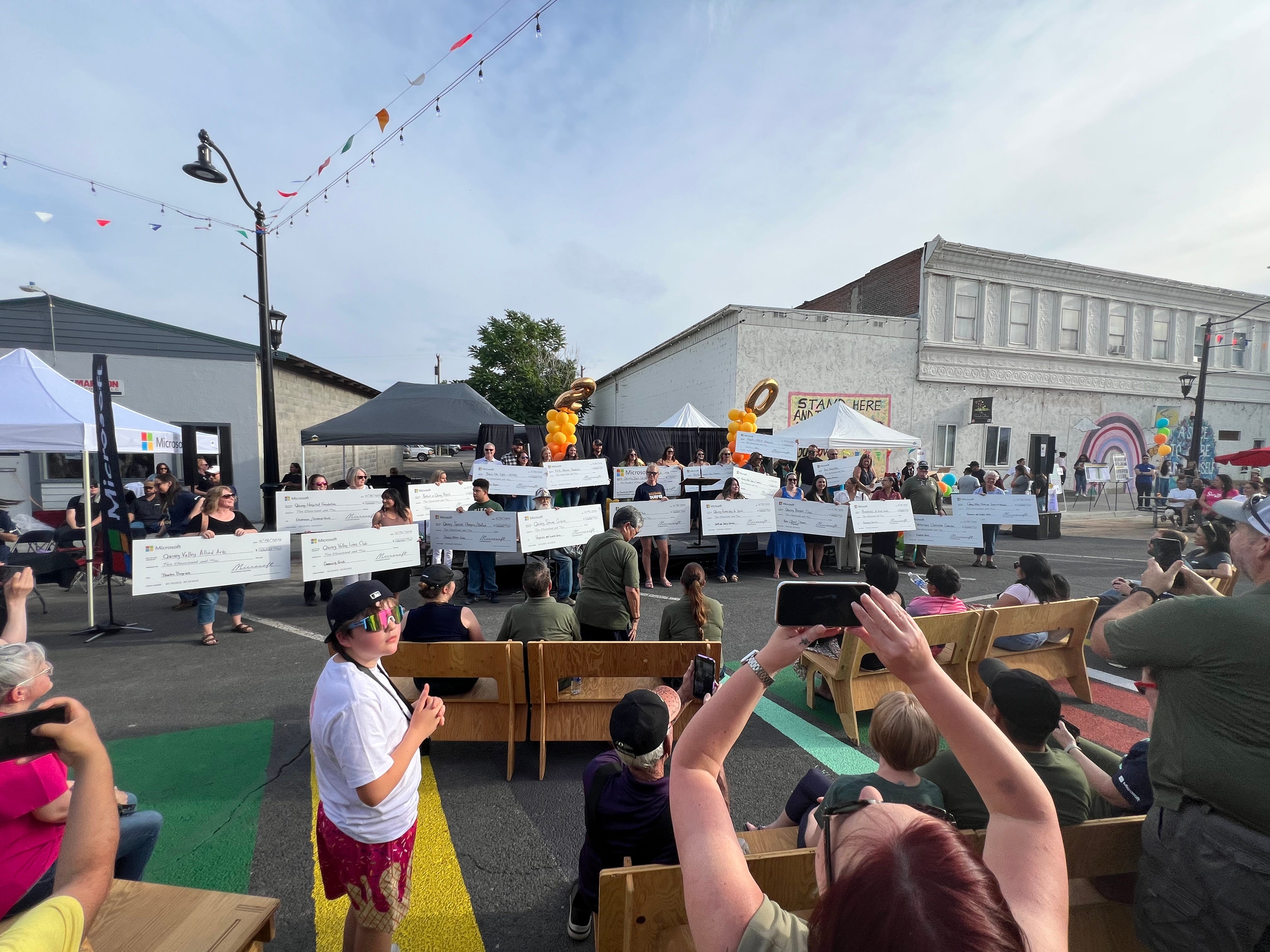
During the celebration, the company handed out $200,000 in grants to 20 local nonprofits. Each organization received $10,000, and from what I could tell, many of them had no idea it was coming. That moment alone would have been enough to make the night memorable.
But standing there on B Street, watching families gather and neighbors celebrate, I could not help thinking about how much Quincy has changed since Microsoft first arrived.
Because for many of us, Microsoft’s story in Quincy is also part of our own story.
TL;DR
Microsoft celebrated 20 years in Quincy with the B Street Bash on Thursday, May 28, from 5 to p.m. on B Street.
The event brought a massive crowd downtown with food, music, games, local organizations, and families filling the street.
Microsoft awarded $200,000 in grants to 20 local nonprofits, with each organization receiving $10,000.
Those grants are only one visible piece of a much larger pattern of support Microsoft has quietly provided in Quincy over the years.
Microsoft’s impact in Quincy reaches beyond data centers and includes jobs, schools, nonprofits, contractors, families, and local economic growth.
For many in the 98848, including my own family, Microsoft’s story here is personal.
While data centers are part of a heated national conversation, Quincy’s 20-year experience shows that technology, agriculture, families, and community can grow together when the relationship is built right.
I Remember When This Started
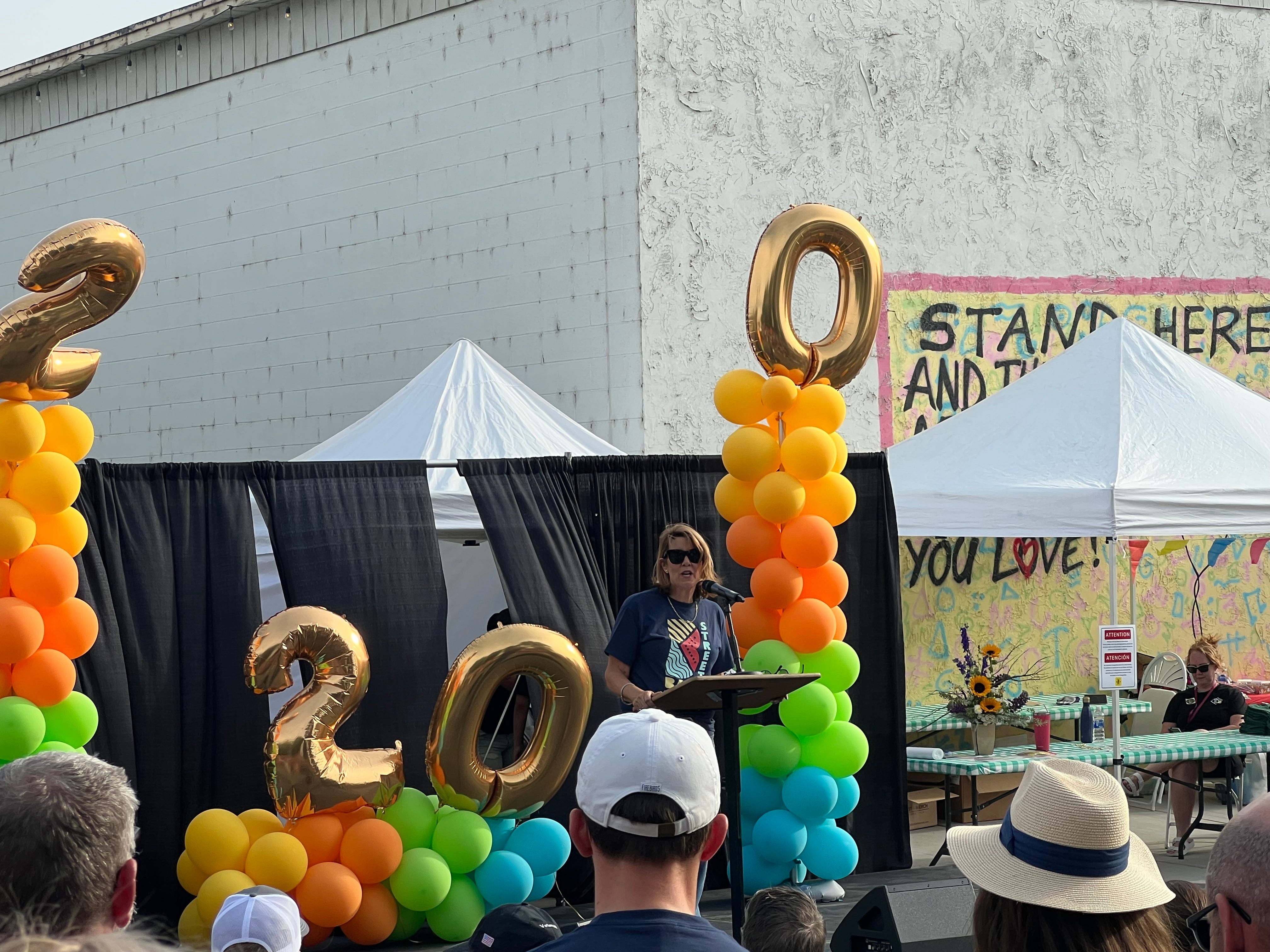
During the program Thursday night, Lisa Karstetter spoke about Microsoft’s 20 years in Quincy. If you do not know Lisa, you probably have not been paying close attention to the community. She has been part of this area for years, and her family has been woven into Quincy life in the same way so many Microsoft families have been.
As she spoke, and as another Microsoft employee talked about the early days of building the first data center, he mentioned that he did not know how many of the original people from those early construction days were still around.
I stood there and thought, “I’m still here.”
I remember it.
Microsoft only beat me to Quincy by a little bit. Microsoft is the reason my wife and I came here. I came to work construction on the original Microsoft facility. My wife joined the security team there. Both of us started during those early years when the site was still becoming what it would one day be.
Quincy was a very different place then.
It was smaller. It felt quieter. It was still very much a sleepy agricultural town. I had been in plenty of small farming communities before, and Quincy had that feeling of a place where, unless you had a reason to be there, you probably would not just end up there.
And then Microsoft started building.
When I first came here it was small but, entire neighborhoods were starting construction. In the next few years businesses started changing. Service businesses were expanding or rebuilding. New businesses started coming in. Akins was still Akins, but even places like that have grown, shifted, and changed over the years. The town was stretching, but it had not yet become what we know today.
That Data Center construction projects changed the conversation in town almost immediately. There were close to 1,000 construction workers around the area at one point, and that kind of sudden workforce does not arrive quietly. Those workers needed places to live, places to eat, fuel, groceries, supplies, and services. Money started moving through the community in a different way. Local businesses felt it. Housing felt it. The whole town felt it.
The first time I pulled onto Microsoft’s Columbia site, I was stunned.
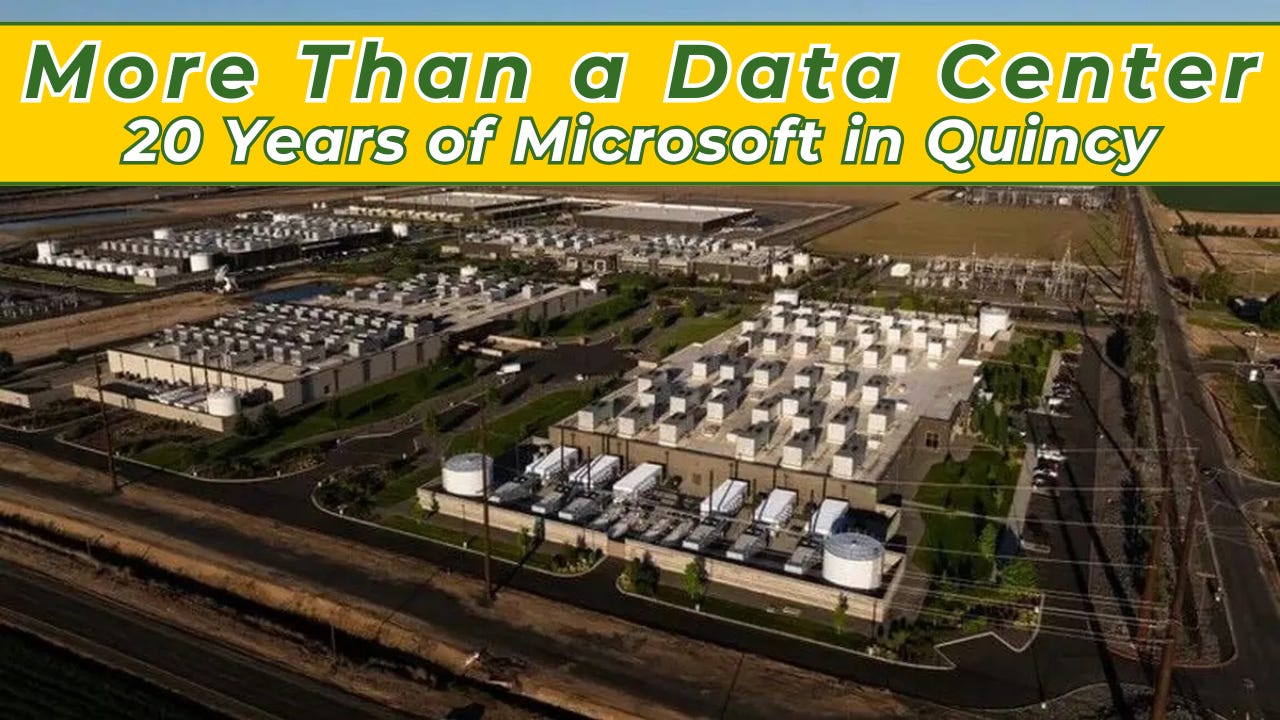
I had worked construction before, but I had never been that close to a project of that size. The facility itself was enormous. Parts of the building were still dirt floors. Crews were cutting in utilities, running underground wiring and piping, and every trade you could imagine was somewhere on that site. It was one of those places where you could stand still, look around, and realize you were only seeing a small piece of the whole project.
I remember thinking, “Why here?”
Why would Microsoft, of all companies, come to this small agricultural town in the middle of Central Washington and build something this massive?
After almost 20 years of living here, I do not think about Quincy that way anymore. This is home. But at the time, I was still new enough to wonder what Microsoft saw that the rest of us did not fully understand yet.
Looking back now, none of us really knew we were watching the beginning of a relationship that would reshape Quincy for the next two decades and beyond.
We were thinking about the work.
We were thinking about jobs.
We were thinking about what this meant for the next few years.
We were not thinking about our kids growing up here. We were not thinking about new schools, new neighborhoods, new businesses, new families, and the 98848 becoming a place where agriculture and technology would live side by side every single day.
But that is exactly what happened.

More Than a Building
For my family, Microsoft was never just a building on the edge of town.
It was part of our life.
My wife spent somewhere around seven and a half or eight years on the security team. I worked through different phases of construction at Columbia and later came back in a different role after Microsoft helped open the door to my next career.
After years in construction, I moved into IT. My first real IT job was working on the Office 365 Exchange launch over at Microsoft’s Redmond campus. I was still living in Quincy, still coming home to Quincy, and my wife was still working at the local facility. Eventually, I came back and worked with the IT team at the Columbia facility here in town.
So when I say Microsoft has been part of my family’s story, I do not mean that in some vague way.
I mean I worked there.
My wife worked there.
Our lives changed there.
Some of my favorite memories from those years had very little to do with technology and everything to do with people.
I remember Microsoft sponsoring a fundraiser for Seattle Children’s Hospital. They offered to donate money for every guy willing to shave his head. Then they added more if you had a beard and were willing to shave that too. I had a beard at the time and had not seen my bare face in a long while, but my company said they would match Microsoft’s donation.
So I figured, why not?
It was a chance to help raise money I did not have sitting in my own paycheck. Before long, a bunch of us were walking around the data center with freshly shaved heads and smooth faces right as winter was coming on. Half the time we barely recognized each other.
It was funny, but it also said something.
That kind of thing was not always public. It did not always become a press release. It was just something people did because they had the chance to do something good together.
Then there was Jack Eaton.
God rest him.
Jack was the facilities program manager and one of the early faces of Microsoft’s relationship with Quincy, the city, the county, and the larger community. He was one of those people who helped connect the company to the place it had chosen to call home.
I will never forget one day when I was working IT at the facility. Jack was in a conference room giving a presentation to visitors. I saw him step out of the room and walk straight toward me. For a second, I wondered if I had done something wrong.
Instead, he grabbed my hand, smiled huge, and congratulated me because he had just heard my wife and I were expecting our first child.
That moment has stayed with me for years.
Jack was an important man in that facility. He was busy. He had responsibilities far above mine. But in that moment, he saw us. He remembered the years my wife had put in with security and the years I had been around through construction and IT. He treated us like family.
People in the office even took up a collection to get something nice for the baby.
That is not a corporate memory.
That is a people memory.
And those are the moments when Microsoft stopped being a global company somewhere out there and became the people right in front of us.

Microsoft Became Part of Our Families
Over the years, I have watched that same story repeat itself again and again.
People came here for work and stayed because Quincy became home.
I still run into people I worked with years ago. I see their children growing up. I see those children volunteering, playing sports, performing in local programs, and becoming young adults in the same community their parents helped build.
One of the men I worked with years ago helped build youth basketball and sports opportunities in this region. His family grew up here. One of his children recently graduated. Another former colleague’s daughter recently volunteered with us through the QVAA children’s program. I looked at her and could hardly believe enough time had passed for that to be true.
But it has.
That is what twenty years does.
Last night at the B Street Bash, I ran into two young men I have known almost the entire time I have lived here. When I first met them, they were around high school age. Now they are grown men with families of their own, working for Microsoft, providing for their households, and raising the next generation here.
That is when it really hit me.
Microsoft has become a generational story in Quincy.
It is not just about the people who came here to build the first facility. It is not just about the contractors, security teams, IT staff, facilities crews, cleaning crews, administrative teams, and support workers who kept things going. It is now about their children growing up in this community, going to our schools, playing on our fields, performing on our stages, and in some cases going to work for Microsoft themselves.
That matters.
Because Microsoft is not just a corporation in Quincy.
It is people we sit next to at basketball games. People we see at school events. People we go to church with. People we run into at the store. People whose kids play with our kids. People who volunteer, coach, donate, serve, and show up.
That is the part outsiders often miss.
They see buildings.
We see neighbors.
Quincy Grew Up Alongside Microsoft
Quincy has changed dramatically over the last 20 years, and Microsoft is not the only reason for that growth, but it is impossible to tell the story of modern Quincy without including Microsoft.
When I first came here, Quincy’s population was much smaller. Then you added the construction workforce, and the real number of people living, working, eating, shopping, and spending money here changed fast. Housing developments started filling in. Businesses adjusted. Services expanded. The town began to stretch.
I still remember when the AHO development was display houses, an office, and a lot of open ground. I made one of the first offers on a house there, but they were not selling the display homes at the time, so we ended up buying elsewhere. Now look at that area. It has almost run out of room to grow.
That is one small example of a much larger story.
Hundreds of houses have been built. New businesses have arrived. Existing businesses have grown. Programs have expanded. Families moved here for work connected to data centers and then became part of the community.
Microsoft has provided direct jobs, yes.
But the impact goes far beyond the people wearing Microsoft badges.
There are contractors, electricians, low voltage workers, IT vendors, facility workers, security teams, janitorial crews, landscapers, uniform companies, floor mat companies, window washers, restaurants, gas stations, housing developers, and local service businesses that have all felt the impact of this industry being here.
Some local companies grew because they first got the opportunity to serve Microsoft or the data center world. Some of those companies now employ dozens or even more than 100 people and serve the wider region.
That is why you cannot measure Microsoft’s impact by only counting the people inside the facility.
That would miss the ripple effect.
And in a place like the 98848, ripple effects matter.
The Parts Most People Never See
Now that I spend so much of my time covering local news, one of the things I have come to appreciate most is how much Microsoft does in the background. Most people see the buildings, some people see the employees. A few people see the grant checks when they are handed out publicly like last night.
But there is a lot more that happens quietly.
Thursday night, Microsoft awarded $200,000 in grants to 20 local nonprofits. Those grants went to organizations that serve this community in real and practical ways. They supported the arts through groups like QVAA and local school music and theater programs. They supported agriculture and youth programs. They supported Quincy Partnership for Youth. They supported veterans through Veterans Operation Creation. They supported organizations like Serve Quincy Valley that help families and individuals in need.
That money did not just go into accounts.
It went into work.
It went into organizations that feed people, teach young people, support veterans, help families, build community, create opportunities, and make life better for people who live here.
And that is only what people saw Thursday night.
What many people do not see is the bigger picture.
Microsoft helped make our new high school possible. That beautiful facility did not happen in isolation. It happened because of a combination of community effort, public investment, planning, growth, and major financial support from Microsoft.
Microsoft has also supported education in quieter ways, including helping Quincy schools prepare for a world where artificial intelligence is no longer something coming someday, but something students and teachers are already facing now. They have helped provide resources and support so educators can learn, adapt, and better prepare students for the future. (You can read about that here: Quincy Schools Are Leaning Into AI and They’re Doing It the Right Way)
That kind of support does not always get shouted from the rooftops.
But it matters.
You can look around at major community events and often find Microsoft somewhere in the background helping make things possible. Fourth of July celebrations. School programs. Community organizations. Facility updates. Youth programs. Local events.
They do not usually make a spectacle of it.
They often do it without a press release.
They just keep showing up.
And that says something about the relationship Microsoft has built here.

Their Community Is Our Community
One reason Microsoft invests in Quincy is simple.
This is not just where they do business.
This is where their people live.
Their employees have children in our schools. Their families attend our churches. They go out to dinner here. They volunteer here. They sit in the same bleachers we do. They attend the same concerts, plays, games, and community events.
Our schools are their schools.
Our nonprofits are their nonprofits.
Our community is their community.
That is why the relationship feels different here than it might look from far away.
When people talk about Microsoft as a company, they usually talk about it in national or global terms. They talk about software, AI, cloud computing, Windows, Office 365, data centers, infrastructure, and corporate strategy.
Those things are all real.
But here in Quincy, Microsoft also has names. Lisa. Michael. Noe. Bryce. Mike. Jack. Shawn. Chris. Darrell. Robert. Gigi
And many, many more.
Some I have known for years. Some I meet now through local events. Some were here when I worked there. Some came later. But they are part of the same larger story. A story that is becoming a generational story for many families. Microsoft is not some faceless company sitting outside the community.
It is woven into the community through the people who live here.
The National Data Center Debate Looks Different From Quincy
There is a national conversation happening right now about data centers, artificial intelligence, power consumption, water use, land use, and the future of technology infrastructure.
You cannot miss it.
It is on cable news, social media, online feeds, and in conversations across the country. People have strong opinions, and some of those concerns are fair. Data centers are large. They use power. They use water. They take land. Like any major industry, they have an impact.
Those questions should not be ignored.
But they should also not be discussed only in the abstract by people who have never lived in a community like ours.
Quincy is an agricultural community. It always has been, and it always will be. Agriculture is still the primary backbone of our community as it has been since the Columbia Basin Project back in the 40’s. At the same time, Quincy has also become a technology community. That makes us an interesting place, because we live every day at the intersection of farms, families, food production, power, water, and data.
We know the debate firsthand.
Even here there is still debate as AI requires more power and there is no more utilities to bring more power. The Grant County PUD district is using eminent domain to condemn private land opting to satisfy the need in the cheapest and most profitable way for them, impacting the most property owners and homes of all the possible routes for new lines. Which somehow comes down on the heads of the Data Centers.
We definitely know the debate firsthand.
Not everyone is a fan of the Data Centers, but for all of us, they are a major part of our lives no matter where you stand.
We also know something else that a lot of people don’t.
Here in the 98848, data centers are not just buildings on the edge of town. They are tied to jobs, families, businesses, contractors, schools, nonprofits, and community growth.
Does that mean there are no challenges?
Of course not.
Growth always brings challenges. Power capacity matters. Water use matters. Land use matters. Planning matters. Stewardship matters. The future will require better technology, better systems, and continued accountability.
But after almost 20 years of watching this relationship up close, I can say this: Quincy is proof that data centers and communities can grow together when the relationship is built on more than extraction.
Microsoft did not just come here, build, and disappear behind a fence.
They became part of the town and became part of the story.
What This Means to You
If you live in Quincy, George, Winchester, Crescent Bar, Sunland Estates, or anywhere in the 98848, Microsoft’s 20-year anniversary is not just a corporate milestone.
It is part of our local story.
It means local nonprofits received real money that will turn into real help for local people. It means families have built careers here. It means our schools have benefited from partnerships that help prepare students for the future. It means local businesses have grown because of the work connected to data centers.
It means our community has been shaped by a relationship that started with construction and became something much deeper.
It also means we should pay attention.
Good relationships do not stay healthy by accident. They require communication, accountability, investment, and people who continue to show up for one another. Microsoft has been a major part of Quincy’s growth over the last two decades, and as Quincy continues to grow, that relationship will continue to matter.
Twenty Years Later, It Still Comes Back to People
Standing on B Street Thursday night, it would have been easy to see only the celebration.
The music. The food. The games. The crowd. The grants. The balloon archways that were still completely over the top. Like I said, Microsoft knows how to throw a party.
But I saw something more.
I saw twenty years of relationships.
I saw twenty years of jobs.
I saw twenty years of families building lives here.
I saw twenty years of community projects, school investments, quiet donations, nonprofit support, and people choosing again and again to invest in a town many outsiders had never heard of when this all started.
I saw my own family’s story woven into Quincy’s story. I saw the young men I once knew as teenagers now raising families of their own and working for the same company that helped bring so many of us here. I saw children playing in a community that looks very different from the one my wife and I arrived in almost 20 years ago.
And I saw a reminder that the 98848 is not just shaped by buildings, roads, schools, farms, or businesses. It is shaped by relationships.
That is what last night was really about.
Yes, it was a party.
Yes, Microsoft throws amazing parties.
But the real story was not the stage, the food, the games, or even the $200,000 in grants that will help a lot of people in our community through the groups entrusted with them.
The real story is that Microsoft’s Quincy story has always been a people story.
It is a story of workers who came here and stayed. Families who grew here. Schools that expanded here. Businesses that found opportunity here. Nonprofits that received support here. A town that changed here.
Microsoft is not a perfect company. No company is. There have been challenges along the way, and there will be more challenges ahead. Growth is never simple.
But after nearly 20 years of living this story, working in it, raising a family through it, and now covering it as part of local news, I have a lot of evidence that something good has happened here.
Data centers and agricultural communities can work together.
Technology and small towns can grow together.
Big companies and local families can build something meaningful together.
And here in Quincy, we have spent the last 20 years proving it.
The balloon archways will come down, B Street will go back to normal. The music has already faded, the food trucks have gone to their normal routes, and the crowd has dispersed and become another memory.
But the relationship that brought everyone there is still here.
It is in our schools.
It is in our nonprofits.
It is in our businesses.
It is in our neighborhoods.
It is in the families who came here for work and stayed because Quincy became home.
In many ways, Microsoft’s story in Quincy is still being written.
So is Quincy’s.
And if the next 20 years look anything like the last 20, that story is still worth celebrating.