

I interviewed all 4 candidates for the Grant County Commissioner District 3 race for 2026.
All 4 Candidates were asked the exact same 20 questions in the exact same order
They never saw each others answers
The answers have not been altered, edited, modified, editorialized, changed, or edited in any way by the staff, ownership, or affiliates of this publication.
For each I have posted the transcript, not a story, their words. (transcripts by AI)
For each I have posted the audio from the interview.
A full list of the questions
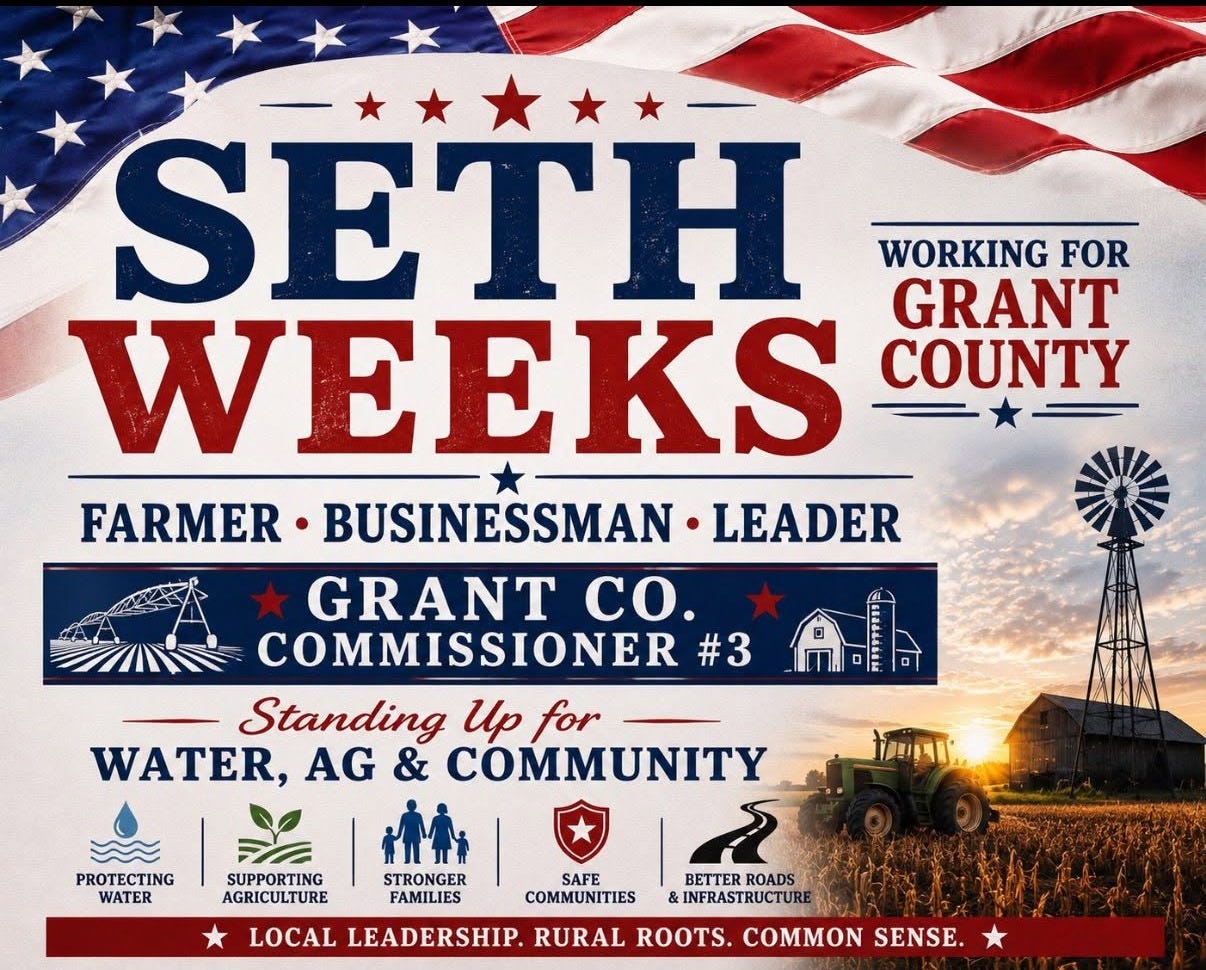
Below the interviews I will post their posted bio from their candidate website, their sign and a link to their website and or FaceBook
The Interview Begins Here
Seth Weeks Interview Audio File
Seth Weeks Interview Grant County Commissioner District 3 race for 2026
Brent Dowlen: [00:00:00] interview with Seth Weeks for Grant County Commissioner District 3. Seth, tell us a little bit about yourself, your background, and your connection to Grant County and the communities in District 3
Seth Weeks: So I was born and raised in Mattawa, graduated from Wahluke High School in 2001. Uh, my dad passed away when I was a senior, and I went, wrestled for Yakima Valley Community College for two years and, and, um, studied horticulture there.
Went back to Mattawa and have ran my family farm, um, since. Um, I’ve been a pillar of the Mattawa community, um, youth sport, running youth sports programs, fundraising. Um, community, community involvement is huge with me. Um, I got elected to the school board in 2010 and have served until, um, a few weeks ago when I resigned to, to go on this next adventure.
Um, [00:01:00] I enjoyed my time on the school board and, and, um, with the community and, and now I’m, um, involved in the Royal City community. My kids go to school in Royal. I’m the head high school girls wrestling coach, and we just won a team state championship, um, this last season, so that was awesome. And, um, yeah.
So that’s my background in Grant County.
Brent Dowlen: All right. What experiences in your personal life or career have best prepared you for public office and county leadership?
Seth Weeks: I feel like my time spent on the school board is, is a good start to, to politics, you know, um, um, overseeing budgets and operations at the school and, um, helping with the cuts that had to be made the last few years with the legislation, um, coming down the pipe.
And, and obviously there’s a lot of things that are out of our [00:02:00] control as a school district. Um, the, uh, paid leave that, that hurts us, um, when we have various teachers out on leave for having babies or whatever it may be and having to hire, hire, um, subs. You know, none of that was, I feel like, was taken into consideration.
So, um, uh, at Walluke, we’ve cut over $3 million from our budget in the last few years. Um, some of that being, um, staffing, and a lot of it was necessary, um, just because class sizes are getting smaller, and some of it, um, you know, was, um, unfortunate and, and just cuts had to be made to, to, uh, you know, make ends meet.
And so, um, I feel like more than anything, my time on the school board and, um, running my own business, um, the last 20-plus years, um, [00:03:00] a lot of, a lot of that time was things were good in farming and, and agriculture, and the last five years or so have been really tough. And so even on my own farm, I’ve had to find ways to, to make cuts and be more efficient.
And I think, um, I know that our government, government entities can be better at, um, efficiency and using our tax dollars wisely. So I feel like all of that stuff my past 20 years is gonna help me be a, a good commissioner.
Brent Dowlen: What do you believe people misunderstand most about the Grant County government and the role of county commissioner?
Seth Weeks: I’ve learned a lot in the last, you know, month or so, um, since I’ve decided to, to throw my hat in the ring. Um, I think that a lot of the misconceptions are when there’s a tax increase that that comes straight from Grant County, which, [00:04:00] um, it doesn’t. That most of that stuff I know comes from Olympia. Um, there’s only a certain amount the county can raise on our taxes, and there’s only a certain small percentage of that that goes to the county.
Um, most, most of it goes to the state. And so I think that’s probably one of the biggest misconceptions of, uh, of what a commissioner’s role is in the county.
Brent Dowlen: Okay. What values or principles guide your decision-making when you’re dealing with difficult issues or public pressure?
Seth Weeks: Um
I’m, uh
I’m a firm believer in, um, in values and morals, um, um, driving, driving decisions [00:05:00] and, and that, you know, that’s what should drive our decisions and our opinions is, is our moral compass. And I, I am, uh, I’m a man of integrity. And, um, and so I feel like those, those characteristics and those character traits, um, are very important in, in decision-making.
I am not someone who will be, um, a sellout or be bought out. I will not change my, my, um, opinions or, or my beliefs. I’m, I’m firm in my, in my beliefs and, um, that’s not to say that I will not consider other people’s opinions. Of course I, I, you know, um, I learned a lot working with various board members over the years, and everybody’s got a different background and got a different, um, [00:06:00] set of beliefs and, and I feel like everybody’s opinion matters and everybody’s opinion is valid.
But I will not change my core values, um, because somebody else has different values or beliefs than me. Um, and I feel like that’s one, one thing that makes me, um, who I am and, and I will stand firm on, on that.
Brent Dowlen: Outside of politics and work, what keeps you grounded and connected to community?
Seth Weeks: Like I said before, I, uh, I’m highly involved in, in my community, um, both Mattawa, where I live, and Royal City, where my kids go to school. Um, I, I believe it, it takes a village to raise kids and, and I love being part of, of, you know, helping to raise other, other people’s kids, um, when, when people need help.
Um, you know, and, and I love the support from the community, [00:07:00] um, when, when we need help. I have three children, um, one in high school, one going into high school, and then a third-grader. And there’s always somewhere to go and somewhere to be and, and I think community, um, a strong, tight-knit community, um, is, is the most important aspect of raising kids and just, um, daily life is, is a strong community
Brent Dowlen: Why are you running for Grant County Commissioner District 3 specifically, and why now?
Seth Weeks: Um, you know, I’m, like I said, I run my own farm, and farming’s tough these days. And, and a lot of, a lot of what makes ag- farming and the ag industry tough is, is, um, the red tape and the regulations. Um, it seems like there’s always more and more regulation coming down the pipe, and it’s really hard, um, both to, to meet those regulations [00:08:00] and, and it’s costly.
And I just feel like, um, my, my character and, um, my work ethic will make me be a valuable commissioner for the county. Um, and, and I feel like that was one of the main, uh, main things driving me to, to wanna be a commissioner, is I can help, um, I can help industry and business and ag. And, um, I know that, that water and, and land and farming is one of our most...
It is the most valuable resource in Grant County, and I wanna help to protect that
Brent Dowlen: What do you believe qualifies you to lead Grant County through the next several years of growth and change?
Seth Weeks: I [00:09:00] think this is, um, one of those redundant questions. I just, I just feel like my, my, um, natural leadership abilities. I’m a, I’m a coach at heart. I’m, I’m a-- I love to help people. Um, and I feel like those characteristics are-- make me a good candidate to, to be a commissioner
Brent Dowlen: What is the biggest issue you believe District 3 is facing right now that isn’t getting enough attention?
Seth Weeks: Um
Huh
I think it goes back to, um, policy and, and regulations, um, both with land use, um,
policy [00:10:00] and, um, all the regulation that comes with, with doing business, whether it’s farming, whether it’s building h- homes. Um, you know, I just, I just feel like the, the regulations are too stringent and, um, that, that costs us both time and money as, as far as, um, business goes
Brent Dowlen: Okay.
Quincy and the surrounding communities have seen rapid industrial and population growth over the last decade. Do you believe that county infrastructure is keeping pace, and what would you prioritize first?
Seth Weeks: Um, I know Quincy has exploded. I, I... And, you know, they’ve got the, the data centers and Microsoft and whatnot, um, and that’s great for the Quincy community. I don’t think that the rest of the county, um, [00:11:00] is benefiting from that, uh, like, like we should. Um, I know that I, I feel, my personal feelings is that South Grant County, the fur- further south you go, um, we get less, less, um, support, I guess you would say.
And I feel like, um-
The growth in Q- Quincy is awesome, but that-- the county’s infrastructure, roads and, and, um, land is, is being used to grow Quincy and the indust- the industry in Quincy, and the rest of the county, um, isn’t getting, isn’t getting any benefit from that, and I feel like, like we should
Brent Dowlen: Housing affordability and housing availability continue to be major concerns across the entire county. What role should county [00:12:00] government play in addressing housing challenges while still protecting rural communities?
Seth Weeks: I feel like, um, land use is, is very important on, uh, in that, um, subject. Um, I know that it-- where I’m at in Matawa, South Kent County, um, there’s e-everything is zoned ag and, um, from what I’ve been told from, from county assessors or county officials that anything zoned ag in South Kent County will not be rezoned, um, to i.e.
industrial or, or residential. And I feel like the need for, for single-family dwellings and affordable housing is, is, um, needed. And I feel like the county isn’t, um, isn’t taking that into consideration as, as it should. [00:13:00] Um, and so I guess land use is probably, probably the biggest issue
Brent Dowlen: District 3 includes farming communities, industrial development, and growing, growing residential areas.
How do you ba- balance economic growth while preserving the character and identity of our rural communities?
Seth Weeks: I mean, it’s all, it’s all important, right? It’s all... Our agriculture is certainly important. We need to put food on the table and, and Grant County is, um, is a huge ag and farming, um, area. And I know that the industrial growth is important as well. I think that we need to, we need to find a balance, um, a balance in all aspects, um, of growing in Grant County, [00:14:00] of growth.
And so I just feel like the, the balance and the, um, taking all aspects of industry into consideration, um, is, is a key to, to economic growth for us
Brent Dowlen: Road conditions and transportation infrastructure are constant concerns throughout Grant County. What would your priorities be for county roads maintenance and long-term infrastructure planning?
Seth Weeks: I feel like
There’s areas that need some definitely, uh, some definite, um, work. We’ve got, we’ve got gravel roads in, in, um, Mattawa, Royal City that, that should not be gravel, uh, in 2026. I feel like we haven’t prioritized [00:15:00] that enough, um, in the rural, rural areas. Um, I feel like the efficiency with our, with our maintenance, um, departments probably could be better.
And I just feel like, um, efficiency is probably the key factor there and prioritizing, um, projects and, and making sure we’re efficiently using our, our resources and our tax money to, to, um, develop, develop and maintain our roads is very important
Brent Dowlen: Water is one of the most important long-term issues in Central Washington. What concerns do you have about water infrastructure, access, and future planning for the county?
Seth Weeks: Um, drought, drought’s [00:16:00] affecting a lot of the US. I feel like we’ve got a lot of water in, in, in our area, um, but we, we need to protect it. Um- I think that we need to, um, put an emphasis on, um, water, water containment and water, um
Water resource management for sure, and whether that’s more containment or, um, just water use, we have to be diligent about, about, um, protecting our water because that is the most important re- resource in our area
Brent Dowlen: Many residents feel disconnected from county government because decisions are often made in Ephrata while the impacts are felt all over Grant County. How would you improve, improve communication and transparency [00:17:00] with the communities you represent?
Seth Weeks: I feel like transparency is key. Um Constituents of Grant County Commissioners, um, need to feel like they are being considered, and it’s sad, but a lot of people, I think, go through life and, and don’t really pay attention to what’s going on. And so I feel like therefore that causes a lot of the, the, um, the issue of people being felt like they’re n- not being considered.
Um, but I feel like Grant County needs to be, um, be as transparent as possible and, and make sure and communicate with, with the residents of Grant County on, on issues and, um, things that are the happenings of Grant County. And I [00:18:00] just feel like that the transparency, um, and communication... Th- more is better
Brent Dowlen: Public safety remains a major concern across the county. How should commissioners work with the sheriff’s office, the fire districts, the EMS providers, and local cities to improve safety and emergency response?
Seth Weeks: I think just listening to the constituents in different areas of the county. I know that where I’m at in Matilija Desert Air, we feel that we don’t get, um, we don’t get the support from the sheriff’s department as, as much as we should, being Grant County residents. I mean, it’s... Y- you, you call, you call for help, and sometimes it’s an hour and a half before a deputy can arrive, and, um, that’s, that’s unfortunate.
I know that we don’t have any or many deputies. I think we’ve got one deputy that lives in, in [00:19:00] Matilija or, or Desert Air, and so I know that’s a big concern for the Desert Air citizens. Um, and I just feel like, um, our prosecutors need to, need to, um, support the sheriff department in, in prosecuting criminals.
I, I, I feel like, um, crimes are committed a lot of times, and then whether the criminal is booked or, or not booked, um, either way, they’re back out on the street Monday morning, and they’re, and they’re doing the same-- committing the same crimes. And so I feel like, um, I’ve talked to several deputies that, that feel like, um, probably our, our issue there is more the prosecutors not prosecuting these, these criminals.
Um, and maybe it’s we don’t have room in our jail. We built the [00:20:00] new jail, great, so we might have more space to, um, to detain people for committing crimes. Um, but I feel like a commissioner should be working closely with the sheriff department, um, EMS, fire, and, and making sure that, um, everybody in the county, no matter where you live, um, feels like they are being supported by those services.
Brent Dowlen: What are your thoughts on the pace of data center and industrial growth around Quincy and the surrounding area around it? What opportunities and challenges do you see coming with that growth?
Seth Weeks: I know that the data centers are, um, are necessary this day and age. I don’t know how I’m not familiar [00:21:00] enough to, to make, um, a prudent decision at this point on whether we need more da- data centers. But I know just through research, um, and, and reading some stuff about data centers across the US, um, it seems like we don’t know enough.
We don’t know what we don’t know yet and, and, um, I’m worried about these data centers, um, with pollution and,
um, EMF, um, issues on, on long-term health, and I don’t know that we know what those, those, um, risks, risks are at this point. I think we might be getting-- putting one foot in front of the other too fast and getting too far ahead of ourselves. Um, I, I know that there’s a lot of talk on the, the data centers using, um, using too much water, and we [00:22:00] know that water is an issue all across the nation and, um, water pollution.
Um, so I guess I just need to learn more about the data centers and, and how they are, how they are, um, going to be power efficient because power is another issue. Um, we’ve got solar farms going in all over the place, and I know those are kind of a, a burden on the, on the power grid as well, but we need power to run the data centers so, um Yeah, I think I- I- I’m not saying that we don’t need data centers at this point.
Um, I don’t know how many we need and what the risks are, and so that’s, th- those are my biggest concern about the data centers. I don’t like seeing solar farms going up on fertile farm ground that could be used for farming because we need to feed the [00:23:00] world and, um, but I’m not opposed to solar farms being put on rock piles that aren’t, isn’t ground that’s farmable.
And so I think we just need to be diligent about making decisions on, on whether, whether data centers and solar farms, um, where they should be going up and, um, the access to power transfer stations. Um, we definitely shouldn’t be inhibiting on private property, um, like is happening in, in Grant County right now.
I know there’s, um, lots of people upset in my neck of the woods in Royal City where, where, um, they’re, they’re wanting to put in these big power towers and basically stealing the land from, from residents to put power towers in to ultimately supply power to, uh, [00:24:00] a data center in Quincy that does, um, no benefit to the people of Royal City and, and surrounding area
Brent Dowlen: Small towns often struggle to make their voices heard compared to larger population centers like Moses Lake. How would you ensure communities like George, Royal City, Mattawa, and the unincorporated areas around Grant County remain represented?
Seth Weeks: Well, we need, we need representation from the smaller towns, from, from South Grant County in particular when we’re talking about the race I’m running in.
Um, I, I feel like if somebody from Quincy area gets elected to commissioner number three, then I feel like my constituents will continue to feel like we aren’t represented because a lot of people feel like, um, the [00:25:00] county doesn’t care about anything that happens south of I-90. And so I just feel like having a representative that lives in the small communities in the south part of the county, um, is...
will be
more concerned about things that happen in the south part of the county, um, than if, if we have another elected official that’s living in, in Quincy or, or the, the larger cities up north of I-90.
Brent Dowlen: What role should county government play in supporting local economic development while also making sure growth benefits residents and not just outside investors or corporations?
Seth Weeks: I feel like local government, uh, uh, local government and small government is very important to me. Um, [00:26:00] I, I know that a lot of the things that happen, um, are controlled by Olympia and, and, uh, that’s just the way government works. But we need to, um, as a commissioner, I will stand up to Olympia and fight for, fight for, um, what, what we need to, what we need to efficiently run, um, run Grant County and support industry and businesses in, in Grant County, um, and, and cut regulations where we’re able to, to make it easier for, for industries to, to do business and prosper.
Brent Dowlen: County commissioners are responsible for major budget decisions. Where do you believe taxpayer dollars are being spent effectively currently, and where do you believe the county could improve?[00:27:00]
Seth Weeks: Um, I feel like maybe at this point I don’t know enough to, to give the greatest answer, but I’m the type of person, I’m a lifelong learner. I love learning new things and I love digging in, um, to issues and finding... Sorry, I don’t know what happened there. Just cut off.
Brent Dowlen: No worries Do you want me to-- Do you wanna start over on that question or?
Seth Weeks: Yeah, just repeat that question one more time.
Brent Dowlen: Sure. County commissioners are responsible for major budget decisions. Where do you believe the taxpayer dollars are being spent effectively, and where do you believe that the county could improve?
Seth Weeks: As I was saying, I feel like, um, maybe I, I don’t know enough to answer that question, um, at this point. Um, but I’m, I’m the type of person that’s gonna [00:28:00] sit down and really dig into the budget and figure out where, where we can be more efficient and where, listening to my constituents, where we need to, um, where we need to To spend more money and, and look at the, look at the, um, expenses that maybe are not as necessary, um, and make an informed decision on, on how to move forward and how to build the bus- build the budget to where it is, um, proportionate to, to meet, um, the constituents’ needs in, in every aspect of their lives.
Brent Dowlen: All right. Last question. If you’re elected, what would you want residents District 3 to say about your leadership four years from now?
Seth Weeks: Well, [00:29:00] I, I want, I want people to say that, um, that Mr. Weeks, um, supported, supported me, um, listened, and, um, and made me feel like, um, I was important no matter what community people are in.
Um, I, I care for Grant County, um, tremendously and, um, you know, especially, especially the ag industry. Um, we need some-- we need support, me being a farmer myself. Um, we need support, and we need, um, somebody to, to take, um, ag and rural, um, communities into consideration and, um, make decisions that are gonna, that are gonna make our communities, um, stronger and more prosperous.
[00:30:00] Um, and I, I would like people to... I know people will say that, that, um, I acted as a transparent and caring and hardworking commissioner at the end of the day.

Bio (condensed)
Seth Weeks is a lifelong Grant County resident, farmer, coach, and former Wahluke School Board member with deep roots in South Grant County. Born and raised in Mattawa, Seth graduated from Wahluke High School before studying horticulture at Yakima Valley Community College and returning home to run his family farm. He has spent more than 20 years in agriculture and business, while also serving his community through youth sports, school board leadership, fundraising, and coaching. Seth’s focus is on supporting agriculture, strengthening rural communities, improving infrastructure, protecting water and land resources, and making county government more transparent and responsive to residents.
Facebook: Weeks for Commissioner
All 4 Candidates will be present for the County Commissioners Dist #3 Candidate Forum Wednesday June 17th at 5:30 PM at the Port of Quincy Business & Event Center

Back to Candidate Hub
Disclaimer:
This interview is presented as part of our commitment to providing accessible, local information to the community. All candidates in the 2026 Grant County Commissioner race were given the same questions, in the same format, and the opportunity to share their perspectives directly.
The responses published here are the candidate’s own words, presented without editing, interpretation, or commentary beyond basic transcription. Audio recordings are provided alongside transcripts to ensure full transparency.
Welcome to Quincy WA News does not endorse, support, or oppose any candidate. Our role is to provide information so residents of Grant County—including the 98848 communities—can make informed decisions based on their own judgment.