

I interviewed 2 candidates for the Grant County Superior Court Judge race for 2026.
Both Candidates were invited to be interviewed
Both Candidates responded were asked the exact same 16 questions in the exact same order
They never saw each others answers
The answers have not been altered, edited, modified, editorialized, changed, or edited in any way by the staff, ownership, or affiliates of this publication.
For each I have posted the transcript, not a story, their words. (transcripts by AI)
For each I have posted the audio from the interview.
A full list of the questions
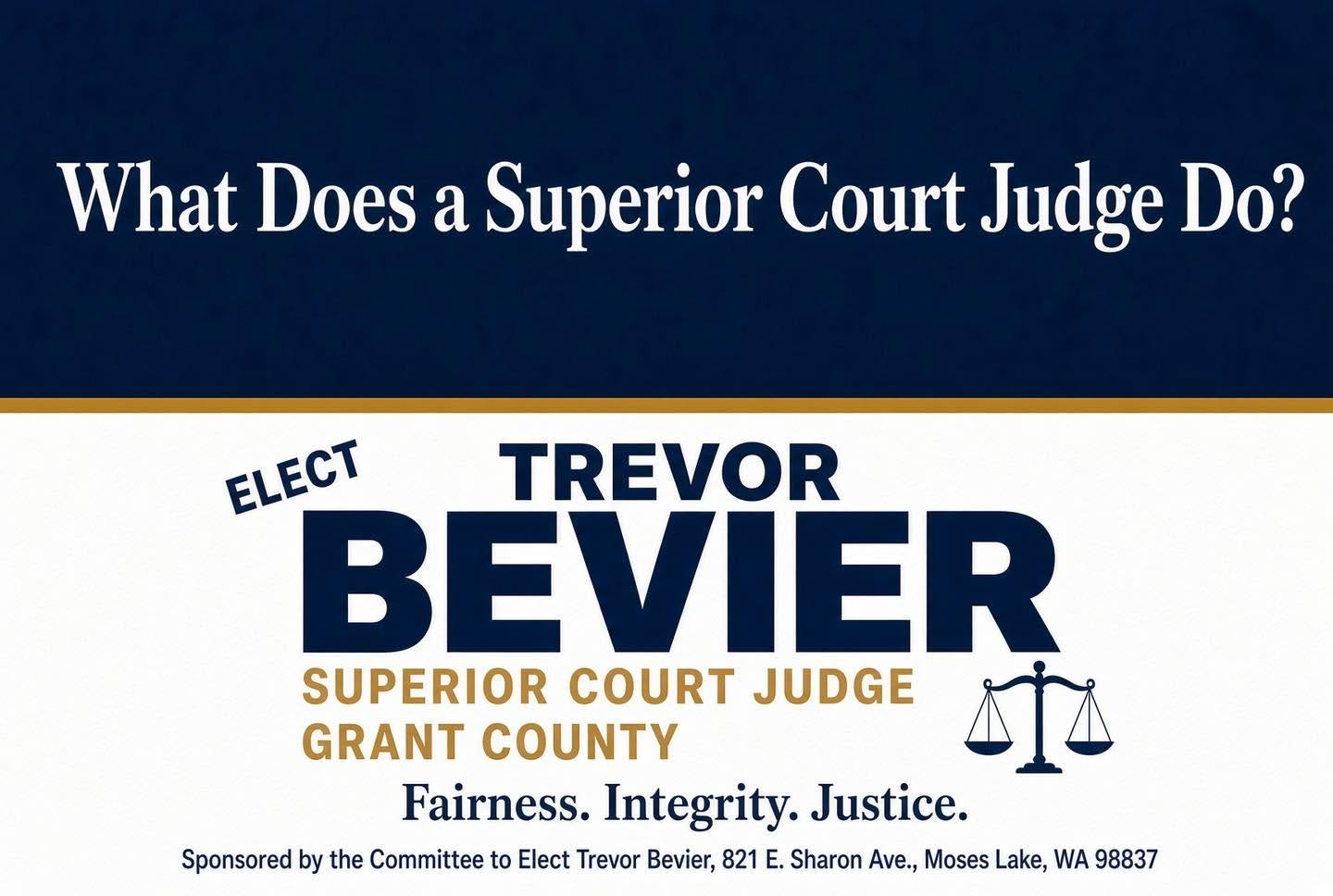
Below the interviews I will post their posted bio from their candidate website, their sign and a link to their website and or FaceBook
The Interview Begins Here
Trevor Bevier Interview Audio File
Trevor Bevier Interview Grant County Superior Court Judge Race for 2026
Brent Dowlen: [00:00:00] For voters who don’t know you, tell us about yourself, your connection to Grant County, and the experiences that led you to seek seat on the Supreme Court bench, or sorry, Superior Court bench.
Trevor Bevier: Yes. Uh, uh, my name is Trevor Bevier. Um, I grew up here at Grant County. Uh, graduated Ephrata High School. Um, I worked, uh, in the summer, uh, around farms and construction business.
Uh, after high school, I went to, uh, Big Bend Community College, got my associate’s degree. I went to work for a title insurance company in Moses Lake, where I spent 10 years, um, writing high-liability agriculture and commercial real estate title insurance policies. Um, I left, uh, the title business to obtain my bachelor’s degree, Central Washington University, and then my law degree from Gonzaga.
As soon as I got those, I returned back home to Grant County. Um, I joined a law firm in Moses Lake, where I was in private practice for 14 years. Uh, and, uh, left private practice to join the prosecuting attorney’s office as a civil deputy prosecuting attorney. Grant County’s been my home, um, my [00:01:00] entire life.
Only left long enough to go to schools that weren’t here in Grant County, and then, uh, and then came back. Um, it’s a community I love and, and, uh, it’s near and dear to my heart.
Brent Dowlen: What part of your legal career has best prepared you to handle the broad range of criminal, civil, family, juvenile, and other cases that come before the Grant County Superior Court judge?
Trevor Bevier: I think the entirety of my legal career has done that. Um, first and foremost, I’ve been exposed to a lot of different areas throughout my career. Um, even before becoming an attorney working in the title insurance industry, uh, I’ve spent a lot of time reviewing property records, uh, analyzing documents, uh, making sure transactions, um, were able to be insured, would close into the practice of law.
The broad range of, of practice ranging from civil litigation, real estate, both transactional and litigation, probates, wills, estates, uh, guardianships, [00:02:00] um, criminal matters, family law matters, uh, run the gambit that, uh, that has been there. Additionally, at the prosecuting attorney’s office right now, I advise the elected officials in Grant County.
I handle the outside litigation that, that the county’s involved in. Um, so I, I’ve done it all. I’ve sat in all the chairs. I’ve prosecuted cases. I’ve defended cases. I’ve been on the plaintiff side, been on the defendant side. Uh, so I understand everyone that’s going to come into that court, what they’re going to be presenting to the court and where they’re coming from.
That coupled with my experience here in Grant County, growing up here, I understand the people, I understand the issues that they’re facing, and, uh, I think all of that prepares me to sit on the bench to hear cases, um, ensure that parties are heard, and dec- decisions are rendered fairly.
Brent Dowlen: What do you believe is the proper role of a superior court judge?
And just as importantly, what is not the role of a judge?
Trevor Bevier: So the superior court judge sits as a trial court, uh, [00:03:00] mainly. So they’re going to hear cases that are brought, uh, cases involving real property, um, uh, money disputes. They’re going to hear, uh, criminal case, felony matters. Um, they’re going to hear domestic matters.
So they’re going to be, um, settling disputes. As a trial court, you’re going to, uh, take in evidence. Um, you will serve both as the trier of fact in a bench trial, and then you’ll serve as, uh, making evidentiary rulings in a jury trial, uh, ensuring the jury instructions, um, are proper so cases can be decided.
That process is also preparing a transcript if the parties disagree with the decision so they can go to an appeal. So it might not be the end decision that’s there, but it’s important to ensure that there’s a proper record, um, evidence was admitted properly, so it can be considered by an appellate court in the event the parties disagree with the ruling.
They can go to the court of appeals, and if they still disagree with the decision, they can appeal to the superior-- to the supreme court, excuse [00:04:00] me. Additionally, the superior court serves as, uh, an appellate court for district court decisions. So just like a superior court is a trial court, district court, um, is a court of limited jurisdiction, is a trial court for those matters that it can hear, and parties that disagree with the decision can appeal to the, um, superior court.
Um, in that role, it is to, um, listen to the facts, make, apply the rules of evidence, um, and issue a decision. The, the court is bound by, uh, decisions of higher courts. As I mentioned, the Courts of Appeals and the Supreme Court, they issue written decisions that guide the court. So the court has, uh, that law to follow along with the statutes.
And so the court’s job is to take in the facts, interpret the, uh, case law and the statutes, and issue a ruling. It’s not to substitute its own judgment. It’s not to, um, uh, make decisions, try to make policy. Um, that’s for the, the other courts to decide, the higher courts, [00:05:00] uh, whether or not precedent should be overturned
Brent Dowlen: How would you describe your judicial philosophy, particularly when the law, legal precedent, and your own personal beliefs may point in different directions?
Trevor Bevier: So I- my judicial philosophy would probably be closest to a textual, um, philosophy. Uh, words matter. The words are written for a reason. Um, and so the, the first thing is, is to find out what is written. Um-
If it, if that’s not enough, then you start looking to, um, you know, other cases trying to analyze, uh, things. But that’s what guides it ultimately at the end of the day is, is what the law, the applicable law is, what the facts are. Um, uh, Justice Antonin Scalia was, um, a, a model to me, and, uh, I appreciated his approach going to the text and, um, looking at the [00:06:00] law and ultimately applying it.
So as a trial court, the best thing you can do at that point, if there’s something that’s, you know, there’s no decision on point, would be to take what you have and look at the law and apply it, uh, to the best that you can. Um, ultimately, if it’s one of those decisions, it’s not gonna stop with the Su- the Superior Court, right?
I mean, it’s, it’s-- party’s going to appeal it. There’s cases that get filed that you just know are going all the way to the top court, uh, be it the Supreme Court of the State of Washington or, or the US Supreme Court. Um, and so the role of the judge at that point, regardless of, of whatever my personal beliefs are, is to apply the facts as given, apply the law as given, render the best decision you can, make the best transcript you can for the appeal.
So, um, ultimately a, a decision can be rendered once it works through the appellate process.
Brent Dowlen: Judges sometimes have significant discretion within the boundaries of established law. What principles should guide a judge when exercising this, that [00:07:00] discretion?
Trevor Bevier: So I think the, um, fairness, uh, is ultimately one that should guide, right? I mean, what should happen in a given situation? What is, is fair, um, to the parties?
You know, we can look at, uh, um, decision... Sorry, the fly is, uh, there. We can look at, um, you know, uh, what’s right and what’s wrong, um, ultimately whenever it comes down to that discretion. Um, discretion, uh, that comes to mind is in, uh, domestic matters is, um, you know, we can talk about the best interest of a child is, is looking through, um, hearing the facts of the parties, hearing the circumstances and, and trying to apply what’s, you know, best for the child.
There’s a, a lot of discretion, um, that judges have in that situation. A lot of times parties disagree with that, you know, and that’s why we have the appellate process. But ultimately looking at what right, what’s best for the parties after listening intently and treating everyone with respect [00:08:00] so that you have the ability to exercise that discretion.
Brent Dowlen: Just for the transcript and the record, guys, if we break up, it’s, we’re being dive bombed by this fly that will not go away. So if something sounds funny or off for a second, it’s, we’re being dive bombed by this very focused fly who-
Trevor Bevier: It,
Brent Dowlen: it is- ... wants to mess with us.
Trevor Bevier: It is attacking, that’s for sure.
Brent Dowlen: What does judicial temperament mean to you, and how would people who have worked with you or against you describe your temperament when circumstances become contentious or s- sorry, contentious or sal- stressful?
Trevor Bevier: So ju- judicial temperament means, um, keeping a level head, listening intently, treating parties with respect, but still applying the rules, um, and applying the law fairly. Um, I believe that I’ve earned a reputation for having a level head, um, being calm in complex situations, and acting [00:09:00] intently, and, and really thinking and analyzing the facts before just acting.
Um, not coming off the handle, not, um, acting irrationally. And I think there’s also a degree of humility within that. As a judge, you exercise, um, a lot of, uh, authority over the parties. They’re coming in, they have a dispute, they’re looking for someone to, um, resolve that, and so there’s, there needs to be a, a, uh-
Sorry, getting attacked by this fly is, um, there needs to be a, a degree of humility, um, that’s in there and recognizing that the parties are, are coming to you, uh, to resolve their matter. Um, a- and so that, that’s where the temperament comes in and, and being able to recognize that in a emotionally charged situation that you can still receive the facts necessary, you can still apply the law as required, and you can still issue a decision that, [00:10:00] um, um, that is, is fair and, and, uh, equitable under the law.
Brent Dowlen: You didn’t know I brought in the fly just to, you know- ... put you on the spot, right?
Trevor Bevier: Yeah. Yeah. It’s, uh, I didn’t know we’d be battling that this morning.
Brent Dowlen: Superior Court judges make, may make decisions that profoundly affect someone’s freedom, family, property, or future. How do you approach that responsibility of making a consequential decision when reasonable people could reach a different conclusion?
Trevor Bevier: Well, and I, I think that, uh, going back to one of the answers is i- if it’s a matter that reasonable individuals could reach a different conclusion, that’s a matter that could be ripe for an appeal. If a party disagrees with the decision, um, you know, then, then that’s their, their right to do that, and that certainly happens.
I know over the course of my career I’ve, uh, haven’t agreed with decisions that judges have made and taken it to the appellate level. Um, but as far as approaching, um, those as, as a court, I think it’s, it, it’s simple, is you listen [00:11:00] intently to the individuals as they’re presenting their case. You treat everyone with dignity and respect.
Um, you apply the law fairly to the facts that you’ve received in, and then you issue a decision, um, in a timely manner. And if parties are heard and the law has been applied in a fair manner, they can disagree with it, but they have two things: one, they feel like they’ve been heard, and two, they have, uh, a transcript that if they disagree with the decision, then, um, they can appeal it, uh, and go through to a higher court.
Brent Dowlen: What is the appropriate balance between following legal precedent and independently interpreting the Washington and United States Constitutions and statutes?
Trevor Bevier: So courts are bound by the principle of stare decisis, which is previous decisions shall control. And so, um, on, uh, a lot of issues the court is going to face, you’re going to have the law as written, which the court is, is going to be bound to apply.
Um, and then you’re going to have [00:12:00] judicial decisions that are going to guide that. And so the first part, especially the, the Superior Court, is they’re gonna be bound by the courts of appeals, um, and the, uh, the court, uh, excuse me, Washington, uh, State Supreme Court, and, um, you know, the US Supreme Court decisions.
So those are going to be important. If I disagree with the decision on that, uh, but there’s controlling precedent, then I’m bound to follow that precedent regardless of, of my personal belief. And so it, it-- going back to the words matter, um, that I mentioned earlier, reading the cases and applying the law fairly, um, that’s the role of the court.
If parties disagree with that, that’s where the attorneys and the parties have the ability to appeal a decision. If they think a case is wrongly decided, then it needs to work up through the court of appeals and ultimately to the Supreme Court for consideration of change of that analysis. But that’s the role of the parties and the attorneys, not the roles of the, uh, uh, Superior Court judge.
Brent Dowlen: What role should a judge’s personal [00:13:00] values, life experiences, and understanding of community play in judicial decision-making, and where should boundaries be?
Trevor Bevier: So I think all those apply to the judge’s ability to take in facts and apply decisions, being able to understand where a party is coming from whenever they’re listening for facts and establishing what is going to be applied to the case whenever they’re a finder of fact.
In a jury situation, the jury is going to be the finder of fact at that point. So the jury is going to be making those particular decisions, but the judge has the role of ruling on evidentiary objections to make sure that the evidence that the jury is hearing is actually proper under the rules, you know, which is very important because if evidence is admitted improperly or excluded improperly, that’s grounds to overturn.
And now all of a sudden we’re redoing this again because there was an error that was made. So that’s an important step along the way. [00:14:00] I think a judge’s sense of right and wrong is important because that is helpful in determining how the law is applied.
I think at the end of the day, most laws are written with a sense of what’s right and what’s wrong. That’s how society functions. And so if you have that barometer to help gauge within that, I think it aids in making those decisions. But ultimately, at the end of the day, the role of the judge is to apply the law as it’s written and make a record.
And if there’s changes within that, then the parties have the ability to take it to appellate courts.
Brent Dowlen: Criminal cases require judges to consider public safety, defendants’ constitutional rights, victims, statutory requirements, and in some circumstances, rehabilitation. How do you approach balancing those responsibilities while remaining impartial?[00:15:00]
Trevor Bevier: That’s a great question. Um, so as far as the criminal matters, the, the judges, um, have certain boundaries they have to follow, especially one, uh, at various stages of criminal proceeding. Whenever you talk about bail, the initial appearance, they have, um, boundaries that they have to follow as far as, uh, what they can do, conditions they can impose, uh, and other things.
And those are important safety considerations because if you have someone that’s, that’s charged with a serious crime that poses a, a public safety risk, then it’s important to, to balance that. But you have to act within those boundaries because if you don’t, um, then you, uh, you run the risk of having an appeal.
You run the risk of, of, uh, delaying those proceedings further, um, in order to have justice administered. So, um, you have to, to look at the facts, um, listen, apply the law intently. Uh, as it’s coming through on sentencing, the same thing, is you have sentencing guidelines and, and statutory [00:16:00] guidelines and case law that set boundaries on what you can or can’t do.
Um, you know, so again, that, that all comes through as, as applying the law to the facts and making sure that it’s diligent and, uh, rendering those decisions based upon the facts in front of you. But, you know, ultimately following the facts is, is, and the law is, is the most important thing that you have at that point
Brent Dowlen: Family law, dependency and juvenile cases can involve highly emotional circumstances and decisions with long-term consequences for children and families. What experience and approach will you bring to those cases?
Trevor Bevier: So while I was in private practice, the firm I did had a very robust family law practice.
Um, and I, uh, assisted with the numerous trials and briefing on issues ranging from relocation matters, um, to, uh, you know, full custody matters to, um, [00:17:00] division of assets, things like that. Domestic matters are incredibly emotionally charged. And, um, you know, the laws are also written, um, with the intent to be, you know, fair and equitable between the parties.
Um, it requires calmness and it requires diligence with taking in the facts necessary, um, to establish, okay, how do we, how do we divide assets? How, who is going to be the primary, uh, custodian of the children? What’s going to be in their best interest? Um, and, and being able to treat people with respect so they, they can take that temperature down a little bit and try to take the emotion out to, to go, um, you know, here’s, here’s what is really important whenever it comes to rendering this decision for this child.
It, it, and so I think that’s important and, and having a, um, a calm temperament and, you know, really [00:18:00] letting the balancing act of, of letting the party tell their story and, and so they’re heard, but at the same time, making sure the important facts are, are actually considered in getting to, uh, the core of the issue and, and sorting through the noise, uh, to be able to get to the parties to where they can, they can move on with their lives, I, I think is the most important fact.
And, and it, it’s, it’s difficult. Those are emotionally charged, uh, situations and, and they’re, they’re tolling on an individual, but having the ability to work through complex situations with calmness and a level head, um, is how you do that.
Brent Dowlen: Many people enter the Superior Court without an attorney and may have very little understanding of court procedures.
What responsibility does the judge have to make the courtroom understandable and, and accessible while remaining neutral and not becoming an advocate for either side?
Trevor Bevier: That’s a great question. Um, and so the, the court, um, has-- a-and when I talk about the court, I’m talking about the, the Washington [00:19:00] State courts.
They have on their website resources and, and, uh, for pro se litigants. Um, it’s important that they have those resources, and they, they are able to, um, look at, uh, you know, have access to the rules if they want to proceed on their own, have access to, to resources that are available to them. Um, regardless, pro se litigants are also bound by the same rules as anyone else walking through the courtroom, and they, um, uh, so the rules of evidence still apply to them.
The rules of procedure still apply to them. Um, and so it, it’s important to have that baseline, um, that’s out there. But, uh, you know, the, the courts having that information available, whether it be, you know, posted in the, in the, uh, clerk’s office, which some of those resources are, especially the, uh, when you talk about, um, unlawful detainer cases, eviction cases, um, they have, uh, information posted for, um, the Northwest Justice Project who the [00:20:00] individuals can, um, reach out to for free legal, um, assistance and, and making sure that, uh, you know, those resources are available either through the court website or, or through the resources there at the courthouse.
Um, but it’s not the, the court’s job to get them in touch with those individuals. It’s just to have that information available. Um, because the balancing side of that is, is, is if you have one side that shows up prepared, ready to comply with the rules and argue their case, but they’re, you know, having unreasonable continuances because another party, um, has that, then it’s unfair to that party.
So it’s, it’s important to be fair to both parties, have those resources available, but cases still have to be heard.
Brent Dowlen: Justice is... Sorry, justices. That was good English. Justice requires careful consideration, but lengthy delays can also have serious consequences for defendants, victims, families, civil litigants. How would you balance thoroughness with the need to move cases through the Grant County Court system [00:21:00] efficiently?
Trevor Bevier: That’s also a great question because I’ve, I’ve been through that in, in other courts, uh, to where you’ve been bumped for, uh, whatever reason. You may have been preparing for, um, a summary judgment hearing, and you’ve requested a court date, and then all of a sudden, the week before you’re to be heard, um, it’s stricken because there’s another matter and there’s not a judge available.
And so that’s just kind of the reset side of it and whatnot. So, um, part of that is, is, is being efficient with the work, um, and having that work ethic to, to really look through the cases. So I mean, being a, a superior court judge is not an 8:00 to 5:00, 9:00 to 5:00 job. Um, you know, it, it takes more than that to prepare for a docket.
It takes more than that whenever you’re going through trial. Um, my work history in private practice, putting in those hours that it takes to, um, advocate effectively for clients and my current role as a deputy prosecuting attorney requires work outside of the 8:00 to 5:00 in order to perform the job effectively.
Ultimately, [00:22:00] the, the goal is, is to, um, be prepared for every case that you can, um, and be able to listen to cases, hear them, issue, uh, decisions, and that requires a lot of work, a lot of diligence, and a lot of effort. My work ethic was forged here in Grant County. Um, it, it’s something I take pride in and something that, uh, I would bring to the bench to be able to work through those matters.
Brent Dowlen: If elected, what changes, if any, would you want to explore in the administration and operation of the Grant County Superior Court, and why?
Trevor Bevier: One of the things that I have in mind is there is a, uh, court rule, uh, and, uh, it’s either CR78 or 79. The citation is, is gonna escape me here at the moment, but it allows for the court to establish, uh, for hearing of, uh, matters on the motion docket without oral argument if the court, you know, so deems it.
And so that’s a, that’s an opportunity for the court to review the pleadings, and your oral argument’s not [00:23:00] necessary in this matter, uh, and can issue a decision. So that can free up court docket time, uh, on Fridays. Um, I think that’ll also allow cases to move forward more efficiently because if parties, uh, recognize that they’re, you know, not going to be able to...
Uh, it, it may be an incentive for motions that maybe otherwise should not be brought to not be brought, and that would also help, uh, free up the court time. I think there’s also an opportunity to, um, look through with, uh, dockets on eviction matters. Uh, looking at, uh, the Friday civil docket, there’s a lot of evictions that are on, on the docket every single week.
Um, and so looking at, at ways to, to potentially, uh, increase efficiency to where they’re heard, uh, more quickly, um, you know, that’s gonna take a, a top-down approach, looking at the calendar, uh, and seeing what can be done, uh, with that. Um, but I think the biggest thing is, is, is my experience in, in, with my civil background, uh, will add to the experience of the other judges on the bench and will [00:24:00] complement, and will be able to work collaboratively to, um, you know, work all matters through as a whole to be able to, uh, to bring that, that, um, experience, uh, to the court
Brent Dowlen: A judge will inevitably issue rulings that some members of the community strongly disagree with. How should a judge respond to public criticism while maintaining both judicial independence and public confidence in the courts?
Trevor Bevier: So the role of the judge is to take in the facts and apply the law as it’s written.
Um, that’s the judge’s role. As far as responding to, to criticism, um, that’s something that, you know, that’s a hypothetical. I, I don’t know you know, what’s, uh, what that may look like, but I’m not so sure that it’s the role of the judge to respond in that situation because the appropriate avenue for parties that disagree with a judge’s decision is to take it to the appellate level, um, and so, you know, see if the judge in fact got it [00:25:00] wrong.
Um, we’re all, we all, we’re all human. We all make mistakes. Um, you know, even if you take in the facts and apply the law, um, a lot of appellate decisions, you know, come back as, you know, they just flat got it wrong, and that’s, that’s why it needs to come back. So, um, the, the best thing a judge can do in that situation is to have a commitment to the law, have a commitment to listening to the parties intently and, uh, you know, keep moving forward to the best that they can
Brent Dowlen: For a voter sitting at their kitchen table with a ballot that’s never met you, what do you want the voter to understand about the kind of judge you would be if entrusted with the Grant County Superior Court Position 3?
Trevor Bevier: I am an individual that everything I’ve ever done, I’ve approached, um, wanting to have a complete understanding. Um, I want to listen to all the information that I possibly can before taking action. Uh, [00:26:00] I’m also a person that, um, strives to treat everyone with respect. So if they’re coming into the courtroom, they’re gonna be heard with respect.
They’re gonna, you know, have their case heard, um, and they’re going to be able to apply it. Also, a judge that has a work ethic that, um, is unparalleled. Uh, it’s first one there, last one out. That’s just how I was raised, how I approach life. Um, and also I’m from Grant County. I’m-- I know the community. I know the people.
I know what, what drives, um, people. I know what, what’s important to people, and I think that’s helpful whenever you’re listening to peoples, having an understanding as to where they’re coming from. Um, that assists with taking in the facts and being able to apply them to the law as written. Um, above all, um, I have a commitment to the law and the Constitution.
Um, it’s the bedrock of our society. It’s important that you, [00:27:00] um, follow the law, follow the Constitution. Um, and my commitment to that is, is unparalleled. Um, I’ve been through advising the elected officials of Grant County that, um, that demonstrates, uh, the ability to work through complex situations with a level head.
Um, it, it’s my commitment to the community. I’m here, I’m raising my kid. Um, I grew up here in Grant County. I want my kid to have the same experience that I had here in Grant County, and that’s why I’m doing this. I’m doing this to, for the community. I’m doing this, um, to do everything that I can, uh, to make this community the best that it can be
Brent Dowlen: Thank you for taking the time
Trevor Bevier: Thank you
Website Bio (condensed)
Trevor Bevier is a lifelong Grant County resident and graduate of Ephrata High School. He attended Big Bend Community College before earning his bachelor’s degree from Central Washington University and his law degree from Gonzaga University.
Before becoming an attorney, Bevier spent 10 years in the title insurance industry in Moses Lake, working with agricultural and commercial real estate transactions. After law school, he returned to Grant County and spent 14 years in private practice, handling a broad range of legal matters including civil litigation, real estate, probate, estate, guardianship, criminal and family law cases.
Bevier currently serves as a civil deputy prosecuting attorney for Grant County, where he advises elected county officials and handles outside litigation involving the county. He is seeking election to Grant County Superior Court Position 3.
Website: https://electtrevorbevier.com
Facebook: Facebook
Questions for Candidate

Back to Candidate Hub
Disclaimer:
This interview is presented as part of our commitment to providing accessible, local information to the community. All candidates in the 2026 Grant County Auditor’s race were given the same questions, in the same format, and the opportunity to share their perspectives directly.
The responses published here are the candidate’s own words, presented without editing, interpretation, or commentary beyond basic transcription. Audio recordings are provided alongside transcripts to ensure full transparency.
Welcome to Quincy WA News does not endorse, support, or oppose any candidate. Our role is to provide information so residents of Grant County—including the 98848 communities—can make informed decisions based on their own judgment.